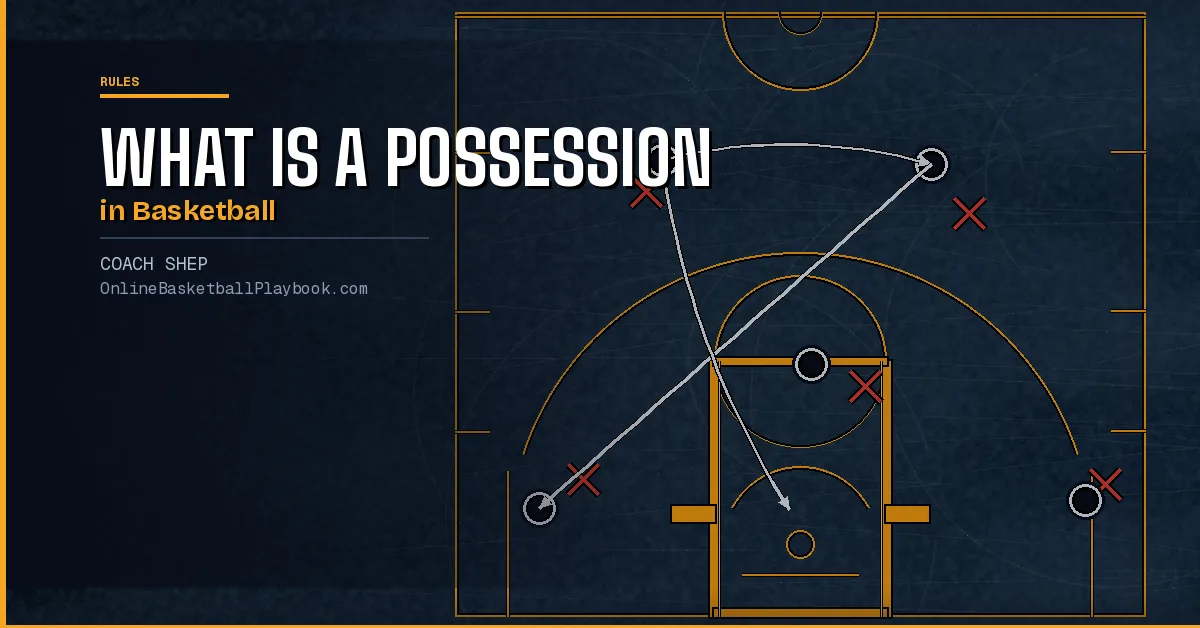
A possession is every sequence where one team controls the ball, from the moment they gain it to the moment they lose it. Every field goal attempt, turnover, and free throw begins with a possession. Understanding them is the foundation of basketball strategy.
The Basic Definition of a Basketball Possession
In basketball, a possession is the period of time that one team has legal control of the ball. It begins the instant a player catches a pass, picks up a loose ball, or takes the ball out of bounds after the opposing team scores. It ends when that team either scores, turns the ball over, or a shot attempt is rebounded by the defense.
Think of a basketball game not as a series of plays but as a sequence of possession trades. Each team gets a turn with the ball, tries to make something productive happen, and then the other team gets their turn. Across 40 minutes of regulation, 48 in the NBA, each team may get 60 to 75 offensive possessions. That limited supply is the core resource every coach is managing, whether they know it or not.
The possession clock reinforces this idea. Under NCAA rules, a team has 30 seconds to attempt a shot before the shot clock expires and the ball is turned over. In the NBA the limit is 24 seconds. These rules exist precisely to keep possessions moving and prevent teams from stalling indefinitely with the lead.
At the youth and high school level, where shot clocks may not exist, the concept of possession is still just as important. Coaches who teach their players to value each possession, to not rush bad shots and to not carelessly give the ball away, are teaching the highest-leverage habit in the game.
How a Possession Ends
Every offensive possession ends in one of four ways, and understanding each outcome helps coaches identify where their team is winning or leaking value.
Made Field Goal or Free Throw
The best outcome. The offensive team converts the possession into points. This can happen on a two-point basket, a three-pointer, or at the free throw line. A made free throw technically ends a mini-possession created by the foul. Two free throws for a two-shot foul count as one possession opportunity in most efficiency formulas.
Missed Shot: Defensive Rebound
The second most common outcome. The offense gets a shot off but the defense recovers it. This is the point where rebounding pays off directly. A defensive rebound ends the offensive possession entirely and flips control of the ball. Defensive rebounding is one of the most underrated possession-winning actions in basketball.
Missed Shot: Offensive Rebound
If the offensive team gets the rebound after a miss, the possession continues. This is called a "live-ball rebound" and it extends the possession without giving the defense a chance to set up. Teams that crash the offensive glass effectively can generate extra shot attempts from a single possession, which raises their offensive efficiency considerably.
Turnover
Any time the offensive team loses the ball without getting off a shot, a bad pass, a charge, a five-second call, a shot-clock violation, the possession ends as a turnover. Turnovers are the most costly possession outcome because they give the opponent a free possession in addition to ending yours. Transition defense becomes critical immediately after a turnover because the defense is often scrambling to get back.
Why Possessions Matter Strategically
Possessions are the currency of basketball. Every tactical decision a coach makes, how fast to play, which plays to run, how to defend, either generates more currency or conserves it. Teams that understand possession-based basketball have a structural edge over those that just "play hard and see what happens."
Consider two teams with identical talent. Team A averages 1.1 points per possession. Team B averages 0.95. Over 65 possessions per game, Team A scores 71.5 points. Team B scores 61.8. That's almost a 10-point swing, not from talent, but from possession efficiency. This is why high-level coaches obsess over points per possession (PPP) rather than raw scoring totals.
Pace, how many possessions a team takes per game, is also a strategic lever. A faster pace gives both teams more possessions, which benefits the better team statistically. A slower pace shrinks the sample, which benefits the underdog. Coaches managing a tempo mismatch often try to control possession count rather than just score per possession. Running a motion offense with patient ball movement can milk clock and reduce the opponent's total possessions.
The arithmetic of possessions also explains why turnovers are disproportionately damaging. A turnover doesn't just cost you zero points on that possession. It hands your opponent a free possession they wouldn't otherwise have. In a close game, a team that commits five extra turnovers has essentially given the opponent five extra scoring opportunities. That is often the difference between winning and losing.
Making the Most of an Offensive Possession
Great offenses don't just run plays. They execute a possession with a purpose. Each sequence should have structure: how the team advances the ball, how they create spacing, how they make the first read, and what the backup options are when the primary action is denied.
Ball Advancement
A possession begins the moment a team gains control, and the clock starts ticking immediately. Efficient offenses push the ball up the floor quickly after made baskets or defensive rebounds, trying to attack before the opposing defense can set up. The fast break is the ultimate expression of this, a possession where the offense outnumbers the defense and can get a high-percentage shot with minimal resistance. Knowing how to run the fast break effectively gives your team an edge every time the ball changes hands.
Shot Quality
Not all shot attempts are equal. A contested mid-range two-pointer and an open layup are both "shots" in the box score, but they produce wildly different results across many possessions. Coaches who track shot quality, corner threes, layups and dunks, free throws versus long contested twos, are managing possession value at a granular level. The goal is to end possessions with the highest-percentage attempt available.
The Role of Ball Movement
Ball movement is the mechanism for finding better shots. Each pass forces the defense to rotate, and rotations create gaps. Teams that move the ball with intention, rather than just passing to pass, generate open looks that wouldn't exist in a stagnant possession. The 5-out motion offense is built on exactly this principle: spread the floor, cut hard, and keep the ball moving until a shooter gets a clean look or a driver gets a lane.
Offensive Rebounding as a Possession Extender
When a shot goes up, the possession isn't necessarily over. Teams that commit to offensive rebounding can extend a possession into a second or third chance. This is a tradeoff: crashing the offensive glass sends players forward and can leave you vulnerable in transition if the defense rebounds and pushes. Coaches decide how many players to commit to offensive glass based on game situation, personnel, and opponent.
Winning Possessions on Defense
Defense is about ending the opponent's possession as quickly and cheaply as possible. The ideal defensive possession forces a turnover or a contested miss followed by a defensive rebound. Poor defensive possessions end in easy layups, open threes, or a string of offensive rebounds.
Forcing Turnovers
Turnovers are the cleanest way to end an offensive possession. Deflections, charges, and five-second calls all generate live-ball situations where your team can immediately push in transition. Aggressive defenses that gamble for steals can generate extra possessions, though they also risk fouling or giving up easy baskets if they gamble and miss.
Contesting Shots Without Fouling
The second goal on defense is to make every shot contested. A well-executed closeout: Closing ground on a shooter without lunging or fouling forces the offense into a lower-percentage attempt. Over many possessions, a team that contests shots effectively will see the opponent's shooting percentage drop. That compounds: a team hitting 45% on contested attempts versus 55% on clean looks is giving up far fewer points per possession to the team that closes out well.
Defensive Rebounding to Finish the Possession
A missed shot is only a defensive win if you secure the rebound. A defensive rebound formally ends the opponent's possession and starts yours. Teams that box out consistently deny the opponent second-chance points, which are among the most demoralizing points in basketball. The defense did everything right and still gave up points because they didn't hold ground after the miss.
Defending the Pick-and-Roll
The pick-and-roll is the most common ball-screen action in modern basketball and one of the toughest possessions to defend. The offense is trying to create a numbers mismatch, either a clear path to the basket for the ball-handler or an open mid-range or three-point look for the rolling big. Learning how to defend the pick and roll is one of the most important defensive skills a team can develop, because so many possessions flow through this action at every level of the game.
Track your team's turnover rate, turnovers per 100 possessions, rather than just the raw turnover count. This possession-adjusted metric tells you how often you give the ball away relative to how many chances you had, which is the number that actually predicts scoring differential and wins.
Possession-Based Stats Every Coach Should Know
Modern basketball analysis is built on possession-based statistics. Even at the high school level, coaches who understand these numbers make better in-game decisions than coaches who rely on intuition alone.
Points Per Possession (PPP)
Divide total points scored by total offensive possessions. Elite offenses at the high school level exceed 1.0 PPP. Elite defensive units hold opponents below 0.85. Tracking PPP over a season tells you far more than points per game, which is heavily influenced by pace.
Turnover Rate
Turnovers divided by possessions, expressed as a percentage. A rate below 15% is solid at the high school level. Above 20% and the team is likely giving away three to five possessions per game that cost them directly.
Offensive Rebounding Percentage
How many of your missed shots do you recover? A team getting 30% of its misses back generates roughly 20 second-chance possessions per 100 missed shots. Significant free points that don't require any additional ball movement or play-calling.
Effective Field Goal Percentage (eFG%)
This metric adjusts raw field goal percentage to account for the extra value of three-pointers. A three-pointer made counts as 1.5 field goals in the formula. eFG% tells you which team is getting better shots, not just who is shooting more.
Free Throw Rate
Free throws per field goal attempt. Teams that get to the line frequently generate points that don't eat into the shot clock and don't require offensive rebounds if made. Attacking the basket, drawing fouls, and converting at the line are all possession-efficient behaviors.
- Start fast: Push in transition immediately after a defensive rebound, the opponent's defense isn't set yet.
- Limit turnovers first: A turnover is worth roughly 1 point given away plus 1 possession lost, the highest-cost mistake in the game.
- Box out on every shot: a defensive rebound officially ends the opponent's possession; missing the box-out keeps it alive.
- Track PPP, not just points: your offensive efficiency per possession is the clearest indicator of whether your system is working.
- Value the offensive glass selectively: committing two players to crash is often worth it; committing all five risks giving up transition possessions.
- Teach shot quality: players should know which shots are worth taking on a given possession and which ones give the defense exactly what they want.
Get free play diagrams, drills, and coaching guides delivered weekly.
Draw this play free in the play drawer →
Membership: the full library, playbook packs, and Pro drawing tools →
Keep Building
Related breakdowns
Basketball Positions: What Each of the 5 Positions Does
The point guard, shooting guard, small forward, power forward and center, what each one does on offense and defense, and when to ignore the numbers.
High School vs College vs NBA Rules: What Changes for a Coach
High school vs college vs NBA rules: shot clock, three-point line, bonus, fouling out, timeouts, backcourt count and defensive three seconds, and what each changes.