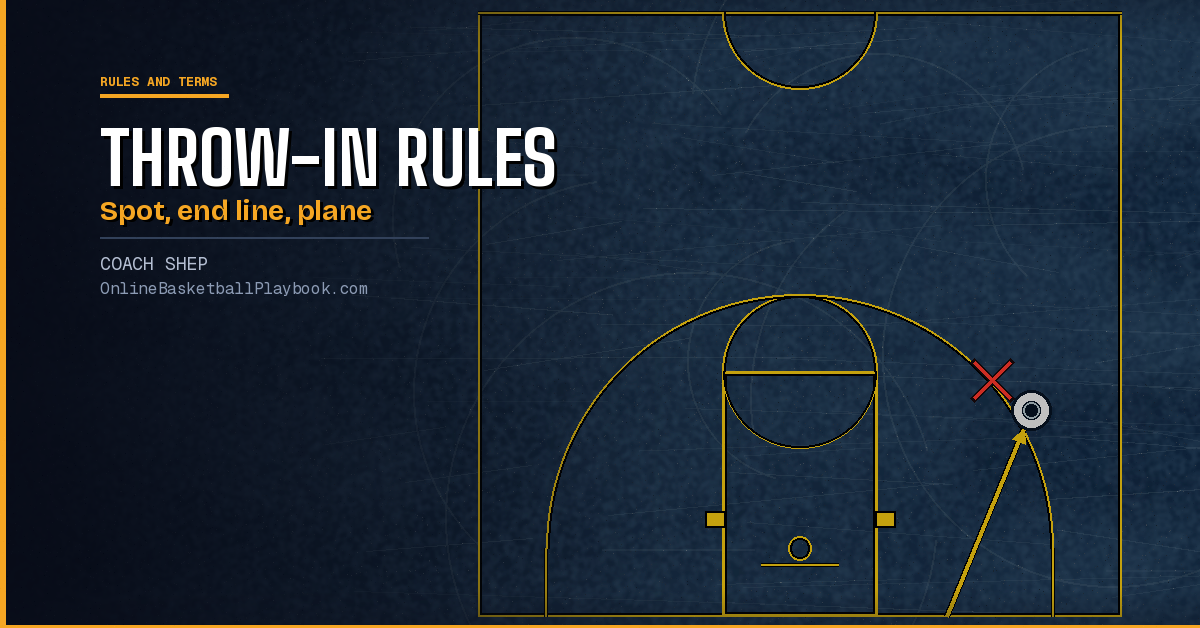
Basketball throw-in rules cover more possessions than most coaches think: every ball out of bounds, every foul before the bonus, every made basket. The thrower has a spot, a count and a list of things he may not do, and the defender has a line he may not cross. The details change by level, and late in a game they decide where the ball goes in and how much time is left.
Each rule below carries its level: NFHS (high school), NCAA men, NCAA women, NBA or FIBA. The NCAA, NBA and FIBA lines come from the current official books.
The current high school book is not free to read, so high school lines come from the NCAA's published comparison chart or are marked as the 2017-18 high school text, and anything newer says to check your state association rulebook. New to the rules? Start with basketball rules for beginners. Every level's rules are on basketball rules and regulations, and the rules pages are listed on the rules and terms hub.
Basketball Throw-In Rules at a Glance
| Level | Time to release | Room to move at a spot | Defender over the line |
|---|---|---|---|
| NFHS | 5 seconds (2017-18 text) | A 3-foot spot, one foot kept on it (2017-18 text) | Not until the thrower releases the ball: team warning, then a technical foul |
| NCAA men | Not more than 5 seconds | A 3-foot spot, one foot on or over it | Not until the ball crosses the plane: a Class B technical for repeats |
| NCAA women | Not more than 5 seconds | A 3-foot spot, one foot on or over it | Not until the ball crosses the plane: team warning, then a technical foul |
| NBA | 5 seconds from receiving and controlling the ball | One step to the left or right | Delay of game, warning then technical. A technical at once in the last two minutes |
| FIBA | 5 seconds | No more than 1 m in total sideways | Violation. In the last 2:00, a warning signal, then a technical foul |
Sources for the table: NCAA men and women Rule 7 Sec. 6 Arts. 6, 8 and 9 and Rule 9 Sec. 4. NBA Rule 8 Sec. III, Rule 10 Sec. III and Rule 12A Sec. II. FIBA 2026 Art. 17. The NCAA comparison chart row "Opponent Crosses Plane" for the high school column. The high school cells marked 2017-18 come from the 2017-18 NFHS book. Check your state association rulebook.
The Designated Spot
On most throw-ins (all but those after a made basket and the few exceptions below), the thrower takes the ball at a spot and has very little room to move from it:
- NCAA men and women. The spot is 3 feet wide with no depth limit. The thrower keeps one foot on or over it until he releases the ball, and may not leave it until the ball has crossed the plane of the line. Pivot-foot and traveling rules do not apply to a throw-in (Rule 7 Sec. 6 Art. 8).
- NBA. The designated spot is one step to his left or right (Rule 10 Sec. III).
- FIBA. He may move sideways no more than a total of 1 m from the place, in one or both directions, and straight back as far as circumstances allow (Art. 17.3.1).
- High school. The 2017-18 high school text sets a 3-foot spot with no depth limit and one foot kept on it. Check your state association rulebook.

Where the spot is also changes by level:
- NCAA men. With the offense in control in its frontcourt, a throw-in after a foul or violation goes to the nearest 28-foot mark on a sideline or to the end line 3 feet outside the lane. An imaginary line from the corner of the court to the free-throw line extended decides which: inside it, the end line, outside it, the sideline (Rule 7 Sec. 3 Art. 2). When the defense knocked the ball out, the throw-in is where it went out.
- High school. The comparison chart gives the same two spots, split by the three-point line: a stoppage on or inside it goes to the end line 3 feet outside the lane, and one outside it to the sideline at the 28-foot line. After an out-of-bounds violation, the throw-in is at the spot nearest where the ball went out.
- NBA. A dribble, traveling or elbow violation gives the ball to the opponents on the sideline nearest the spot, no nearer the baseline than the free-throw line extended (Rule 10 Secs. II, X and XIII). A ball out of bounds goes in at the boundary nearest the spot (Rule 10 Sec. I).
- FIBA. The throw-in is from the place nearest the infraction or where the game was stopped, never directly behind the backboard (Art. 17.2.2).

Plays for each spot are on sideline out of bounds plays and baseline out of bounds plays.
Know which spot your level uses, and have a play ready for each one.
The Five-Second Count
Every level gives the thrower five seconds. When the count starts and how the books word it differ:
- NCAA men. The throw-in count begins when the ball is at the thrower's disposal (Rule 7 Sec. 6 Art. 4), and he releases it not more than five seconds later (Art. 6). The violation reads "consumes more than five seconds" (Rule 9 Sec. 4 Art. 1.d).
- NCAA women. The same count, and the violation reads "consumes five seconds" (Rule 9 Sec. 4 Art. 1.d).
- NBA. He releases the ball within 5 seconds from the time he receives and controls it (Rule 8 Sec. III(a)).
- FIBA. He may not take more than 5 seconds (Art. 17.3.1). After a made basket the count starts when the ball is at the disposal of the first player out of bounds, even if he passes to a teammate (Art. 17.2.10).
- High school. The 2017-18 high school text gives five seconds from the start of the throw-in. Check your state association rulebook.
The count matters to the defense as much as the offense: the defense tries for a five-second call by denying every receiver. The five seconds at every level, on throw-ins, free throws and closely guarded players, are on 5 seconds rule.
Know the count, and throw before it runs out.
What the Thrower May Not Do
Each book lists the throw-in violations. They read alike, with a few extras at each level:
- NCAA men and women. Leave the spot before releasing the ball, fail to pass it directly into the court so it goes out, lodge it between the backboard and the ring, take more than the five seconds, carry or hand the ball to a teammate on the court, touch the court before the release, throw it into the basket or off the back of the backboard, or touch it on the court before another player does (Rule 9 Sec. 4 Art. 1).
- NBA. Carry the ball onto the court, take more than 5 seconds, touch it on the court before another player, leave the one-step spot, throw it into the basket before anyone touches it, step on the court before the release, throw it out of bounds untouched, leave the playing surface to gain an advantage, or hand it to a player on the court. The penalty is the ball to the opponents at the original spot (Rule 10 Sec. III).
- FIBA. Take more than 5 seconds, step on the court with the ball, make it touch out of bounds after the release, touch it before another player on the court does, throw it straight into the basket, or move more than 1 m sideways. The penalty is a throw-in for the opponents from the original place (Arts. 17.3.1 and 17.4).
Teammates on the court have their own rule. In NCAA play they may not line up next to each other parallel to a boundary and within 6 feet of it when an opponent wants a spot between them (Rule 7 Sec. 6 Art. 9.c).
In the NBA they may not take positions parallel or adjacent to the baseline if an opponent wants one of them (Rule 8 Sec. III(a)). The 2017-18 high school text uses 3 feet. Check your state association rulebook.
Players miss most of these, so teach them before the first game.
The Boundary Plane and Delay Warnings
The defender guarding the thrower may not reach over the line before the ball crosses it. The warning and the penalty are where the levels split:
- NCAA men. No part of the opponent's body over the inside plane of the boundary until the ball crosses it (Rule 7 Sec. 6 Art. 9.b). One team warning for delay, then a Class B technical for a repeat (Rule 4 Sec. 10 and Rule 9 Sec. 4 Art. 3). Reaching through the plane to touch or knock away the ball while the thrower holds it, or while it is passed along the end line to a teammate, is a Class B technical with no warning (Rule 9 Sec. 4 Art. 4).
- NCAA women. The same plane rule, one team warning, then a team technical foul. Reaching through the plane to touch the ball, including a pass toward the court that has not crossed the plane yet, is a player technical foul and also counts as the team warning (Rule 10 Sec. 12 Art. 4.g).
- NBA. A defender crossing the line within the designated spot before the release is a delay of game: a warning, then a technical foul for each repeat. In the last two minutes of the fourth period and of overtime, breaking the plane when an offensive player is in position to throw in is a technical foul at once (Rule 12A Sec. II(a)(5)).
- FIBA. Any part of the body over the line before the ball crosses it is a violation (Art. 17.3.2). With 2:00 or less in the fourth quarter or overtime, the referee shows a warning signal before the throw-in, and a defender who then crosses to interfere commits a violation that leads to a technical foul (Art. 17.3.3).
- High school. The comparison chart says a defender may not cross until the thrower releases the ball, a team warning and then a technical foul. In the 2017-18 high school text the first warning does not cost the offense the right to run the end line. Check your state association rulebook.

Tight gyms have a rule too. In NCAA play, where there is not enough room along the line, the official moves the defender back a reasonable distance (Rule 7 Sec. 6 Art. 8.e). FIBA keeps every player at least 1 m from the thrower when there is less than 2 m between the line and a wall or other obstruction (Art. 17.3.2). The 2017-18 high school text gives the thrower at least 3 feet. Check your state association rulebook.
Play the thrower hard, but from your side of the line. The warning is a wasted foul.
Get the next rules guide in your inbox
One email when a new guide or diagram set goes up. Free.
After a Made Basket or a Timeout
After a made basket the thrower is not tied to a spot. He may take the ball anywhere along the end line where the goal was scored:
- NCAA men. He may move along the end line and throw in from any point on it (Rule 7 Sec. 4 Art. 6.a). He keeps that right if a timeout is granted, if the defense fouls near the end line before the bonus or commits a flagrant foul there, or if the defense kicks the ball, and in those cases he may pass along the end line to a teammate out of bounds (Art. 6.b). Otherwise the throw-in pass goes straight into the court (Rule 7 Sec. 6 Art. 6).
- NCAA women. The same right, kept when a timeout is granted before the pass is released, when the defense fouls near the end line before the bonus or kicks the ball, with the pass along the end line allowed in those cases (Rule 7 Sec. 4 Art. 6).
- NBA. He may run the end line or pass to a teammate also out of bounds there, after a made field goal, after a free throw that came from a personal foul, and at the start of the second, third and fourth periods. The five seconds still apply (Rule 8 Sec. III(c)). The sections read do not say whether a timeout after the basket keeps that right.
- FIBA. After a goal or a successful last free throw, any player of the non-scoring team throws in from any place behind the end line, and the rule still applies after a time-out that follows the goal (Art. 17.2.10). Every quarter after the first and every overtime starts with a throw-in from the centre line extended, and that thrower may pass anywhere on the court (Art. 17.2.3).
- High school. In the 2017-18 high school text any player may throw in from any point along the end line or pass along it to a teammate, and the right is kept if the scoring team commits a violation or a common foul before the bonus. Check your state association rulebook, which may also say what a time-out does.

A late timeout can also move the throw-in up the floor:
- NCAA women. After a timeout charged to the offense in the last 59.9 seconds of the fourth quarter or overtime with the ball out of bounds in the backcourt, the team may throw in from the 28-foot line in its frontcourt (Rule 5 Sec. 14 Art. 2).
- NBA. After a timeout charged to the offense in the last two minutes of the fourth period or overtime with the ball out of bounds in the backcourt, the team may throw in at the 28-foot hash mark in its frontcourt, and may then pass into either half (Rule 5 Sec. VI(g)).
- FIBA. With 2:00 or less in the fourth quarter or overtime, after a time-out by the team entitled to the ball from its backcourt, the head coach chooses the frontcourt throw-in line or the backcourt. After a goal, he also chooses the table side or the far side (Art. 17.2.4).
- High school and NCAA men. The comparison chart lists no such rule.
The throw-in can also go backward. In NCAA play the thrower may pass into the backcourt from anywhere (Rule 7 Sec. 6 Arts. 10 and 11). In the NBA a throw-in in the frontcourt cannot be passed into the backcourt except in the last two minutes of the fourth period and overtime (Rule 8 Sec. III(e)). The backcourt rule in full is on backcourt violation.
Decide in the huddle who takes the ball out and where. Players should never have to guess after a timeout.
Coaching the Throw-In
Every throw-in is 5 against 4, with five seconds and a passer who cannot move from his spot except after a made basket and a few other end-line throw-ins. That is why the inbounder is a position worth staffing. A few points coaches teach:
- Pass hard. The inbounder sees the whole floor and throws sharp, crisp passes, never one-handed or soft bounce passes.
- Get open off the line. Receivers set up 3 to 6 feet off the sideline, not on it, so a slightly wide pass can still be caught in bounds.
- Let the official place the ball. After a score, letting the official put the ball at the inbounder's disposal gives teammates time to reach their spots against a press. In a last-second situation, slapping the ball to signal the start wastes time the team does not have.
- Pick the inbounder late in games. Under 4 seconds full court: the best player first, then the tallest, then the best shooter.
Defending the throw-in is on how to defend inbounds plays, the sets are on basketball inbound plays, and the rest of the strange throw-in calls are on unusual basketball rules.
Name your inbounder before the game, the same as your free-throw shooter.
Questions Coaches Ask
How many seconds do you have on a throw-in?
Five, at every level whose book was read: NCAA men and women, the NBA, FIBA and the 2017-18 high school text. Check your state association rulebook. The NBA counts from when the thrower receives and controls the ball.
How far can the inbounder move on a throw-in?
On a spot throw-in, very little. NCAA play gives a 3-foot spot with one foot kept on or over it, the NBA one step to either side, and FIBA no more than 1 m in total sideways. After a made basket the thrower may move along the whole end line.
Can the inbounder pass to a teammate who is also out of bounds?
After a made basket, yes, in the NBA, in FIBA and in the 2017-18 high school text. Check your state association rulebook. In NCAA play only after a timeout or certain defensive fouls or kicks during that throw-in.
What happens if the defender reaches over the line on a throw-in?
It depends on the level: a team warning and then a technical foul in high school and NCAA women's play, a Class B technical for a repeat in NCAA men's play, a delay warning and then a technical in the NBA, and a violation in FIBA. In the last two minutes the NBA and FIBA go to a technical foul sooner.
Where is the throw-in after a foul in the frontcourt?
In NCAA men's play and in high school by the comparison chart, at the nearest 28-foot mark on the sideline or on the end line 3 feet outside the lane. FIBA uses the place nearest the foul, never directly behind the backboard.
Can you run the baseline after a timeout?
In NCAA men's and women's play and in FIBA, yes, when the timeout follows a made basket. The NBA sections read do not say, and for high school, check your state association rulebook.
Want every diagram on the site?
OBP Pro members get the full diagram files for every guide on the site, ready for a practice binder or a scouting report. $9 a month. Or draw your own version free in the play drawer.
See what OBP Pro includesMore Rules Guides
- Unusual Basketball Rules Most Coaches Get Wrong
- High School vs College vs NBA Rules: What Changes for a Coach
- FIBA vs NFHS Rules for Coaches Who Play Internationally
- Basketball Game Clock Rules: When It Stops and When It Starts
Back to Basketball Rules and Regulations and every Rules and Terms page.
Keep Building
Related breakdowns
Basketball Free Throw Rules: Lane, Rim and Violations by Level
Basketball free throw rules at the NFHS, NCAA, NBA and FIBA levels: the time limit, the ring rule, lane spaces, when players may enter, violations and the bonus.
Basketball Positions: What Each of the 5 Positions Does
The point guard, shooting guard, small forward, power forward and center, what each one does on offense and defense, and when to ignore the numbers.
Basketball Game Clock Rules: When It Stops and When It Starts
Basketball game clock rules by level: when the clock stops, when it starts on a throw-in or a missed free throw, made baskets late and the last-two-minute rules.