Basketball game clock rules look simple: the clock runs while the ball is live and stops on a whistle. The details are what decide close games. When does it start on a throw-in? Does a made basket stop it? How little time can come off a deflection? Each level answers a little differently, and the answers change in the last minute or the last two minutes.
Every rule below carries its level: NFHS (high school), NCAA men, NCAA women, NBA or FIBA. The NCAA, NBA and FIBA lines come from the current official books.
The current high school book is not free to read, so high school lines come from the NCAA's published comparison chart or are marked as the 2017-18 high school text, and anything else says to check your state association rulebook. The shot clock has its own page, basketball shot clock rules, and the late-game decisions built on these rules are on basketball clock management.
Basketball Game Clock Rules at a Glance
| Level | Game | Clock stops on a made basket | Least time off a touch late |
|---|---|---|---|
| High school | Four 8-minute quarters | No rule in the comparison chart | No rule in the comparison chart |
| NCAA men | Two 20-minute halves | Last 59.9 seconds of the second half and overtime | .3 of a second in the last 59.9 seconds of any period |
| NCAA women | Four 10-minute quarters | Last 59.9 seconds of the fourth quarter and overtime | .3 of a second in the last 59.9 seconds of any quarter |
| NBA | Four 12-minute periods | Last minute of the first three periods, last two minutes of the fourth and overtime | .3 of a second on a throw-in hit straight out of bounds |
| FIBA | Four 10-minute quarters | 2:00 or less in the fourth quarter and overtime | No minimum time off. 0.3 needed to catch and shoot (Art. 16.2.5) |
Sources: the NCAA comparison chart rows for game length, the stop after a field goal and the deflection under a minute. NCAA men and women Rule 5 Secs. 6, 10 and 11. NBA Rule 5 Secs. II and V and Comments on the Rules II.L. FIBA 2026 Arts. 8.1, 16.2.5 and 50.2.
When the Clock Stops
At every level the clock stops when an official blows the whistle. The books list the reasons:
- NCAA men and women. The game and shot clocks stop when an official signals a foul, a held ball or a violation (Rule 5 Sec. 11 Art. 1), at the end of a period, for an injury or blood, to confer with the table, for an unusual delay or an emergency (Art. 2), and when a timeout is granted (Arts. 3 and 4).
- NBA. The timing devices stop whenever the official's whistle sounds (Rule 5 Sec. V(a)).
- FIBA. The game clock stops when time expires, when a referee whistles while the ball is live, when a goal is scored against a team that has asked for a time-out, and when the shot clock sounds while a team has the ball (Art. 50.2). The timer's own signal does not stop the clock (Art. 50.1).
- High school. In the 2017-18 high school text the clock stops when an official signals a foul, a held ball, a violation or a time-out. Check your state association rulebook.
The timeout rules by level are on basketball timeout rules.
Teach players to play to the whistle. The clock keeps running until it blows.
Made Baskets by Level
A made basket does not stop the clock for most of the game. Late in the game, at most levels, it does:
- High school. The comparison chart lists "No rule" for stopping the clock after a made field goal. Check your state association rulebook.
- NCAA men. The game and shot clocks stop on each made field goal in the second half's last 59.9 seconds and in the last 59.9 seconds of any extra period (Rule 5 Sec. 11 Art. 9).
- NCAA women. The same stop in the last 59.9 seconds of the fourth quarter and any overtime (Rule 5 Sec. 11 Art. 9).
- NBA. The timing devices stop after a made field goal in the last minute of the first, second and third periods, and in the last two minutes of regulation and of any overtime (Rule 5 Sec. V(b)).
- FIBA. The game clock stops on a goal when it shows 2:00 or less in the fourth quarter and each overtime, and on any goal scored against a team that has asked for a time-out (Art. 50.2).

Where the clock keeps running after a basket, the team that just gave up the score is spending time getting the ball in. Where it stops, the clock waits for the throw-in.
Know your level's window, and plan the possession after a late basket around it.
When the Clock Starts
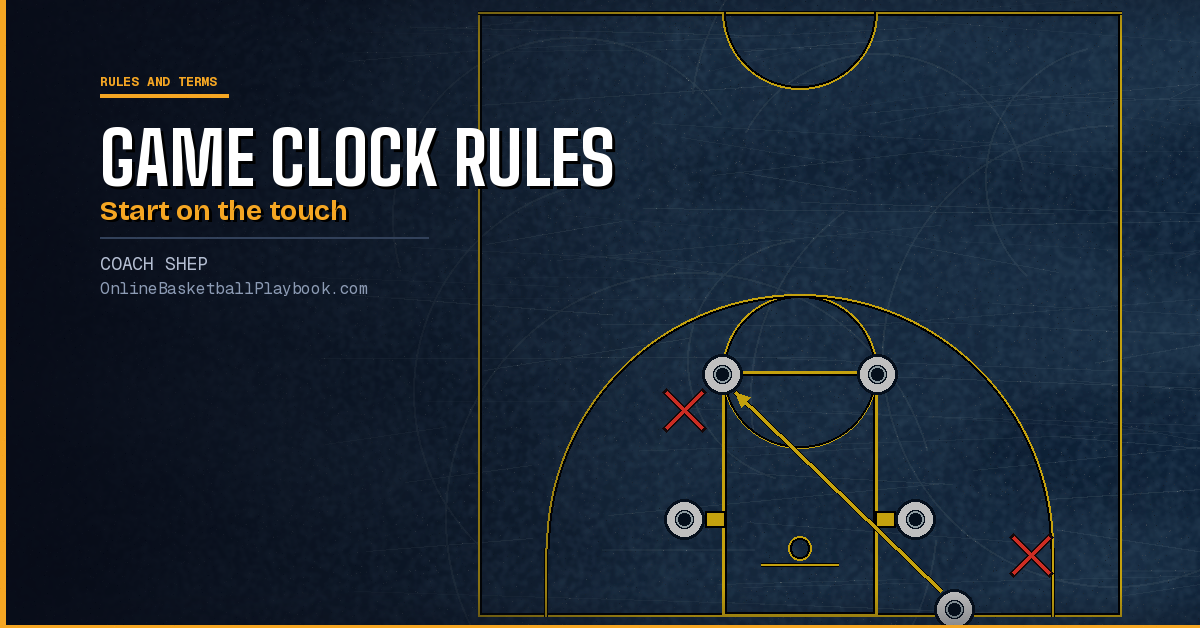
After the clock has stopped, it starts again on a touch, not on a throw:
- On a throw-in. NCAA men and women: when an inbounds player legally touches the ball after the release (Rule 5 Sec. 10 Art. 2.a). NBA: when the ball is legally touched by any player within the playing area (Rule 5 Sec. VIII(a)(2)). FIBA: when the ball touches or is legally touched by any player on the court (Art. 50.2).
- On a jump ball. NCAA: when the tossed ball is legally touched. NBA: when it is legally tapped. FIBA: when a jumper legally taps it.
- On a missed free throw that stays live. NCAA: when the ball legally touches a player on the court (Rule 5 Sec. 10 Art. 2.c). NBA: when the miss is legally touched by any player (Rule 5 Sec. VIII(a)(1)). FIBA: when a player on the court touches the ball or it touches him after an unsuccessful last free throw (Art. 50.2).
- High school. The 2017-18 high school text starts the clock on a throw-in or a live missed free throw when a player on the court touches the ball or it touches him. Check your state association rulebook.


In NCAA play the clock starts when the official signals time in, and the timer may start it by rule if the official forgets, unless the official signals that time stays out (Rule 5 Sec. 10 Art. 1). Jump ball rules are on basketball jump ball rules, and free throws are on basketball free throw rules.
Every throw-in is free time until the catch. Use it.
Get the next rules guide in your inbox
One email when a new guide or diagram set goes up. Free.
The Last Minute and the Last Two Minutes
The books add rules for the end of a period. The NCAA's window is the last 59.9 seconds, the NBA's and FIBA's mostly the last two minutes:
- NCAA men and women. In the last 59.9 seconds of any period, when the ball is legally touched inbounds and an official stops the clock at once, at least .3 of a second must come off the game clock (Rule 5 Sec. 10 Art. 2.d). The comparison chart lists no such rule for high school.
- NBA. The two-minute part of a period starts at 2:00, and the game clock shows tenths of a second in the last minute (Rule 5 Sec. II(f) and (h)). At least .3 must come off when a ball is thrown in and hit straight out of bounds. The clocks must show .3 or more for a player to catch the ball and shoot, and with .2 or .1 left only a tip-in or a high lob can score (Comments on the Rules II.L).
- FIBA. With 2:00 or less in the fourth quarter or overtime, the clock stops on a goal, the team that just scored gets no time-out unless a referee has stopped play (Art. 18.2.8), and after a time-out by the team with the ball in its backcourt the coach may move the throw-in to the frontcourt (Art. 17.2.4). The clock must show 0.3 or more for a player to catch a throw-in or a last-free-throw rebound and shoot. With 0.2 or 0.1 left, only a tap or a direct dunk can score (Art. 16.2.5).

Late timeouts can move the ball too: NCAA women in the last 59.9 seconds and the NBA in the last two minutes let the offense throw in from the 28-foot line in the frontcourt after a timeout with the ball in the backcourt. The full rules are on basketball throw-in rules, and what overtime does to the clock and the fouls is on basketball overtime rules.
Draw your last-second plays for the time your level allows, down to the tenth.
Timing Mistakes
Clocks get started late and stopped late. The NCAA men's book says how to fix it in games without replay equipment. An obvious mistake in starting or stopping the game clock is corrected during the first dead ball, before the ball is touched by anyone but the thrower. When the clock should have been running the whole time, it is corrected before the second live ball is touched by anyone but the thrower.
When the official has definite knowledge that time ran off after his whistle, he has the timer put the correct time back on the clock. No correction carries over from one half or extra period to the next (NCAA men Rule 5 Sec. 12 Arts. 1 and 2). For high school, the NBA and FIBA, read your own book's timing section.
Watch the clock on every late dead ball. The fix has to come before the ball is live again.
What the Clock Rules Change for a Coach
The clock rules on this page shape these late-game plans:
- The clock starts on the touch. One long pass buys time. With three or four seconds left and a timeout, a team can throw long to half court, call timeout on the catch and run a half-court play.
- Play on after a make. Stan Van Gundy prefers no timeout on a full-court play after a make, because the defense cannot set.
- Call timeout under 10 seconds. After scoring with under 10 seconds left, a timeout sets the defense, and nobody is caught celebrating.
- A last shot needs time for a putback. Coaches who hold for the last shot leave time for an offensive rebound but not enough for the opponent to answer.
- Start the last shot on time. Set at 10 seconds, start at 8, shoot at 3 to 5.
The last-second sets are on basketball late game situations and basketball after timeout plays. The strange clock calls, with the rest of the rules coaches get wrong, are on unusual basketball rules, every level's full rules are on basketball rules and regulations, and every rules page is on the rules and terms hub.
Decide your clock rules with your staff before the season, then practice them until nobody has to ask.
Questions Coaches Ask
Does the clock stop after a made basket in basketball?
Only late in the game, and not at every level. NCAA: the final 59.9 seconds of the second half for men, the fourth quarter for women, and overtime. NBA: the last minute of the first three periods and the last two minutes of the fourth and overtime. FIBA: 2:00 or less in the fourth quarter and overtime. The comparison chart lists no such high school rule.
When does the clock start on a throw-in?
When a player on the court touches the ball, not when the thrower lets it go. The NCAA, NBA and FIBA books say so, and so does the 2017-18 high school text. Check your state association rulebook.
Does the clock start on a missed free throw?
Yes, in NCAA, NBA and FIBA play and in the 2017-18 high school text (check your state association rulebook), when the miss stays live and the ball touches a player on the court.
How much time has to come off the clock on a tip?
NCAA: at least .3 of a second when the ball is touched inbounds and the clock is stopped at once in a period's last 59.9 seconds. NBA: at least .3 on a throw-in hit straight out of bounds, and with .2 or .1 left only a tip-in or a high lob can score. FIBA: no minimum time off, but a catch and shot needs 0.3, and with 0.2 or 0.1 only a tap or a direct dunk counts (Art. 16.2.5).
Does the clock stop on every whistle?
Yes. The NCAA, NBA and FIBA books stop the game clock when an official whistles or signals a foul, violation or held ball while the clock is running.
How long is a high school basketball game?
Four 8-minute quarters with 4-minute overtimes, by the NCAA comparison chart. NCAA men play two 20-minute halves, NCAA women and FIBA four 10-minute quarters, and the NBA four 12-minute periods.
Want every diagram on the site?
OBP Pro members get the full diagram files for every guide on the site, ready for a practice binder or a scouting report. $9 a month. Or draw your own version free in the play drawer.
See what OBP Pro includesMore Rules Guides
- Unusual Basketball Rules Most Coaches Get Wrong
- Basketball Throw-In Rules: Spot, End Line and Boundary Plane
- High School vs College vs NBA Rules: What Changes for a Coach
- FIBA vs NFHS Rules for Coaches Who Play Internationally
Back to Basketball Rules and Regulations and every Rules and Terms page.
Keep Building
Related breakdowns
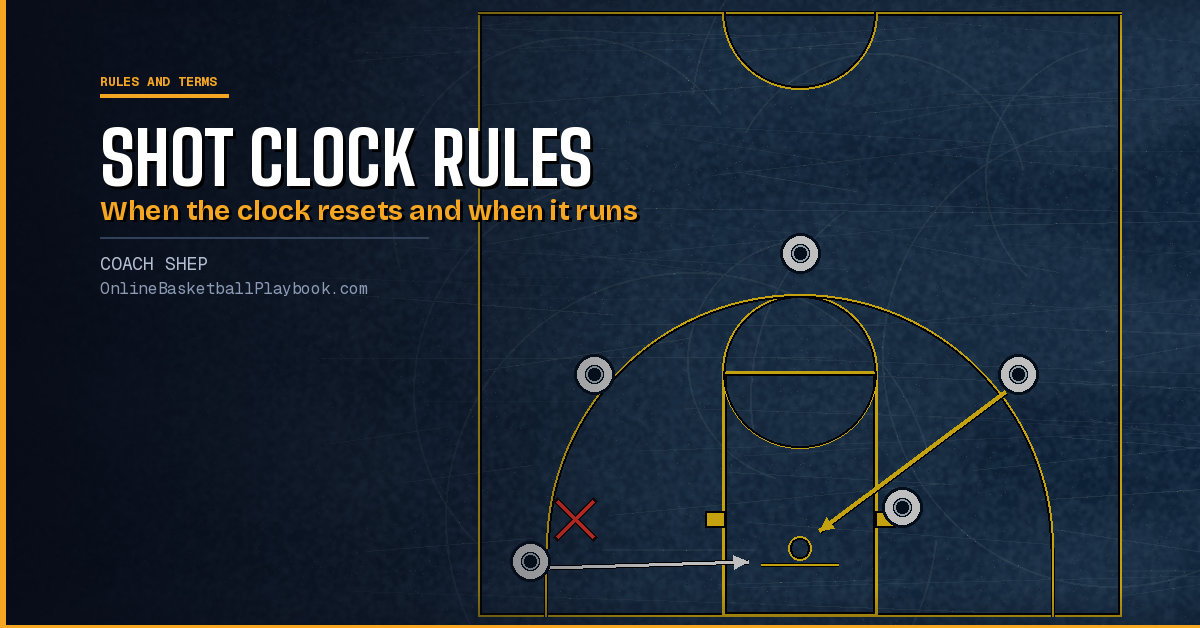
Basketball Shot Clock Rules: Length and Resets by Level
Basketball shot clock rules at the NFHS, NCAA, NBA and FIBA levels: the length, what counts as a try, and when it resets on rebounds, fouls and kicked balls.
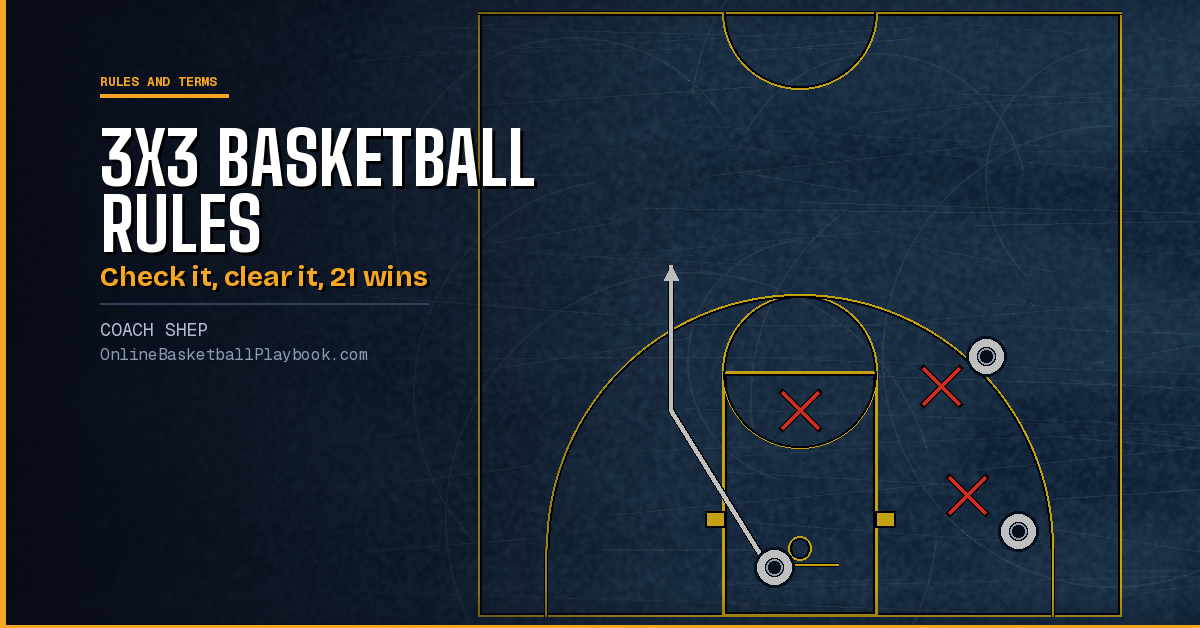
3x3 Basketball Rules: FIBA Scoring, Clock, Check-Ball and Fouls
3x3 basketball rules from the FIBA rulebook: teams, scoring, the 21-point win, the 12-second clock, check-ball, clearing the ball, fouls and penalties.