3x3 basketball rules come from FIBA, which runs 3x3 as an Olympic sport. The game is played at one basket by two teams of three players, each with one substitute. A basket inside the arc counts 1 point and a basket behind the arc counts 2. The first team to 21 wins, or the team ahead after 10 minutes. Everything on this page comes from the Official 3x3 Basketball Rules approved by FIBA in December 2025 and valid from January 1, 2026, with the article number for each rule. Local 3-on-3 tournaments and leagues may write their own rules, so check the event's rules before you play. The five-on-five game is on basketball rules for beginners.
3x3 Basketball Rules at a Glance
| Rule | FIBA 3x3 | Article |
|---|---|---|
| Players | 3 on the court, 1 substitute, no coach on the court or the bench | 1.1, 4.2.1 |
| Points | 1 inside the arc, 2 behind the arc, 1 per free throw | 16.2.1 |
| Game length | One 10-minute period | 8.1 |
| Early win | First to 21 or more before time runs out | 1.2, 9.5 |
| Overtime | First team to score 2 points wins | 8.5, 9.6 |
| Shot clock | 12 seconds | 29.1.1 |
| Restart after a dead ball | Check-ball behind the arc at the top | 17.1 |
| Change of possession | The ball must go behind the arc before a shot | 30.2 |
| Team foul penalty | After 6 team fouls: 2 free throws, and from the 10th, 2 free throws and the ball | 41 |
| Time-outs | 1 per team, 30 seconds | 18.2 |
Court, Ball and Teams
A regular 3x3 court is 15 m wide and 11 m long, the width of a full FIBA court, with one basket. It has a free-throw line 5.80 m from the baseline, a 2-point line 6.75 m from the basket and a no-charge semicircle under the basket (Art. 2.1). The arc line itself belongs to the 1-point area, so a shot with a foot on the line is worth 1 (Art. 2.2.3). At grassroots level 3x3 can be played anywhere, with any court markings fitted to the space.
The game uses its own ball. Only a FIBA 3x3 approved ball may be used, and it measures 720 to 740 mm around and weighs 580 to 620 g (equipment appendix, Table 1). Other basketball sizes are compared on basketball sizes.
A team has no more than four players: three on the court and one substitute. Coaches are not allowed on the court, on the substitutes' seats or coaching from outside the court (Art. 4.2.1), so players run their own team. A team must have three players ready to start (Art. 9.3, official competitions).
Scoring and How a Game Is Won
A basket from inside the arc counts 1 point, a basket from behind the arc counts 2 and a free throw counts 1 (Art. 16.2.1). If a defender deliberately scores in his own basket, it is a violation and the goal does not count (Art. 16.2.4).
Regular playing time is one period of 10 minutes, and the game clock stops on dead balls and free throws (Art. 8.1). The first team to score 21 points or more wins straight away if it happens before time runs out. FIBA calls this sudden death, and it applies only to regular playing time (Art. 1.2). If the score is tied at the end, there is a one-minute break and an overtime, and the first team to score 2 points in overtime wins (Arts. 8.2, 8.5). Without a game clock, the organizer sets the time and the score to play to, and FIBA suggests matching them: 10 minutes and 10 points, 15 and 15, or 21 and 21 (Art. 8.7).
Starting Play: Coin Flip and Check-Ball
A coin flip decides first possession. The team that wins it picks the ball at the start of the game or the ball at the start of a possible overtime (Art. 9.2).
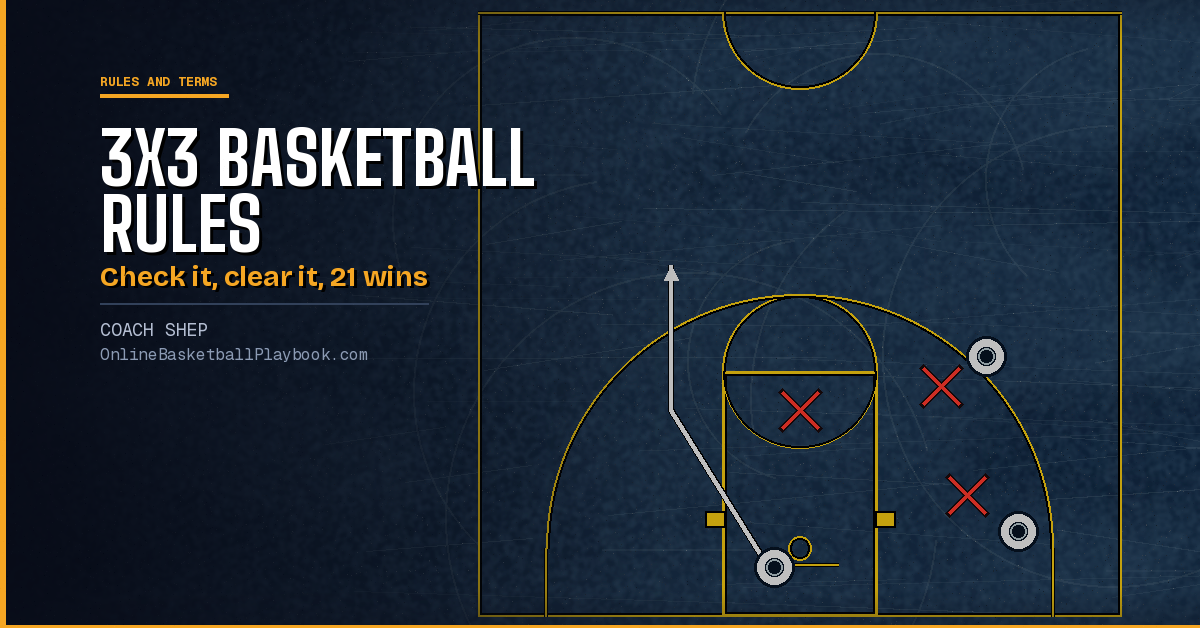
Every possession that follows a dead ball starts with a check-ball: an exchange between a defender and an offensive player behind the arc at the top of the court. The offensive player stands behind the arc with neither foot on or inside the line, facing the basket. The two players stand about 1 m apart. The defender bounces him the ball with a normal pass, and he must catch it with both feet on the floor (Art. 17.2). Play is live once the check-ball is done (Art. 10.2). A violation gives the other team a check-ball (Art. 22.2), and so does a held ball or other jump ball situation, which goes to the last defensive team (Art. 12.2).

Clearing the Ball Behind the Arc
A player is behind the arc when neither foot is on or inside the arc line (Art. 30.2.2). The rule works differently for each way a team gets the ball.
- After a made basket or last free throw. There is no check-ball and no inbound pass. A player from the team that was scored on takes the ball from inside the court, directly under the basket and not from behind the baseline, and dribbles or passes it behind the arc. The defense may not play for the ball in the no-charge semicircle (Art. 30.2.1).
- After a defensive rebound. The rebounder must pass or dribble the ball behind the arc before his team can shoot (Art. 30.2.3).
- After an offensive rebound. The offense keeps attacking. It never has to clear its own rebound (Art. 30.2.3).
- After a steal or a block. The defense has to get the ball behind the arc first, by pass or dribble (Art. 30.2.4).

A shot released before the ball is cleared is a "no-cleared ball" violation. The goal does not count and the other team gets a check-ball (Art. 30.3.1). That includes a controlled tap by a defender who gained control and tapped the ball in without clearing it (Art. 16.2.5).


The plays that work in a 3-on-3 setting are on 3-on-3 basketball plays.
Get the next coaching guide in your inbox
One email when a new guide or diagram set goes up. Free.
The 12-Second Clock and Other Time Rules
A team must try a shot within 12 seconds. The clock starts when a player gains control of a live ball, when the offensive player has the ball after a check-ball, or when the team that was scored on has the ball after a made basket or last free throw. The shot must leave the shooter's hand before the signal and then touch the ring or go in (Art. 29.1.1). When any player gains control after the ball touches the ring, the clock goes back to 12 (Art. 29.2.5). On a court with no shot clock, the referee counts the last 5 seconds aloud when a team is not attacking the basket (Art. 29.1.3).
| Time rule | 3x3 limit | Article |
|---|---|---|
| Shot clock | 12 seconds | 29 |
| In the restricted area while your team has the ball | 3 seconds, and both feet must be outside to be out | 26 |
| Closely guarded within 1 m | 5 seconds to pass, shoot or dribble | 27 |
| Dribbling inside the arc with your back or side to the basket | 3 seconds, once the ball has been cleared | 28 |
The five-on-five versions of these rules are on basketball shot clock rules, the 3 seconds rule and the 5 seconds rule.
Fouls and Free Throws
Players are not fouled out for a number of personal fouls (Art. 41.1.3). The team count decides the penalty instead. A team is in the penalty after its sixth team foul (Art. 41.1.1).
| Foul | Team fouls 1 to 6 | Team fouls 7 to 9 | Team foul 10 and up |
|---|---|---|---|
| Foul on a player not shooting | Check-ball for the fouled team | 2 free throws | 2 free throws and the ball |
| Foul on a shot inside the arc, missed | 1 free throw | 2 free throws | 2 free throws and the ball |
| Foul on a shot behind the arc, missed | 2 free throws | 2 free throws | 2 free throws and the ball |
| Foul on a made shot | Basket counts plus 1 free throw | Basket counts plus 2 free throws | Basket counts plus 2 free throws and the ball |
The table follows Arts. 34.2 and 41.2.1. A foul by the team that has the ball gives the other team a check-ball, with no free throws (Art. 41.2.2). Three other fouls have their own penalties.
- Technical foul. 1 free throw, then a check-ball for the team that had the ball. It counts as a team foul (Art. 36.3).
- Unsportsmanlike foul. A player's first is 2 free throws and no possession, his second is 2 free throws and the ball, each counts as 2 team fouls, and two of them disqualify the player (Art. 37.2).
- Disqualifying foul. Counts as 2 team fouls (Art. 38.3.4).
Every foul and what it means in the five-on-five game is on the basketball fouls list and technical fouls in basketball. Free throw procedure is on basketball free throw rules.
Time-Outs and Substitutions
Each team gets one 30-second time-out. In FIBA's official competitions, or if the organizer chooses, there are also two TV time-outs at the first dead ball after the clock shows 6:59 and 3:59. Either team may ask for a time-out when the ball becomes dead before a check-ball or free throw, never while the ball is live, and an unused time-out carries into overtime (Art. 18.2). The five-on-five time-out rules are on basketball timeout rules.
Substitutions come at the same moments: when the ball becomes dead before a check-ball or free throw (Art. 19.2). The substitute does not need to tell the referees or the table. He waits behind the endline, opposite the basket, and comes on after his teammate steps off the court (Arts. 4.2.2, 19.4, 19.5).
Under-12 Changes
FIBA recommends changes for players under 12 (Appendix E):
- The basket may be lowered to 2.60 m.
- The first team to score in overtime wins.
- No shot clock. The referees count the last 5 seconds aloud if a team is not attacking.
- No team foul penalty. Fouls lead to a check-ball, except fouls on a shooter, technical fouls and unsportsmanlike fouls.
- No time-outs.
Coaches use small-sided games like 3-on-3 in practice too. The reasons are on reasons to use small-sided games in practice.
Questions People Ask
How many points is a 3 in 3x3 basketball?
2 points. A basket from behind the arc counts 2, a basket from inside the arc counts 1 and a free throw counts 1 (FIBA 3x3 Art. 16.2.1).
How long is a 3x3 basketball game?
One 10-minute period. A team that reaches 21 points first wins before time runs out, and a tie at the end goes to an overtime that ends when a team scores 2 points.
What is the shot clock in 3x3?
12 seconds. The shot must leave the hand before the signal and then hit the ring or go in.
Do you have to take the ball back in 3x3?
After a made basket, a defensive rebound, a steal or a block, yes: the new offense must get the ball behind the arc before it shoots. After an offensive rebound, no.
Can you foul out in 3x3 basketball?
Not for personal fouls. A player is only disqualified for two unsportsmanlike fouls or a disqualifying foul. The team foul count sets the free throw penalties.
Want every diagram, printable?
OBP Pro members get the full diagram files for every drill and rules situation on this page, ready for a practice binder. $9 a month. Or draw your own version free in the play drawer.
See what OBP Pro includesMore Guides From This Batch
- Pack Line Defense Drills: Closeouts, Shell, Post and Scored Games
- 21 Basketball Rules: How to Play the Game of 21
- Middle School Basketball Rules: Quarters, Ball and State Changes
Back to Basketball Rules for Beginners and every Rules and Terms page.
Keep Building
Related breakdowns
Basketball Rules and Regulations by Level: NFHS, NCAA, NBA, FIBA
Basketball rules and regulations from the official books by level: court, clock, shot clock, fouls, violations, free throws and timeouts for NFHS, NCAA, NBA, FIBA.
Basketball Fouls List: Every Foul, Penalty and Limit by Level
Basketball fouls list for coaches, with every personal, offensive, flagrant and technical foul, the free throws, the bonus and the foul-out limit at each level.