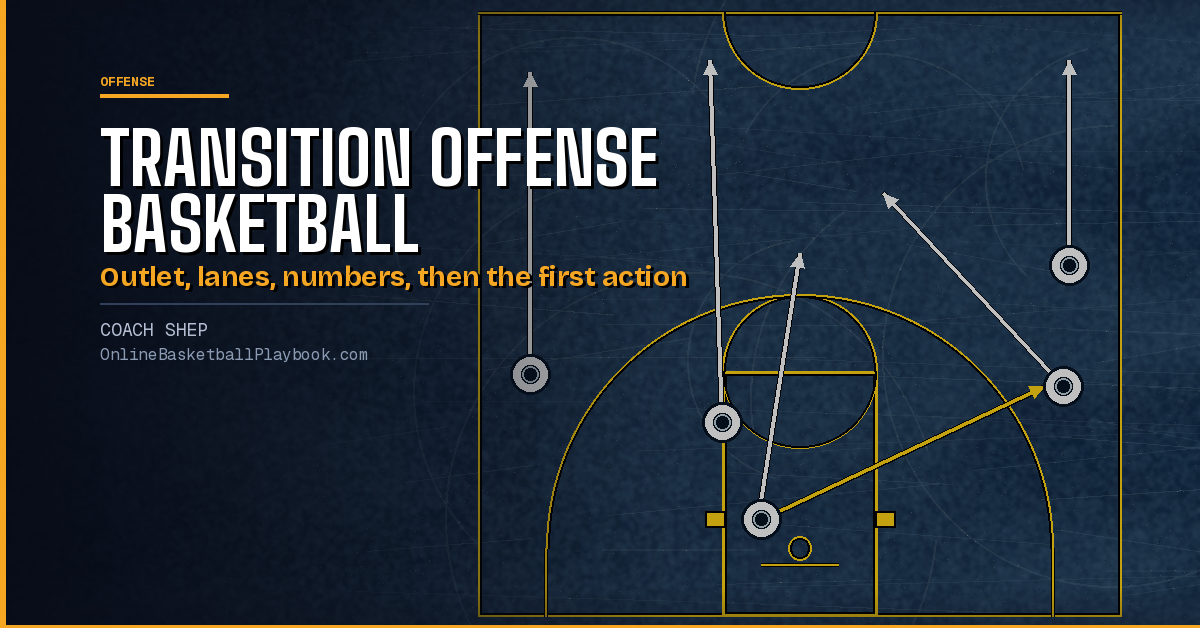
Transition offense basketball is everything that happens between the change of possession and the half-court offense: the rebound or inbound, the outlet, the lanes, the numbers advantage at the far end, the secondary break when the first look is gone, and the early action the ball flows into before the defense is matched up. This page is the transition hub for the offense section. Each part has its own guide, linked below, and where coaches teach a part differently the versions sit side by side.
Transition Offense Basketball Starts With the Outlet
The break starts on the rebound. In one version the rebounder turns in the air toward the outside so the outlet is open when he lands. In another he takes the ball at its highest point, makes a quarter turn over the outside shoulder and throws a two-hand overhead pass. The outlet is the most important part of playing fast, and a half-second delay stalls the whole system. Dean Smith's Carolina break adds a first rule: keep control, because a forced outlet is a turnover.
Where the outlet goes is a coaching choice, and the versions differ:
- Point guard in the middle third. The Carolina break outlets to the point guard at the ball-side slot after a rebound or a make.
- The sideline after a steal. Also Carolina, because the defenders sprint back through the middle.
- Long first. One version's order is long, then short, then middle. Another says longer is better, or the rebounder pushes it himself.
- A fixed catch point. One NBA version has the point guard catch at the free-throw line extended. Several versions have the receiver catch with his back to the sideline so he sees the whole floor.

Lanes and Who Runs Where
The shared rule is wide wings and the ball in the middle. Željko Obradović keeps the ball in the middle because the middle man can pass either way and the trailing defender cannot help until the ball reaches his side. One version puts the wings about three feet from the sideline with their eyes on the ball. One NBA version sends the wings deep to the corners, because a wing who stops at the free-throw line extended blocks the point guard's drive.
Who runs the middle and who runs to the rim is where coaches split hardest:
- The post sprints the middle. Jim Calhoun's post runs the middle every time, and the Carolina break makes the first big down the floor the rim runner.
- The 4 to the rim. One dribble-drive version sends the 4 to the front of the rim on every miss, even if he got the rebound.
- The point guard owns the middle. One version runs the point guard free-throw line to free-throw line with the wings crossing underneath.
- The first big screens, the second spreads. One NBA version has the first big set the drag screen and the trailing big spread to the opposite slot.
- The rim runner clears. Another NBA version has the rim runner clear to the dunker spot the moment he touches the rim so the lane stays open.
Both the numbered and the free-flow camps want a trailer. One reason given is that a missed layup on the break is the most fixable wasted possession. Another version keeps the trailer and the safety short of half court so a 3 on 1 never becomes a 5 on 1 and gives up a counter break. The lane rules and the full read tree are on how to run the fast break.
Primary Break: 2 on 1 and 3 on 2
Roy Williams defines the primary break by the defense: two or fewer defenders back, with a shot in two or fewer passes. Three or more back means the secondary break.
The 2 on 1 has several taught reads. Attack the rim first and pass second, giving the defender the outside shot and never the layup. Or advance mostly by passing so the lone defender cannot commit. Or read him: a defender who steps up means pass, one who lays back means go. Obradović adds that if nobody is guarding you, do not pass, wait for the defender to come. One version keeps both players wide outside the lane with a stutter dribble.

The 3 on 2 stops at the line. In one version the point guard stops at the free-throw line, reads the top defender, and passes to the wing cutting to the rim as that defender commits. The same version calls driving below the line the most commonly broken transition rule at the youth and high school level. Another version tries to pass ahead first to make a 2 on 1.

The drills that build these reads are already on fast break basketball drills, the 3 man weave and transition offense drills, so this hub does not repeat them.
Get the next coaching guide in your inbox
One email when a new guide or diagram set goes up. Free.
Numbered or Free-Flow Break
Numbered lanes
Each number owns a lane. One older version runs the 2 in the right lane and the 3 in the left every time. Another assigns roles by skill: the best handler at point, the most accurate long shooter on the right wing, the post as the runner and the best defensive rebounder as the trailer.
Free-flow
One youth and high school version rejects numbered breaks. Players end up in the wrong spot after contesting a shot, substitutions scramble the roles and fixed lanes stop players from reading the floor. Its rule: ahead of the ball run wide, behind the ball fill the middle, and anyone may push.
Both camps want wide wings, a rim runner and a trailer. One famous pro break has its own page, the Showtime Lakers fast break system.
Secondary Break
The secondary break runs when the defense gets back but is not yet set. In one numbered version, 2 and 3 sprint the sidelines, 4 runs opposite the ball and cuts to the ball-side block, and 5 trails to the elbow. The options are read in a set order, and if nothing shows before half court, the half-court offense takes over.

Other secondary breaks end somewhere on purpose. One NBA model ends in a side pick and roll after a pass ahead, a cut away and a reversal, with a named counter for every denial. Others drop straight into a continuity, such as break entries that flow into the flex. Full guide: secondary break basketball.
Early Offense
Early offense is the first action the ball flows into before the defense is matched up. One version puts the push into the front court at three to five seconds, and says walking it up gives the defense time to deny and trap. Another explains why it works: a guard may be guarding a post, and the helping big is not yet attached to his man.
The first action most versions build on is the drag screen, a ball screen from a trailing big before the defense is set. Others are the pistol, a hand-off or ball screen between the guard and the wing, and a reversal straight into the half-court offense. Dan Hurley bans the ball screen off a miss in one of his drills, because he wants guards winning one on one ahead of the ball instead of leaning on the screen.

Full guides: early offense in basketball, taking advantage of early offense and the called sets on transition offense plays for quick scores.
When to Push and When to Pull Back
Pace against control is a real split, and both sides win games. The run side says a faster pace forces more mistakes, a recovering defender fouls more, and more possessions tire the opponent. The control side says you cannot take a bad early shot even when you love to run, and that on offense a beat late beats a beat early.
A working rule. Run for easy baskets, to play more players and because a running team does not get pressed. Do not run with high turnovers, a slow dominant post, or when you need to control tempo. Two smaller rules help the handler decide on the spot. The break is over if you have to dribble across half court. Another says a denied push should flow into the set offense without backing the ball out, because backing out gives the defense the time it needed.
Crash or Get Back
The break also depends on what happened on your own shot. Tagging up is the set of rules for that moment: how many crash the offensive glass, who gets back, and how the crashers become defenders when the opponent rebounds. The counts coaches use run the whole range.
- Five crash, then tag up. All five go, and each player guards whoever was guarding him if the ball is lost. Its two gates are no turnovers and no surprise shots.
- Four crash, one back. The point guard stays at half court, or in another version the three-point shooter stays back.
- Three crash, two back. One NBA version decides who crashes by who shot it.
- Two crash, three back. Several versions send only two, and one never sends more than two.
Whether a team can crash hard and still stop the break also splits: one version says yes with the tag-up rule, another says pick one and keep it all year. The defense's side is on transition defense in basketball.
The Versions Coaches Run
| Version | Outlet | Lanes | Flows into |
|---|---|---|---|
| Carolina break (Dean Smith) | Point guard at the ball-side slot, sideline after a steal | Wings wide to the corners, first big is the rim runner | Early options, including a high pick and roll or drag |
| Roy Williams | To the 28-foot line in practice | Point guard top of the key to top of the key | Secondary break when three or more are back |
| Numbered break | Point guard catches the inbound | 2 and 3 on the sidelines, 4 to the ball-side block, 5 trails | Set options, then half court |
| Free-flow | Anyone may push | Ahead of the ball wide, behind it fill the middle | Pistols and a ghost screen into motion |
| NBA drag model | Point guard picks a side | Wings deep to the corners, first big drags | Drag screen game |
| NBA ball-screen model | Pass ahead to a wing | Rim runner clears to the dunker spot | Side pick and roll with named counters |
| Flow into flex | Not set by the version | Post to the ball-side block, guards to the corners, rebounder trails | The flex continuity |
Where Coaches Split
No threes on the break
Bob Knight bans threes in transition and wants the ball in the paint and at the free-throw line.
Threes and layups
Hurley's drill counts only threes and layups. One version takes threes or layups inside seven to ten seconds. Another version gives shooters a green light on any open shot off the pass ahead.
Screen on the run
Most of the early-offense material builds on the drag screen and its family: drag, double drag and the step-up.
No screen off a miss
Hurley's drill bans it, calling the drag screen a crutch that keeps guards from winning one on one ahead of the ball.
The outlet target and who runs the middle split too, as listed above, and so does the crash count. A fourth split is who decides the shot: one version teaches each player which break shot the coach accepts from him, and Roy Williams wants every player to like the shot taken.
How to Choose
Questions to settle:
- Decide the pace. Use the run-or-control rule above against your roster: ball handlers, turnovers, and whether your best post is slow.
- Pick the outlet target and the middle man. Point guard in the middle, a sideline catch, or a long first look. Then decide whether a guard or a post runs the middle.
- Pick numbered or free-flow. Numbered lanes give roles. Free-flow survives substitutions and players who end up in the wrong place after a contested shot.
- Name where the break ends. A drag screen, a continuity, or a reversal into the half-court offense, so a stopped break never has to back the ball out.
- Set the shot rule and the crash count. One version decides the crash count before the season so every player knows his job before the shot.
Questions Coaches Ask
What is the difference between the fast break and transition offense?
One version defines the primary break as two or fewer defenders back with a shot in two or fewer passes. Transition offense covers the whole stretch from the rebound to the first half-court action, including the secondary break and early offense.
What is a secondary break in basketball?
The organized break a team runs when the defense gets back but is not yet set, with lanes, a trailer and a set order of options before the half-court offense.
Where should the outlet pass go?
Coaches differ. Some outlet to the point guard in the middle third, some go long first, and some fix the catch point at the free-throw line extended.
Should the point guard drive in a 3 on 2?
In the version on this page he stops at the free-throw line and reads the top defender, passing to the cutting wing when that defender commits.
Want every diagram, printable?
OBP Pro members get the full diagram files for every alignment, action and drill on this page, ready for a practice binder or a scouting report. $9 a month. Or draw your own version free in the play drawer.
See what OBP Pro includesMore Coaching Hubs
- How to Beat a Zone Defense: Every Zone and Where to Attack It
- Basketball Screens: Every Type of Screen and How to Read It
- Junk Defense Basketball: Box and 1, Triangle and 2, When to Use
- Basketball Workout Plan: How to Build One by Position
Back to every Offense page.
Keep Building
Related breakdowns
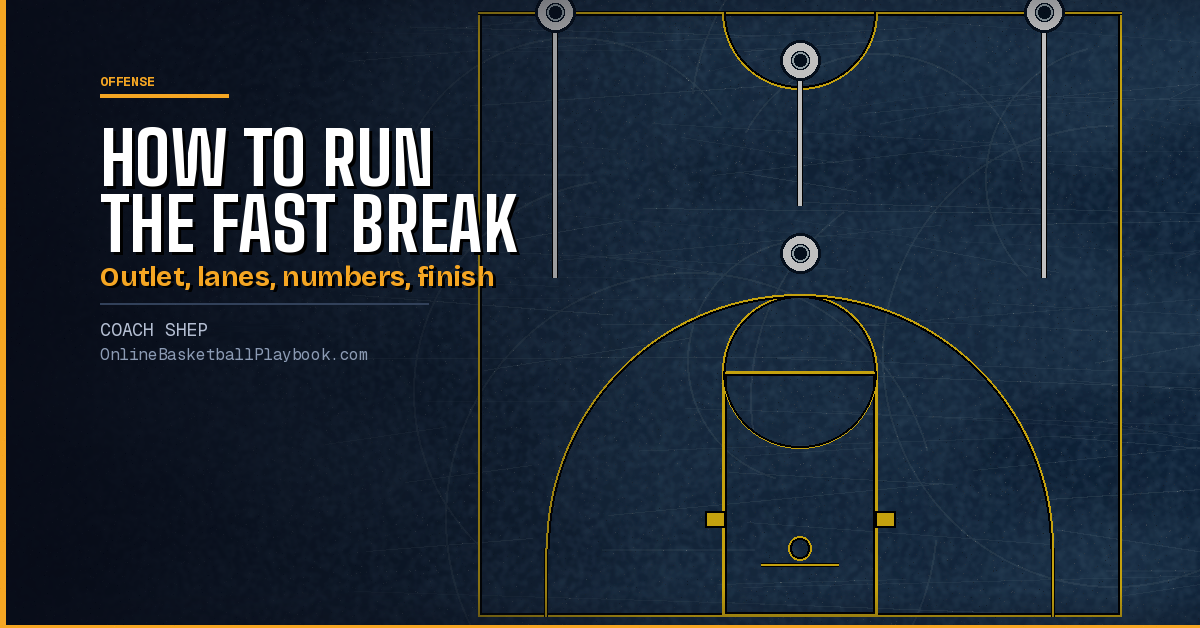
How to Run the Fast Break: Lanes, Reads and Drills
How to run a fast break: start it off a stop, fill three lanes, read each numbers situation, flow into a secondary break and build the habits with a drill ladder.
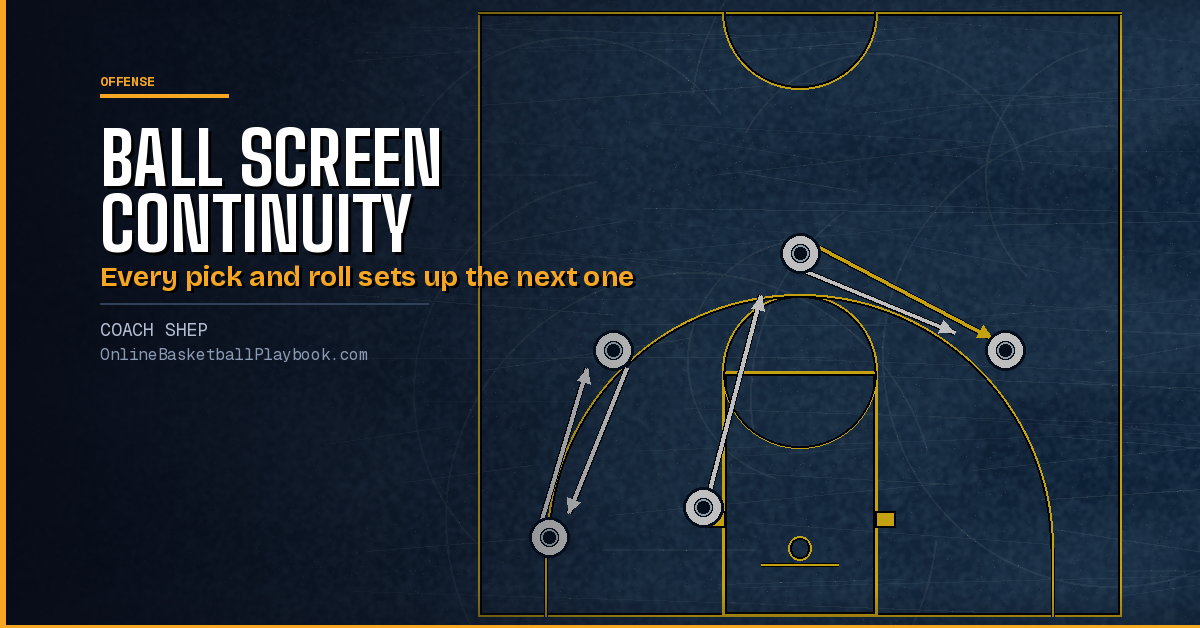
Ball Screen Continuity Offense: Pick and Roll Rules and Reads
Ball screen continuity offense in full: the 4-out and two-big engines, reload rules, spacing, angles, reads, counters, Spain, Ram, double drag and zone versions.
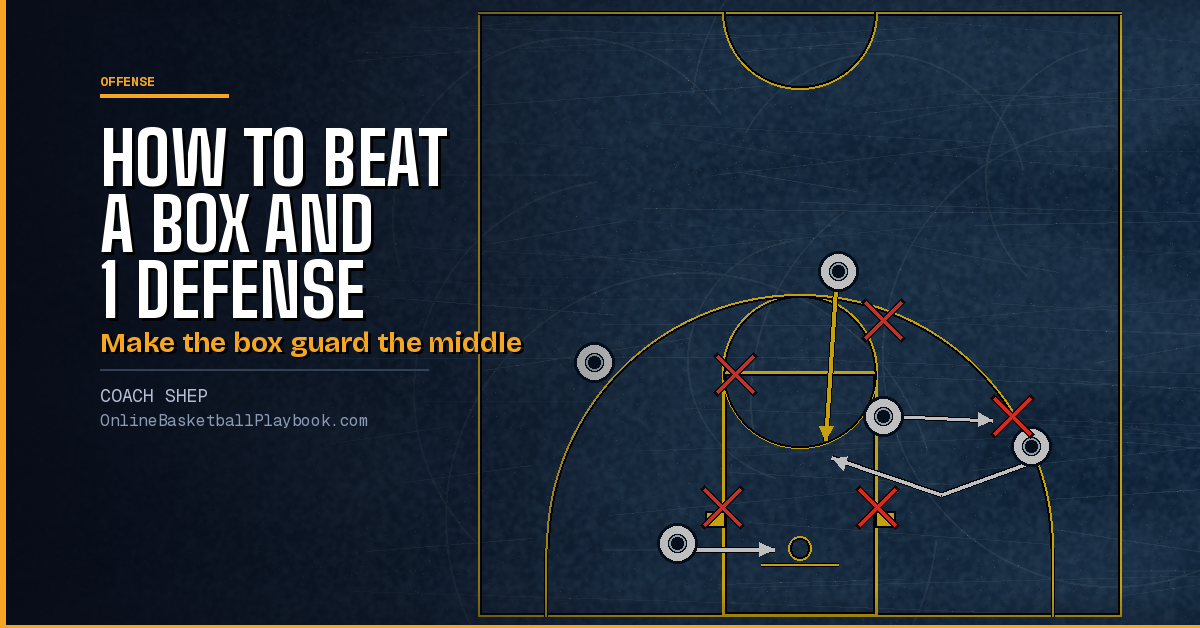
How to Beat a Box and 1 Defense in Basketball: Sets and Reads
How to beat a box and 1 defense in basketball: whether to isolate the star, the soft middle, flare, hand-off and back screens for the star, the decoy and set plays.