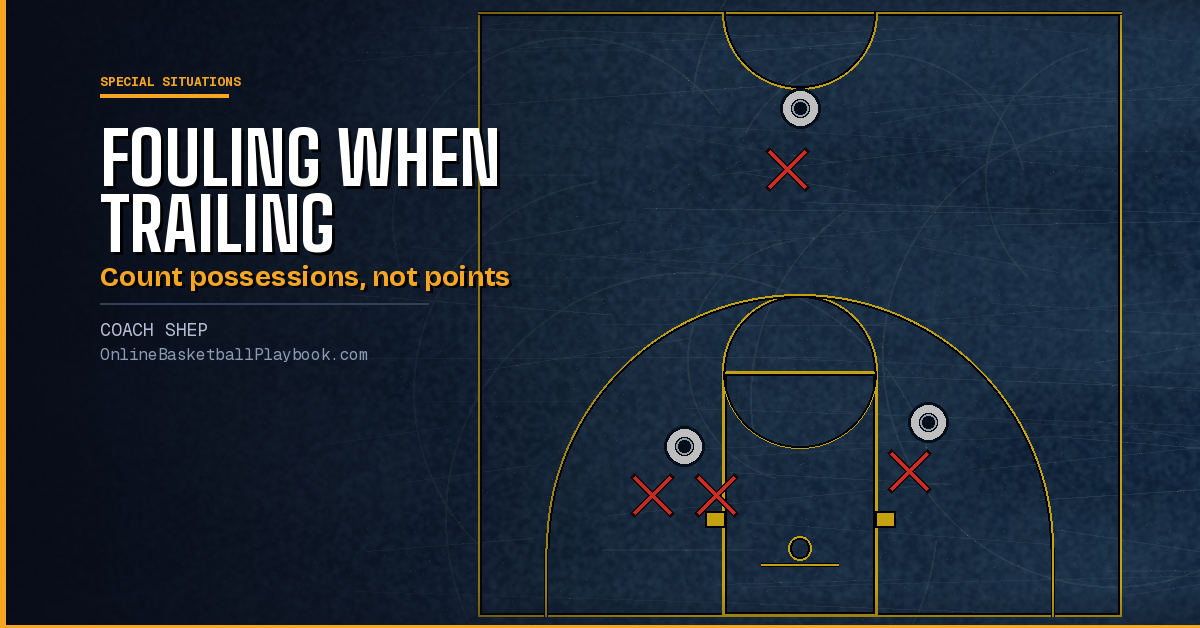
Fouling when trailing late is a math problem with a rulebook attached. Every foul stops the clock, and once the other team is in the bonus it hands over free throws, so the trailing team is trading points for time. The coach has to know how many possessions he needs, how many seconds each one costs, and what each foul gives away at his level.
There is no agreed time-and-score table that says "down this many with this much time, foul now." What coaches carry instead is a set of counts and rules, each with an owner, and this page lays them out side by side: when to start, the numbers by level, how to foul, who to foul, the down-3 call, the intentional miss and the rebound. The whole late-game picture is on basketball clock management.
Fouling When Trailing Starts With Counting
The counts coaches use to frame a late deficit:
- Possessions, not points. Frame every late call by how many possessions behind you are, not the raw margin.
- Games are close. Most games are decided by 8 or fewer points, so 3 or 4 possessions decide them.
- One second per action. Jay Wright teaches that each dribble, pass, shot fake or shot costs about one second off the clock.
- Push or burn. A point guard test: down ten with two minutes left means push for quick scores, and up four with two minutes left means burn clock and get a good shot.
Basketball is a game of time at the end. The trailing team stretches the game with timeouts and fouls, and the leading team milks the clock.
Teach the point guard to count possessions out loud in practice, so he can count them in a game.
When to Start Fouling
Coaches split on how soon to foul and how much to gamble for a steal first:
- Foul at once. Credited to Dean Smith: trailing by more than two possessions late, the clock is a bigger enemy than the opponent, so foul immediately rather than let time run.
- One steal, then foul. Trailing by two or three possessions inside a minute, try one quick steal, then foul at once if it does not come. Letting 20 seconds run off before fouling wastes time you could have used.
- Double the point guard first. Trailing late, double the point guard before the inbound so someone else has to catch it.
- Defend with fouls to give. With fouls to give before the bonus, defend the ball and the inbound hard. A foul then forces only another inbound, which can bring a steal, a five-second call or burned clock.

The counterweight is the evidence. A study of over 2,000 NBA and college games found that trailing teams who foul to extend the game succeed 1.5 percent of the time. That number is the reason one end-of-game format, the Elam Ending, turns off the clock and plays to a target score instead. It does not settle when to foul.
Pick your start-fouling rule before the game and tell the team in plain words: we foul at this score and this time. Coach Shep's own calls for this moment, Hold Fist and Get the Ball, are on Coach Shep's full court press.
The Numbers by Level
The math you can actually count is in the rulebook. A free throw is worth one point, and these rules decide how many each foul gives away and whether the clock stops after a make.
| Level | Bonus | Team fouls reset |
|---|---|---|
| NFHS (high school) | Two free throws from the fifth team foul in a quarter, no one-and-one | Each quarter |
| NCAA men | One-and-one from the seventh team foul in a half, two shots from the tenth | Halftime |
| NCAA women | Two free throws from the fifth team foul in a quarter, no one-and-one | Each quarter |
| NBA | Penalty after four team fouls in a period, two shots, three team fouls per overtime | Each period |
| FIBA | Penalty after four team fouls in a quarter, two free throws | Each quarter, with overtime fouls counted in the fourth quarter |
Two late-game wrinkles change the count:
- NBA, last two minutes. If a team has not used its four team fouls in the first ten minutes of a period, it may commit one team foul in the last two minutes without penalty.
- NCAA men, the one-and-one. Between the seventh and ninth team fouls, the shooter has to make the first to get the second.
Whether the game clock stops after a made basket decides how much time a trailing team keeps:
- NFHS. No rule to stop the clock after a made field goal.
- NCAA men. The clocks stop on each made field goal inside the final 59.9 seconds of the second half or an overtime. NCAA women: the last 59.9 seconds of the fourth quarter or any overtime.
- NBA. The clocks stop after a made field goal in the last minute of the first three periods and the last two minutes of regulation and overtime.
- FIBA. The game clock stops on a made basket with 2:00 or less in the fourth quarter and each overtime.
One more piece of arithmetic sits under every foul. A clean basket you concede is erased by scoring on your next trip. A three-point play from fouling a shooter needs that score plus a stop and a second score. Rules for every level are on basketball free throw rules and basketball fouls list.
Know your level's bonus before the game. A staff that counts fouls wrong late is fouling blind.
How to Foul
A player told only to "go foul" will grab or hammer an opponent, and that becomes an intentional foul. Fouling is a skill that has to be taught and practiced, in order:
- Steal first. Deny the passing lane and go for the steal, because a steal is much better than a foul.
- One hard trap. Take one hard trap before fouling.
- Then the ball. If that fails, foul by trying to knock the ball loose rather than grabbing or pushing.
- No hard fouls. There is no place in the game for a hard foul, especially on a layup.
- Concede the clean layup. Give up a clean layup rather than foul a shooter into an and-one.
- A quiet signal. Use a one-word signal, such as "emergency," so the referee does not hear a shouted order to foul.

The rules punish fouling away from the ball, so foul the player with it:
- NCAA men. A flagrant 1 includes fouling a player away from the ball to stop the clock or keep it from starting. The penalty is two free throws and the ball.
- NCAA women. A flagrant 1 includes contact away from the ball to stop the clock, with two free throws and a throw-in.
- NBA. An away-from-the-play foul, deliberate contact by the defense away from the play in the last two minutes or before the release on a throw-in, is one free throw and the ball.
- FIBA. A foul on a throw-in in the last 2:00 of the fourth quarter and overtime is one free throw and the ball. The 2026 disruptive foul, unnecessary contact not playing the ball, including to stop the clock at the end of a quarter, is two free throws and a frontcourt throw-in.
- NFHS. The high school rules list an intentional personal foul. Check your state association rulebook for its penalty.

When you must foul, sub in players who can afford a foul rather than lose your best players to disqualification, and use the foul itself to get a substitute in instead of spending a timeout. Use timeouts before fouls to stop the clock when you still have them. More on the rules is on intentional foul basketball and flagrant foul basketball.
Steal, trap, then the ball. Drill the order until nobody grabs.
Who to Foul
The choice of who goes to the line splits coaches too:
- Not the best scorer. Never foul the opponent's best scorer, because it sends him to the line to earn every point.
- Not a cold shooter. Never send a player who is missing from the field to the line, because made free throws can take the lid off the basket for him.
- Not by percentage alone. Do not pick the fouled player by free-throw percentage alone. Some poor shooters do better under pressure, and some good shooters get worse late.
- The weakest shooter, early. A gutsy option: foul the weakest free-throw shooter at once while the opponent is not yet in the bonus, but not in the double bonus or under 10 seconds.
- The big on a miss. Stan Van Gundy fouls the big on a miss.
The leading team knows this too. It funnels the ball to its best free-throw shooters once in the bonus, even subbing out a poor foul shooter.
Name who fouls, and whom, before the game. Erik Spoelstra, fouling up 3, allowed only one player on his team to foul on purpose.
Down 3 With Seconds Left
Down 3 is its own decision, and coaches split three ways:
- Take the three. Go for the three under 10 seconds. A pro team down 3 with 14 seconds ran a screen-the-screener set for a three that forced overtime.
- A quick two, then pressure. Take a quick two and immediate pressure over a contested three when only seconds remain, because a missed three usually ends the game. With more than 10 seconds, drive for two and press.
- Plan for their foul. Keep a situation card for down 3 with 4 seconds when the leader fouls on the inbound.
The two-for-one, holding for the last shot and the up-3 call from the other bench are on basketball late game situations. Decide the down-3 call before the game, not in the huddle.
The Intentional Miss
When the trailing team is at the line late and needs more than the free throws can give, it can miss on purpose. The rules and cues:
- Hit the rim. A free throw must enter the basket or touch the ring, so a backboard-only miss does not count as a try at NCAA, NBA and FIBA levels. Hubie Brown tells the shooter to hit the rim.
- Stay behind the line. The shooter may not cross the free-throw line until the ball touches the ring (FIBA), the ring or backboard (NBA), or the ring, flange or backboard (NCAA men and women). For high school, check your state association rulebook.
- Miss to a side. A late free-throw play for 2 to 3 seconds left, down 3 (miss the second) or down 2 (miss the only one), has the shooter miss off the left side of the rim while one player busts to the middle and another sprints the left side for the put-back.
- Line up for the miss. Hubie Brown steps one player to the dotted line and one to the opposite side of the rim for the miss.
- Down 3 with two seconds. Hubie Brown's missed free-throw play has the shooter miss left and a back screen free a shooter on the diagonal pass for the three.
Free-throw rules by level are on basketball free throw rules. Rehearse the miss before you need it.
Get the next coaching guide in your inbox
One email when a new guide or diagram set goes up. Free.
Rebound the Free Throw
Once the other team is in the bonus, every foul sends it to the line, and a missed free throw is a possession the trailing team needs. A trailing team late in a close game assumes every one of its own shots will miss and attacks the boards. On the other team's last shots, every defender boxes out, even if that means face-guarding.

More people lose on offensive rebounds than on anything else, in Stan Van Gundy's words. Box-out technique is on box out drills.
Foul, then rebound. A foul without the rebound only costs you points.
How to Practice It
Fouling and clock management are practice reps, not skills players already have. Scored formats coaches use:
- Down 8 and up 8. Three minutes, one timeout, the double bonus.
- The delay drill. One team shoots a one-and-one down 8 with 2 minutes and one timeout, and the other breaks pressure into its delay game.
- Situation cards. One situation a day at the end of practice, drawn from a box of cards with the score, time, ball and fouls.
- Fixed scenarios. Down 4 with 40 seconds, or down 5 at the side with 24 seconds, one timeout and both teams in the bonus.
Run them with a manager on the clock, an assistant officiating and the real bonus rules for your level. Late-game drills are on practicing game situations, timeouts on basketball timeout rules, and every situation page is on the situations hub.
Practice the foul, the miss and the box-out together, the way they happen in a game.
Questions Coaches Ask
When should you start fouling when trailing?
Coaches split. Credited to Dean Smith: trailing by more than two possessions late, foul at once. Another rule: trailing by two or three possessions inside a minute, try one quick steal, then foul.
Does fouling at the end of a game work?
Rarely. A study of over 2,000 NBA and college games found trailing teams that foul to extend the game succeed 1.5 percent of the time.
How do you foul without it being intentional?
Go for the steal first, then foul the ball handler by trying to knock the ball loose. Never grab, push or foul a player away from the ball, which several levels penalize with free throws and the ball.
Who should you foul late in a game?
Never the best scorer or a shooter who is struggling, and not by free-throw percentage alone. A gutsy option is to foul the weakest free-throw shooter early, before the bonus.
How many fouls until the bonus in high school?
Under NFHS rules, the fifth team foul in a quarter gives two free throws, with no one-and-one, and fouls reset each quarter.
Want every diagram on the site?
OBP Pro members get the full diagram files for every guide on the site, ready for a practice binder or a scouting report. $9 a month. Or draw your own version free in the play drawer.
See what OBP Pro includesMore Pressure, Inbounds and Guard Guides
- When Not to Press: Bad Reasons, Thin Benches, Poised Guards
- Youth Basketball Inbound Plays: Simple and Safe Plays to Run
- Deny the Inbound or Concede the Catch: Two Schools
- Guard Workout: Handles, Reads and Finishing You Can Print
- Passing Against Pressure: Beat the Trap, the Deny and the Press
Back to Basketball Clock Management and every Special Situations page.
Keep Building
Related breakdowns
When to Call a Timeout in Basketball: Strategy and Rules
When to call a timeout in basketball, when to play on, how to budget them for the finish, how to run the huddle, and how many timeouts each level allows.
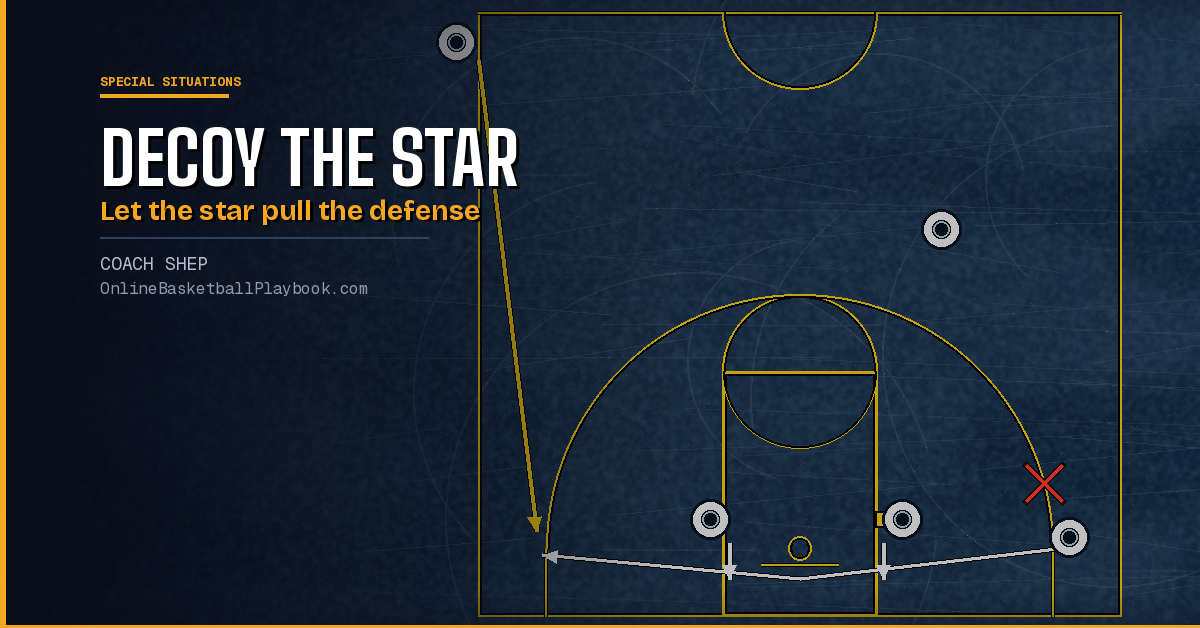
Late Game Plays When They Deny Your Best Player
Late game plays for when the defense denies your best player: decoy the star, where he starts, reads for the sag and the deny, the open inbounder and the back door.
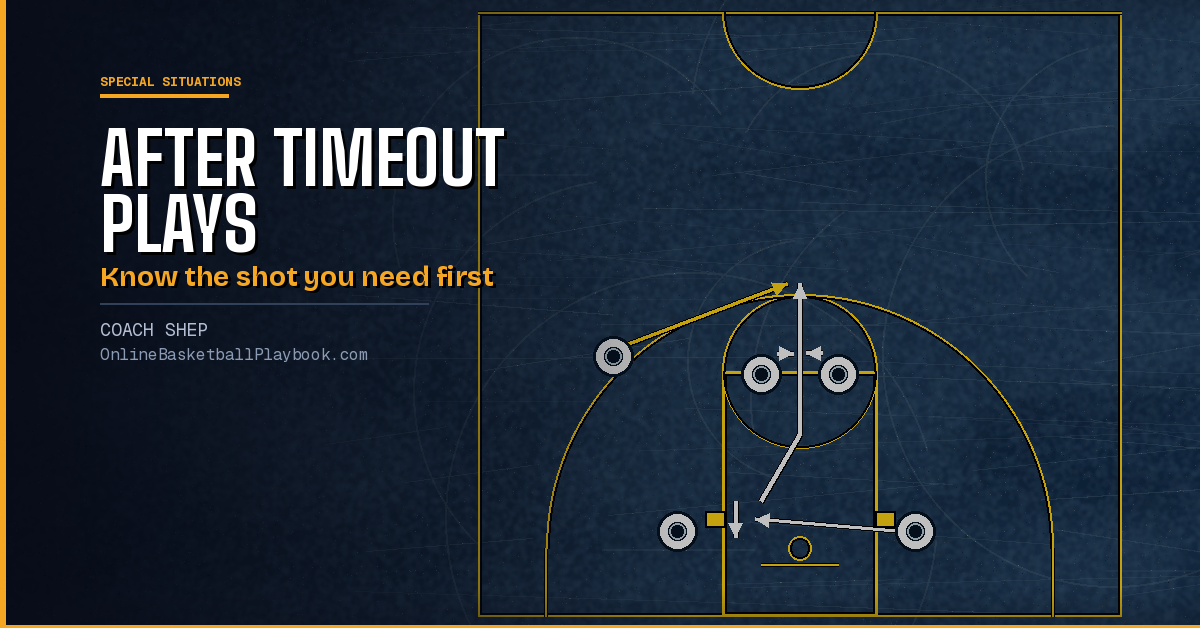
After Timeout Plays: ATO Sets by Score, Clock and Spot
After timeout plays sorted by situation: need a three, need a two, stop a run, sideline or baseline, man or zone, with the fake, the counter and the huddle rules.