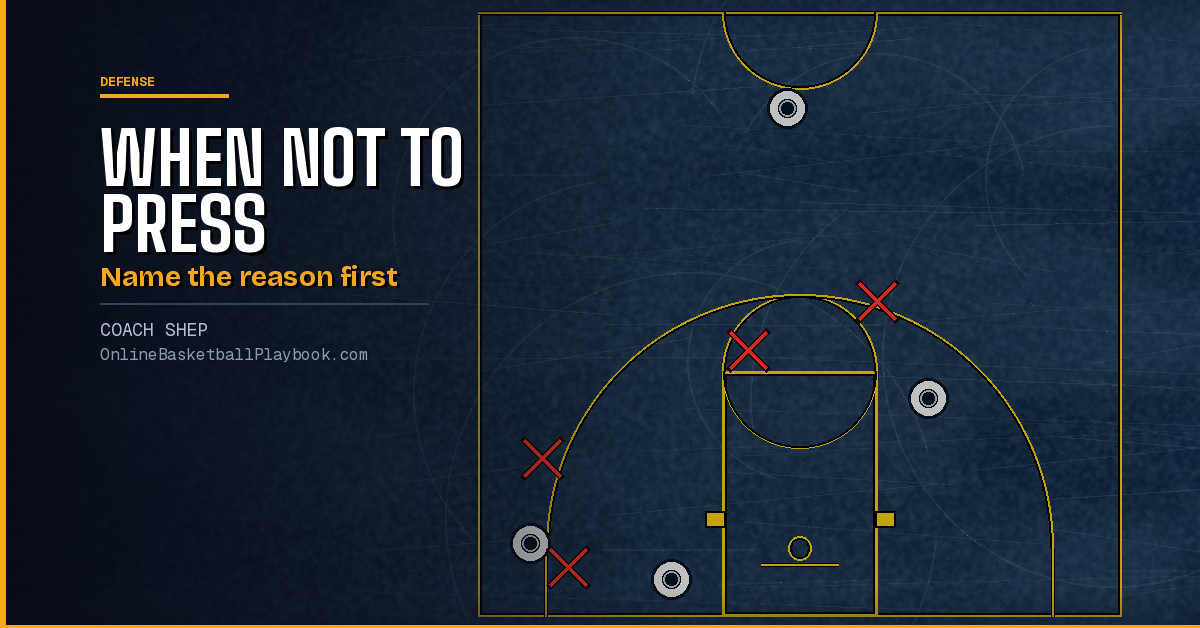
Knowing when not to press matters as much as any trap rotation. A press costs fitness, fouls, practice time and an easy basket every time it breaks, so the first question is why you are pressing tonight, and the second is when you will stop.
This page collects the reasons not to press, each with the coach or source behind it: the bad reasons, the roster a press needs, the opponents that beat it, the moments in a game when it does not fit, when to pull it, the youth rules that limit it, and the three sins that break any press once it is on. The press families themselves are compared on best full-court press and explained on full court press defense.
When Not to Press: Start With Why
Tom Davis, writing as Boston College's coach, opened his press article with one question before any X's and O's: why are you pressing? A coach who cannot name a real purpose should not press, and Davis named two bad reasons outright:
- You are behind late. Pressing as a panic button, with no plan behind it.
- Fans or bosses expect it. Pressing because the crowd likes it or the administration wants an exciting team.
Not every coach agrees on the first one. West Virginia's old full-court zone press was an "ace in the hole" used only about six or seven times a season, as a weapon when trailing, and its comebacks from 10 or more points down put opponents on edge. Trailing also appears as a good reason to press beside a quicker team, weak ball handlers on the scouting report and pressing as a base defense. So coaches split on the comeback press:
- Bad reason. Davis lists being behind late as a reason that does not hold up.
- Its whole purpose. West Virginia's press existed for the comeback and was saved for it.
The reasons coaches give for pressing, from tempo to wearing out a short bench, are listed on full court press defense.
Write the reason on the call sheet. If you cannot write it, do not press.
Not Without the Roster
A press is a roster decision before it is a scheme decision. Before installing any press, ask whether the team has quickness, well-conditioned athletes, a good bench and players who will buy in. Tired or foul-prone players on a shallow roster make the press a liability.
Coaches who built pressing programs say the same thing in their own words:
- Depth and some speed. Don Meyer warned that trapping may give up layups and more fouls, and that a team needs depth and some speed to do it.
- No weak links. West Virginia's coach wanted "real quick boys" at guard and the cut-off spots, plus desire, and said a couple of weak links ruin the press like a chain. He kept fresh legs coming off the bench.
- Fouls hurt twice. A press needs depth, so every foul costs a player and the press that depends on him.
- Short bursts. Vance Walberg says players can go full speed for only about 1.5 minutes, so he carries two to three players for his key on-ball spot, and in a high school game sent his first three subs in at the 6:30 mark.
Copying an extreme press whole is its own trap. Grinnell's press-every-possession system forced about 28 turnovers a game, and its own coach says most high school teams should not try to copy the whole system, because it needs a deep roster of good athletes and shooters. Walberg's version is on Vance Walberg's full court press, and the depth plans are on how to build a pressing team.
A press also costs practice time. And a team is only as good a pressing team as it is a half-court defensive team.
Count your bodies and your legs before you count your traps.

Not Against Poised Guards
The opponent decides as much as your roster does. The warnings coaches give about who beats a press:
- Poised, experienced guards. West Virginia's own press was called a gamble that can be overdone and beaten by poised, experienced opposition.
- A big who catches and throws over it. One opponent beat West Virginia by putting a tall player at the spot where the inbound was caught. He fielded the pass and threw a flat pass over the defenders' hands to a cutter, which made a 3-on-1. His coach said that once the ball reaches a big man behind the front line, the strength of the press is lost.
- A quick inbound. Gary Williams found a team that gets the ball in quickly tough to press, and a team that likes to set up its press break easier.
- Good players avoid traps. Billy Donovan says that against good teams his press does not get many traps, because good players stay out of them. He judges the press by whether it keeps the offense out of its half-court sets.
- A composed handler. A full-court man press is beaten by a handler who stays composed. A 2-2-1 gets few steals against patient teams. A full-court 1-3-1 is beaten by quick reversal and exposed to tall teams who throw over the middle defenders.
Tempo is the other read. Push and press when you are the quicker, deeper team. Slow the game and get back in transition defense when you are the more deliberate one. Ralph Miller is quoted that only about 5 percent of possessions come from steals, against 60 to 80 percent from rebounding after a score.
Scout their guards first. A press built for a shaky point guard will not scare a poised one.
Not After Every Possession
Coaches who press still choose when. The most repeated rule is about made and missed shots, and coaches split:
- Only after a score. Bruce Pearl does not press on a missed shot. A scramble press built on Dean Smith's ideas goes in only after a score. A three-quarter 1-2-2 used as a shot-clock tool runs only after made baskets and drops to the base defense at about 22 seconds on the shot clock. The point is to protect transition defense.
- After misses too. Walberg presses after misses, and Grinnell presses after everything.
- In bursts. Against good guards, a pre-trap of the point guard before the inbound is mixed in at intervals, especially early in the game and in the last two to three minutes of the first half. Against weak ball handling it can run all game.
- A call for each situation. Hubie Brown maps his presses to the moment: full court after a made field goal, a three-quarter 2-2-1 after every foul shot, a 1-3-1 on a backcourt sideline inbound or after a timeout, and man picked up at the top of the key on misses.
Presses that start before the inbound are on how to defend inbounds plays.
Pick the moments before the game and signal them from the bench.

When to Pull the Press
A press that worked in the first quarter can hurt in the fourth. The signals coaches use to drop it in a game:
- It is broken. Start the game pressing, drop it once the opponent breaks it or scores easy layups, then bring it back later as a surprise or in a critical stretch.
- Foul trouble. Drop it when key players are in foul trouble. Walberg sits a player with two fouls in the first half.
- A big lead, with the bench. Pull it at a 25-point lead in high school, and let the bench run the same system rather than sit back.
Coaches split on what to do with a late lead:
- Drop it. Drop the press to protect a comfortable late lead.
- Change it. Switch to a no-trap 2-2-1 that retreats and only contains.
- Keep pressing. Jay Wright presses with a lead late to slow the opponent down.
Every press needs an exit as well as a start. Jay Wright converts on four triggers: the ball in the middle, any diagonal skip, any exit from a trap, and he calls how a team converts after it gets beaten the most important thing it does. Converting means everyone sprints to the paint, loads to the ball, then matches up. If your team has not drilled that sprint, the press is not ready for a game. Transition rules are on transition defense.
Decide the exit before the start. The players should know when the press ends as well as they know when it begins.
Not With Young Teams
Youth basketball is where "when not to press" gets written into rules. The limits by owner:
- Man pressure, no trapping zone press. Trapping zone presses work against young players only because kids cannot pass over or through them. That is strength, not tactics, and a steal-and-layup track meet develops nobody. Full-court man pressure with no trap gamble is fine.
- No full-court press at all. Some youth leagues ban full-court presses and zones outright and require man-to-man.
- Pressing by period. One provincial association's U10 rules barred pressing for the first 7 of 8 periods and allowed it in the 8th unless a team led by more than 15 points, with no intentional double teams anywhere on the floor.
- Later in development. Canada Basketball's development model keeps zone defenses and zone presses out of the early part of its Train to Train stage and brings them in near the end.
Check your league's rules before the first practice. If pressing is allowed, the order of teaching is on how to teach a press to youth teams, and the man press itself is on full-court man-to-man pressure.
Teach young players to guard the ball first. The trap can wait until they can pass out of one.
The Three Sins Once You Do Press
Once the press is on, the reasons not to press become rules not to break. A ball press built on matching up from spots names three sins a defender can never commit:
- Never get split. The two trappers close the gap so the handler cannot dribble between them.
- Never run at a naked handler. A throwback with no defender on him can lob over the top, so nobody chases him.
- Never put three on the ball. Only two defenders trap at any time.


Other press rules sit beside the three sins. Never foul the trap, because the trap is meant to force a lob. Keep the ball out of the middle. Sprint back the moment you are beaten. Donovan names the two outcomes his press can never allow, a wide-open layup and a wide-open three, and calls the press a failure if it fouls or gives either one up. Trap technique is on trapping in basketball, and the press drills are on full court press defense drills.
Coach Shep's own press, with its numbered calls and the fallback behind each one, is on Coach Shep's full court press. Every press page on the site is listed on the defense hub, and the offense's side is on basketball press break.
Break a sin once and you give up a layup. Break it twice and it is time to stop pressing.
Get the next coaching guide in your inbox
One email when a new guide or diagram set goes up. Free.
Questions Coaches Ask
When should you not press in basketball?
When you cannot name a reason, when the roster lacks quickness, fitness or a bench, when the opponent's guards are poised, when key players are in foul trouble, and when the press keeps giving up layups. Youth league rules can limit or ban it too.
Is pressing when behind a good idea?
Coaches split. Tom Davis called being behind late a bad reason to press. West Virginia saved its zone press for comebacks and used it about six or seven times a season.
Should you press after a missed shot?
Bruce Pearl does not press on a miss, and a scramble press built on Dean Smith's ideas goes in only after a score. Walberg presses after misses as well.
When should you stop pressing in a game?
When the opponent breaks it or scores easy layups, when key players are in foul trouble, or to protect a comfortable late lead. A 25-point lead in high school is one line for pulling it, with the bench running the same system.
What are the three sins of pressing?
Never get split, never run at a naked handler, and never put three defenders on the ball.
Should youth teams press?
Youth guides allow full-court man pressure with no traps and hold back trapping zone presses. League rules can ban full-court presses outright, so check yours first.
Want every diagram on the site?
OBP Pro members get the full diagram files for every guide on the site, ready for a practice binder or a scouting report. $9 a month. Or draw your own version free in the play drawer.
See what OBP Pro includesMore Pressure, Inbounds and Guard Guides
- Youth Basketball Inbound Plays: Simple and Safe Plays to Run
- Deny the Inbound or Concede the Catch: Two Schools
- Fouling When Trailing: When, Who and How by Time and Score
- Guard Workout: Handles, Reads and Finishing You Can Print
- Passing Against Pressure: Beat the Trap, the Deny and the Press
Back to Best Full-Court Press and every Defense page.
Keep Building
Related breakdowns
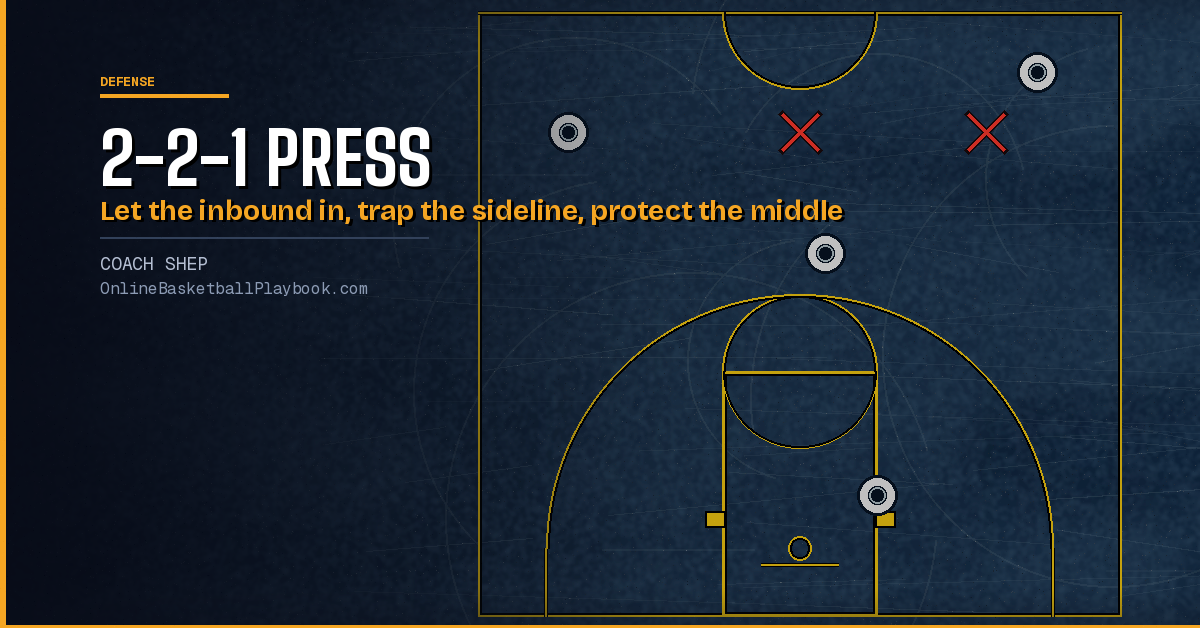
2-2-1 Press: Setup, Traps, Rotations and Drills
How to run the 2-2-1 press: who plays each spot, how coaches trap the sideline, the rotations after a reversal, how it breaks, how offenses attack it and the drills.
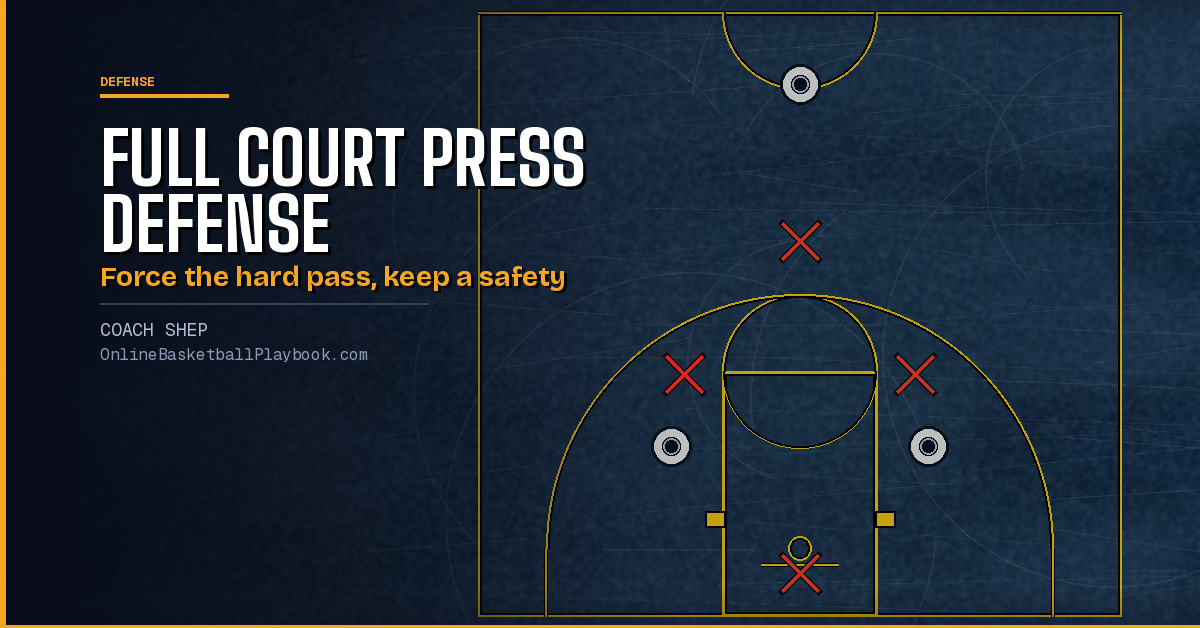
Full Court Press Defense: Types, Rules and How to Install It
Full court press defense pressures the ball for 94 feet. See the press families, shared rules, trap mechanics, the cost, the install order and drills.
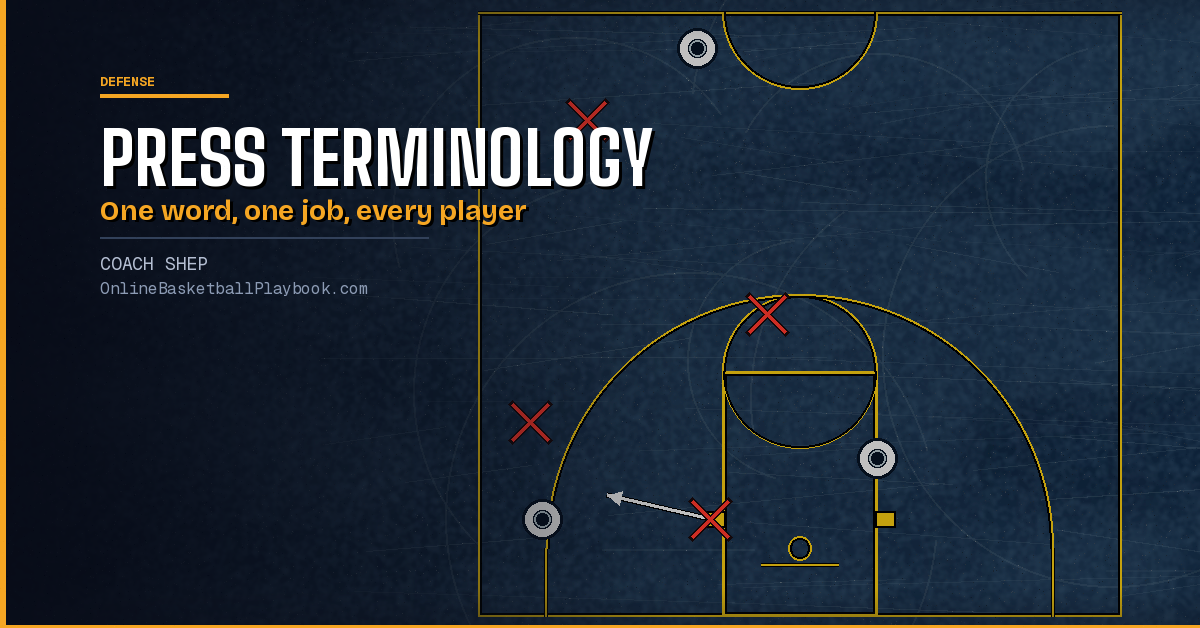
Basketball Press Terminology: Trappers, Interceptors and Safeties
Basketball press terminology by job: trappers, interceptors, safety and goaltender, line names, run and jump, peel down, rotate and calls that change meaning.