How to teach a press to youth teams starts with two questions: what does your league allow, and what will your players still use when they are older? Most youth guidance points the same way. Teach full-court man pressure first, hold back the trapping zone presses, and build the press through small games instead of walk-throughs. This page covers the league rules to check, the best full court press for youth basketball by version, the skills that come before it, the small games that teach it, the rules of a youth man trap press and the simple zone presses some programs add later.
Check Your League's Rules First
Youth leagues write their own defensive rules, and some of them limit pressing. There is no single youth rulebook, so read yours before the first practice. These are examples of what youth rule sheets have said, not rules for your league:
- No full-court press at all. One faith-based youth league's rules call for man-to-man only, defenders within arm's reach of their man, no double teams except limited help, and no full-court press.
- Pressing late only. One provincial association's 2010-11 under-10 rules allowed no pressing in the first 7 of 8 periods. In the 8th period both teams could press unless one led by more than 15, and intentional double teams were not allowed anywhere on the floor. Its under-10 rules required person-to-person defense, with a warning and then team technical fouls for breaking it, and its under-11 and under-12 rules open with the same person-to-person wording.
- Zone presses later in the teens. One national development model keeps zone defense and zone presses out of the early part of its Train to Train stage (about 11 to 15 for girls and 12 to 16 for boys) and adds them near the end of it.
School games below high school are usually run by state associations or leagues on NFHS rules with their own changes. Middle school rules by state are on middle school basketball rules. When in doubt, check your state association or league rulebook.
Which Press to Teach Youth Teams First
Most youth guidance puts man pressure first. The versions differ on when, or whether, a trap or a zone press comes in:
| Version | What it teaches |
|---|---|
| Man press only | No trapping zone presses for youth. A man-to-man press is fine |
| Full-court man pressure, no traps | Half-court man rules over the whole floor, recommended for younger teams instead of a match-up press |
| Man trap press with written rules | Man-to-man with a trap on the pass to the sideline and never in the middle third |
| Stripped-down 1-1-2-1 match-up | A simple sideline trap near half court for younger teams or teams with little practice time |
| Containment 2-2-1 | Force the sideline, allow the reversal, deny the advancing pass. Used with high school and youth teams |
Where they part ways is age. One level-by-level plan adds presses in 8th grade. Another calls the press and the 2-3 zone fool's gold at the freshman and JV levels and says to play man to man and play everyone. The no-trap man version is on full court man to man pressure, and the youth case for man-to-man in general is on teaching man to man defense in youth basketball.
Start with man pressure, and add a trap only when they can beat one.
The Skills That Come Before the Press
Footwork. In the live-games youth system, defensive footwork comes in a set order before anything live: a mass stance drill, mirror defense, then a hip turn (a small hop and quarter turn) taught in place of a plant-and-pivot. It adds a crossover step for the first one or two steps when the dribbler gets a step, then plays live 1 on 1. Footwork is one of only two skills that system drills without competition. More stance and slide work is on defensive footwork.
The full-court 1 on 1. The first game is one defender against one handler the length of the floor. The defender's job is to turn the handler in the backcourt.

The pressure rules. One set of pressure rules holds for every pressure defense at every level:
- Hands up and no reaching.
- Tips and deflections come first, and steal passes, not dribbles.
- Force the ball out of the middle.
- Pressure the ball and count on the help.
- Help on the line and up the line, and sprint to the help side.
Stance and turns first, the press second.
How to Teach a Press to Youth Teams With Small Games
The live-games system teaches its press almost entirely through live small games, which it calls the backbone of practice:
- 1 on 1 full court.
- 1 against 2, and 2 against 1. The offense plays against a two-man trapping defense.
- 2 on 2, no pass ahead in the backcourt. The offense may not pass forward in the backcourt, so it has to make lateral and back passes, and the defenders must trap and recover.
- 3 on 3, dribble it over. The ball must be dribbled across half court.


Then it builds the press as a scrimmage ladder: 3 on 4 with a safety at half court, then 4 on 3, 4 on 4, 5 on 4 and 5 on 5. This system puts 75 to 95 percent of practice in live play from 1 on 1 up. Steals are not the point of its press. As Ralph Miller noted, most possessions come from rebounds and made baskets, not steals, and the pressure works as a body punch that wears a team down.
Let the games do the teaching, and keep the ball live.
Get the next coaching guide in your inbox
One email when a new guide or diagram set goes up. Free.
The Youth Man Trap Press
When a youth team is ready to trap, the live-games system's press is man-to-man with written rules:
- No layups.
- Trap on the pass to the sideline.
- Never trap in the middle third of the floor.
- Trap the back pocket of a dribbler.
- Help on the line and up the line.
- Once a teammate runs to trap, guard two men.
The defender on the inbounder chooses whether to trap aggressively or passively.

The trap itself, the angle, the feet and the hands, is on trapping in basketball. Keep the reaching out of it, as the pressure rules above say.
Trap the pass to the sideline, and guard two when a teammate leaves.
A Simple Zone Press Later
If your league allows it and your team is older, some programs add one simple zone press. Teach one press and change the pressure within it, rather than several presses. If you are unsure whether to press at all, see when not to press. Versions coaches use with younger teams:
The stripped-down 1-1-2-1. It has four looks, set by how the offense lines up to receive: one guard up, two guards up, four across, and a full deny. Against one guard up, the defender on the inbounder pressures him and takes away the pass to the middle, forcing the inbound to the corner, while another defender denies the middle. When the dribbler comes up the sideline, two defenders set the trap. A third slides toward the ball to look for the interception and the last one sprints back to stop the layup. Its key rule is that after the inbound, the defender who guarded the inbounder stays above the ball so he can still deny the middle pass. Its full-deny look works best after a timeout or a dead ball, and fails if one defender slacks off.
The containment 2-2-1. The guards push the ball to the sideline and never give up the middle pass, the reversal back to the middle is allowed, and the back man stays in line with the ball. It is built not to need elite athletes and is safe enough to be a base defense. The full 2-2-1 is on 2-2-1 press, and its drills on full court press defense drills.
The diamond, one trap at a time. In one 1-2-1-1 diamond press, the trap on the inbound catch goes in first with youth players, and coaches add the version that waits for the dribble later, for a couple of possessions a game once the players understand the first.
Whatever you add, keep the sprint back: when the press breaks, every defender who is beaten runs to the paint first. Whole-season planning for young teams is on coaching youth basketball, and the other defenses for young players are on best defense for youth basketball.
Questions Coaches Ask About Pressing With Youth Teams
What is the best full court press for youth basketball?
A full-court man-to-man press. Youth guidance holds back trapping zone presses, and some leagues ban presses outright, so check your league's rules first.
Should youth basketball teams press?
Some leagues limit it. Youth guidance allows a man press and holds back trapping zone presses, which win on strength rather than skill against kids who cannot pass over them yet.
At what age should you teach a zone press?
Versions differ. One national model adds zone presses near the end of its Train to Train stage, one level-by-level plan adds presses in 8th grade, and one high school handout calls the press fool's gold at the freshman and JV levels. Check your league's rules first.
How do you teach kids to trap?
Start with 1 against 2 and 2 on 2 games in the backcourt, with rules such as trap on the pass to the sideline and never in the middle, then build up through 3 on 4 to 5 on 5.
Is pressing in youth basketball allowed?
It depends on the league. Some ban full-court presses, some allow them only late in games, and some limit double teams. Read your league's rulebook.
Want every diagram on the site?
OBP Pro members get the full diagram files for every guide on the site, ready for a practice binder or a scouting report. $9 a month. Or draw your own version free in the play drawer.
See what OBP Pro includesMore Coaching Guides From This Batch
- Full Court Press Defense Drills: Traps, Rotations and Live Reps
- Half Court Trap Defense: The 1-3-1, 2-3 and 1-2-2 Traps
- Full Court Man to Man Pressure: Pickup, Deny and Trap Rules
Back to Best Full-Court Press and every Defense page.
Keep Building
Related breakdowns
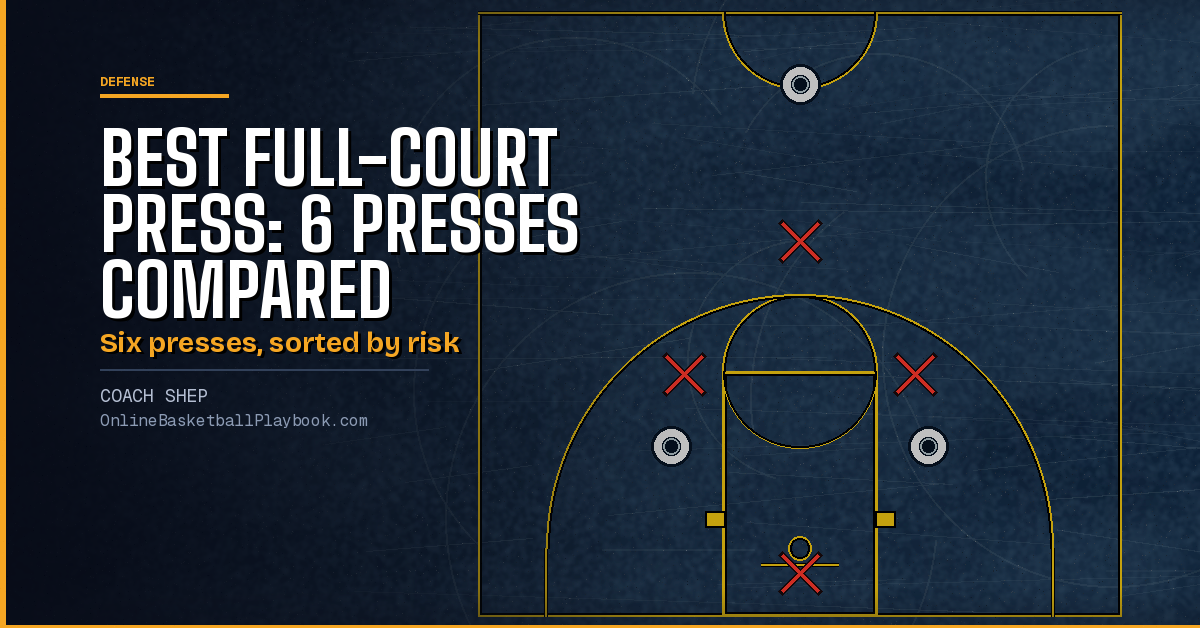
Best Full-Court Press: 6 Presses Compared
The 1-2-1-1, 2-2-1, 1-2-2, 1-3-1, run and jump and full-court man, sorted by where they pick up, where they trap and how much they risk.
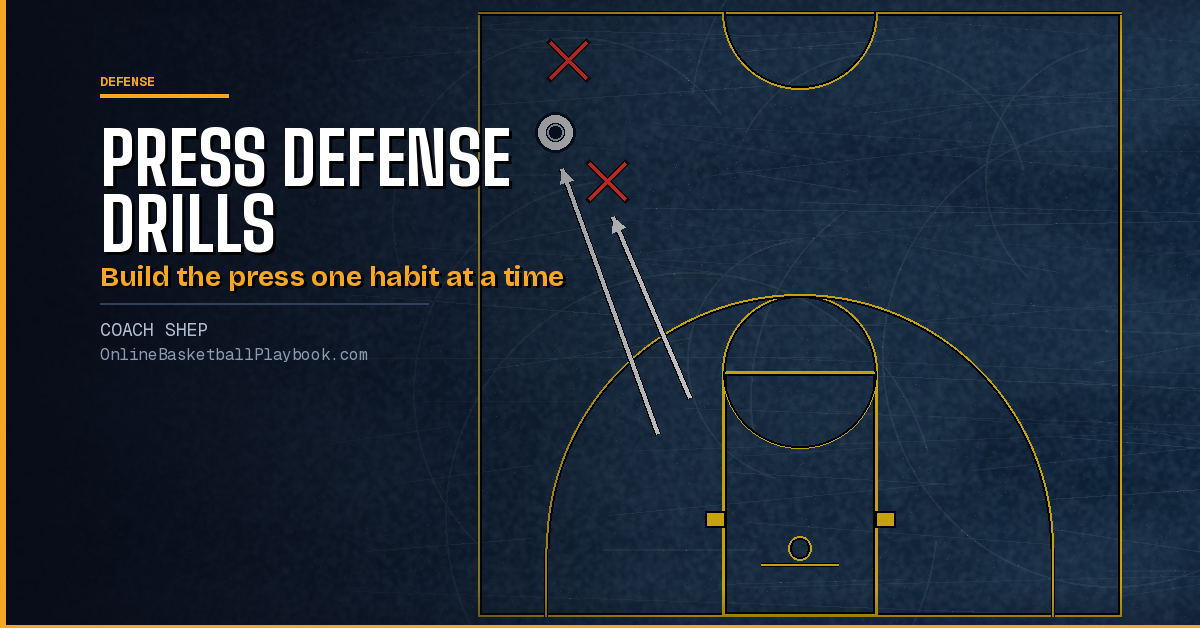
Full Court Press Defense Drills: Traps, Rotations and Live Reps
Full court press defense drills that build the press in pieces: footwork, trap drills, back-tips, sideline traps, rotation drills, live games and how to score them.
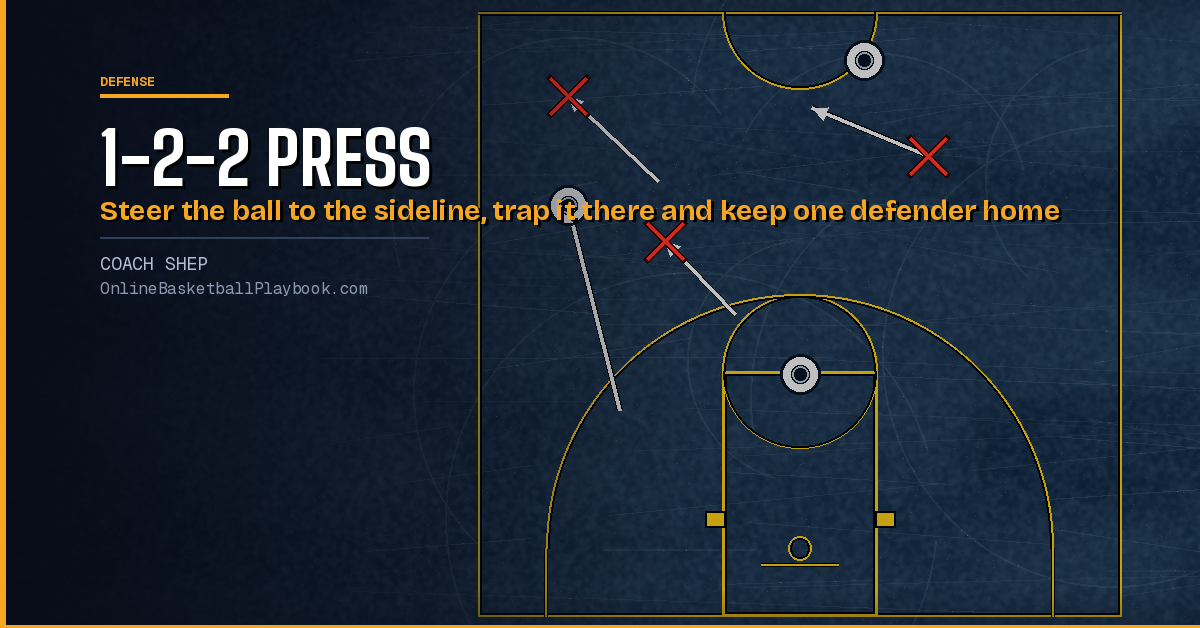
1-2-2 Press: Roles, Traps, Rotations and Breakdowns
1-2-2 press guide covering who plays the top, middle and back line, where each version traps, how it rotates on a reversal and what to do when it breaks.