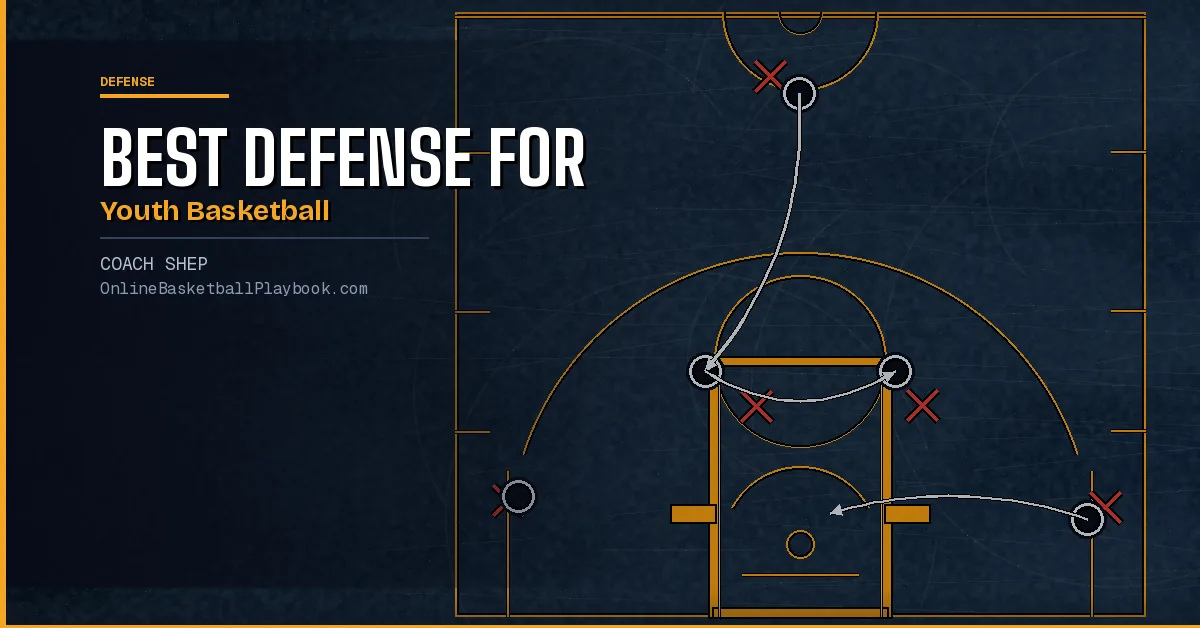
Teaching defense to young players starts with habits, not schemes. The right defensive system for youth basketball builds effort, awareness, and footwork (skills that transfer to every level of the game).
Why Defense Comes First at the Youth Level
Most youth coaches spend the bulk of practice time on offense: plays, shooting, and ball-handling drills. That's understandable. Scoring is visible and exciting. But the coaches who build winning programs year after year almost always share one conviction: defense is where character gets built, and it's where young players learn to compete.
Defense requires something offense doesn't demand in the same way: consistent effort regardless of whether the ball is in your hands. A kid can drift on offense and still get a catch, a screen, or a backdoor cut at the right moment. On defense, one second of lost focus means a layup for the other team. That accountability (playing hard without the ball) is the foundation of basketball team culture.
At the youth level, defense also equalizes talent gaps. The fastest kid on the floor isn't automatically the best defender. Anticipation, positioning, and communication matter just as much as athleticism. That means every player on your roster can contribute defensively, which raises team engagement and helps youth basketball coaches keep all twelve players invested in every possession.
Starting with defense also sets the tone for what your program values. Teams that build their identity around stopping people tend to be tougher, more connected, and more consistent from night to night. You're not just teaching a skill. You're teaching a mindset that compounds over seasons.
Man-to-Man Defense: The Essential Foundation
Before you install a zone, before you run a press, before you draw up any defensive scheme, teach man-to-man. It is the single most important defensive system a youth player can learn, and most development experts agree it should be the exclusive focus at the youth level through at least age 12.
The reason is straightforward: man-to-man defense forces individual accountability. Every player has a job. Every player has to find their person, stay attached, and communicate when they lose sight of them. There's nowhere to hide and no scheme to cover for you. That individual growth is what youth basketball is supposed to produce.
The Core Man-to-Man Stance
Start here before any other concept. The defensive stance is the platform everything else is built on. Feet shoulder-width apart, knees bent, weight on the balls of the feet, back flat. The hand nearest the ball is active and in passing lanes; the other hand helps control the hip. Eyes on the chest of the offensive player, not the ball, not the feet.
Drill this stance daily. Make it automatic. Young players who don't have a reliable stance will stand straight up under pressure and get blown by on every drive. A solid stance, drilled with repetition, becomes reflex, and reflex is what holds up in a real game.
Positioning Relative to Ball and Man
The next concept is ball-you-man positioning. Players must learn to stay between their man and the basket while staying aware of where the ball is. When the ball is on the strong side, defenders on the weak side drop toward the lane, opening themselves up to provide help. This is the core concept behind help defense principles and it cannot be skipped at any level.
Young players naturally want to ball-watch. They follow the ball with their eyes and lose their man. Teach them early to see both, using their peripheral vision to track the ball without losing their assignment. The two-second drill (players freeze while coach calls out where the ball is) is a simple, effective way to build this awareness.
When and How to Teach Zone Defense
Zone defense is controversial in youth basketball circles. Some leagues ban it outright before a certain age. Others allow it freely. The right answer depends on the age group and how the zone is being taught, whether it's a crutch or a learning tool.
The case against zone at the earliest ages is solid: when young players are in a zone, they stop tracking offensive players and focus only on a geographic area. That removes the accountability component that makes man-to-man so valuable for development. If a kid is staring at the ball from a gap position and nobody is moving into their area, they can look busy without really competing.
That said, there are legitimate times to teach zone concepts. The 2-3 zone defense is the most common starting point for youth teams. It protects the paint, it's easy to organize, and it helps younger players understand defensive rotations and floor spacing from a new angle. If you use it, use it as a supplement, not a replacement, for the man-to-man foundation you've already built.
Teaching Zone Rotations
The most critical concept in zone defense for young players is ball rotation. As the ball moves, the zone must rotate together. If one player is slow to move, the whole structure breaks down. This is a communication skill as much as it is an athletic one. Players must talk, call out ball movement, and shift as a unit.
Walk through it slowly at first. Freeze the ball, rotate. Freeze the ball, rotate. Add movement gradually. The goal isn't to confuse offenses with trick alignments. It's to teach players how to move together and cover space intelligently.
Key Defensive Habits Every Youth Player Needs
Beyond systems and schemes, there are a handful of habits that define good defensive players. These are worth repeating every practice, every huddle, every film session. Build them early and players will carry them through high school and beyond.
Communication
Defense is the loudest part of basketball. Talk on every screen. Call out "ball" when your teammate needs help. Say "I got ball" on loose balls so two defenders don't collide. Announce switches. This communication habit is the difference between a scrambled defensive breakdown and a disciplined stop. Don't wait for players to do it naturally. Require it, and make it part of your defensive drills from day one.
Active Hands Without Fouling
Young players tend to foul in one of two ways: reaching across the body to swipe at the ball, or slapping down on the arms during a shot. Both are habits that need to be addressed early. Teach players to keep their hands active, palms up, flicking at the ball from below, not swiping from the side. Active hands disrupt passing lanes and force turnovers without fouling.
Closeouts
Every youth player needs to learn how to close out properly. A closeout is the sprint from your position to contest an open shooter. Done wrong, you fly by and give up a wide-open shot or get blown by on a drive. Done right, you break down into a defensive stance as you arrive, contest the shot with a high hand, and stay in front. Study the details at basketball closeout technique: It's one of the highest-leverage fundamentals a young player can learn.
Transition Defense
Most youth points come in transition. A missed shot, a turnover, and suddenly the opponent has a numbers advantage before your team gets back. Teach players to sprint back on every possession, not jog, not walk. The first priority is getting behind the ball. The second is protecting the basket. Review transition defense principles and make them a non-negotiable habit from the first practice of the season.
How to Structure Defensive Practice
Defense gets better in practice, not in games. If you're waiting for games to teach defensive habits, you're already behind. Structure your practice so that defensive work comes in multiple doses, not just one long defensive segment at the end when players are tired.
A smart structure dedicates time at the start of practice to individual defensive fundamentals. Stance, footwork, closeouts, and slides. These are quick and high-energy. Five minutes of defensive footwork at the start of practice beats fifteen minutes of dead-leg defensive drills at the end.
The shell drill is one of the most valuable teaching tools available. It walks players through ball rotation, help defense, and communication in a controlled setting with no live offense. Run it three to four times per week, especially early in the season. If you haven't worked through the shell drill progressions, start there before any live defensive work.
From shell drill, progress to 3-on-3 live defense, then to 5-on-5 controlled scrimmage. Keep the drill progressions connected so players understand why each piece matters. Every drill should have a clear win condition for the defense, "stop them for five possessions without a layup" is better than a vague "play defense."
Use your basketball practice plan to schedule defensive segments intentionally. Track how much time you actually spend on defense each week. Most coaches think they spend more time on it than they do. If defense is a priority, it needs to show up in the calendar, not just the speech.
Common Mistakes Youth Coaches Make on Defense
Even well-intentioned coaches repeat the same mistakes when teaching defense to young players. Knowing them ahead of time helps you avoid the patterns that slow development down.
Teaching Too Many Systems Too Fast
A youth team that runs man-to-man, a 2-3 zone, a full-court press, and a box-and-one is a confused youth team. Every system added is a concept that needs to be understood and drilled separately. The time spent switching between systems is time not spent mastering any one of them. Pick one or two defensive looks, get really good at them, and stick with them through the season.
Rewarding Only Steals and Blocks
When coaches celebrate only steals and blocked shots, players chase those plays at the expense of sound positioning. The steal-hunter gambles for the ball and gets blown by. The shot-blocker leaves his feet and fouls. Teach players, and celebrate, the boring good plays: taking a charge, forcing a difficult shot, making the extra rotation, communicating a screen. Those habits win games at every level.
Neglecting Individual Footwork
Defensive footwork is a skill just like shooting. Lateral slides, drop steps, and the ability to change direction without crossing feet. These require repetition to become reliable. Spend dedicated time on basketball footwork drills that are defensive in nature, not just offensive. Most youth players never get this training, which is why their defense breaks down the moment a ball-handler attacks them at full speed.
Skipping Rebounding as Part of Defense
A defensive possession isn't over until your team has the ball. Too many coaches teach the defensive concept but skip the boxing-out habit that ends it. Every missed shot is a 50/50 ball if neither team boxes out, and offensive rebounds are one of the fastest ways for a youth team to give up easy baskets. Build boxing out into your defensive culture from the start. Use your rebounding drills as defensive drills, not just as big-man work.
The goal at the youth level isn't to build a defense that wins this weekend's tournament. It's to build habits that make your players genuinely hard to score on in five years. Every rep of good defensive footwork, communication, and positioning is an investment that compounds.
- Stance first, always: Feet wide, knees bent, weight forward. Drill it until it's automatic before adding any scheme.
- Man-to-man before zone: Build individual accountability before teaching players to hide in a geographic area.
- Talk on every possession: Make verbal communication a non-negotiable; if they're not talking, stop the drill.
- Close out correctly: Sprint, break down, high hand. Never fly by and never give up the drive without a fight.
- Sprint back in transition: No jogging, no watching. Every player turns and goes on every change of possession.
- Box out to end the possession: A good defensive sequence ends with a defensive rebound, not just a difficult shot.
- Keep systems simple: One or two defensive looks, mastered, beat five looks that nobody understands.
Get free play diagrams, drills, and coaching guides delivered weekly.
Draw this play free in the play drawer →
Membership: the full library, playbook packs, and Pro drawing tools →
Keep Building
Related breakdowns
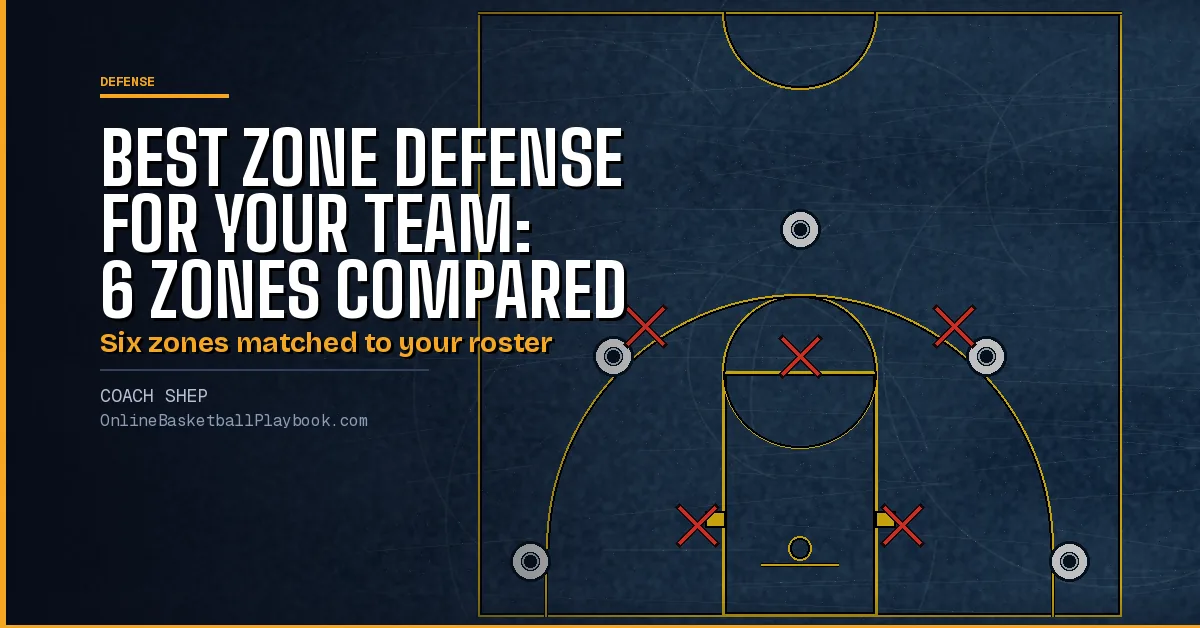
Best Zone Defense for Your Team: 6 Zones Compared
The 2-3, 3-2, 1-3-1, 1-2-2, 2-1-2 and matchup zone, each matched to the roster and the opponent it beats.
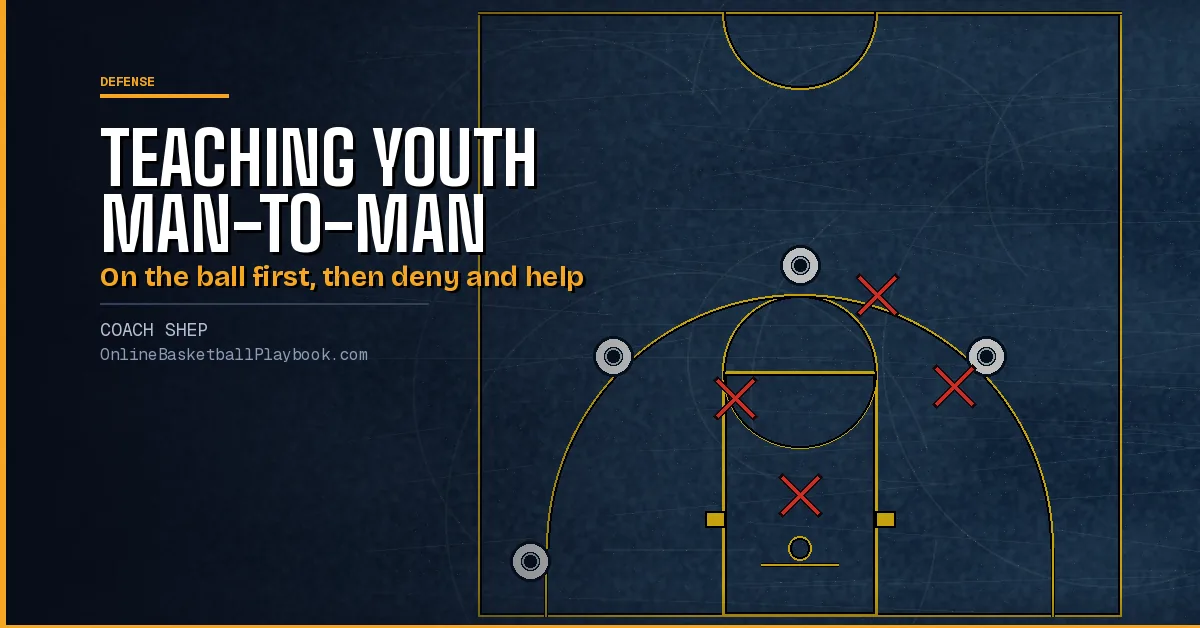
Teaching Man to Man Defense in Youth Basketball, by Age
Teaching man to man defense in youth basketball: what to teach first at each age, the cold, warm and hot levels, the pistol cue, deny and help, and when zones fit.
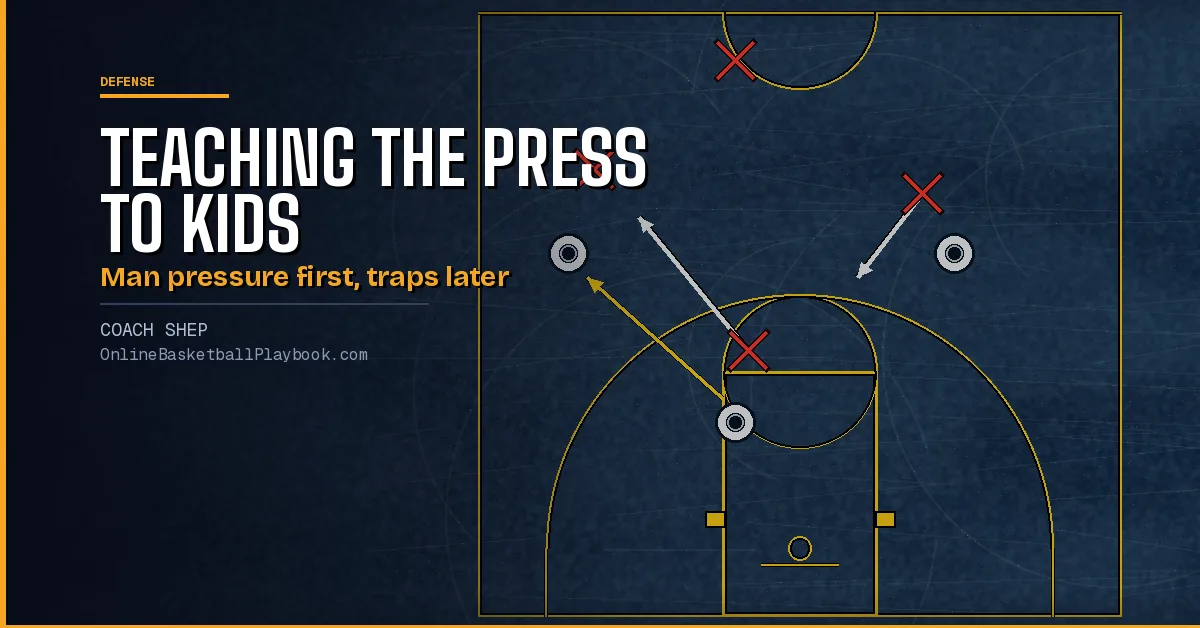
How to Teach a Press to Youth Teams: What to Teach First
How to teach a press to youth teams: check your league's rules, start with man pressure, build it through small games, then add a simple trap or zone press later.