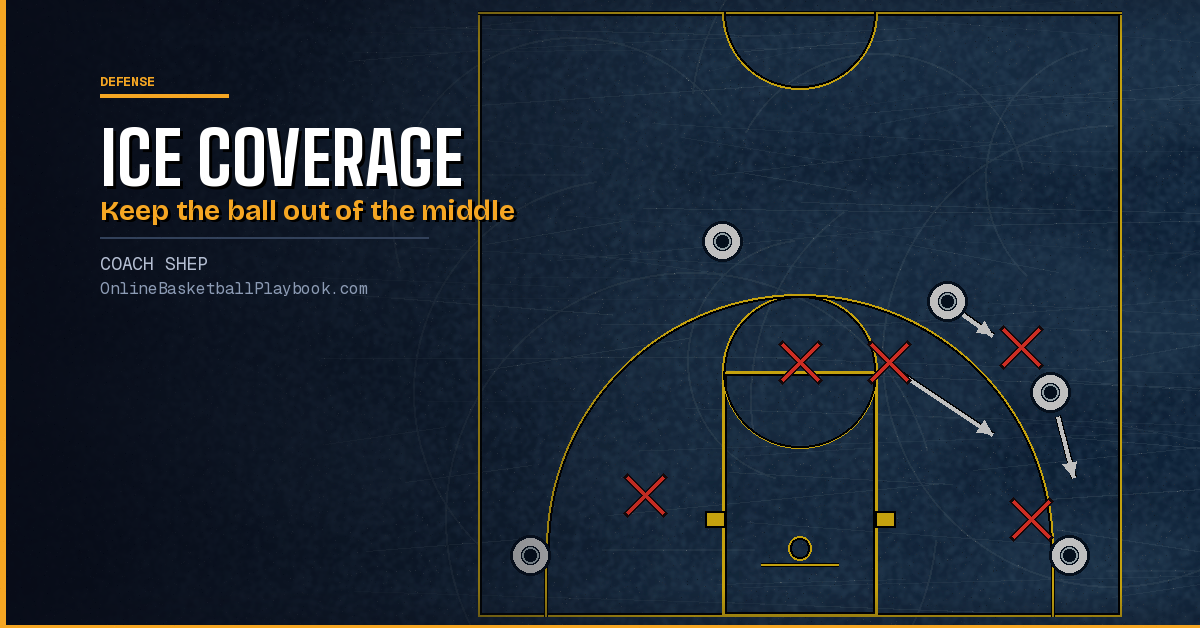
Ice is a basketball defense for the side pick and roll. As the screener comes from the middle to screen on the wing, the on-ball defender jumps to the middle side so the handler can only go toward the sideline and the baseline, away from the screen. The screener's defender sits below the screen to stop him there. The aim is a screen that never gets used and a ball that stays out of the middle of the floor. Different programs call the same idea down, blue or push. This page covers how to ice a side ball screen, both defenders' jobs, keeping the ball in the box, the nail stunt and the full rotation, weak on a middle screen, what beats ice and how to teach it. The other coverages are on the pick and roll defense hub.
Ice in Basketball Defense: What It Is
One version describes the goal as stopping the ball screen from ever happening, instead of fighting through it. FIBA Europe's terminology lists ice, fan and push down as one coverage: force the reject, while the screener's defender mirrors the side the handler is forced to. Push coverage is also called ice or down. The box version, covered below, credits the coverage to the Utah Jazz's defense of wing screens against the Chicago Bulls in the NBA Finals.
Other versions do the reverse. One version makes the on-ball defender send the handler into the screen with his weak hand, so he is never rejected or split. Ice and its relatives keep the screen from connecting at all.

The Call
The call has a trigger, by version:
- At the screen call. In one version the on-ball defender jumps to the middle the instant the screen is called.
- At the screener's first step. In the step-toward-the-ball version the big calls ice as soon as the offensive big takes one step toward the ball, then sprints to get in line with the ball.
- A number for the side screen. In the numbered version the big calls a number on a side screen, and the on-ball defender forces the ball down toward the baseline.
One version adds a separate call for the offense that shorts the pick and roll with the opposite post.
Ice Pick and Roll: The Two Defenders
The on-ball defender
- Jump to the middle. He takes the middle side of the handler so the ball can only go down, toward the sideline and the baseline, away from a screener who comes from the middle.
- Get into the body. One version wants him into the handler's body and space, because the more room the handler has, the easier it is to build speed and fake the defender out.
- Square it up first. In the step-toward-the-ball version the guard must square the handler up, or the handler must pick up his dribble, before the big does anything else.
The screener's defender
- Early, loud, visible, wide and up to touch. One version wants the big within arm's length of the screener and showing the handler a body that takes away the straight line to the rim.
- Square up and contain on the sideline. Another version has the big square up and contain on the sideline. He does not leave for the roller until the handler picks up his dribble or the on-ball defender calls him off, then he recovers with his hands high.
- Up at the screen, by version. In the hot version of push, the screener's defender stays up at the level of the screen.
In the box version below, the big holds until the on-ball defender is completely back in front of the ball, unless the ball is passed, when he releases at once.
Keep the Ball in the Box
One version teaches ice as a box with four walls: the on-ball defender, the screener's defender, the sideline and the baseline. The ball should leave the box only by a pass, never by the handler getting back to the middle off the dribble.

The same version says ice is stronger when the ball-side corner is filled, because the corner player shrinks the box. Coaches read a filled corner differently on other coverages. The corner-read version reads a filled corner as a reason not to trap and to drop instead, and one pack line program may trap a wing ball screen with the corner filled.
The Nail Stunt or the Full Rotation
A defender at the nail, the middle of the free-throw line, protects the box. On a catch by the screener, he stunts and jabs at him to buy time for the big to recover. One version says the staff must decide before practice which help is live, and give the team one plan:
- Stunt and recover. Each help defender jabs, then gets back to his own man.
- Full rotation. The nail defender takes the screener, and every weak-side defender rotates over one spot.


Other help rules, by version:
- Two tags. The step-toward-the-ball version gives the lowest weak-side defender the last tag on the roller and the other weak-side defender the first tag. If the ball is skipped while the low man is on the roller, he must close out on the back side.
- Push out, pull in. The same version gives a rule of thumb: when the ball is driven at you, push out, and when it is driven away from you, pull in.
- The nail takes the pop. In the rotate version of push, the nail defender rotates to the screener who pops.
The weak-side rules in general are on help defense principles and how to coach defensive rotations.
Get the next coaching guide in your inbox
One email when a new guide or diagram set goes up. Free.
Weak on the Middle Screen
Several programs pair ice on the side screen with a second call for the middle screen, between the elbows. It is often named weak.
- Weak with the big up to touch. One version calls weak on the middle pick and roll, with the big up to touch, a hand on the screener's back.
- Weak and the weak-side I. The numbered version says it hates the ball in the middle of the floor. In its weak, the big strings the ball out to the sideline until the guard gets back, the strong-side defender plugs the gap, and the two weak-side defenders stack in an I. The top of the I tags the roller and hands him to the bottom of the I.
- Weak to the weak hand. Another version's weak call turns the handler to his weak hand.
- One rotation for both. One program ices sideline pick and rolls and weaks middle ones to the left, so the handler is pushed away from the screen in both and the team learns one rotation.

The numbered version also has a weak blitz, in which the big and the guard trap and stay until the handler picks up his dribble, and the top of the I takes the first pass. The trap is covered on blitz and trap ball screens.
When Ice Fits and What Beats It
When it fits. One version says ice suits a team that already forces baseline and has quick-footed big defenders, and is stronger with the ball-side corner occupied. Another version lists ice as the coverage for sideline ball screens, used to force a rejection away from the middle. The no-middle and pack line rules are compared on how to coach pack line defense.
What beats it. One observer saw an NBA team attack ice with a full fill-around, so the weak-side tag could not get to the roller. The screener can also catch at the elbow, which is what the nail stunt is for. The offense's full set of reads is on pick and roll reads.
From a zone. Zones handle the side screen too. One match-up zone forces it down, with the low defender bumping the handler once he reaches the bump area. A tandem 2-3 instead stunts with the next defender and funnels the ball to the center. The zone versions are on how to coach a matchup zone.
Teaching Ice
One coverage per cycle. One pack line shell gives ball screens three of its ten shell minutes, with one coverage per cycle, ice among them.
Shell in stages. The step-toward-the-ball version builds a ball screen shell in four stages and adds a 4-on-4 against multiple pick and rolls. More set-ups are on drills to teach ball screen defense.
One language. The call words change by gym: ice, down, blue, push. One team used blue for down on one screen action. Another wants one vocabulary for every coverage, called loud and continually. The full vocabulary is on basketball terminology.
Questions Coaches Ask About Ice
What is ice in basketball defense?
A side pick and roll defense. The on-ball defender jumps to the middle side so the handler can only go toward the sideline and baseline, away from the screen, and the screener's defender sits below the screen to contain him.
Is ice the same as down or blue?
Yes, programs use ice, down, blue and push for the same idea. FIBA Europe lists ice, fan and push down as one coverage.
When should you ice a ball screen?
On a side screen, where the sideline acts as a wall. One version says it fits a team that already forces baseline, with quick bigs, and is stronger with the ball-side corner filled.
What is weak coverage in basketball?
The middle screen version in several programs. The on-ball defender takes the screen away and pushes the handler away from it, and in one version the big stays up to touch the screener.
Who guards the roller in ice?
The screener's defender, once the on-ball defender is back in front. Until then a nail defender stunts at the screener, or the defense makes a full rotation with the nail man taking the screener.
Want every diagram on the site?
OBP Pro members get the full diagram files for every guide on the site, ready for a practice binder or a scouting report. $9 a month. Or draw your own version free in the play drawer.
See what OBP Pro includesMore Coaching Guides From This Batch
- Drop Coverage Basketball: How the Big Plays the Ball Screen
- Hedge Basketball: Hard Hedge, Flat Hedge and the Recovery
- Switching Defense Basketball: How to Switch Ball Screens
- Blitz Pick and Roll Defense: How to Trap a Ball Screen
Back to Pick and Roll Defense and every Defense page.
Keep Building
Related breakdowns
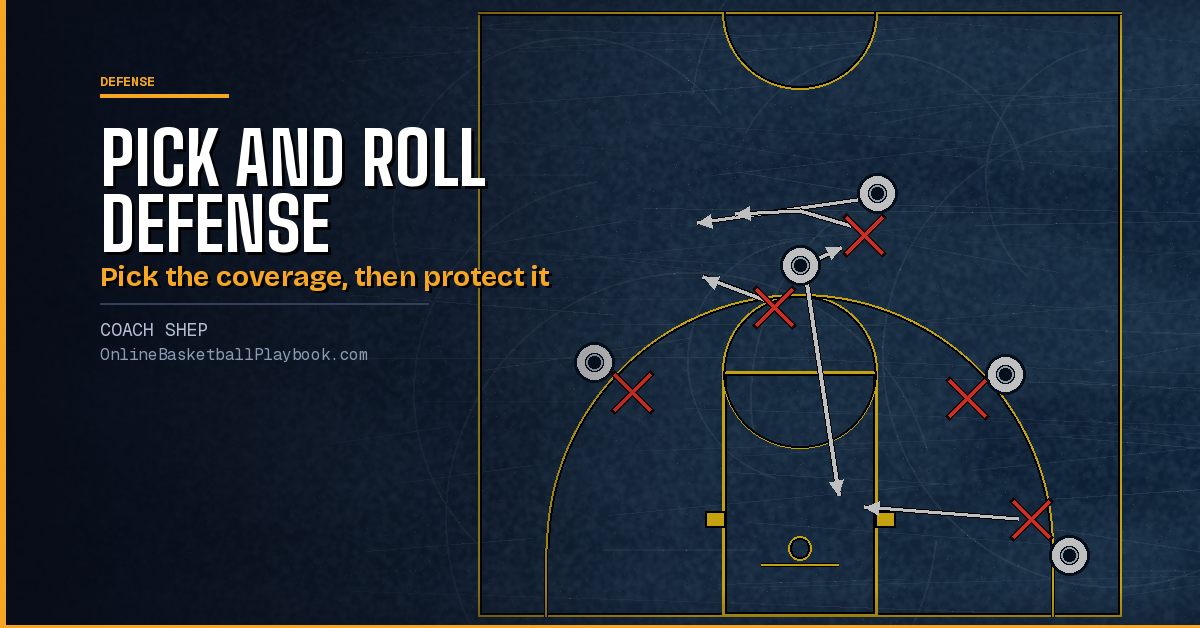
Pick and Roll Defense: Every Ball Screen Coverage Compared
Pick and roll defense compared: drop, show, blitz, switch, ice and under, what each takes away and gives up, the help behind it and how to choose.
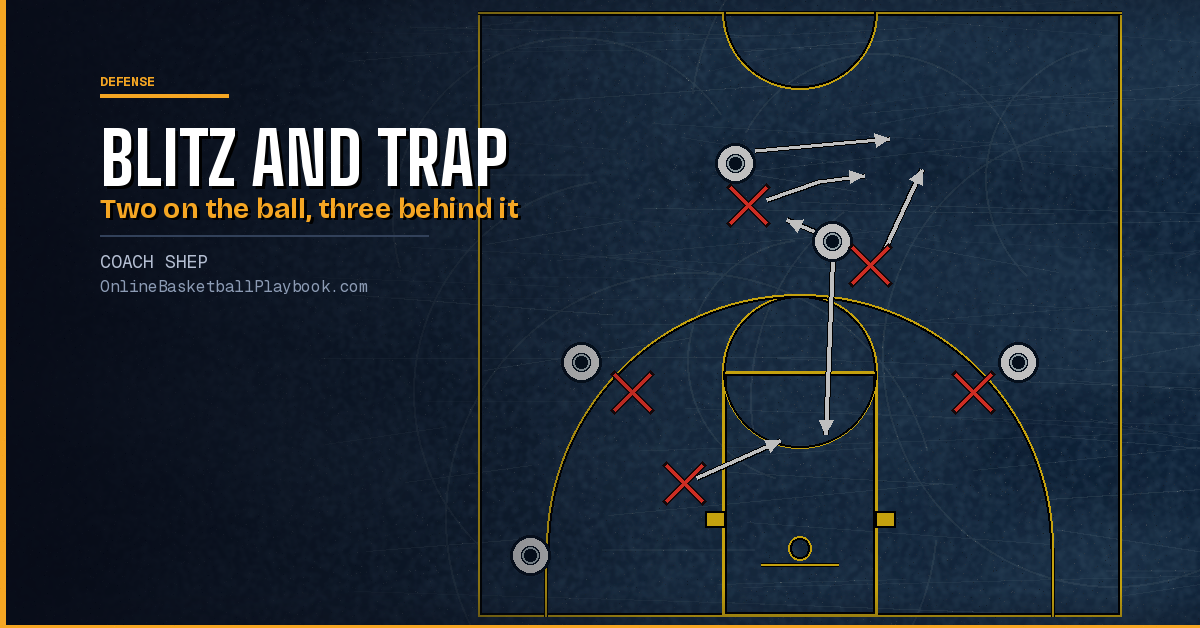
Blitz Pick and Roll Defense: How to Trap a Ball Screen
Blitz pick and roll defense explained: how to trap a ball screen, when the blitz fires, the rotation behind it, the offense's answers and the disguise.
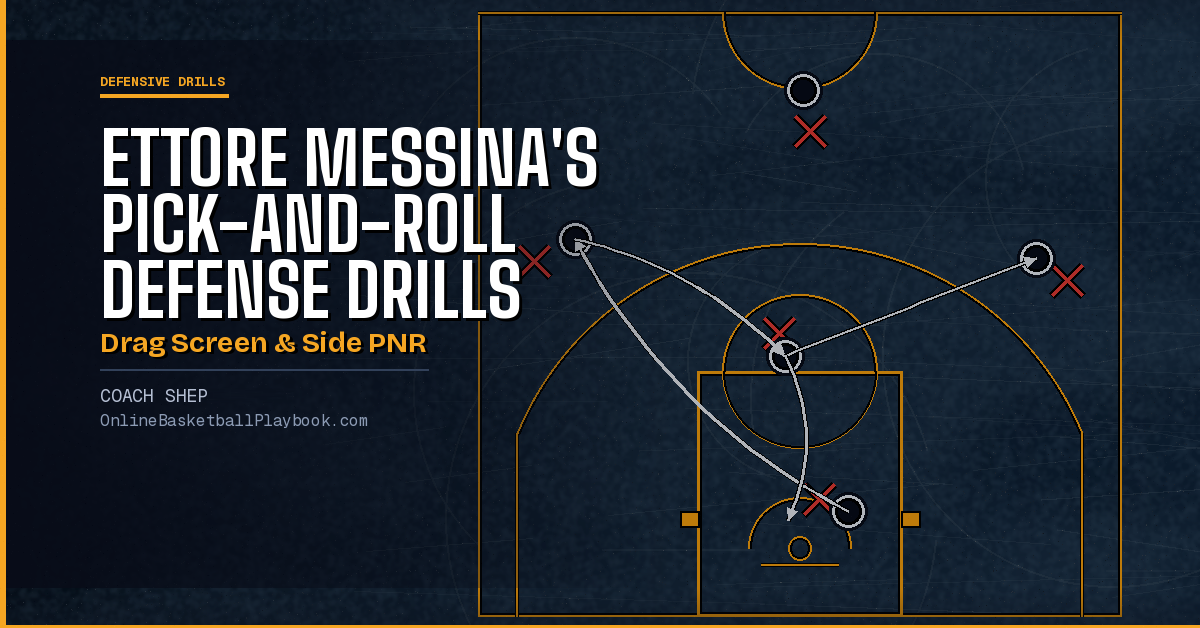
Ettore Messina's Pick-and-Roll Defense Drills: Drag Screen & Side PNR
Two 2-on-2 drills from Messina's clinic notes that fix the biggest reason teams give up easy buckets in transition: letting the ball handler reach the arc before the screen arrives.