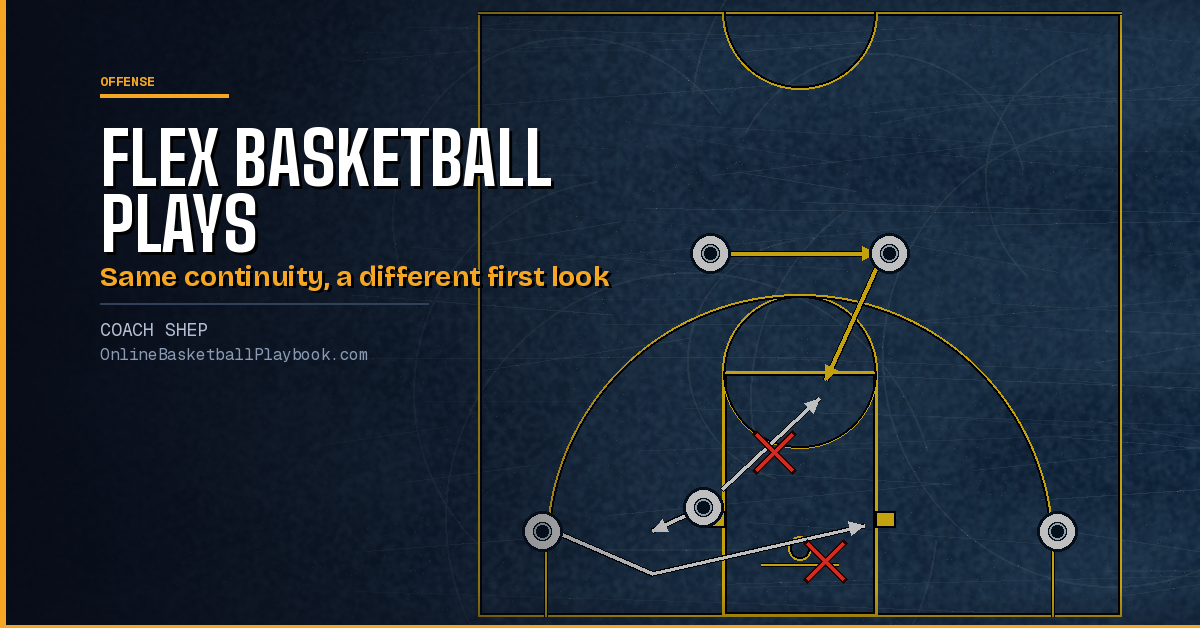
Flex basketball plays are the named calls coaches add on top of the flex continuity: specials for a shooter or a post, counters for a switching or denying defense, personnel swaps and entries from the break. Many are written to finish back in the flex. The base action they build on, the flex cut and the down screen for the screener, is explained in the flex offense guide. This page draws the plays themselves, version by version, and sets the plays that share a name side by side, because Push, Go and Bump each mean different actions in different versions.
Flex Basketball Plays at a Glance
| Play | Version | What it is for |
|---|---|---|
| Deep | Two-rule version | A quick post-up for 5 |
| Stack | Two-rule version | A post entry from a double stack |
| UCLA | Two-rule version | A pick and roll with a weak-side double screen |
| Push | Two-rule version | A shot for a hot shooter off the down screen |
| Down | Two-rule version | A perimeter shot for the post |
| Baseline double for the shooter | Two-rule version | A three for the best shooter off a baseline double |
| Pin | Two-rule version | A post-up against a switch |
| Reverse | Two-rule version | A guard screening a post against a switch |
| Post-flash backdoor | Two-rule version | A backdoor pressure release |
| Transition | Two-rule version | The secondary break straight into the flex |
| Princeton | Two-rule version | Raised spacing against pressure or switching |
| Backdoor, Duck In, Go, Pass Off Elbow | Corner-fade version | Answers to denial, switching and a cheating flex defender |
| GO, Bump, Invert | Power-triangle version | Answers to an early defender and a guarded down screen |
| Curls, Flare, Push, Stagger | Personnel-swap version | Personnel fixes inside the continuity |
The Eleven Specials
The two-rule version, the one that starts from 1-4 low in the flex offense guide, carries eleven special plays and answers the two weaknesses it admits, predictability and switching, with them. It says not to run all eleven in a season: pick the ones that fit your team and the defenses in your league, and skip the switch counters if nobody in the league switches. Nine of the eleven are drawn here. Transition and Princeton are described in text.
Deep

A quick post-up for 5. The point dribbles to the wing and the corner player cuts to the basket off 5's screen, then loops up to the high post. 5's defender is often busy with that cutter as he pops high, which leaves 5 open for the feed.
Stack

An entry built to get the ball inside. Both blocks are stacked, with the corner players on the baseline side, and from the regular 1-4 set the corner players simply step in to the blocks. The point keys it by dribbling toward one stack. The ball-side baseline player screens away for the other baseline player, who comes off both players in the ball-side stack to the corner for the pass.
UCLA

A pick and roll with a double screen on the weak side. After the UCLA cut, 5 steps out and runs the pick and roll with the wing, who takes at least two dribbles to get into the lane or a jumper near the elbow. At the same moment the point comes off a double screen from 3 and 4 on the weak-side block. This version says the double screen may produce a shot, and it also keeps the help defenders from helping on the pick and roll.
Push

A perimeter shot for the corner player who would normally make the flex cut. This version runs it for a shooter who is on a roll. Instead of cutting off the flex screen, the corner player pushes the post across the lane and comes off the down screen himself. It can also be run to look for a post-up by 5. The personnel-swap version uses the same name for a different action, shown below.
Down

A perimeter shot for the player in the post. After a pass to the corner, everyone screens as they normally would. When the corner player passes back out, he screens down for the post, and instead of reversing the ball, the perimeter player hits the post coming off the screen. The point, in this version, is that the change surprises a defense that has guarded the regular flex for several trips. Down screen technique is on down screens.
Baseline Double for the Shooter

A three for the team's best shooter. The point dribbles at the shooter, sending him toward the basket, while the ball-side high post pops to the top of the key and the other wing and post move toward the weak-side post. The point passes to the top of the key, and the ball swings to the shooter coming off the baseline double screen.
Pin

A counter to a switching defense. The guard holds on the perimeter and does not down screen. 5 sets the flex screen, then rolls up the lane toward the ball. Because he screened for a smaller teammate, a switch leaves the smaller defender on his back in the post.
Reverse

The second switching counter, also looking for a big-little screen near the basket. The post usually sits on the ball side in the flex, so the play starts by reversing the ball to put him on the weak side, hence the name. The post does not set the baseline screen. On the guard to wing pass, the guard basket-cuts and screens for the post instead of screening away, so a switch puts a guard's defender on the post.
Post-Flash Backdoor

A backdoor pressure release. Both posts flash to the high post and both wings take two steps toward half court to pull their defenders away from the basket. On the pass to the high post, the ball-side wing back-cuts for the layup. If he is not open, he keeps going off a double screen from the other wing and post on the weak side. If that is covered, the high post passes to the point, who has V-cut to the ball-side wing, and dives to the low post. If nothing is there, the team goes back into the flex.
Transition and Princeton
Transition takes the secondary break into the flex. The wing who catches the ball on the break looks inside first and can dribble toward the baseline to flatten the defense, which frees the reversal and buys the post time. If the post-up is not there, he reverses the ball and goes straight into a flex cut. Princeton raises the offense: baseline players move up to the free-throw line extended and the guards move back 8 to 10 feet, which this version says opens room for back cuts, curls and slipped screens. It is drawn as the high flex in the flex offense guide, and the Princeton offense itself is on Princeton offense.
Get the free flex offense playbook (PDF)
Every flex cut, starting set, counter, special and drill from this guide and the flex plays page, with all 30 diagrams, in one printable PDF. Free.
Same Name, Different Play
Five names cover different actions depending on the version.
| Name | Version | The action |
|---|---|---|
| Push | Two-rule version | The corner player pushes the post across the lane and uses the down screen instead of the flex cut, for a hot shooter |
| Push | Personnel-swap version | A forward replaces the post on the guard to guard pass, so a guard you do not want posting up stays off the block |
| Go | Corner-fade version | The flex defender cheats into the lane, so the flex screener crosses the lane and the cutter pops to the top of the key |
| GO | Power-triangle version | The cutter's defender beats him around the screen early, so the screener pivots and screens that defender and the cutter goes to the free-throw line area |
| Bump | Early-offense version (bump back) | The cutter's defender cheats under the screen, so the cutter bumps back off a double screen from the down-screener and the post |
| Bump | Power-triangle version | A call that tells teammates the cutter will flare back out while two teammates screen his defender |
| Bump | Corner-fade version, transition | A transition counter: one wing bumps the other to the corner and posts up |
| Invert | Corner-fade version | An entry that starts the posts in the corners and the wings on the blocks |
| Invert | Power-triangle version | The post back-screens for the guard instead of the guard screening down, after the flex cutter clears through the lane |
| Swing | Bo Ryan | A separate 4-out continuity that uses a flex screen on the slot to slot pass |

The two Go plays share a trigger, a defender cheating on the flex cut, but the sources draw them differently and none says they are the same action. Bo Ryan's swing has its own guide on swing offense, and other versions list a youth swing that is not his.
Read Counters
The corner-fade version drops the down screen for a corner fade and teaches four counters as reads, each triggered by a defensive mistake rather than a call from the bench.
- Backdoor. Without the down screen there is room to back-cut against a team that denies the reversal pass. The cutter flashes a fist, and if no pass comes he clears to the corner and a teammate cuts to the slot for the reversal.
- Duck In. When the defense switches the flex screen, the screener ducks into the paint right after screening. It is drawn in the flex offense guide.
- Go. Drawn below.
- Pass Off Elbow. Any pass from the elbow down to the corner sends the two players in the slots into a double stagger away for the corner man. The corner can feed the post or hit the player coming off the stagger, and the passer can look for a high-low feed on the post seal. Then the post clears to the corner, the other post pops for the reversal, and the continuity resumes.

The same version can run Go for a whole possession as an entry of its own, which keeps a post on the blocks because he keeps crossing the lane on every Go. Its transition package adds four counters for one of the corner players, two of them read off his defender: flash high if he cheats under, curl if he chases over, bump and post if that player wants to post, and baseline screens from two teammates. Two secondary sets come off the same break. One frees that player for a three off a double stagger, and the other brings him off baseline screens and swings the ball back for a post entry.
GO, Bump and Invert
The power-triangle version, which starts with the point in the middle, teaches three calls against defenders who have learned the pattern.

GO. Some defenses teach the cutter's defender to leave early and beat him around the screen. The cutter yells GO, the screener pivots and screens that defender in the lane, and the cutter fakes, then cuts to the free-throw line area where the screener would normally have gone. The guard still sets his down screen and then moves out toward the wing in case his own defender picks up the cutter. This version credits the move to a Davidson coach and says it produced open jump shots.

Bump. Against the same early defender, the cutter can call Bump to tell teammates he will fake the cut and flare back outside. The post and the guard screen the defender who had him, and the ball goes to the wing. The early-offense version draws the same picture as a bump back, with the cutter coming back off a double screen from the down-screener and the post.

Invert. A counter to a defense that has been guarding the down screen. The flex cutter first runs through the lane, dragging his defender out toward the corner. Then, instead of the guard screening down for the post, the post sets a back screen for the guard, who may be open for a layup. This version says it can be called out loud now and then, and if a taller player has rotated to the slot, he may get a dunk off it.
The same version adds a special double screen from the corner, a staggered screen for a shooter, and quick hitters for a shooter, a post and a high post screen, with the rule that players must know how to get back into the basic flex if a quick hitter breaks down.
Personnel Swaps
The personnel-swap version gives four swaps, each fixing one roster problem without leaving the continuity. Three of the four end with the offense flowing back into the flex.

Curls. For a big you do not want standing at the elbow. On the down screen he curls into the paint, ready for a pass, then loops out to the wing while the screener fills the slot.

Flare. For a perimeter shooter you are trying to free. After the guard to guard reversal, the post sets a flare screen and the shooter fades for a skip pass. If the skip is not there, the offense goes back into the flex.
Push. Drawn above. A forward replaces the post so a guard stays off the block.

Stagger. For a jump shot instead of a paint cut. After the reversal, two teammates set staggered screens and the player who would have made the flex cut curls hard off them.
Flex Series and Entry Menus
Several versions package their flex plays as series or entry menus rather than single calls.
| Version | The menu |
|---|---|
| Overload version | Seven series: basic, corner, pop-out (the flexing guard pops to the top of the key, with a high-low seal), back screen (an inverted flex cut and a flare instead of the down screen, usable as an end-of-quarter set), a two-screen corner entry (the point comes off two screens to the ball-side corner before the flex starts), corner post and transition |
| Gonzaga's entries | Eleven headed plays under a title that says twelve, three off the break (Regular Break, Double Down, 90) and eight half-court entries: Crackdown and its variant BIG, three 1-4 entries (Post, Wing and High), High Stack, Slice, UMASS and Box. Crackdown was its most common entry. Slice, UMASS and Box all start with the point dragging the dribble to the right. |
| 4-out version | Five disguise formations (1-3-1, double stack, box, 1-4 low, 1-4 high) and 20 quick hitters, four for each formation, one from each group: pick and roll, double screens for shooters, perimeter clear-outs and give and go. Every one ends with normal flex action. |
| Corner-fade version | Ten entries: 1-4, Invert, Ball Screen, 2 Out 3 In, Box to Box, Skip Pass, a Go entry, Double Stack, a baseline inbound and a sideline inbound |
| Corner-finish version | Five variations on the base cut: Flex Screen and Roll, a backdoor cut, a high-low swap between the bigs, a baseline inbound play and an isolation |
| Early-offense version | Three entries into the same continuity: High Post Rub, Weakside Shuffle Cut and Dribble Clear, plus a Pop variation where the corner pops to the elbow off the down screen instead of using the baseline screen |
Inbound entries into the flex are collected on baseline out of bounds plays, and entries off the break on secondary break basketball.
Flex Actions Inside Other Offenses
The flex screen shows up in offenses and sets that are not the flex.
| Version | Where the flex action appears |
|---|---|
| Bo Ryan's swing | The slot to slot pass triggers a flex screen, and the screener then flashes to the middle |
| Five-setup rotation | A flex variation that rotates through five mirrored setups and returns to the first after ten rotations, with a turnaround bank shot off the block screen |
| CMU Wheel | A 4-man pattern with flex-style screens to the ball-side block |
| 2-3 Low pattern | A back screen, flex cut and seal on every reversal. Its Cyclone action, credited to Fred Hoiberg, opens with a flex screen, then a UCLA screen at the elbow and a high ball screen. |
| Princeton Chin series | Chin Flex, where a cutter goes through the lane and sets a flex screen, then gets a down screen himself for a three on the wing |
| Hawk set | Flex as one of three fallback continuities, with a bump-back counter and a corner double screen |
| Belmont | Flex, Flex-Open and Flex-Seal among 26 half-court sets, next to a backdoor series |
| CSKA Moscow | Horns Flex Normal, a chain of a down screen, a flex screen and a second down screen, with a post-seal look and a catch-and-shoot look |
| Miami Heat | A Set Choice: the player coming off the screens flex-cuts if his defender cheats the double screen, and uses the double if the defender cheats the flex |
| Larry Brown | Zipper Flex: a dribble entry, a down screen for a guard to pop up, then a flex screen |
| Duke and other college sets | Duke's A Set Flex 1, and flex calls in several college batteries, including Virginia's Flex Duck |
| Lob counter | A flex lob, a counter for a defender who goes over the top of the flex screen |
| Youth set | The point cuts to the corner off screens and a forward cuts to the far low post off a screen, offered against man, zone or a box-and-one |
Horns entries are covered on horns sets, and the continuities themselves on continuity offense basketball.
Choosing Which Flex Plays to Carry
The sources give three rules for building the package, and none of them says carry everything.
- The two-rule version: pick the plays that fit your team's strengths and the defenses in your league. If no team in the league switches, do not spend much time on switch counters.
- The code-word version, on its corner options: pick two or three and give each a code word.
- The 4-out version: keep disguised entries separate from quick hitters, and end every quick hitter in normal flex action.
Switch counters such as Pin and Reverse pair with the defensive side on how to coach defensive switching. Packaging calls of any kind is covered on how to run quick hitters, and more sets are in basketball plays and the offense section.
Questions Coaches Ask About Flex Basketball Plays
What are flex offense plays?
Named calls run inside or on top of the flex continuity, such as Deep, Pin, Reverse and the baseline double for the shooter, that change one piece of the pattern for a specific shot or counter and then return to the flex.
What is Pin in the flex offense?
A counter to switching. The guard holds instead of down-screening, and the post sets the flex screen and rolls up the lane toward the ball with the smaller switched defender on his back.
What is the Go counter in the flex?
Two versions exist. In one, the flex screener crosses the lane and the cutter pops to the top of the key when the flex defender cheats into the lane. In the other, the screener pivots to screen an early defender and the cutter goes to the free-throw line area.
How many special plays should a flex team run?
The two-rule version, with eleven specials, says not to run all of them, only the ones that fit your team and your league's defenses.
Do flex plays work out of other sets?
Yes. Flex screens appear in the swing, Princeton Chin series, horns sets and pro sets such as Miami's A Set Choice and Larry Brown's Zipper Flex.
Want every diagram on the site?
OBP Pro members get the full diagram files for every guide on the site, ready for a practice binder or a scouting report. $9 a month. Or draw your own version free in the play drawer.
See what OBP Pro includesMore Continuity Offense Guides
- Flex Offense Basketball: Cuts, Sets, Counters and Drills
- Shuffle Offense Basketball: Shuffle Cut, Rotation and Counters
Back to Flex Offense and every Offense page.
Keep Building
Related breakdowns
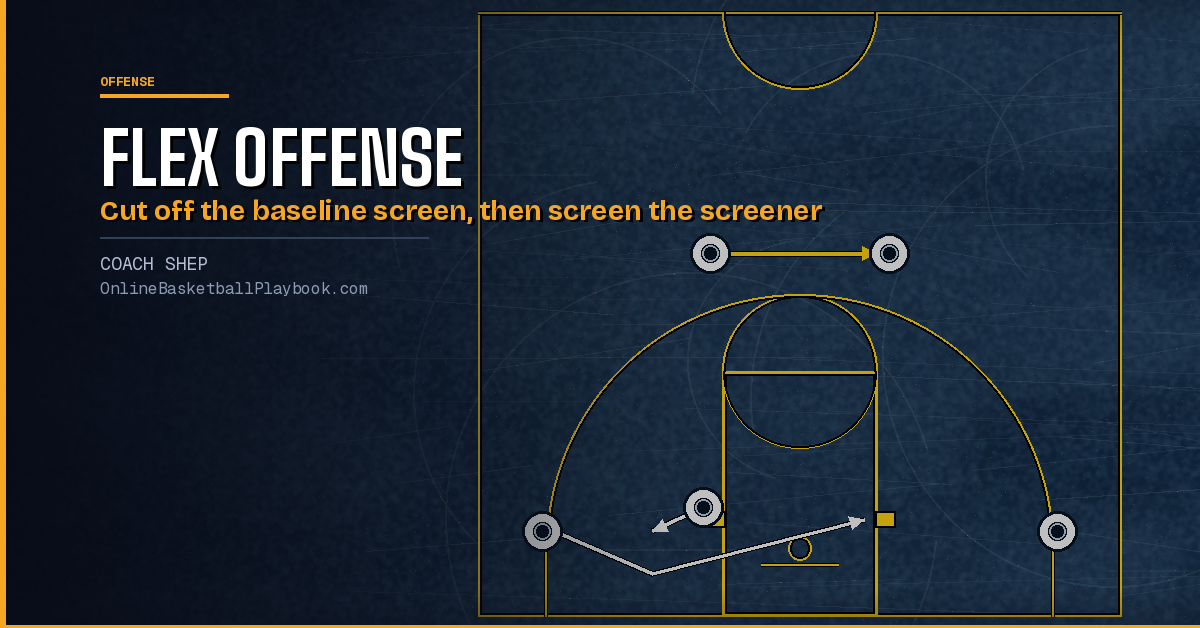
Flex Offense Basketball: Cuts, Sets, Counters and Drills
Flex offense basketball in full: the flex cut and down screen, seven after-cut options, eight starting sets, counters for denial and switching, and install drills.
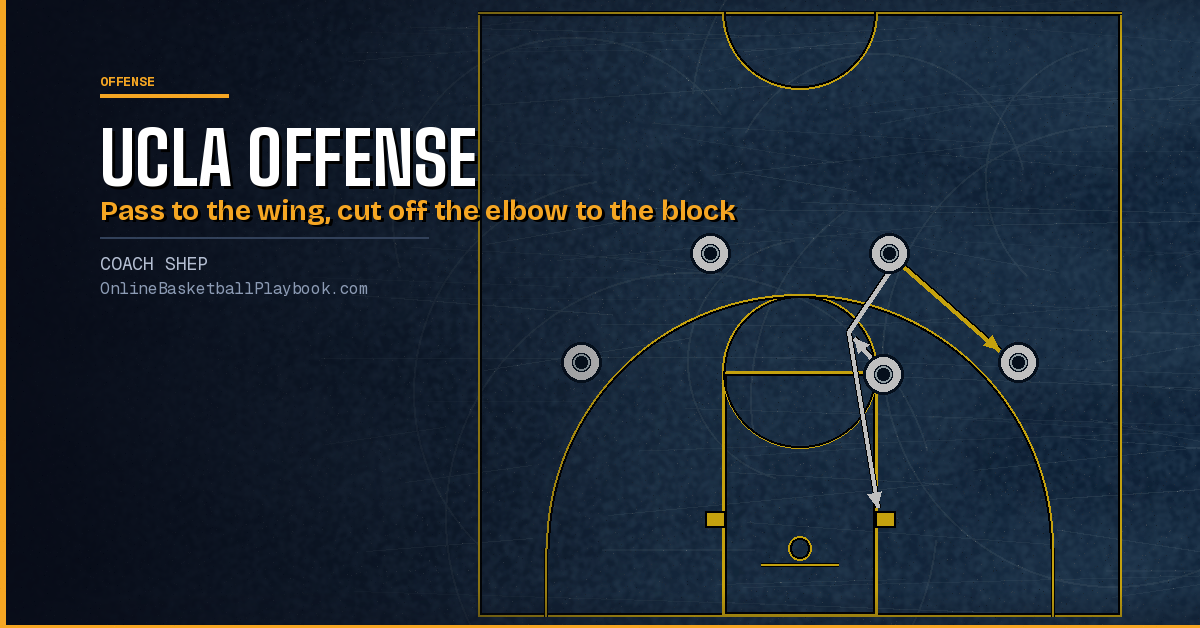
UCLA Offense Basketball: UCLA Cut, High Post Series and Counters
UCLA offense basketball in full: what a UCLA cut is, the 2-3 high and 1-4 high starts, reads off the cut, denial counters and the high-low version.
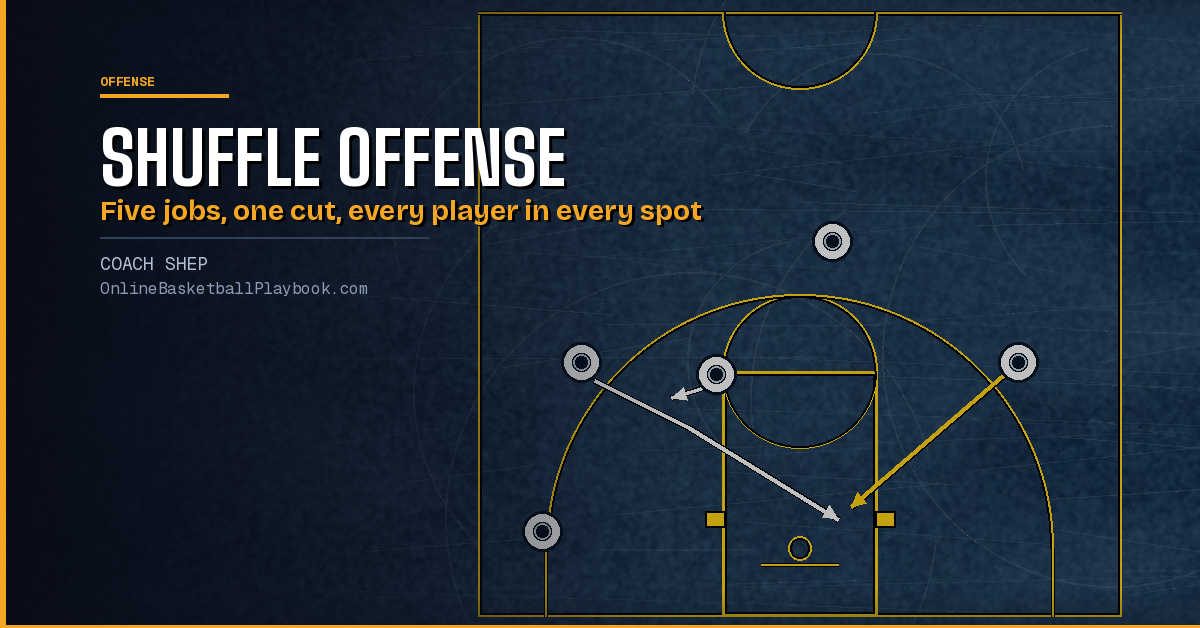
Shuffle Offense Basketball: Shuffle Cut, Rotation and Counters
Shuffle offense basketball in full: the five spots and their jobs, the shuffle cut, the rotation, counters for denial and fronting, zone versions and drills.