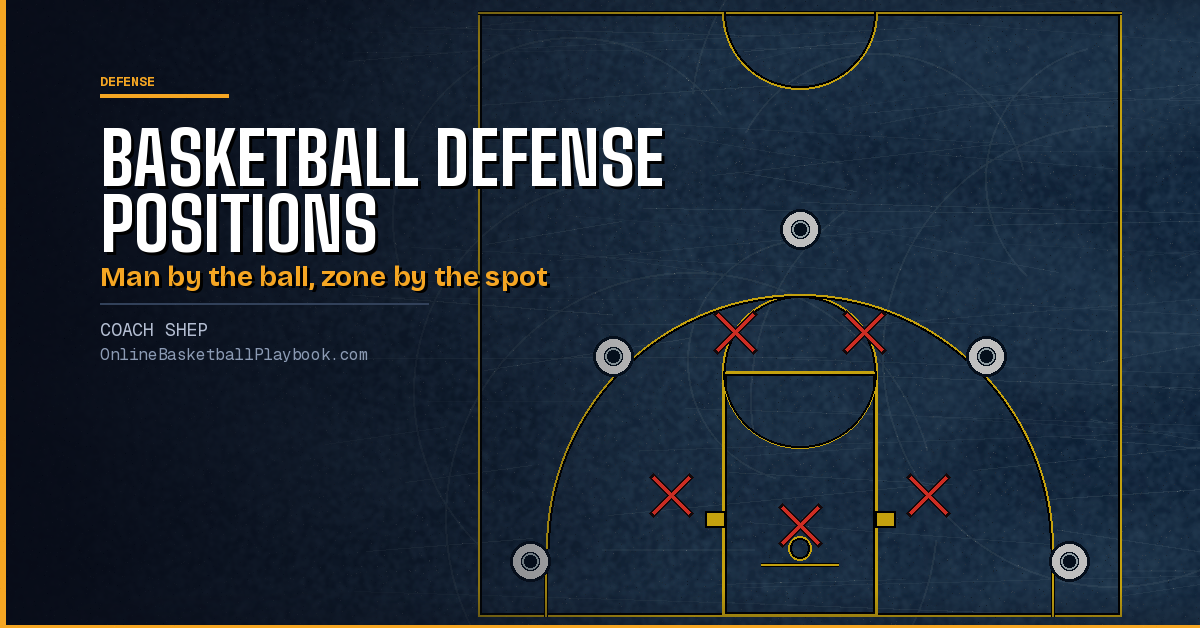
Basketball defense positions work differently from offensive positions. On offense a player is a point guard, a wing or a post wherever the ball is. On defense, where a player stands depends on the defense. In man-to-man each defender guards one opponent, and the ball decides where he stands in relation to that man. In a zone each defender owns a spot on the floor, and the spot decides who should play it: the quickest players on top, the rebounders and the biggest player at the back. This guide goes through the defensive positions in man-to-man, in each common zone, in transition and in a press. The offensive positions are on basketball positions explained.
Defensive Positions in Man-to-Man
Man-to-man gives every defender one opponent, but he does not stand next to that man. The ball organizes all five. One defender pressures the ball, and the other four sit on or near the line between their man and the ball, closer to the ball the farther their man is from it. Ettore Messina names the most common mistake as standing between your man and the basket instead of between your man and the ball.
| Position | Where the defender stands |
|---|---|
| On the ball | Pressures the ball handler, nose on the ball |
| One pass away | Up the line toward the ball, either denying the pass or sagging into the gap (see the two versions below) |
| Two passes away | In help, with one foot in the lane, seeing the ball and his man |
| Three passes away | Deeper help, with both feet in the lane |
Some teams teach the spots by the lane like this. Others teach a line from the ball to the man, with the one-pass-away defender halfway along it and two steps off it. Every pass moves all four off-ball defenders. They jump toward the ball while the pass is in the air, so they are in position before the catch. The full set of off-ball rules is on ball you man defense.
The biggest choice in a man defense is what the defender one pass away does.


| Version | One pass away |
|---|---|
| Deny version | Contests the pass and tries to stop the ball from being reversed |
| Pack version | One defender on the ball and four inside the 16-foot line, with no denial on the perimeter |
| By opponent | Denies the wing against wing shooters and gives it up against a point guard who drives |
Mike Krzyzewski's 1988 rules deny one pass away and Dick Bennett's pack line packs the gaps.
The deny and pack versions are compared on pack line vs pressure man-to-man, and the help rules for the defenders two and three passes away on help defense basketball. A no-trap pressure man adds a position-based help rule: never help from the strong side, guards help guards and bigs stay home.
Messina builds the roster for defense first, with one true point guard, three interchangeable perimeter players and one true center. The stance and footwork for the on-ball spot are on defensive stance and the full system on man-to-man defense.
Defending the Post
The post defender's position changes with the ball, and coaches split on how far in front of the post he plays.
- Three-quarter on the high side. Dick Bennett plays the post from the high side and never full-fronts, because fronting gives up offensive rebounds. He says how you play the post decides how you play the perimeter.
- Front by ball spot. One version three-quarter fronts the post when he is two passes away and dead-fronts him with the ball on the wing. Another fronts the low post all the way once the ball drops below the free-throw line.
- Front first. Some systems make fronting the first tool.
Footwork and the double-team choices are on post play in basketball.
Basketball Defense Positions in a Zone
A zone gives each defender an area instead of a man, and the zone is only as good as the players in each spot. Who goes where changes from coach to coach. Each zone below lists its spots, the job and the type of player usually put there. When the coaches split, the table shows each version. Choosing among the zones is on best zone defense in basketball.
2-3 Zone Positions

| Spot | Job | Who usually plays it |
|---|---|---|
| X1, X2 (top) | Pressure the ball, help on the high post, take over the wing on the bump | The quickest players, moving sideline to sideline together. Athletic enough to switch with the wings |
| X3, X4 (back-line wings) | The first wing catch until bumped, the corners, the weak-side lob and skip, weak-side rebounds | Strong defensive rebounders, one always on the weak side. Quick enough to close out to the wing |
| X5 (middle) | Low post, short corner, high-post catch, the rim and the talking | Usually the biggest player, though an aggressive athlete can be very effective there |
Bob Huggins splits the 2-3 another way: the two top defenders guard every pass going away from the basket, and the back three guard every pass going toward it. One version of the 2-1-2 starts the center at the high post and needs a mobile shot blocker there, while its 2-3 can live with a slow, tall center at the rim. Rotations are on 2-3 zone defense and 2-1-2 zone defense.
3-2 Zone Positions

| Spot | Job | Who usually plays it |
|---|---|---|
| Rover (middle of the top line) | Owns the high post, picks off lobs out of traps, crashes the glass | Usually the small forward, long and athletic |
| Wings | Deny their men and trap | Usually the guards |
| Two low defenders | Guard the blocks and also the corners | The posts, who have to get out to the corners, which is this zone's unusual demand |
In the 3-2 the middle of the top line sags to the free-throw line and the wings deny, so the point guard is left alone. That is the difference from the 1-2-2, where the top defender is on the ball. More on 3-2 zone defense.
1-3-1 Zone Positions

The 1-3-1 is where coaches disagree most about personnel.
| Spot | Long-top version | Quick-top version |
|---|---|---|
| Top | A big, long point guard who denies the reversal | The quickest player, picked first, who turns the dribbler and pressures sideline to sideline |
| Wings | The best athletes, the toughest spot | Trap the corners and guard the weak-side block, picked last |
| Middle | Denies above the free-throw line, fronts below it, a hard worker more than a skilled one | Fronts the post everywhere, high and low |
| Baseline | The most aggressive player, a guard | A smart, high-motor guard, often the point guard, who covers both corners |
Other teams put the point guard on top to direct the ball and play the center on the baseline, or keep a big at the rim while the wings cover the corners.
One version picks the roles in this order: the top first, then the middle, then the baseline, then the wings. Traps and rotations are on 1-3-1 zone defense.
1-2-2 Zone Positions

| Spot | Job |
|---|---|
| Top defender | The key player, athletic and smart. Steers the dribbler to a side, then denies the high post when the ball is anywhere else |
| Wings | Protect the high post with the ball on top, guard the ball on their wing, and sag, deny or trap when the ball goes to their corner |
| Posts | Protect the paint and the block, rebound and guard the ball in the corners. The ball-side post fronts on the wing pass |
A variation keeps both bigs at the basket and lets the wings scramble to the corners, only against poor shooting teams. Another slides the top defender down to front the post when the ball goes to a corner, so the best athlete stays between ball and basket. See 1-2-2 zone defense. A match-up zone uses the same shells with man rules inside. In one version the point defender sets the match-ups and everyone matches off him. In another the rotation keeps the bigs inside and the smaller players outside. See how to coach the match-up zone.
Get the next coaching guide in your inbox
One email when a new guide or diagram set goes up. Free.
Positions in Transition Defense
The first defensive positions of a possession are taken while the offense is still shooting. The get-back assignment is set before the shot, and it is given out two ways.
- By jersey number. The 1 is a free safety who meets the outlet, the 2 and 3 sprint the sideline lanes, the 4 takes the inside lane and any trailer, and the 5 sprints to the paint and takes the first cutter.
- By arrival. The first man back goes under the basket, then closes out. The second goes to the free-throw line to stop the ball. The third takes the closest open man near the ball, the fourth the basket, and the fifth the free-throw line.
Tom Izzo sends four to the offensive glass and keeps only the point guard back at half court. Dick Bennett sends the point guard to the opposite free-throw line and the off guard to half court, and a shooter back too against athletic teams. The rest of the get-back rules are on transition defense basketball.
Positions in a Press
A press names its positions by line: a front line, a middle line and a back line, with jobs like trapper, interceptor and safety. In a 2-1-2 press, the front line is the two guards, the middle is the most agile player and the back line is the two tallest. In one 2-2-1 the second line is the two bigs and the last man is the best anticipator. Others keep the slowest big at the back. Each press's positions are on its own page: 2-2-1 press, 1-2-1-1 diamond press, 2-1-2 press, and the words on the press terminology guide.
Questions Coaches Ask
What are the defensive positions in basketball?
In man-to-man they are set by the ball: the defender on the ball, the defender one pass away, and the help defenders two and three passes away, plus the post defender. In a zone they are the spots of the zone, such as the two top defenders, the two back-line wings and the middle of a 2-3.
Where should my best defender play in a zone?
It depends on the zone. In a 1-2-2 the top defender is the key player. In a 3-2 the rover owns the high post. In a 1-3-1 coaches put their quickest or longest player at the top or the baseline, and they disagree on which.
Where does the center play on defense?
In man-to-man he guards the other team's post, three-quarter fronting or fronting by the defense's rule. In a 2-3 he plays the middle at the rim. In a 2-1-2 he starts at the high post, and in a 1-3-1 the big may play the middle or the baseline.
What is the difference between man-to-man and zone positions?
In man-to-man a defender follows one opponent and positions himself by the ball. In a zone he guards an area and whoever enters it. Both systems are compared on man-to-man vs zone defense.
Who guards the point guard in a zone?
In a 1-2-2 the top defender picks him up and steers him to a side. In a 3-2 the point guard is left alone while the top line denies the wings and the high post. In one match-up zone the point defender takes the guard on the left against a two-guard front, and everyone matches off him.
Want every diagram, printable?
OBP Pro members get the full diagram files for every rule, defense and press on this page, ready for a practice binder or a team meeting. $9 a month. Or draw your own version free in the play drawer.
See what OBP Pro includesMore Guides From This Batch
- Basketball Timeout Rules: Length, Number and Signals by Level
- Basketball Coach Resume: What to Put on It and What Gets Read
- 2-1-2 Press: Setup, Traps and Rotations of the Full Court Press
Back to Types of Defense and every Defense page.
Keep Building
Related breakdowns
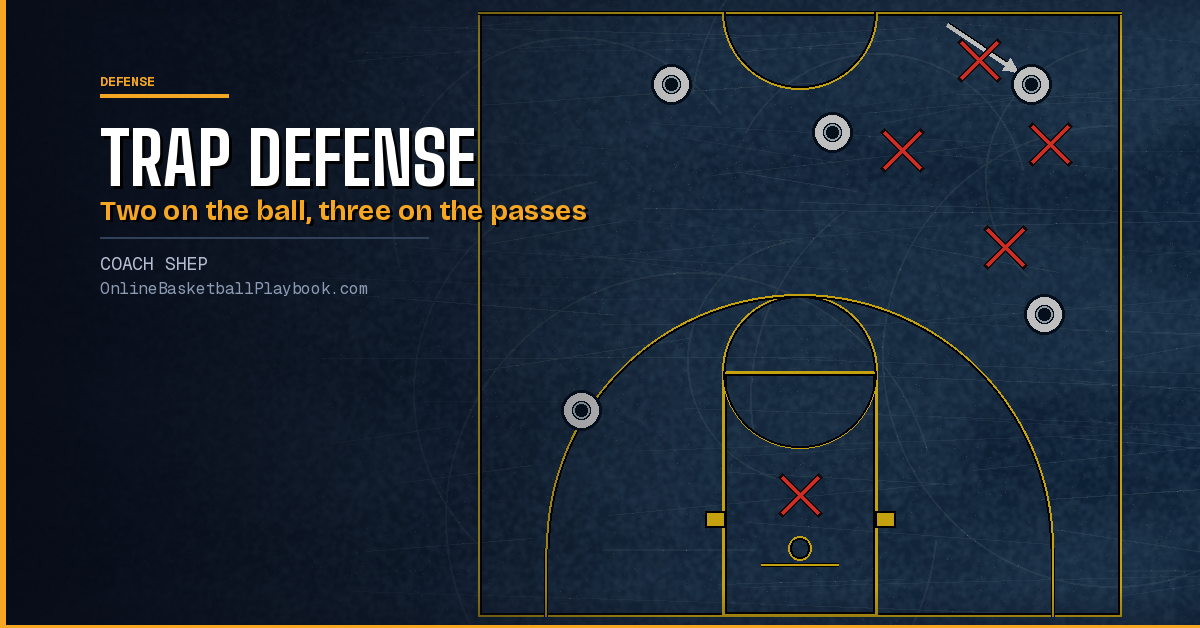
Trap Defense Basketball: When, Where and Who to Trap
Trap defense basketball explained: how two trappers close, when to spring the trap, the spots on the floor, the interceptors and goaltender, and every version.
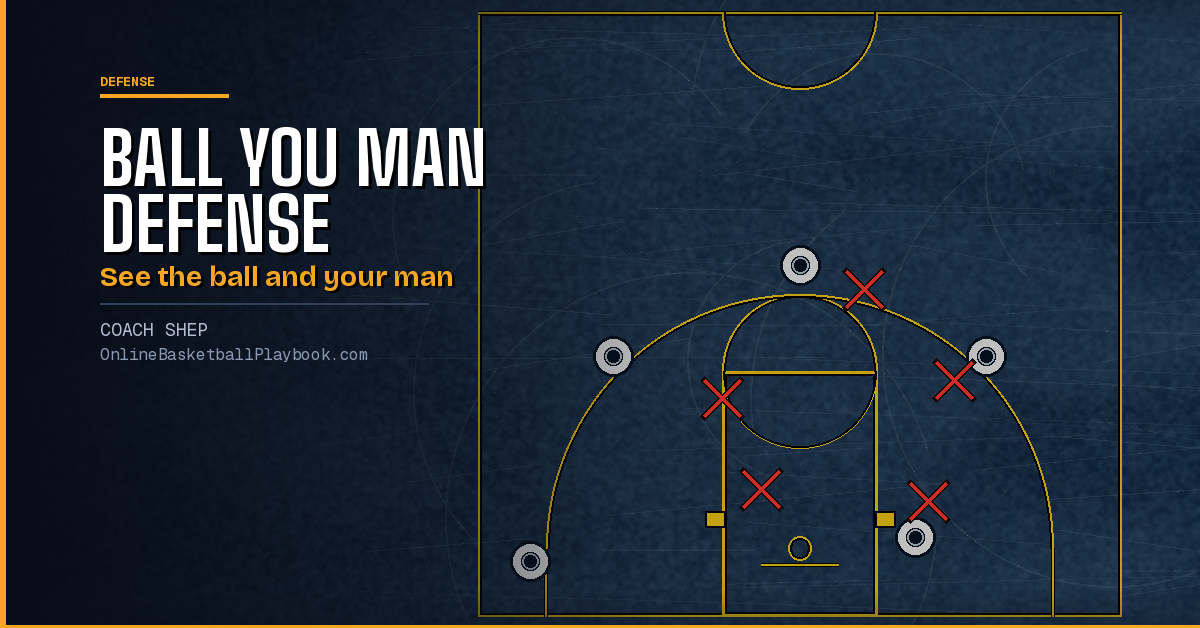
Ball You Man Defense: Off-Ball Positions by Passes Away
Ball you man defense explained: the triangle between ball, defender and man, positions one, two and three passes away, and the pressure and pack line versions.
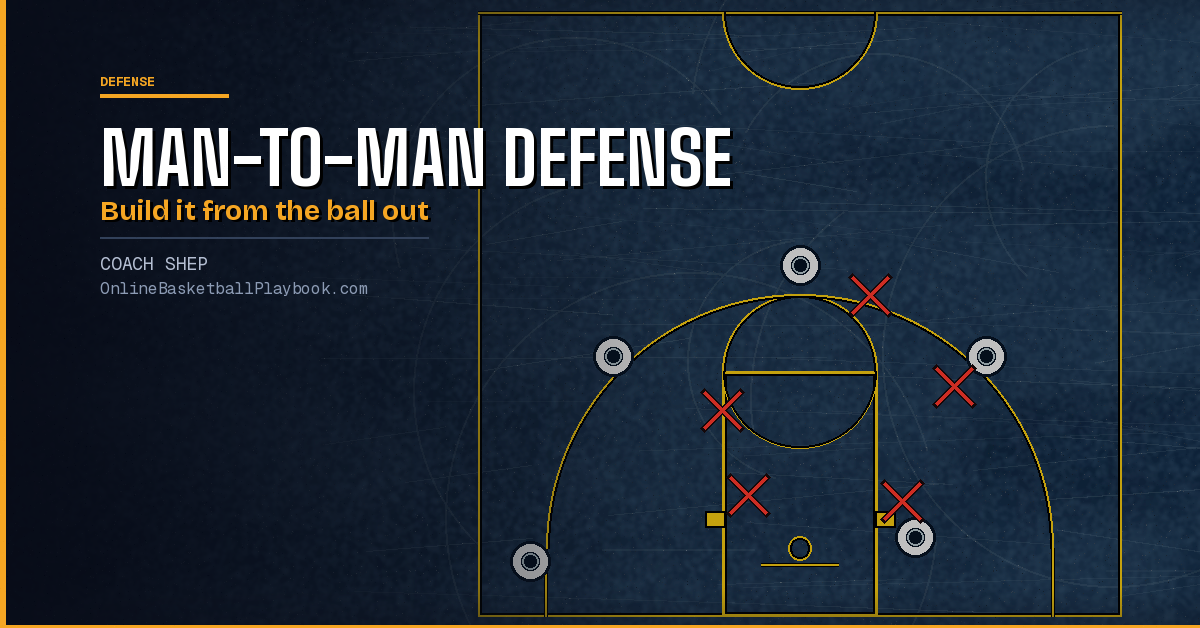
Man-to-Man Defense: Stance, Positioning, Help and Drills
Man-to-man defense starts with the ball-you-man line. Build it in order from the on-ball stance to one pass away, help and rotation, screens and the shell drill.