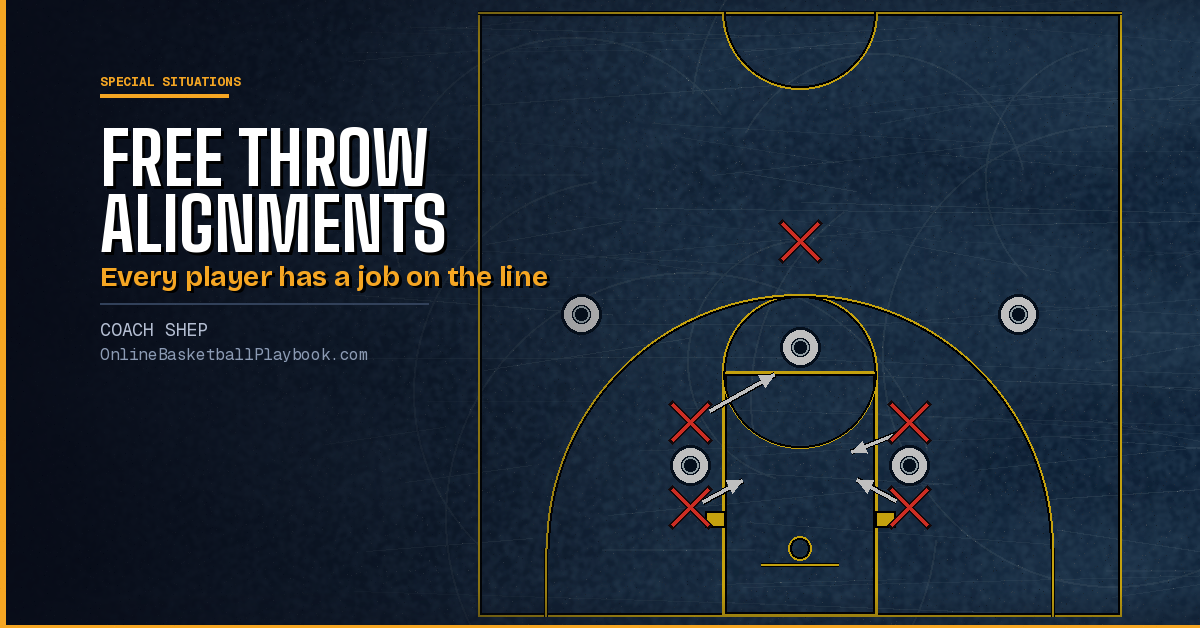
Free throw alignments are the spots and jobs every player takes when a free throw goes up: who stands in which lane space, who boxes out whom, who crashes, who gets back and who runs the break. An offensive rebound off a missed free throw is a big play, and championships are lost when a team does not box out on a free throw. This page sets out the lane rules by level, then the defensive and offensive alignments, the push after the shot and the intentional miss, each version side by side. It sits in the special situations section.
Free Throw Alignments in Basketball Start With the Lane Rules
Every alignment on this page has to fit the lane rules of the level you coach. They differ more than most coaches expect.
| Level | Lane spaces | Lane players may move | Everyone else may move |
|---|---|---|---|
| NFHS (high school) | Two shooting-team players and four opponents. The first marked space on each side goes to the opponents, the second to the shooting team, the third to the opponents. One player per space. (2017-18 book text, current wording not verified.) | When the shooter releases the ball (since 2014-15). They may not enter the semicircle until the ball touches the ring. | When the ball touches the ring (2017-18 book text). Until then they stay behind the free-throw line extended and the three-point line. |
| NCAA men and women | Up to six: four opponents and two shooting-team players. The two spaces closest to the end line stay open. The first space above the block on each side is an opponent's, the second the shooting team's, the third an opponent's. | When the shooter releases the ball | When the ball strikes the ring, flange or backboard, or the free throw ends |
| NBA | Opponents fill the spaces nearest the end line, the shooting team the next ones, and only one third space may go to an opponent. Lane players may not drift more than 3 feet off the lane line before the release. | When the shooter releases the ball | When the shooter releases the ball. Until then they stay behind the three-point line above the free-throw line extended. |
| FIBA | Rebound places are held alternately. The number per side is shown only in a rulebook diagram we could not read, so check the book. | When the ball leaves the shooter's hands | When the free throw ends |

Two more rules shape the miss. The shooter has 10 seconds at the NCAA and NBA levels (and in the 2017-18 NFHS text) and 5 seconds in FIBA. Every rulebook we checked requires the free throw to go in or touch the ring (the NFHS line comes from the 2017-18 book). In the NCAA, the shooter may not break the plane of the line until the ball strikes the ring, flange or backboard. The violations and their penalties by level are on basketball free throw rules. For any high school rule not listed here, check your state association rulebook.
Defending the Free Throw: Box Out Versions
At the NFHS and NCAA levels the defending team holds the spaces nearest the basket. Coaches differ on footwork, on timing and on who takes the shooter.
| Spot | Version | Technique |
|---|---|---|
| Every lane space | Feet together | Feet together, not staggered, so the step is longer. Step up the lane, not into it, hands at elbow height, and call out that the shooter is boxed. On the first of two shots, relax so you do not commit a lane violation. Once inside, do not get pushed too far under the basket. |
| Low spaces | Version 1, slide on the rim | As the ball hits the rim, slide a foot into the lane and block the man beside you. |
| Low spaces | Version 2, Bruce Weber's turned stance | Before the shot, turn with the bottom foot off the lane line, never both feet on it, weight on that bottom foot, elbows at shoulder height and the top foot as close to the offensive player as you can get. When the ball hits the rim, slide the top foot into the lane in front of him and keep the arms up, because a lowered arm invites a swim move. |
| Low spaces | Version 3, box out the two offensive players | The two lowest defenders box out the two offensive players and nobody else. |
| Top spaces | Version 1, pinch from above | One defender steps hard into the middle to pinch the best offensive rebounder from above, and the other boxes out the shooter. |
| Top spaces | Version 2, the better rebounder crashes | The better rebounder of the two crashes, and the other boxes out the shooter. |

The timing in Version 1 and Version 2 is the slide as the ball reaches the rim. Lane players may legally move on the release at the NFHS, NCAA and NBA levels, so the slide is a coaching choice, not a rule. The footwork for a box out in general is on box out basketball.
The Pinch on a Great Rebounder
Against one great offensive rebounder, pinch him. The two defenders on either side of him stand with feet together and hands at elbow height, then step together the instant the ball leaves the shooter's hand. Put as many defenders on the lane line as the rules allow, so the pinch can happen on both sides at once.

Its early push alignment has a pinch version too. Two defenders pinch a strong rebounder, and a third dives in to box out the shooter. The rest of that alignment is in the push section below.
Shooting Team: Rebound or Get Back
The shooting team holds only two lane spaces at the NFHS and NCAA levels. The offensive rebound on a free throw is anticipation and hustle, not size, and it comes with two team calls.
- Cross. 5 screens across for 4, who flashes to the opposite side, and 5 boxes out the smaller defender.
- Duck. 5 sets a back screen up the lane for 3, who cuts to the basket.

The individual counters: spin to the baseline if the defender blocks you in the lane, swim over his arm if he blocks you low, and if neither works, tip or slap the ball out to a guard. A free-throw rebounding drill runs on the same choice, cross or spin and tip it out.
How many go to the glass is a program choice. One version sends two guards up the floor, calls "X" on the release for the offensive rebound, and uses a spin to the baseline as its change-up. The rest of the crash-or-get-back question is on how to defend the offensive rebound.
The Push Off a Free Throw
Turn the free throw into a fast break. A clean box out is what makes the break possible. Its base alignment, for the team defending the free throw:
- The two strongest rebounders take the baseline spaces, and the one on the right is the inbounder after a make.
- The shooting guard boxes out the shooter.
- The point guard and the other wing hold the three-point line, ready to push or to match up if the other team gets the rebound.
On a make, the inbounder takes the ball out fast and throws to the point guard, the wing screens for the point guard and then runs the left lane, the shooting guard runs the right lane after his box out, the other big sprints to post up on the ball side, and the inbounder trails. On a miss, the rebounder outlets to the point guard and trails, and the same lanes fill. If the point guard's defender fights through the screen or the defense denies the inbound, the point guard reverses direction, and the inbounder can throw over the top. A quick hitter off a make sends the inbound to the wing near half court, the point guard cuts diagonally to the ball-side free-throw line extended, and the wing passes ahead and cuts to the basket.
The free throw quick strike that runs on a make or a miss, with players taking set spots: an outlet with heels on the sideline, a runner to half court, a rim runner and a runner to the deep corner. It also has three sets credited to Michigan State that start after a made free throw. The full transition picture is on fast break and transition offense.
Get the next coaching guide in your inbox
One email when a new guide or diagram set goes up. Free.
The Intentional Miss
Down two with one shot, or down three with two shots and the first one made, a team may need to miss on purpose and score the rebound. Treat it as a skill to practice with assignments set in advance. The ball must hit the rim, and the shooter cannot cross the line until it does.

The versions side by side:
| Version | Situation | The plan |
|---|---|---|
| Miss left, bust to the middle | 2 to 3 seconds left, down 2 with one shot, or down 3 with the first of two made | Miss off the left side of the rim. 4 busts to the middle so X4 must box out hard and X3 comes to the middle. 2 sprints to the left side of the rim for the putback. |
| Screen the box-out man | Down 2, about 1.2 seconds, must miss and score | Attack the gap in the lane that no defender covers. Screen the box-out man and slip behind him for the rebound, but wait until the ball leaves the shooter's hand to avoid a lane violation. Assign someone to the long rebound off the back of the rim. |
| Hit the rim | Any late miss | Practiced, assigned in advance, and the ball must hit the rim. |
Check your level's timing for the player coming from the wing. At the NCAA level he must stay behind the free-throw line extended and the three-point line until the ball strikes the ring, flange or backboard. In the NBA, everyone may move on the release. Clock rules for the rebound and the timeout after it are on basketball clock management.
Late-Game Free Throw Situations
- Defend the miss. The defensive rebound after a missed free throw matters most late in a close game, when the other team is fouling on purpose. Most last-second games are decided on putbacks.
- Down 1, the opponent shooting. Jay Wright's notes say that if the opponent misses with 3 to 5 seconds left and his team has no timeout, the rebound must be secured first.
- The designated shooter. Develop a designated free throw shooter like any other role. Another version names a special teams unit in advance, including the best free throw five.
- The possession arrow. Don Meyer would double-violate a free throw to win the possession arrow. In the NCAA, a double free-throw violation goes to the alternating-possession arrow unless another free throw or a throw-in follows.
- Calls during the opponent's free throws. In one pro version, most plays are called while the opponent shoots free throws.
The plays for the last seconds that follow a free throw are on last second basketball plays.
Practicing Free Throw Alignments
Drill the box out before live free throws and install the push off a free throw as its own drill, with assignments for a make and a miss. Practice the intentional miss for the end of games, including the rule that the ball has to hit the rim. Shooting drills that end at the line are on free throw drills, the shot itself on free throw shooting, and box-out drills on box out drills and rebounding drills.
Questions Coaches Ask
Who gets the low block spots on a free throw?
At the NFHS and NCAA levels, the defending team takes the first space on each side and the shooting team the second. In the NCAA, the two spaces closest to the end line stay empty, so the first occupied space is the one above the block.
When can players enter the lane on a free throw?
Lane players may move on the release at the NFHS, NCAA and NBA levels, and in FIBA when the ball leaves the shooter's hands. Players outside the lane wait longer at most levels: until the ball touches the ring in the 2017-18 NFHS text, and until it strikes the ring, flange or backboard in the NCAA.
How many players can line up on the free throw lane?
Six in the NCAA, and six in the 2017-18 high school text, four opponents and two from the shooting team. In the NBA the count works out to five by our reading, because only one opponent may take a third space.
How do you intentionally miss a free throw?
Hit the rim, because a ball that misses the rim is a violation, and stay behind the line until it hits. The miss-left version misses off the left side of the rim while a wing sprints to that side for the putback.
Who should box out the free throw shooter?
Versions differ. Two versions assign a top-space defender. Another alignment has the shooting guard box out the shooter.
Want every diagram, printable?
OBP Pro members get the full diagram files for every special situation, practice block and defensive look on this page, ready for a practice binder or a bench card. $9 a month. Or draw your own version free in the play drawer.
See what OBP Pro includesMore Core Coaching Guides
- Last Second Basketball Plays: Full Court, 3/4 and Side Out
- Jump Ball Plays and Alignments: Opening Tip and Defensive Looks
- How to Run an Effective Basketball Practice: Plan, Pace, Score
- Defensive Identity Basketball: Choosing What Your Team Will Be
Back to Special Situations and every Special Situations page.
Keep Building
Related breakdowns
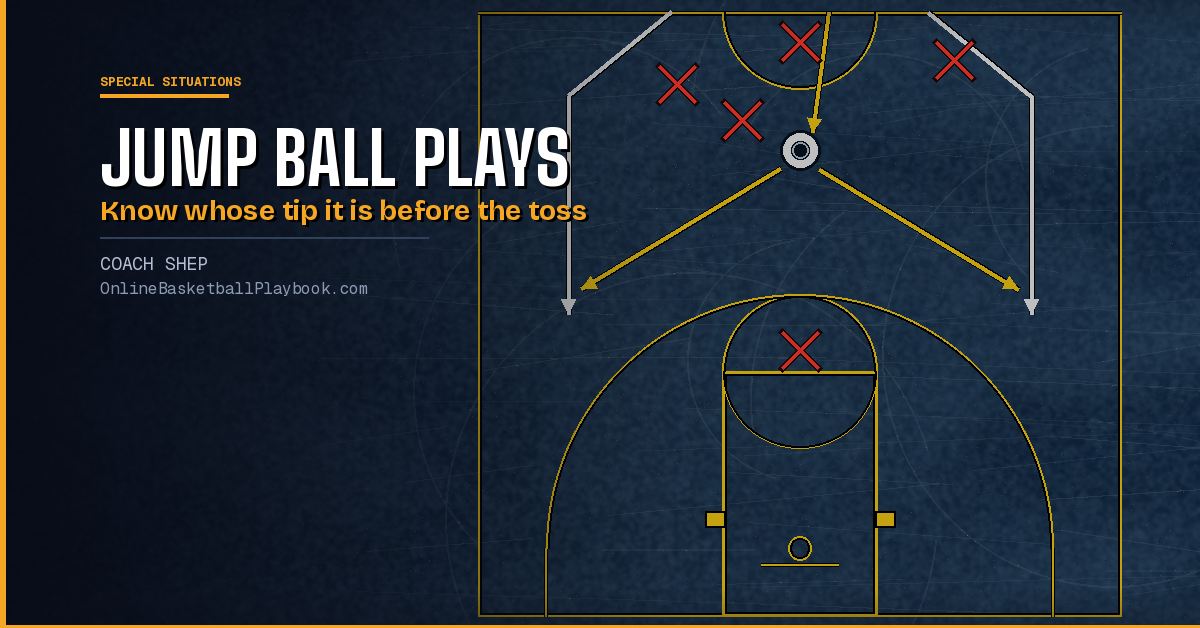
Jump Ball Plays and Alignments: Opening Tip and Defensive Looks
Jump ball plays and tip off positions: box and diamond alignments, opening tip plays with a height edge, defensive and even tips, and the rules by level.
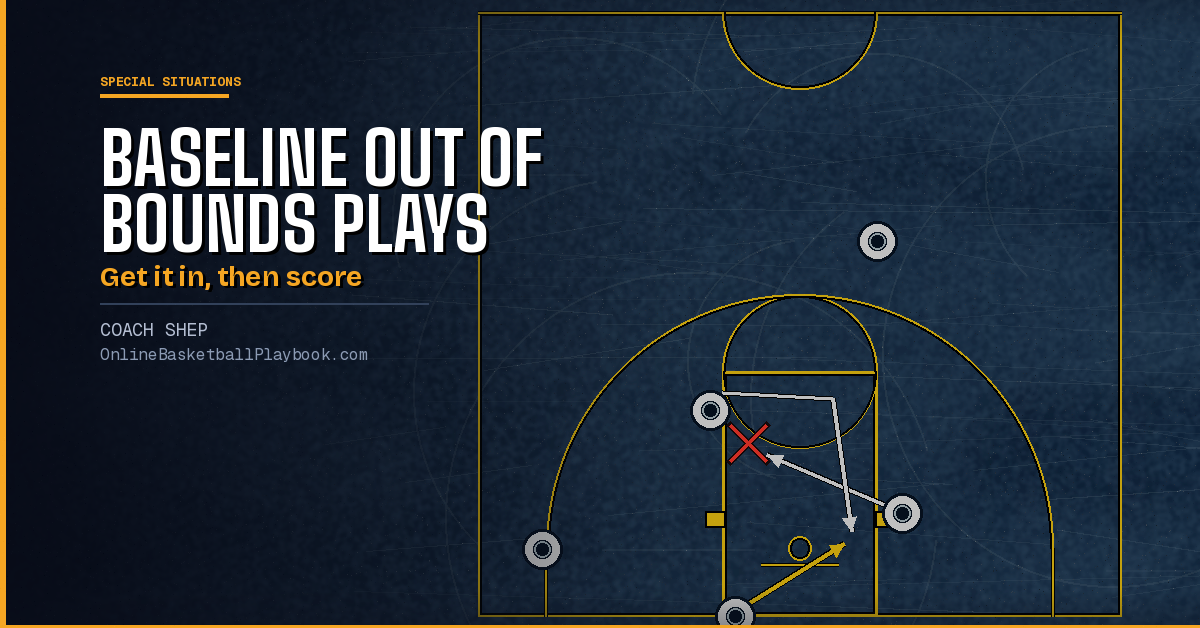
Baseline Out of Bounds Plays: Sets vs Man, Zone and for Youth
Baseline out of bounds plays drawn step by step: a box back screen and roll, Pick the Picker, the double stack, a 2-3 zone play, youth one-pass plays, the rules and the reads.
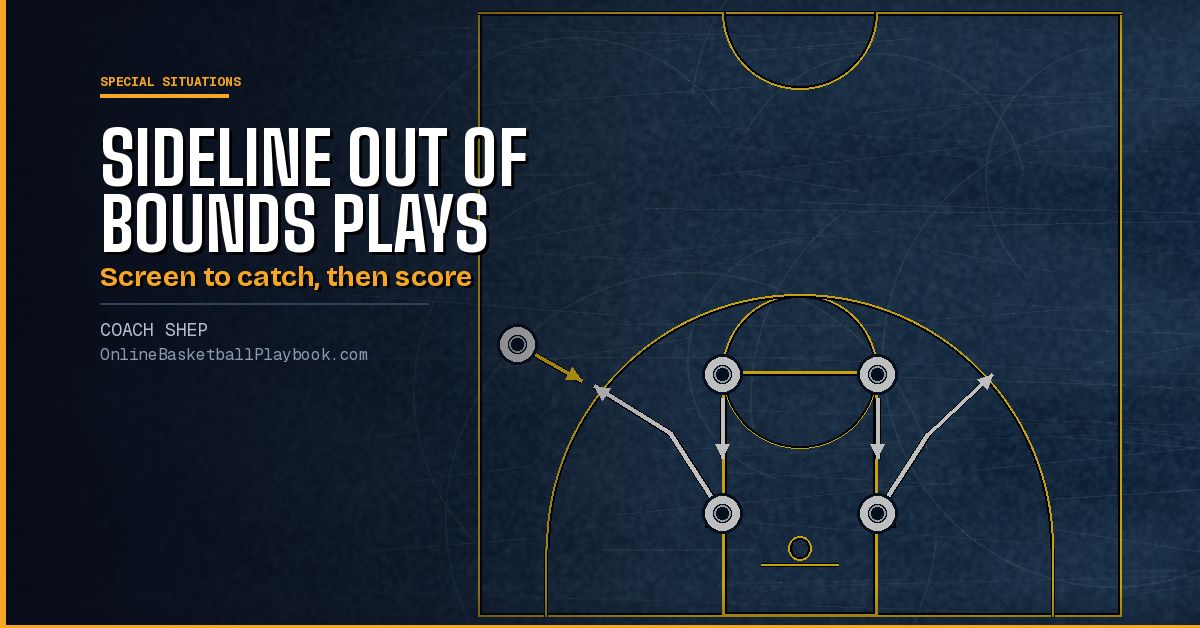
Sideline Out of Bounds Plays: SLOB Sets, Reads and Practice
Sideline out of bounds plays for coaches: SLOB sets from a box, stack and line, the inbounder's reads, plays against zone and denial, the clock and practice.