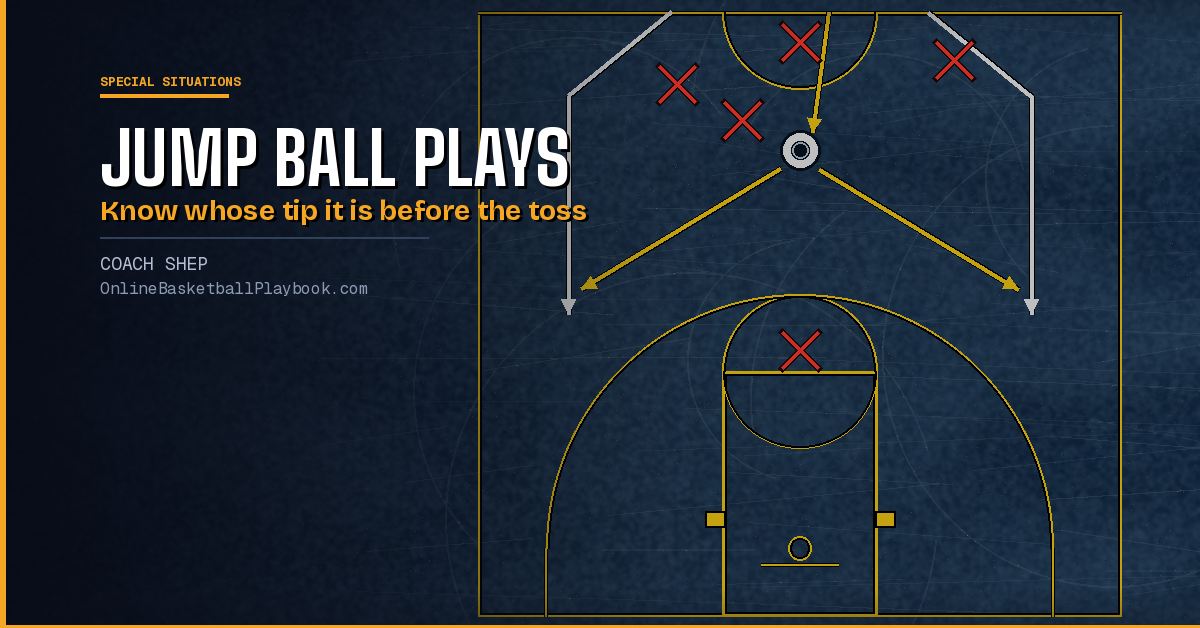
Jump ball plays are the alignments and set plays a team uses when the referee tosses the ball at center court, most often on the opening tip. Every jump ball falls into three cases: the other team will almost surely win it, it is even, or your team will almost surely win it. Each case gets its own tip off positions. This page covers those alignments and the plays that come out of them, side by side by version. The rules themselves (violations, re-jumps, the possession arrow) are on basketball jump ball rules. This page is about where to stand and what to run. It sits in the special situations section.
Jump Ball Plays Start With Three Cases
| Case | What it means | The plan |
|---|---|---|
| Defensive jump ball | The other team has a clear height or jumping edge | Move and rotate early, deny the forward tip, and keep one or two players back |
| Even jump ball | Either team could win it | Treat it like an offensive rebound: box out, anticipate and rotate on a signal |
| Offensive jump ball | Your team has an edge of about 6 inches or more, or a clearly better jumper | Run a set jump ball play, tip forward to your tallest player and keep defensive balance |
How much the tip is worth splits coaches. Under the possession arrow, winning the opening tip barely changes the possession count, because the team that loses it gets the next jump ball situation. One version still runs a tip play with a real edge, for the early layup and because one extra possession can decide a close game. Without an edge, that version lines up to defend, sometimes with two guards back. Another says a tip play is worth practice time only with a real height or leaping advantage.
What the Rules Allow at Each Level
Whether a tip play is worth running depends on what follows the tip at your level, and on where players may stand.
| Level | When there is a center jump | Later jump ball situations | Spots around the circle |
|---|---|---|---|
| NFHS (high school) | Check your state association rulebook | A re-jump must be by the players involved, before team control. Otherwise, check your state association rulebook. | Check your state association rulebook |
| NCAA men | The start of the game and each extra period | Possession arrow. The team that did not control the opening tip gets the first arrow. | Teammates may not take adjacent spots if an opponent asks for one. After the toss, players may move around the circle without breaking its cylinder. |
| NCAA women | The start of the game and each overtime | Possession arrow. The second, third and fourth quarters start with the team that holds it. | Same as NCAA men |
| NBA | The start of the game and each overtime, between any two opponents | No arrow. A held ball is a jump ball between the two players involved, and the opening tip also sets who inbounds to start each later period. | No adjacent teammates if an opponent wants a spot, and nobody directly behind an opponent on the circle. The player whose basket is nearest picks his spot first. |
| FIBA | The start of the game only | Possession arrow for every later jump ball situation, including the start of each quarter after the first and every overtime. The team that did not gain first control gets the first arrow. | No adjacent teammates if an opponent wants a spot, and nobody on or over the circle line before the tap |
Two more rules shape the plays. At the NCAA level, each jumper stands in the half of the circle nearer the basket his team defends. In the NCAA, a player more than 3 feet outside the circle is not bound by the circle restrictions. And the game clock does not start until the ball is legally tapped, at the NCAA, NBA and FIBA levels. The violations (catching the tip, tapping it more than twice, leaving early) are listed on basketball jump ball rules and basketball violations list.
Tip Off Positions: Box and Diamond
There are two shapes around the circle. A box puts two players on the front corners of the circle and two on the back corners. A diamond puts one in front, one behind and one on each side. When the two teams alternate spots around the circle, a box on one side leaves the diamond spots for the other.

Each shape has a defensive job. In a box, the two players in front take strong positions to deny and disrupt a forward tip, and the other two read the tip and rotate into the open spots. In a diamond, the two players in line with the baskets hold those spots and the others box out. Watch the jumper's eyes and hand, because jumpers usually show where the tap is going. Most right-handed jumpers tip forward to their left and most left-handers forward to their right. Stay in contact with the jumper after the tip, since many jump ball plays use him.
Offensive Tip Plays
With an edge, the play can score in seconds. The opening tip play puts the strong post on the offensive side of the circle, two quick players wide on the half-court line and one player back for safety.

4 can pivot and pass, or redirect the tap in one motion. 4 and 5 trail as safety valves, and if the other team wins the tip, everyone sprints back. The timing risk: guards who leave too early can be called for a violation, which gives the ball away. The call is rare and the cost is an ordinary inbounds play. For youth teams the caution is firmer: the guards must not release before the tip.
Other offensive tip plays, side by side:
| Version | Play | The action |
|---|---|---|
| Tip to the tall teammate | Tap out to a cutter | 5 tips to the tallest teammate, 4, who taps or passes it out to a wing cutting to the basket. 5 tips to the side away from 4's defender. 1 and 5 stay back for balance. |
| Diamond | Guards split the jumper | 5 tips to 4, 1 and 2 split the jumper, and 4 feeds either one. 3 stays back. |
| Box | Screens for a split cut | 5 tips to 4, 1 and 3 screen for 2 splitting the post, and 4 feeds 2 cutting to the basket or kicks to 1. |
| Tip to the wing | Jumper cuts off a back screen | 5 tips straight to a wing and cuts to the basket off 4's back screen. The wing feeds 5 while the far wing spots up. |
| Tip back to the guard | Forward releases to the rim | 5 tips to 1 as 3 releases to the basket. 1 feeds 3 or drives. |
| Spread at the circle | Break back for the tip | 3 and 4 spread near the circle. 3 breaks back for the tip as 1 releases up the outside lane, and 4 back screens for 5. If 3's defender stays back, 3 dribbles into the middle for a 3 on 2. |
| Release plays | Sprint release, then a pass chain | Sprint release: as 1 breaks across for the tip, 3 sprints to the basket and 2 circles off 4's screen to fill a lane. The second: a chain of passes that ends with a give-and-go cut at the basket. 4 and 5 stay back in both. |
| Big to a rim runner | Tip to the big | The tip goes to a big, who hits a teammate sprinting to the rim for a lob or a layup. He keeps a call for a big-on-guard tip at both ends of the floor. |
| Zeljko Obradovic | Tip to the big | Tip to a big, then sprint for a layup or go straight into a pick and roll. |
| Mike Fratello | Jump ball three | The tip goes back to a named shooter who shoots best early, with a skip pass option and runners to the corners. |
Tom Izzo keeps three jump ball plays, and one pro version carries three plans: one for controlling the tip, one for an even tip and one for a steal. When the other team concedes the tip by dropping everyone back, the play is simple.

Get the next coaching guide in your inbox
One email when a new guide or diagram set goes up. Free.
Defensive Jump Balls
When the other team has the edge, get players moving and rotating early. If a violation is called, little is lost, because the defense is set when the other team inbounds. There are two alignments.
- One back. The best defender lines up back near the top of the free-throw circle to protect the basket. Two defenders box out the two opponents in front, the fourth reads the tip and crashes the open spot, and the jumper tries to tip it back long to the safety.
- Two back, the "Y." For a team facing a clearly better jumper and a set play. Two defenders stand back near the top of the free-throw circle, so the other team cannot score on a numbers advantage and has to set up. The other two crash the open spots, and the jumper tries to tip it back to either safety.

The warning: once the other team gets the ball, the stop becomes the whole job. The habits for that first possession are on transition defense basketball.
Even Jump Balls
On an even tip, treat the circle like an offensive rebound. Players box out, read the jumper and rotate early. The rotation goes one way, clockwise or counter-clockwise, on a signal set before the toss, and the signal can be as simple as a hand on the hip or the head.

Check the circle rules for your level before you install it. In the NCAA, players may move around the circle after the toss as long as they do not break its cylinder, and in FIBA no non-jumper may be on or over the circle line before the tap. The box-out footwork itself is on box out basketball.
After the Tip
Keep defensive balance on every tip play and, if the defense recovers and no good shot is there, to flow straight into a set or motion offense. The opening possession then plays like any other early possession. The break side of that is on fast break and transition offense, and the rest of the dead-ball calls (out of bounds, free throws, the last shot) are on free throw alignments and last second basketball plays.
Practicing Jump Balls
Practice the tip itself ahead of time to find the best tipper, who may not be the tallest player. Don Meyer lists jump balls with loose balls and out of bounds plays among the things practice must include so they show up in games, and his game sheet starts with a jump ball call. Tom Izzo groups jump balls with timeouts, out of bounds plays and free throws as special teams. The out of bounds rules that follow a jump ball situation are on basketball out of bounds rules.
Questions Coaches Ask
What are the best tip off positions?
Line up in a box or a diamond, chosen by whether you expect to win the tip. Against a clearly better jumper, one version keeps one or two players back near the top of the free-throw circle.
Who can jump for the opening tip?
In the NBA and FIBA, any two opponents. The NCAA books describe the jump as between two opponents in the center circle. For high school, check your state association rulebook.
Does winning the opening tip matter?
Less where there is a possession arrow, because the team that loses the opening tip gets the first arrow. One version still runs a tip play with a real edge, for an early basket and one extra possession.
Can the jumper catch the tip?
No. At the NCAA, NBA and FIBA levels a jumper may not catch the ball or tap it more than twice before it touches a non-jumper or the floor.
Can players move before the ball is tipped?
In the NCAA, players may move around the circle after the toss without breaking its cylinder. In FIBA, no non-jumper may be on or over the circle line before the tap. Check your level's book before you rotate.
Want every diagram, printable?
OBP Pro members get the full diagram files for every special situation, practice block and defensive look on this page, ready for a practice binder or a bench card. $9 a month. Or draw your own version free in the play drawer.
See what OBP Pro includesMore Core Coaching Guides
- Last Second Basketball Plays: Full Court, 3/4 and Side Out
- Free Throw Alignments in Basketball: Lane Spots and Box Outs
- How to Run an Effective Basketball Practice: Plan, Pace, Score
- Defensive Identity Basketball: Choosing What Your Team Will Be
Back to Special Situations and every Special Situations page.
Keep Building
Related breakdowns
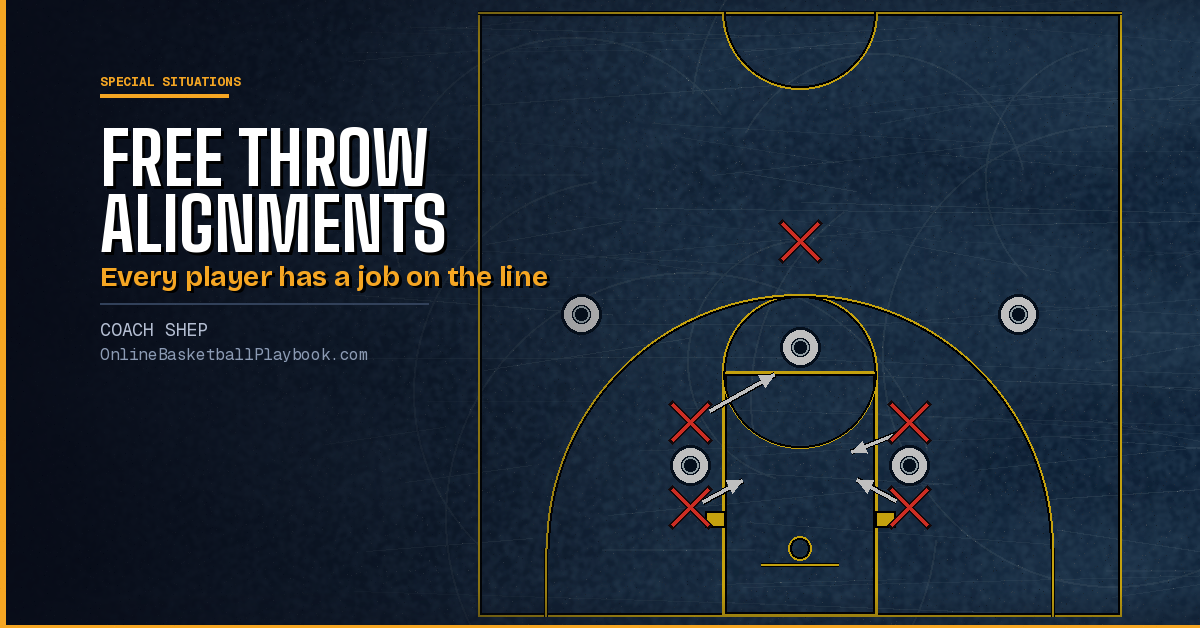
Free Throw Alignments in Basketball: Lane Spots and Box Outs
Free throw alignments basketball coaches use on both ends: lane spaces by level, defensive box outs and pinches, offensive rebounding calls and the intentional miss.
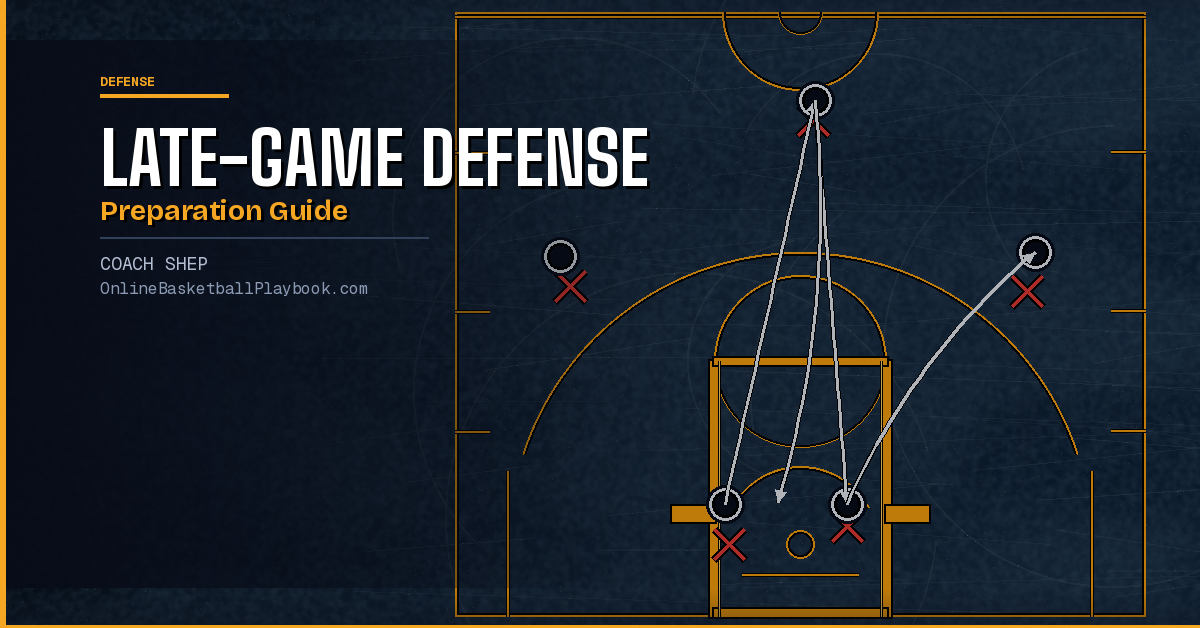
Preparing for Late-Game Defensive Situations
Preparing for Late-Game Defensive Situations