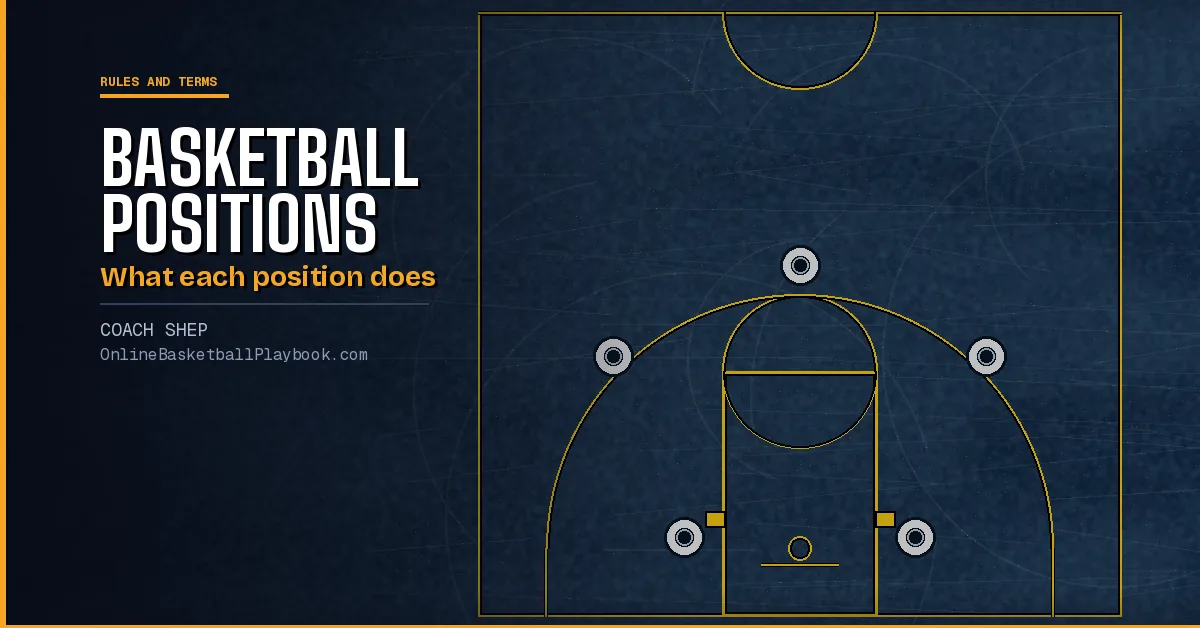
There are five basketball positions: point guard, shooting guard, small forward, power forward and center. Coaches number them 1 through 5, and those numbers show up on every play diagram and in every huddle. Each position comes with a job on offense and a job on defense. This guide covers all five, the hybrid roles that blur the lines, how positions change from one offense to the next, and how youth basketball positions work, where many coaches teach young players every position before they settle on one.
The 5 Basketball Positions at a Glance
| Position | Usually starts | Main job on offense | Main job on defense |
|---|---|---|---|
| Point guard (1) | Top of the key | Brings the ball up, runs the offense, sets the tempo | Pressures the ball handler, fights over screens |
| Shooting guard (2) | Wing | Scores from the perimeter, moves without the ball | Guards the best perimeter scorer |
| Small forward (3) | Wing | Does a bit of everything, shoots and drives | Guards whoever the matchup needs, often the best player |
| Power forward (4) | Block or elbow | Scores inside, screens, stretches the floor if he can shoot | Guards a big, rebounds |
| Center (5) | Block | Scores inside, screens, rebounds | Protects the rim, controls the defensive glass |

Point Guard (1)
The point guard is the 1 and usually the smallest, quickest player on the floor. He brings the ball up against pressure, calls and runs the offense, controls the tempo and creates shots for teammates off the pick and roll or a drive and kick. He scores when the defense gives it to him. On defense he pressures the other team's ball handler, fights over screens and talks everyone back in transition.
Basketball IQ matters more here than at any other spot, because the point guard has to read the defense, the clock and every teammate's job at once. Coaches describe three kinds: the pass-first floor general, the scoring point guard, and the combo guard who can play either guard spot. Good ones avoid crowded spots, change speeds instead of just playing fast, know where each teammate likes to catch the ball, and manage time and score late in games.
Quickness and decisions matter more than height at the 1. Drills and plays for this spot: Point Guard Play and Basketball Plays for Point Guards.
Shooting Guard (2)
The shooting guard, also called the 2 or the off guard, plays off the ball while the point guard starts the offense. He is usually the team's best outside shooter. His offensive jobs are scoring at all three levels (at the rim, midrange and three), spacing the floor, moving without the ball, running the floor in transition, and handling the ball as the second option. On defense he usually takes the other team's best perimeter scorer and fights through screens to stay with him.
The position has moved from the midrange scorer toward the shooter who catches and shoots off movement or guards and spaces the floor. Modern types include the combo guard, the 3-and-D guard, the movement shooter and the swingman who can also play the 3. A good 2 uses teammates' screens, reads when his defender overplays and cuts backdoor, and rebounds from the perimeter. More at Shooting Guard.
Small Forward (3)
The small forward is the 3 and the most versatile position. He attacks the basket, creates for teammates off the drive, shoots from the perimeter, handles the ball as a second option, rebounds from the wing and often guards the other team's best player. His defensive assignment can change every game and sometimes every possession, so he has to be comfortable guarding quicker guards and stronger forwards.
Common types are the slasher, the point forward who can run offense, the 3-and-D wing, the scorer with size and the physical wing. Most real players are a blend. For young teams, pick the 3 by skills. A wing-sized 12-year-old may end up a guard or a post. More at Small Forward Position.
Power Forward (4)
The power forward is the 4, bigger and stronger than the perimeter players but usually shorter and quicker than the center. His jobs are rebounding on both ends, guarding the other team's bigger players, scoring in the post, setting screens in the pick and roll and pick and pop, and making hustle plays like loose balls and charges.
The biggest change at the 4 is the stretch four: a power forward who can shoot from three. He pulls a slow-footed big away from the rim and opens driving lanes for the guards. That is why coaches now build range into a young 4's development instead of keeping him on the block. At the youth level the 4 is often just one of the biggest kids on the roster, and that should never be treated as permanent. More at Power Forward Position.
Center (5)
The center is the 5 and usually the tallest player. He anchors the paint at both ends. On offense he scores inside, rebounds, sets strong screens and passes out of double teams. On defense he protects the rim, controls the defensive glass, guards the other team's biggest player and runs the help defense with his voice.
Four center types show up today: the traditional back-to-the-basket center, the stretch five who can shoot from three, the small-ball center (an undersized forward playing the 5 for speed), and the point center who runs the offense from the post the way a point guard runs it from the top of the key. Every type needs two or three post moves with a counter, a reliable free throw because opponents will foul a poor shooter on purpose, and the conditioning to run the floor. Post work: Basketball Post Moves and Center Position.
Guards, Wings and Bigs
Coaches often talk in groups instead of numbers. The guards are the 1 and 2. The wings are the 2 and 3, since both usually start on the wing. The bigs, or posts, are the 4 and 5. Most practice plans that split players do it along these lines.
Several hybrid roles cross those groups:
- Combo guard: plays the 1 or the 2, can run the offense or score off the ball.
- Swingman: plays the 2 or the 3.
- Point forward: a forward who can bring the ball up and run the offense.
- Stretch four and stretch five: bigs who shoot from three.
- Small-ball center: a forward playing the 5 so the team can play faster.
What the Numbers 1 Through 5 Mean
Most coaches use the numbers as roles. The 1 is the point guard, the 5 is the center, and "get it to the 5" means get it to the center wherever he is. The numbers can also be spots in an alignment. In a 3-out 2-in set drawn that way, the 2 and 3 are the wing spots and the 4 and 5 are the two low posts, whoever is standing there. Both are common. Before you hand a playbook to a new assistant or a new player, tell them which way your diagrams read.
Spots on the Floor Every Position Needs to Know
Positions tell a player his job. Spots tell him where to stand. Coaches call them in every set and every drill, so players need both vocabularies. All spots below are drawn on a high school court. Ballside (or strongside) is the half of the floor with the ball, and weakside is the other half. Both change every time the ball moves.

- Top of the key: the top of the three-point arc, straight out from the basket. The point guard usually starts here.
- Slot: where the arc meets the line running up from the elbow. It is a common spot for a ball screen.
- Wing: the spot on the arc level with the free-throw line. The 2 and 3 usually start here.
- Free-throw line extended: an imaginary line from each end of the free-throw line out to the sideline. The wing sits on it.
- Corner: where the three-point line meets the baseline.

- High post: the area around the free-throw line. A big who catches here can shoot, pass or drive.
- Elbow: where the free-throw line meets the lane line, one on each side. On a drive, whichever side gets to the elbow first gains the advantage.
- Block and low post: the block is the small painted square just outside the lane next to the basket. The low post is the area around it, where the 4 and 5 post up.
- Paint: the lane between the lane lines, also called the key or the three-second area.

- Dunker spot: on the baseline just outside the lane, beside the rim. A big waits here while guards drive, ready for a dump-off pass or a lob.
- Short corner: on the baseline about halfway between the lane line and the sideline. It is a favorite spot for attacking a zone.
Some coaches use "short corner" and "dunker spot" for the same place. When you install an offense, draw the spot once and use one name for it all season.
Basketball Positions in Different Offenses
The offense you run decides how fixed the positions are. Some systems need a true post. Others want five players who can all pass, cut and shoot.


- 3-out 2-in: the traditional look, two bigs on the blocks and three perimeter players. See 3-Out 2-In Motion Offense.
- 4-out 1-in: one big inside. In the dribble drive motion offense that big is not a post-up hub. He sits on the weak-side block and stays out of the driving lanes. The alternative builds the offense through the post instead. That is a real split, and the best answer depends on the big you have.
- 5-out: all five outside the arc and the paint left open for cutters and drivers. It is often called the only truly positionless alignment, and many coaches recommend it as the default for youth and high school teams. See 5-Out Motion Offense.
- Blocker-Mover: the positions become two jobs. Blockers screen in the lane and Movers cut off them. Post players usually start as Blockers and the best guards and wing scorers as Movers. See Blocker-Mover Offense.
- Princeton: every spot has to pass, cut and shoot. Every player learns post and perimeter roles. A high school version keeps two roles, perimeter and post, so players specialize. See Princeton Offense.
- Flex and triangle: players rotate through every spot, so a post has to face up and a guard has to finish inside. See Flex Offense and Triangle Offense.
Get the next coaching guide in your inbox
One email when a new guide or diagram set goes up. Free.
Basketball Positions on Defense


In man-to-man defense the positions usually match up. The point guard pressures the other ball handler, the shooting guard takes the best perimeter scorer, and the power forward and center guard the other team's bigs. Switching changes that. A team that wants to switch screens needs players who can guard two positions, and some coaches build the roster around one true point guard, three interchangeable perimeter players and one true center for exactly that reason. More at Defensive Switching.
In a zone the numbers turn into areas. In a 2-3 zone two guards contain the ball up top and the center owns the paint, which is the most demanding job in the zone. Coaches disagree about who covers the high post in a zone. Some give it to the center. Others keep the center home and send a guard down. The man-to-man vs zone page covers the trade-offs.
Positionless Basketball
Positionless basketball means every player can dribble, pass, shoot and defend more than one spot, whatever position he is listed at. Small ball uses the same idea: five players with perimeter skills, whatever their height. The trend at the top levels of the game runs this way.
The case for it at young ages is simple. Nobody can predict how tall a 12-year-old will be at 18. A tall kid locked into the post at 11 can reach high school without a handle or a jump shot, and a short kid who never posts up never learns to score with his back to the basket. Players who have played both roles also understand each other: guards who have posted up make better entry passes, and bigs who have handled the ball space the floor better.
Where coaches split: some say positionless is impractical for most high school programs, because rosters are mostly specialists and the system should fit the players you have. Others design their whole team around specialists at every level. Most agree on the youth end: lower levels should learn the skills for every position. The fight is over how early and how fully to specialize after that.
Youth Basketball Positions by Age
- Ages 7 to 12: positions barely exist. Every player handles, passes, shoots, posts and guards.
- Ages 12 to 14: lean into natural tendencies, but do not lock anyone in.
- Ages 14 to 18: real specialization makes sense once body types and skills are clearer.
- Do not split practice into guard lines and post lines before high school.
- Run a positionless offense like 5-out with young teams, and play man-to-man so nobody can hide on defense.
- Use lopsided games to give players reps outside their usual role.
For more on this debate, see Youth Basketball Specialization.
Roles Beyond the Starting Five
A roster also needs roles that no position number covers. The sixth player comes off the bench to change the energy and should have the skills and leadership of a starter. The defensive stopper takes the other team's top scorer, and anything he scores is a bonus. A designated inbounder handles out-of-bounds plays, a job that is under-taught at every level. Some teams also name a designated free-throw shooter. Starting lineups can also change by opponent: an extra shooter against a zone, a stopper against a big scorer, or a better jumper to control the opening tip. Jump ball rules are on Basketball Jump Ball Rules.
Questions Coaches Ask About Basketball Positions
What are the 5 positions in basketball?
Point guard (1), shooting guard (2), small forward (3), power forward (4) and center (5). The 1 and 2 are the guards, the 2 and 3 are the wings, and the 4 and 5 are the bigs.
What does each position do?
The point guard runs the offense, the shooting guard scores from the perimeter, the small forward does a bit of everything, the power forward rebounds and scores inside, and the center protects the rim and scores near the basket.
What are the positions on a basketball team numbered?
1 through 5, from point guard to center. Coaches use the numbers on play diagrams and in calls like "get it to the 5." Some coaches use the numbers for spots in a set instead of roles.
What is a wing in basketball?
An informal name for the shooting guard and small forward together, since both usually start on the wings.
What is a stretch four?
A power forward who can shoot from three. He pulls the other team's big away from the rim and opens driving lanes.
What is positionless basketball?
A style where every player can dribble, pass, shoot and guard more than one spot. The 5-out offense is the most common positionless system.
What positions should youth basketball players play?
Every position, in most youth programs. Many coaches say not to pick one before high school. Positions barely exist from 7 to 12, tendencies can be leaned into from 12 to 14, and real specialization fits 14 to 18.
Every term used on this page is defined in Basketball Terminology, and every rules page sits under Rules and Terms. The position pages: point guard, shooting guard, small forward, power forward and center.
Want the printable playbook packs?
OBP Pro members get the premium playbook packs: the zone attack, out of bounds and practice plan PDFs, plus each new pack as it is finished. The membership page lists what is in each one. Or draw your own version free in PlayDraw.
See what OBP Pro includesMore on Positions
Back to every Rules and Terms page.
Keep Building
Related breakdowns
High School vs College vs NBA Rules: What Changes for a Coach
High school vs college vs NBA rules: shot clock, three-point line, bonus, fouling out, timeouts, backcourt count and defensive three seconds, and what each changes.
Best Basketball Positions for Short People and Tall Players
Which basketball positions fit short people and tall players, why height matters less than skills at young ages, and how undersized and tall players win their spots.