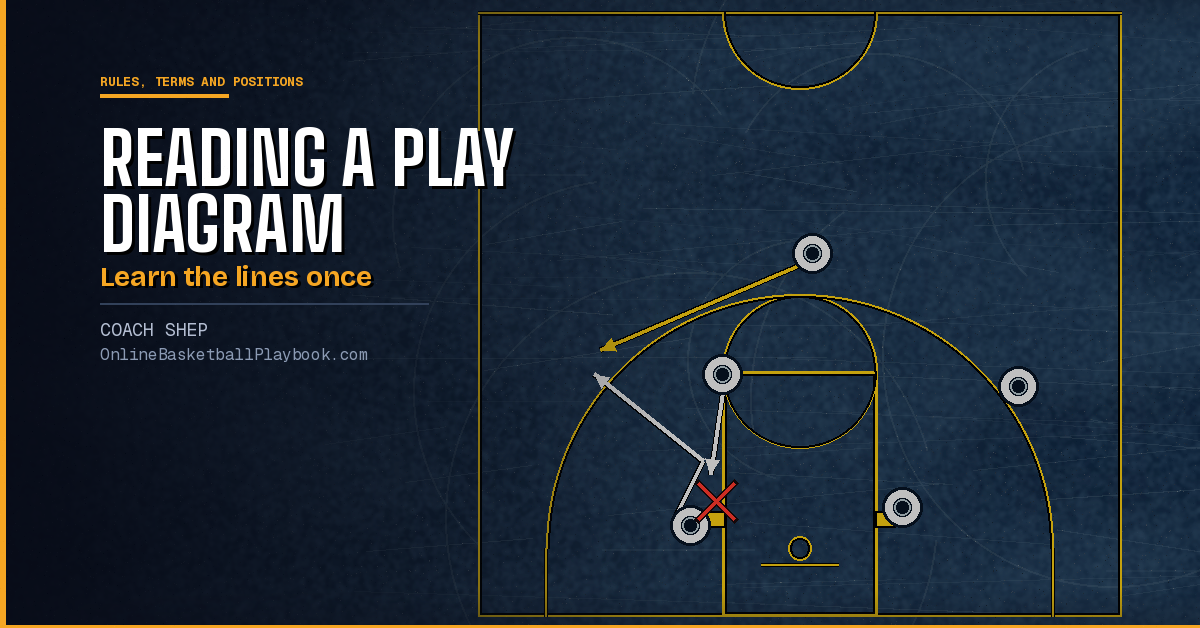
Knowing how to read a basketball play diagram turns a page of lines into a play your team can run. Every diagram uses the same small set of marks: numbered offensive players, defenders, the ball, and lines for a cut, a pass, a dribble and a screen, spread across one or more frames. This guide shows each symbol the way this site draws it, one frame per symbol, then puts them together and explains how to read a frame in order. It also covers the other keys you will meet in playbooks and clinic notes, because the marks are not the same in every source.
The Symbols at a Glance
| Mark | How this site draws it | What it means |
|---|---|---|
| Offensive player | Orange figure with a number, 1 to 5 | One player on the team with the ball |
| Defender | Navy figure labeled X1 to X5 | The defender, usually numbered to match the man he guards |
| Ball | A ball icon on one player | Who has the ball when the frame starts |
| Cut or move | Solid line with an arrowhead | A player running without the ball |
| Pass | Dashed blue line with an arrowhead | The ball moving through the air |
| Dribble | Zigzag line with an arrowhead | A player moving with the ball, including a drive |
| Screen | Brown line ending in a short crossbar | A screener moving to a spot and stopping there |
| Label | Blue box with a word in it | The name of an action, a spot or a rule |
| Spot | Yellow dot | A place on the floor a player is meant to reach |
The court is the high school court, a half court with the basket at the bottom unless the frame shows the full floor. The spot words in every caption follow one standard: top of the key, slot, wing, corner, short corner, block, elbow, nail, high post and paint. They are defined on basketball terms.
Players, Numbers and the Ball
Start every diagram by finding the people. Offense players are orange and carry a number. Defenders are navy and carry an X with a number, so X2 is the man guarding 2. The ball icon sits on the player who has it when the frame begins.

Numbers do not mean the same thing in every playbook. Three conventions are on record:
- Numbers by role. 1 is the point guard, 2 the shooting guard, 3 the small forward, 4 the power forward and 5 the center, with X1 to X5 matching. Most diagrams on this site number this way. See basketball positions explained.
- Numbers by floor spot. In a 3-out, 2-in set, 1 is at the point, 2 on the right wing, 3 on the left wing, 4 on the right block and 5 on the left block, taught to young players as evens on the right and odds on the left.
- Numbers that move by play. Some card sets and playbooks treat players as interchangeable, so the same number can be a different player on the next card.
A sheet that does not say which convention it uses leaves the reader guessing who "the 5" is. State it at the top of every play sheet.
The Cut
A solid line with an arrowhead is a player moving without the ball. The arrow points where he ends up. The same line shows a defender's path, so look at who it starts from.

Most cuts have names, such as the back cut, the curl, the flare and the UCLA cut. The cut words are in the screens and cuts section of basketball terms, and the backdoor read is on cut or backdoor.
The Pass
A dashed line is the ball in the air, from passer to receiver. On this site it is blue so it stands out from the solid movement lines.

When a play has several passes, one key puts hash marks on each pass line to number them in order. This site shows one step per frame instead, so the frame order carries the sequence. On a few rules pages, a dashed line to the rim with a label marks a shot rather than a pass, and the caption says so.
The Dribble
A zigzag line is a player dribbling. The arrowhead shows where the dribble ends. A drive to the rim is a dribble, so it is drawn as a zigzag line too. A drive drawn with a solid line would read as a cut without the ball.

Dribble moves and their names are on basketball dribbling moves.
The Screen
A line that ends in a short crossbar is a screen. The line runs from where the screener starts to where he sets it, and the bar is his body at the moment of the screen. The player using the screen runs past the bar, so read the cutter's line and the screen together.

On this site, every screen a caption names is drawn in the frame. The full family of screens is on basketball screens, and the ball screen in this frame is the start of the pick and roll.
Get the next coaching guide in your inbox
One email when a new guide or diagram set goes up. Free.
The Hand-Off
A hand-off has no symbol of its own. It is drawn from the parts: a zigzag line for the player dribbling toward a teammate, a solid line for the teammate coming to meet him, and often a crossbar where the dribbler's body screens the defender. A blue label names the action so it is not read as a pass.

The reads off the hand-off are on DHO basketball.
How to Read a Basketball Play Diagram in Order
A frame often shows two or three actions at once. The site's own legend reads a frame like a sentence, in four steps, and the labels make a fifth:
- Find the ball. The ball icon tells you who starts with it.
- Follow the dashes. A dashed line shows where the ball goes.
- Follow the solid lines. Each one shows where a player runs without the ball.
- Look for the bars. A crossbar shows who screens and where.
- Read the labels and the caption. A blue label names an action or a spot, and a yellow dot marks where a player should arrive.

The caption under each frame names who passes, who screens and who cuts, in the order they happen. Many collected NBA and college playbooks use the same frame-and-caption layout, often one to four frames per play, and one set of NBA sets could be followed step by step from its captions alone. A diagram with no words loses the read, and words with no diagram lose the spacing, so a good sheet has both.
One step per frame or one frame per play
| Version | How it is laid out |
|---|---|
| One step per frame | Each frame shows one movement step, titled with the play and the read. One package runs to 108 single-frame pages |
| Numbered frames per play | Images 1, 2 and 3 follow one play through its stages |
| Lettered branch frames | Diagram A to E, each a read off what the defense does |
| Step 1, Step 2 and reads | An entry frame, a continuation frame, then bulleted reads under both |
| One card per play | A list of steps by numbered player, sometimes an Option block, and a few small frames |
When a branch depends on the defense, find the defender the frame is built around. In one stack play the inbounder reads X3: if X3 follows his man out, the pass goes inside, and if he stays, the pass goes to the corner.
Other Keys You Will Meet
Playbooks agree that a solid arrow is a cut. They differ on the defender, the pass and the shot, so check the key printed on the sheet before you read it.
| Mark | Numbered-circle key | Circle-and-triangle key |
|---|---|---|
| Offense | Numbered circles, 1 to 5 by role | O1 to O5 drawn as circles, numbered by spot |
| Defense | X1 to X5 | X1 to X5 drawn as triangles |
| Ball | Basketball icon on the starting player | Not described |
| Cut | Solid line with an arrowhead | Solid line |
| Pass | Dashed line with an arrowhead, hash marks to number several passes | Dotted line |
| Dribble | Zig-zag line with an arrowhead | Wavy line |
| Shot | Dotted line with an arrowhead | Not described |
| Screen | Short perpendicular tick at the end of a line | Line with a perpendicular bar |
The trap is the dotted line. One key uses it for a shot and the other for a pass, and nothing on a sheet without a key tells you which. Color is used in some keys to point at the one action a frame is about, drawn in red.
The court matters too. Blank templates come in high school and college, international (FIBA) and NBA markings, because the lane and the three-point arc differ. Draw on the court your team plays on. The full court layouts are on basketball court diagrams and the measurements on basketball court dimensions.
Teaching Players to Read Diagrams
One teaching version calls diagrams the universal language of coaches and teaches the symbols before any play, warning that diagrams look like hieroglyphics until a player learns a few basic marks. It also warns not to assume players can read a play drawn in a timeout. It tells of a Lakers and Celtics playoff timeout where Paul Westhead drew the final play and Magic Johnson confirmed the read, and uses the story to argue that a drawn play works only if players can already read one. The same version says players keep little of a timeout, so limit it to one to three things already drilled. More on that is in when to call a timeout in basketball.
Another version tells coaches to practice drawing plays on a clipboard and to run every play against live defense, because plays that work only 5-on-0 tend to fail in games. A third pairs every diagram with a written description of each player's job and treats the playbook as a living document that changes with scouting.
You can draw your own frames with these same symbols in the free play drawer, and new coaches can begin at Start Here. To see the symbols at work in a full play, open any page in playbook breakdowns.
Questions Coaches Ask
What do the lines mean in a basketball play diagram?
On this site a solid line with an arrowhead is a cut, a dashed line is a pass, a zigzag line is a dribble, and a line ending in a crossbar is a screen. Other playbooks use different marks for the pass and the shot, so check the key on the sheet.
What does X mean in a basketball diagram?
X marks a defender. X1 to X5 usually match the offensive player each one guards, so X2 guards 2.
How do you show a screen in a basketball diagram?
A line from the screener's start to where he sets the screen, ending in a short bar across it. The bar is the screener's body.
How do you show a dribble in a basketball play?
A zigzag or wavy line with an arrowhead. A drive to the rim is drawn the same way, since the player has the ball.
What do the numbers 1 to 5 mean in a play diagram?
Most often they are positions, 1 the point guard through 5 the center. Some playbooks number spots in the alignment instead, so check what the sheet says.
Where can I draw my own basketball play diagrams?
The free play drawer on this site uses the same symbols as the diagrams here.
Want every diagram, printable?
OBP Pro members get the full diagram files for every rule, term and late-game situation on this page, ready for a practice binder or a bench card. $9 a month. Or draw your own version free in the play drawer.
See what OBP Pro includesMore Rules, Terms and Game Guides
- When to Call a Timeout in Basketball: Strategy and Rules
- Basketball Terms: A Glossary for Coaches and Players
- Basketball Shot Clock Rules: Length and Resets by Level
- Basketball Free Throw Rules: Lane, Rim and Violations by Level
Back to Basketball Rules and Regulations and every Rules, Terms and Positions page.
Keep Building
Related breakdowns
Basketball Free Throw Rules: Lane, Rim and Violations by Level
Basketball free throw rules at the NFHS, NCAA, NBA and FIBA levels: the time limit, the ring rule, lane spaces, when players may enter, violations and the bonus.
Basketball Shot Clock Rules: Length and Resets by Level
Basketball shot clock rules at the NFHS, NCAA, NBA and FIBA levels: the length, what counts as a try, and when it resets on rebounds, fouls and kicked balls.
Basketball Terms: A Glossary for Coaches and Players
Basketball terms in plain English, grouped by court spots, positions, offense, screens, defense, rules and stats, each linked to the full guide on this site.