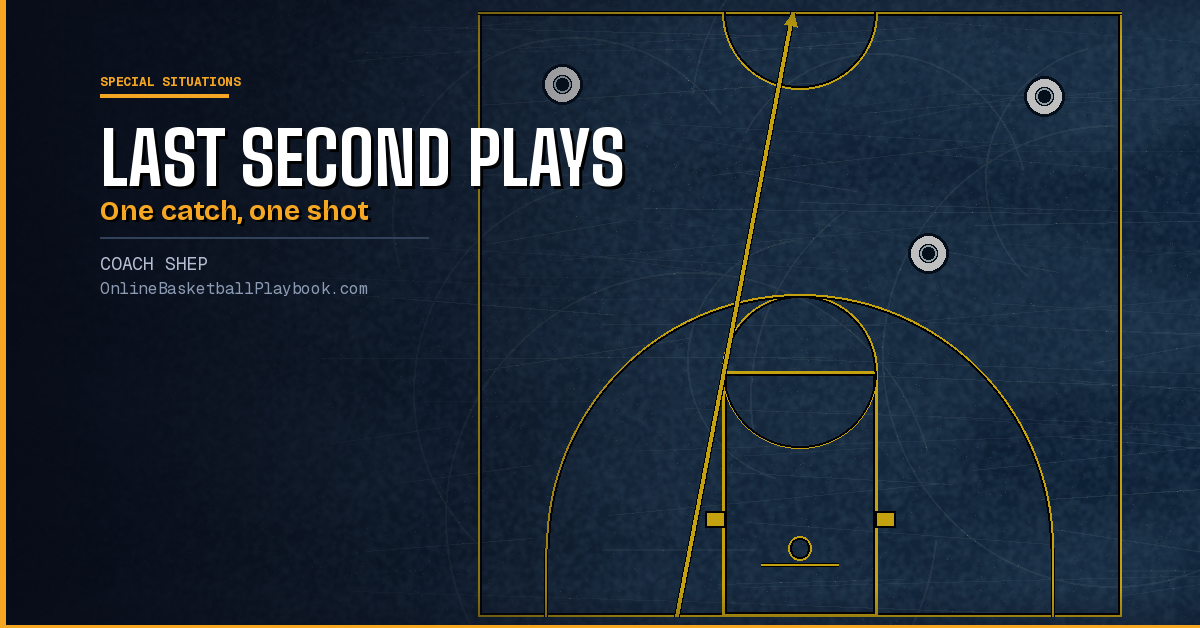
Last second basketball plays are the sets a team keeps for the final few seconds of a quarter, a half or a game, when the defense is set and there is time for one action and one shot. Several versions file these plays the same way: by the seconds left. This page sorts the plays by where the ball starts (full court, three-quarter court, side out) and by how much clock is left, with each version drawn and credited side by side. The decisions around them, such as fouling up 3 or saving a timeout, are on basketball clock management. It sits in the special situations section.
Last Second Basketball Plays Start With the Clock
NBA and college end-of-game sets sort by seconds and score. Read across them and the bands are clear. Under one second, the inbound catch is the shot, so every set is a catch-and-shoot or a lob off a back screen. From two to five seconds, one designed screen frees the shooter: a triple screen, a flare, a zipper or a screen for the screener. Under ten seconds, there is room for a two-part action. Under a minute, the sets for a trailing team lean on isolations and simple two-man pick and roll.
Other coaches cut the clock their own way.
| Version | How the clock is split |
|---|---|
| Jay Wright, two time bands | One set group for 1 to 3 seconds and another for 4 to 7 seconds, each with a free throw, baseline, full court and sideline call. Every dribble, pass, shot fake or shot costs about one second. |
| Jay Wright, three time bands | No-timeout sets for 0 to 3, 4 to 7 and 8 or more seconds. Screener and cutter plays from the baseline, drive plays from the sideline. |
| A set group for each spot | Separate sets for full court, three-quarter court, half court, baseline and free throws, plus separate sets for needing a three and needing a two. |
| An 8-second line | Above 8 seconds, play on. Below 8, call timeout. |
| Hubie Brown | Carries a side out play and an under out play for one second left. |
The dribble budget splits coaches too. One version allows roughly one dribble per 3 seconds of clock, which works out to 3 dribbles with 5 seconds and 5 with 7. Another allows one dribble per second. A third goes further: the player who catches the last pass shoots it, because a dribble gives his defender time to recover.
The Clock Rules That Make These Plays Work
Every full court play on this page depends on one rule: on a throw-in, the game clock does not start when the ball is thrown. It starts when a player on the court touches it. That is the rule at every level we checked.
- NCAA men and women. The clock starts when an inbounds player legally touches the throw-in. In the last 59.9 seconds of a period, when the ball is touched and an official stops the clock at once, at least .3 of a second comes off.
- NBA. The game clock starts when the throw-in is legally touched by any player on the court.
- FIBA. The clock starts once a player on the court touches the throw-in, or the throw-in touches him.
- NFHS (high school). Check your state association rulebook for the current wording.
Some levels also let a team move the ball after a late timeout. NCAA women, the NBA and FIBA allow a frontcourt throw-in after a backcourt timeout late in the game. NFHS and NCAA men have no such rule. The full table is on basketball clock management.
Full Court: One Long Pass
When the ball is under the other basket with three or four seconds left, the full court sets in the material share one shape. A big catches a long pass near half court or above the far arc, then pitches it at once to a shooter.

Four versions of that shape, side by side:
| Version | Setup | The action |
|---|---|---|
| Disguised as the press break | Lines up in the team's usual full court press break look so the defense expects the pass to go to the point guard | 5 sprints to half court for the long pass. 2 and 4 step toward the ball, then cut back to the wings for a three off 5's pitch. One pass and one shot. |
| Desperation three | Best long passer inbounds, the two best shooters near half court by the sidelines, the tallest leaper at the far free-throw line | 5 sprints to half court, the shooters break to the arc, and 5 pivots and throws to the open one. 4 can cut to the ball-side corner if the wing passes are covered, though there may not be time. |
| Baseball and touch pass | Shooters on both wings, the best passer out of bounds at the far end, 4 on a block, a leaping big at the free-throw line | 4 screens for 5, who sprints to just above the three-point line. The shooters cut toward the ball, then back out once the pass is in the air. 5 touch-passes to the open shooter or turns and shoots, and 4 waits under the rim for a tip. |
| Double screen release | A press-break set with two screeners | The point guard comes over the top of a double screen, and the moment he rubs shoulders with 4, 2 runs a fly pattern deep for the long pass. The inbounder must not stand right under the backboard. |
Two more full court ideas. One throws long to a big running from the low post to above the arc, while two teammates set a double screen for a shooter curling to the wing. Another set names the defense each full court play beats: a set for a team that denies or fouls, a set for a team that keeps a deep safety, and one where 4 screens and then slips over the top against a switching defense.
The long pass itself is a skill. Teach the baseball pass in five steps and try different players in practice to find who throws the best deep pass. More on beating pressure the length of the floor is on basketball press break.
Advance and Call Timeout, or Go
With four seconds and a timeout, split the possession in two. The team throws long to half court, calls timeout the moment the ball is caught, and runs a sideline play with two or three seconds still left. Because the clock starts on the touch, only about one second is lost. An assistant quietly tells the official before the play that a timeout is coming, so it is granted at once.
Coaches disagree on whether to stop at all.
- Version 1, advance and call it. Three versions inbound to half court and call timeout with under 4 or 5 seconds.
- Version 2, go without one. Stan Van Gundy prefers no timeout on a full court play after a made basket, because the defense cannot set, while noting that nobody criticizes a coach for calling one.
- Version 3, set a clock line. The Southeastern Conference coach in the table goes above 8 seconds and calls timeout below 8.
Whether a timeout is even there to call depends on your level's budget, which is on basketball timeout strategy.
Three-Quarter Court
A three-quarter court inbound comes from the sideline in the backcourt. There is more floor than a side out and less than the full length. Four sets fit here, and the first is built for 4 to 7 seconds. Two of them get a guard the ball on the move so he can attack at once.

The four sets:
- Sideline break, then loop back. Drawn above. 2's sideline break is the first look, and the loop is the second.
- Curl to the ball, flat ball screen. 3 sprints to the ball-side corner while 2 comes to the ball on a curved cut so he catches already moving. 5 steps up and sets a flat ball screen, which either frees 2 or forces the defense to switch.
- Stagger, handoff, then lob. 3 and 4 set a staggered screen for the first receiver, the inbounder sprints in for a handoff, 4 sets a ball screen for him, and 3 back screens for 5 for a lob.
- Stagger pair with a slip. 1 comes off a staggered pair of screens from 2 and 4. 2 slips out of his and runs up the floor, while 5 flashes to catch the inbound and looks ahead to 2.
A 4-second full court play is close to this family: 1 breaks to the inbounder behind a double screen from 2 and 3, catches, and looks for 2 sprinting downcourt for a jump shot.
Get the next coaching guide in your inbox
One email when a new guide or diagram set goes up. Free.
Side Out: Two Seconds or Less
From the sideline in the frontcourt, there is usually time for one catch. The side out set after a timeout is the second half of the full court split above. The ball is on the sideline at half court, and a tight diamond at the free-throw line breaks in four directions.

If nobody is open, one version of that set lobs to the big inside, hoping for contact and a trip to the free-throw line.
Hubie Brown's one-second play is a sideline set with two looks, drawn in order. The first is a corner three off a double screen.


A one-screener version draws it differently. 3 comes off 5's screen to the corner and 4 trails him off the same screen, and after 2's back screen for the lob, 2 flares to the top of the key.
Other side out sets for the last seconds:
| Version | Time | The action |
|---|---|---|
| Back door for the wing | About 2 seconds, need a three | Clear the floor first. The athletic wing who will catch stands at free-throw line extended, not at the elbow, and does not drift to the corner early. 5 fakes a screen for 4 to hold the help bigs, which opens a back door cut for the wing. |
| Down, cross, then flare | 2 seconds, need a three | A down screen for 3, a cross screen for 2 and then a flare screen for 2. 1 reads 2 in the corner or 3 off the flare. |
| Hubie Brown, 10 seconds or less | Up to 10 seconds | 2 pins down for 3, 4 and 5 double screen for 2 in the corner. If neither is open, 5 pops to catch, 3 goes back door, and 2 back screens for 1 to fade to the corner. |
| Back screen for the lob | 1 second | 3 screens for 2 going to the corner, 1 back screens for 5, and 5 cuts hard to the rim for a lob from 4. |
| An NBA set for half a second | 0.5 seconds | 4 screens at the elbow, 2 runs under a double screen to the corner as a decoy, and 1 curls around the same screens for the lob. |
Tubby Smith's notes add a sideline play that looks for the lob first and a 3-second inbound where the post steps out off the wing's back screen. The full sideline library is on sideline out of bounds plays, the baseline library on baseline out of bounds plays, and more close-game inbounds sets on inbound plays for clutch situations.
Who Catches and Who Inbounds
Coaches split on the star.
Version 1: decoy the star
The defense locks onto the best shooter, so the real action goes to the second option, and the others clear to the corners so one screen has room. Mike Krzyzewski's 1988 late-game threes start the best shooter away from the ball and have the second-best shooter take it out.
Version 2: ball to the best player
Get the ball to the best player, let him decide, and never let him inbound it. Stan Van Gundy's rule when tied is to get the last shot to your best player.
The inbounder is a position worth staffing, with a designated inbounder developed like any other role. Another version names a special teams unit in advance, with the best inbounders listed. Jay Wright's late-game sideline habit is to have the inbounder take his time, even tie a shoe, before he takes the ball from the official, so everyone is in place first. The same former pro player adds that slapping the ball to start the play wastes time once the official has handed it over. The defense's side of the same moment is on how to defend inbounds plays.
Design Rules Coaches Share
- Fake first. The most repeated pattern in the end-of-game library is a false read before the real screen: a fake handoff into a drive, a fake pick and roll that becomes a screen away, or a cross screen before elevator doors.
- Draw the counter in. Have two or three good options, then a straight flow into the team's offense. Call each counter by the original play's name plus "again," so the other bench hears the same call.
- Expect the late switch. Run the counter with one second on the shot clock because teams switch every screen late, and build slips into the full court, three-quarter court and baseline plays.
- Two or three. Keep separate sets for needing a three and needing a two. The three-point sets lean on staggered screens and flares, and the two-point sets on ball screens and the post.
- One trusted play or a big menu. One version runs one core action everywhere. Another wants a few well-drilled plays, not many half-known ones. A third argues the other way: a large catalog with counters makes a team hard to prepare for.
Practicing Last Second Plays
The same former pro player spends the last ten minutes of practice on these plays. Jay Wright practices out of bounds plays by time window, 0 to 3, 4 to 7 and 8 or more seconds. Mike Krzyzewski uses only a few plays in game situations, tapes them, and runs them with his top seven or eight players, not only the starters. A last-second plan rests on one condition: the team has practiced it. Drill formats for the whole late-game picture are on drills to teach late game situations, and the plays by score and time are on basketball late game situations and after timeout plays.
Questions Coaches Ask
What is the best last second play from full court?
No single play wins the vote. The most common shape is a long pass to a big near half court or above the far arc, who pitches it at once to a shooter cutting to the wing. Teams with a timeout often throw to half court and call it instead.
Does the clock start when the inbound pass is thrown?
No. At the NCAA, NBA and FIBA levels the game clock starts when a player on the court touches the throw-in. For high school, check your state association rulebook.
How many dribbles can you take with a few seconds left?
One version allows about one dribble per 3 seconds. Another allows one per second. Some coaches want no dribble at all on the last catch.
Should your best player inbound the ball?
Coaches split. Mike Krzyzewski's 1988 sets had the second-best shooter inbound so the best shooter started away from the ball. Never let the best player inbound.
What play works with one second left?
A catch-and-shoot or a lob. Hubie Brown's sideline play for one second sends a shooter off a double screen to the corner, then back screens the post at the elbow for a lob.
Want every diagram, printable?
OBP Pro members get the full diagram files for every special situation, practice block and defensive look on this page, ready for a practice binder or a bench card. $9 a month. Or draw your own version free in the play drawer.
See what OBP Pro includesMore Core Coaching Guides
- Free Throw Alignments in Basketball: Lane Spots and Box Outs
- Jump Ball Plays and Alignments: Opening Tip and Defensive Looks
- How to Run an Effective Basketball Practice: Plan, Pace, Score
- Defensive Identity Basketball: Choosing What Your Team Will Be
Back to Special Situations and every Special Situations page.
Keep Building
Related breakdowns
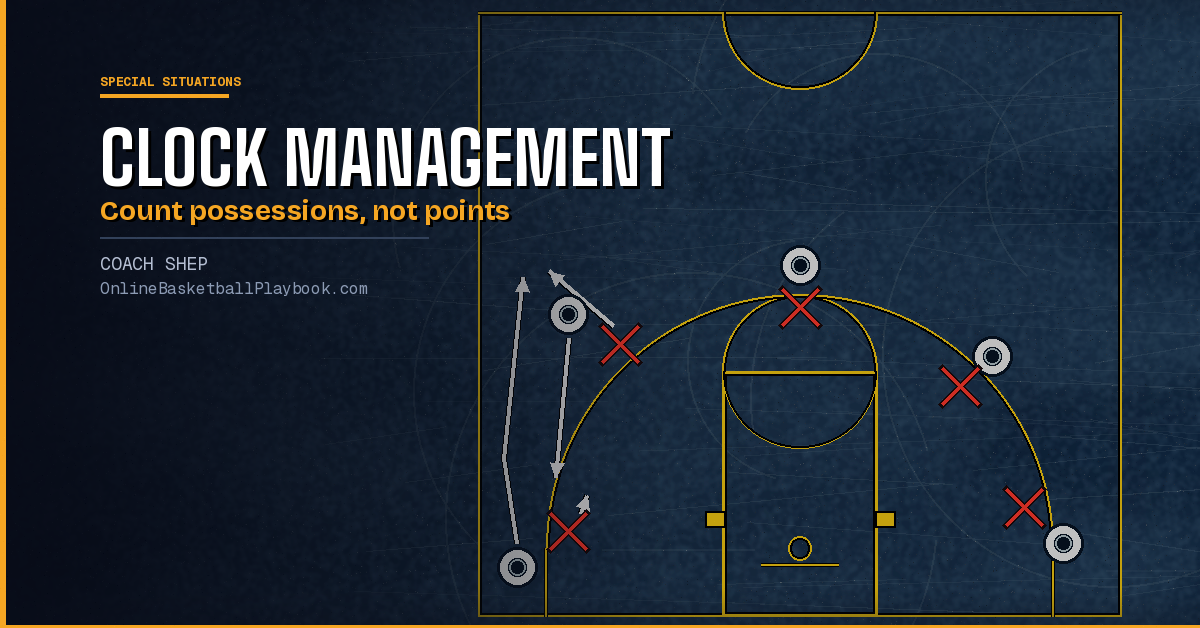
Basketball Clock Management: Foul Up 3, Two for One, Last Shot
Basketball clock management explained: the clock rules by level, counting possessions, foul or defend up 3, fouling when behind, the two for one and the last shot.
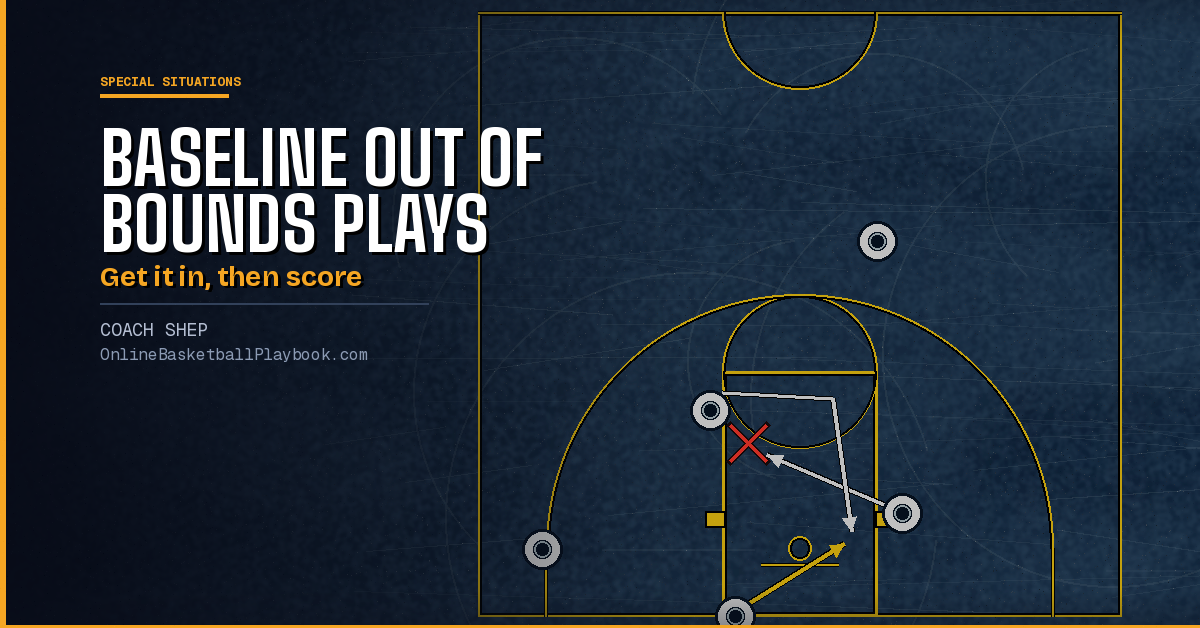
Baseline Out of Bounds Plays: Sets vs Man, Zone and for Youth
Baseline out of bounds plays drawn step by step: a box back screen and roll, Pick the Picker, the double stack, a 2-3 zone play, youth one-pass plays, the rules and the reads.
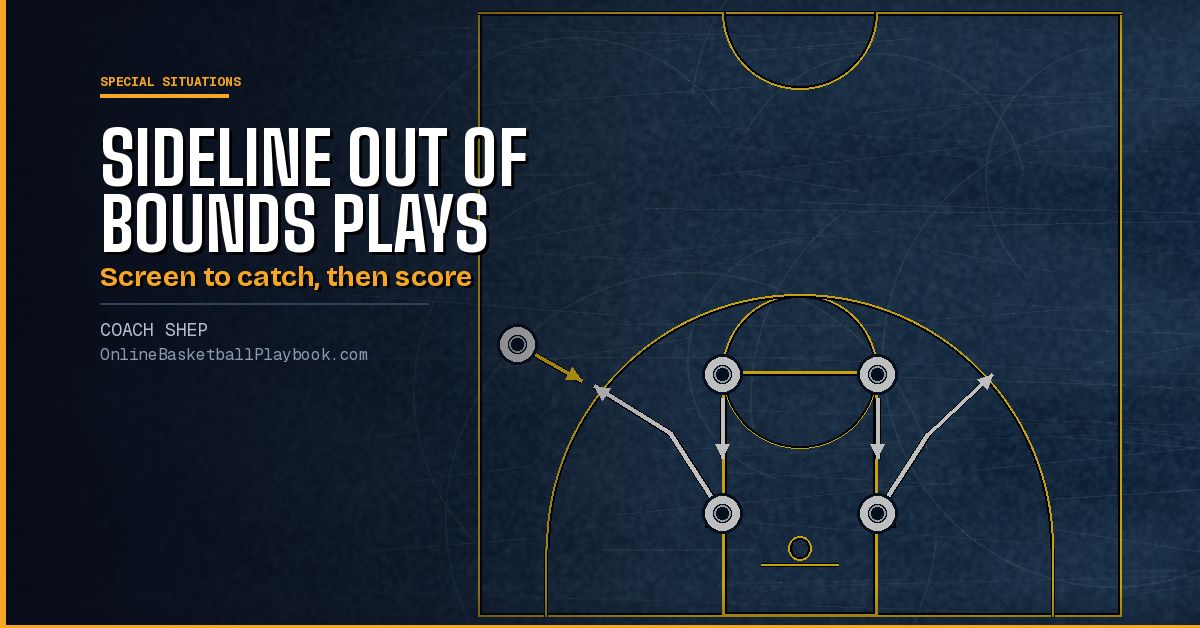
Sideline Out of Bounds Plays: SLOB Sets, Reads and Practice
Sideline out of bounds plays for coaches: SLOB sets from a box, stack and line, the inbounder's reads, plays against zone and denial, the clock and practice.