Full court last second plays are the sets a team runs when it has to inbound the ball from its own baseline, under the basket it defends, with only a few seconds left and the length of the floor to go. Every one of them depends on one rule and one skill: the clock does not start until the ball is touched, and somebody on the team can throw it most of the length of the floor on target. This page covers the full-court plays by family, with each drawn and the counters for each defense. The half-court and sideline versions are on buzzer beater plays, and the overview of every last-second spot is on last second basketball plays.
The Rules Full Court Last Second Plays Depend On
- The clock starts on the touch. At NCAA men and women, the game clock starts when an inbounds player legally touches the throw-in. NBA: when a player on the court legally touches it. FIBA: when the ball touches or is legally touched by a player on the court. At NCAA levels, in the last 59.9 seconds of a period, when the ball is touched and an official stops the clock at once, at least .3 of a second comes off. NFHS: check your state association rulebook.
- Five seconds to throw it. NCAA men and women, the NBA and FIBA all give the thrower-in five seconds to release the ball. NFHS: check your state association rulebook.
- The inbounder can run the end line after a score. At NCAA men and women, after a made basket the team throws in from the end of the court where the goal was made and may move along the end line. The NBA and FIBA also let the thrower-in move along the end line after a score and pass to a teammate who is also out of bounds. NFHS: check your state association rulebook.
- The clock stops after a late basket at some levels. NCAA men and women stop it after each made basket late in the game: the final 59.9 seconds of the second half for men, of the fourth quarter for women, and of any overtime. The NBA stops it in the last minute of the first three periods and the last two minutes of the fourth and any overtime. FIBA stops it with 2:00 or less in the fourth quarter and overtime. The NCAA's rules-differences chart lists no such rule for NFHS.
Because the clock waits for the touch, a pass that hangs in the air for a second costs nothing. The full set of clock rules is on basketball clock management.
Read your level's rules out loud with the team once, before you ever need them.
What the Clock Allows
End-of-game libraries file full-court plays by the seconds left, and the bands repeat:
- 1 to 3 seconds. One long inbound pass, and the catch is the shot or the pitch. Filed by time and spot, an end-line throw-in with 1 to 3 seconds is a long pass and nothing else.
- 3 or 4 seconds. One long pass and one quick pass. This is where the long pass and pitch lives, and where advancing to half court and calling timeout comes into play.
- 5 or 6 seconds. Room for a short inbound, a return pass and a speed dribble up the floor for a two or a foul.
The dribble budget splits coaches:
- Loose. Roughly one dribble per 3 seconds of clock, 3 dribbles for 5 seconds and 5 for 7.
- Tight. One dribble per second.
- Strict. Whoever catches the last pass shoots it, with no pass or dribble.
Count the seconds before you count the dribbles.
Who Throws and Who Catches
Full-court plays are built around three roles, and coaches staff them by skill, not by position:
- The passer. Your best long passer takes it out. Mike Fratello wants to know who on the roster can throw a baseball pass, and the usual advice is to try different players in practice to find the deep passers. Without a crisp sideline-to-sideline skip pass and a baseball or hook pass to the opposite elbow, any last-second play is worthless.
- The catcher. The tallest, best-jumping player, who catches above the crowd near half court or just above the far arc.
- The shooters. The two best three-point shooters, usually near the far wings.
The baseball pass in five steps:
- Start in a quarterback position with both hands on the ball, so you can pull the pass back if the receiver is covered.
- Spread the strong hand on the ball for control.
- Bring the ball to the ear on the throwing side.
- Step into the pass, rotating the hips and stepping with the back foot.
- Follow through with a wrist snap for backspin, so the ball is easier to catch.
Two details about where the passer stands. In the double screen release the inbounder must not stand directly under the backboard, because it blocks the angle. After a score, the inbounder can run the baseline for a cleaner throw past a tall defender, which the NCAA, NBA and FIBA allow after a made basket. At high school, check your state association. More passing technique is on basketball passing fundamentals.
Find your passer in October, not in the final second.
The Long Pass and the Pitch
The most common full-court shape is a long pass to a tall catcher near half court or above the far arc, who pitches it at once to a shooter. The baseball-and-touch-pass version adds a screen to free the catcher:

The touch pass goes as fast as 5 can release it, and 5 may also turn and shoot. The same shape, drawn other ways:
- Desperation three. The two best shooters stand near half court by the sidelines and the tallest leaper at the far free-throw line. The leaper sprints to half court for the long pass, the shooters break to the arc, and he pivots and throws to the open one. The 4 can cut to the ball-side corner if the wings are covered, though there may not be time.
- Disguised as the press break. The team lines up in its usual press-break look, so the defense expects the pass to the point guard. The 5 sprints to half court for the long pass while two players step toward the ball, then cut back to the wings for a three. One pass and one shot.
- The big runs from the block. The long pass goes to the 4 sprinting from low to above the far arc, while two teammates set a double screen for a shooter coming to the wing. The 4 shoots it if nobody else is open.
- Break to the inbounder, 4 seconds. 1 breaks to the inbounder behind a double screen from 2 and 3, catches, and looks for 2 sprinting down the floor for a jump shot.
- Screen for the catcher, then roll, 3 seconds. 1 and 2 clear to opposite sides, 5 screens for 4, the long pass goes to 4 and 5 cuts to the rim for the layup.
Catch it high and get rid of it fast.
Screen and Release Deep
The second family throws over the top to a runner who comes free off a screen. The double screen release grows out of a four-across press break:

The cue is one moment: 2 goes when 1 touches 4. The same idea, three more ways:
- Screen, then go deep. 2 cuts toward the ball, then 4 screens for him to release deep for an overhead throw, while 3 acts as if he is going deep and cuts back to the middle off 1's screen.
- Flash and C-cut for the home run. 5 flashes to the middle while 2 makes a C-shaped cut off 1's screen and goes deep.
- Staggered double for a shooter. Tubby Smith's home run play frees a shooter off a staggered double screen while the inbounder runs the baseline.
Two of these plays grow out of press-break alignments, so the players already know the spots. Press breaks themselves are on how to beat a full-court press.
The runner leaves on a cue, not on a hunch.
Plays Named for the Defense They Beat
A 74-play collection of game-winning specials labels most of its full-court plays by the defense they beat, not just by the ball's route:
| Version | Defense it beats | The action |
|---|---|---|
| Flash and sprint | A team trying to deny or foul | 5 flashes to catch the inbound and 2 sprints to the middle for the pass ahead. |
| Chain of passes | A team trying to deny or foul | 5 goes to the corner, 2 sprints to the middle and 3 sprints up the sideline, for a chain of quick passes. |
| Screen, then slip | A team trying to foul or get a quick steal, or switching | 4 screens for 2 to catch. If the defense switches, 4 releases over the top. |
| Slip and release | A switching defense | 4 and 3 screen for 1, and 4 slips at once and releases up the floor for the pass over the top. |
| Dummy screens | A team that keeps a deep safety | 3 and 5 set dummy screens for 2 and 1, then 5 turns and screens 3's defender so 3 can release deep. The inbounder has to sell the fake to 2. |

Defenses guard this inbound in very different ways. Some face-guard four players and drop the inbounder's defender to half court as a safety, and some double the point guard before the inbound. The defense's options are on how to defend inbounds plays.
Look at what the defense is doing before you call the play.
Five Seconds or More: Bring It Up
With 5 or 6 seconds there is time to inbound short, get the ball back and attack. The split needs at least that much:

After the inbound, 1 sprints in for the return pass and speed-dribbles up the floor for a drive and a two, or a foul. There is no time for another pass.
The quick hit off the sideline catch needs about 6 seconds: 3 catches on the sideline and passes at once to 1, who drives the middle while 2 spots up and 5 looks for the dump pass.
Get the ball to your best driver on the move, then go straight at the rim.
Advance and Call Timeout, or Go
With 3 or 4 seconds and a timeout, two rules of thumb:
- Split it in two. Pass to half court and call timeout the moment the ball is caught, then run a sideline play with 2 or 3 seconds still left. Because the clock starts on the touch, only about a second is lost. An assistant quietly tells the official before the play that a timeout is coming, so it is granted at once.
- Make it a rule. With under 4 seconds, inbound to half court and call timeout instead of trying to go the length.
Whether to stop at all, and when to call one after your own score, is compared on last second basketball plays.
Some levels move the ball for you after a late timeout. NCAA women, the NBA and FIBA allow a frontcourt throw-in after a late backcourt timeout under set conditions. NFHS and NCAA men have no such rule, so the half-court pass and timeout matters most there. The sideline plays that follow are on buzzer beater plays and sideline out of bounds plays, and how to budget the timeouts is on basketball timeout strategy.
Decide go or stop before the game, then follow the rule.
Practicing the Long Pass
- Test every passer. Try different players on the baseball pass until you know your two best.
- Shoot from half court. Practice half-court shots regularly, in shootaround and at the end of practice, with a reward for the first make.
- Rehearse the timeout too. The assistant's word with the official is part of the play, so rep it.
- End practice with it. Spend the last ten minutes of practice on last-second plays, with a few plays drilled well instead of many half known.
More formats for the whole late-game picture are on drills to teach late game situations.
The long pass is a skill. Practice it like one.
Get the next coaching guide in your inbox
One email when a new guide or diagram set goes up. Free.
Questions Coaches Ask
Does the clock start when the inbound pass is thrown?
No. At the NCAA, NBA and FIBA levels the game clock starts when a player on the court touches the throw-in. For high school, check your state association rulebook.
What is the best full court play with 3 seconds left?
The most common shape is a long pass to a tall catcher near half court or above the far arc, who pitches the ball at once to a shooter on the wing. With a timeout and a level that does not move the ball, the other choice is to pass to half court and call timeout.
Who should inbound on a full court last second play?
Your best long passer. Test the baseball pass with several players in practice to find him, and keep him off the spot directly under the backboard.
Can the inbounder run the baseline?
After a made basket, yes, at the NCAA, NBA and FIBA levels. For any other throw-in, and for high school, check your rulebook or state association.
Want every diagram on the site?
OBP Pro members get the full diagram files for every guide on the site, ready for a practice binder or a scouting report. $9 a month. Or draw your own version free in the play drawer.
See what OBP Pro includesMore Coaching Guides From This Batch
- Basketball Press Terminology: Trappers, Interceptors and Safeties
- After Timeout Plays: ATO Sets by Score, Clock and Spot
- Buzzer Beater Plays From Half Court: Sideline and Baseline
- Late Game Plays When They Deny Your Best Player
Back to Special Situations and every Special Situations page.
Keep Building
Related breakdowns
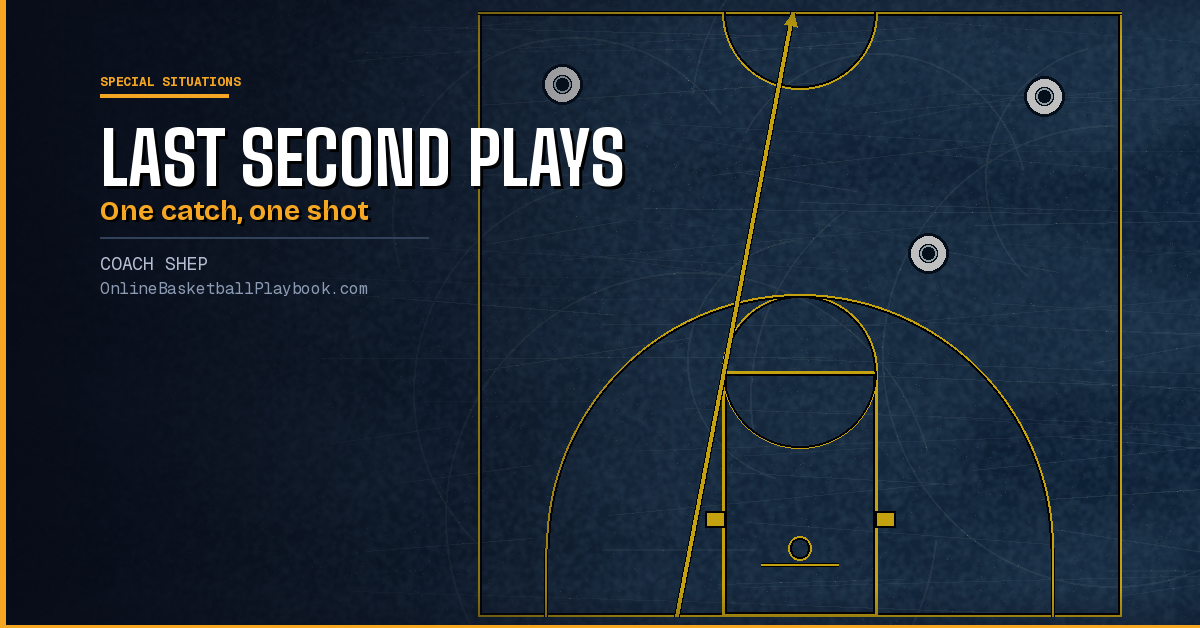
Last Second Basketball Plays: Full Court, 3/4 and Side Out
Last second basketball plays for the final seconds: full court long passes, a three-quarter court loop, side out sets for one second and the clock rules behind them.
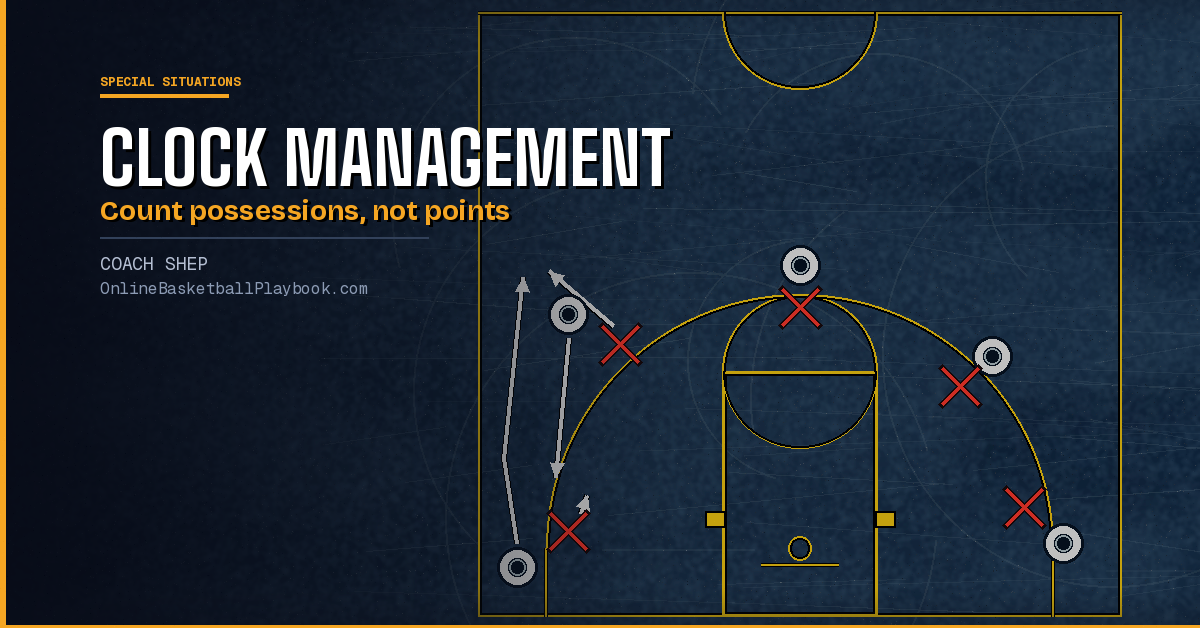
Basketball Clock Management: Foul Up 3, Two for One, Last Shot
Basketball clock management explained: the clock rules by level, counting possessions, foul or defend up 3, fouling when behind, the two for one and the last shot.
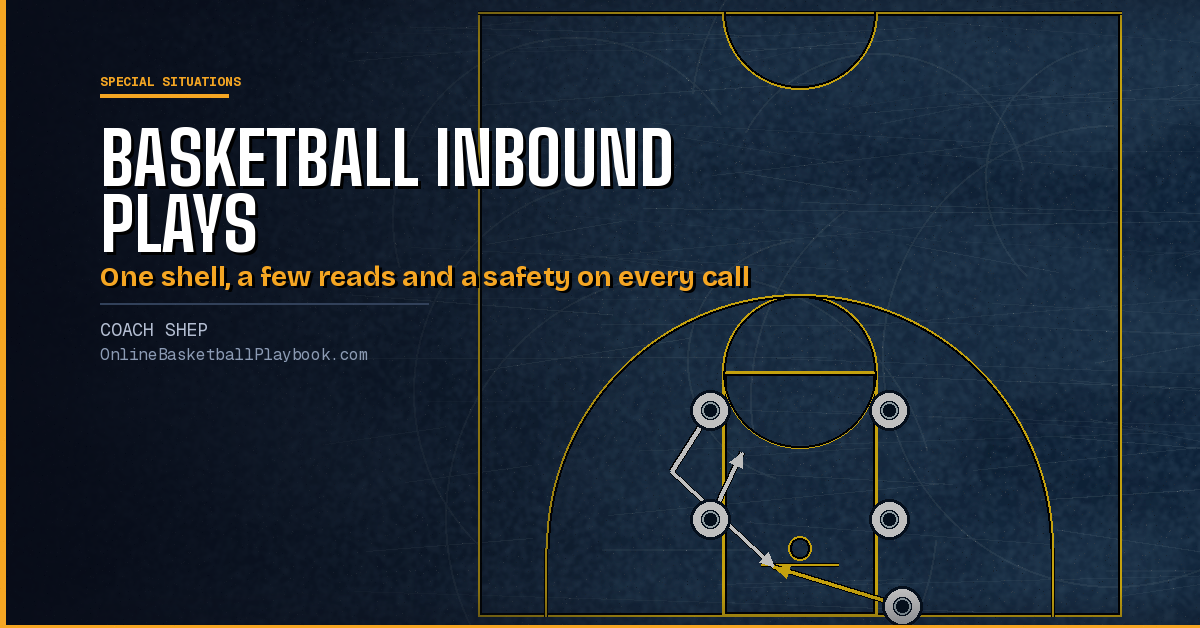
Basketball Inbound Plays: Baseline and Sideline Sets to Run
Basketball inbound plays for baseline and sideline throw-ins, with six drawn sets, simple plays for youth teams, zone looks and where coaches disagree.