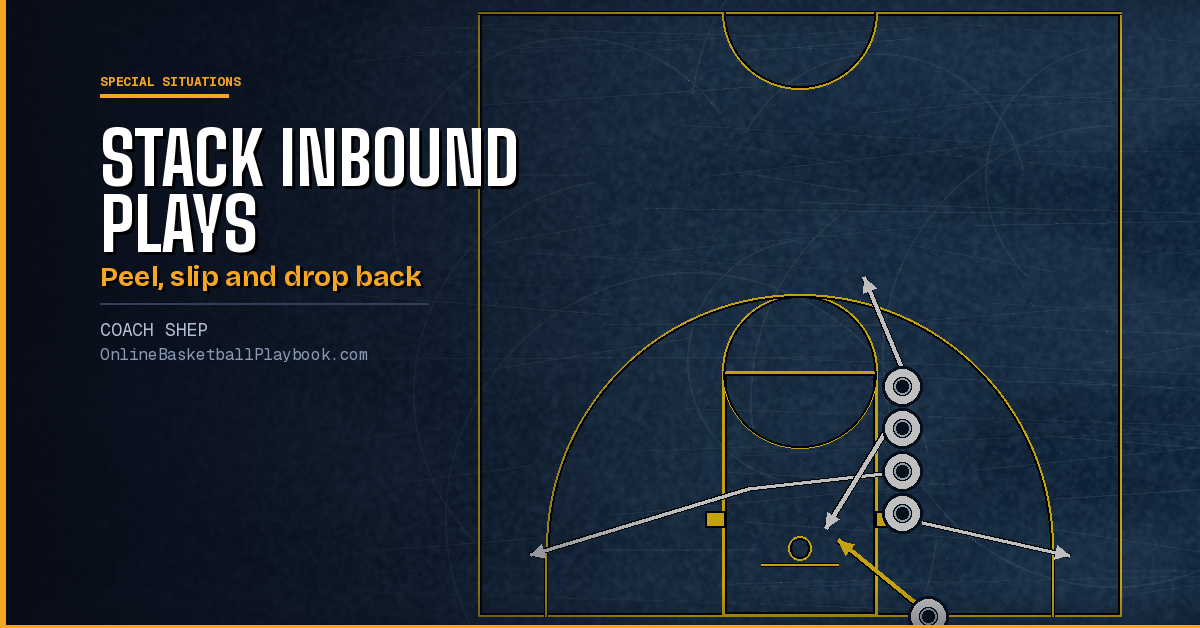
Stack inbound plays line three or four players up in a row, under the basket, along a lane line or across the free-throw line, and then send them in different directions at once. The first players peel off to pull their defenders, the next cutter takes the gap they leave, and the last one drops back as the safety.
Box shapes are on box set inbound plays, the wider baseline menu is on baseline out of bounds plays, and every throw-in spot is compared on basketball inbound plays in the special situations section.
How Stack Inbound Plays Line Up
A stack hides who is cutting where, because every player starts in the same row. Pick where the row goes before you pick the play:
- Stack on the ball side. Four players in a line on the ball-side lane line, splitting out to both sides.
- Stack opposite the ball. The line starts on the far lane line and empties toward the ball.
- Stack near the elbow. The row starts high, near the elbow and not too low, in the zone plays on inbound plays against a zone.
- Double stack. The two posts stack on the blocks with the two best shooters behind them. It is drawn on baseline out of bounds plays.
- Line across the free-throw line. Three or four players straddle the free-throw line facing the ball.
- Low line across the lane. Three players line up across the lane low.
Spacing makes the shape work:
- Real spacing in the row. A sideline stack only works when it is lined up on the lane line extended with real space between players.
- Let them squeeze. In a line, let the defenders squeeze between the players, then cut.
- Cut straight. Every cutter goes directly to his spot, never in a curve.
The stack also overloads a zone the moment it lines up, so the same shape serves against man and zone.
Pick one row, put the same players in the same spots every time, and let the call change only who breaks where.
Split the Stack
The simplest stack play splits the first two players wide and slips the third into the hole. It works because the defenders usually follow the first two.

- Split and slip. The first two players in the row are good shooters, and they break wide to opposite sides. In the confusion the third player slips into the space they left and is often open for a layup. The fourth drops back as the safety, and when the ball goes to the corner or back to the safety, the inbounder, 5, slips into the low post for a quick return pass.
- Split, then screen in. The 5 and 2 split out of the stack, and the 1 steps away, then cuts up the court to screen for the 4.
- Screen in for the corner. Start the same way, then the 5 screens in for the 1, who cuts to the weak-side corner, and the 4 screens for the 2.
- Swing around the post. In a youth strong-side stack in line with the ball, the 5 stands at the head of the stack. The 3 cuts to the strong corner and the 2 to the weak corner as second options, and the 1 looks as if he is cutting back, then uses the 5 as a stationary screen and swings around him to the basket.
Rep the split until the first two break hard every time. The slip only opens if they take their men with them.
Stack Away From the Ball
Start the row on the far lane line and empty it toward the ball side. The last cutter scores off a teammate who has already moved.

If 5, 2 or 4 is open on the way across, the inbounder makes that pass. The same row can use a screen in place of the cut:

- Rub and slip. Either of the two players who cut across can get open for a shot. If the defender on 5 switches and picks up 4, 5 slips the screen for the inbound pass and layup.
- Weak-side stack for the 5. Four players stack on the weak side and the called player is the 5. On the slap all cut hard to the other side of the lane, the 5 about a step early. He touches the far lane line and cuts straight back off the 3's hip, which catches his defender on what becomes a three-player screen. The inbounder ball-fakes outside to make his defender reach.
Empty the row at full speed, every player, every time.
Screens Inside the Stack
Several stack calls turn the row itself into screens, for a lob or for one shooter:
- Lob for the post. Built for a height mismatch. 4 steps out to the short corner and 3 screens for 5, and the inbounder lobs to 5 cutting to the basket. The inbounder can also hit 3 or 4 if open, and 1 pops out as the safety. If none of that is there, 4 screens on the baseline for the inbounder, and if he is not open either, 1 starts the team's continuity.
- Triple screen to the short corner. 1, 2 and 4 line up as a triple screen, and 3 runs out to the short corner to shoot. The inbounder, 5, breaks to the weak side for the rebound, and 4 slides out to the top of the key as the safety once the shot goes up.
- Pinch double. Built for a defense that plays inside or zones. On the inbounder's signal, 4 and 5 step in and double-screen the shooter's defender, the shooter pops out to the short corner, and 1 releases back as the safety. If there is no shot, 3 cuts off 5 and 4's down screens.
- Loop the baseline. 3 loops around 4 and 5's double screen along the baseline as 1 rubs off it to the short corner, then 5 screens for 4 to break the double. The inbounder feeds 3, 1 or 4 rolling to the basket. After the pass in, the inbounder loops out to the top of the key for a shot off 4 and 5's down screens. If X1 cheats over the double screen, 1 back cuts for a quick shot.
- Tight cut, then the counter. From a three-player stack, 3 cuts tight around 4's screen. In the counter, 3 darts out to the slot instead, and 4 and 5 screen for 2.
- One second left. Hubie Brown's play for the final second. 3 sprints to the corner, 2 comes off a stagger from 4 and 5, and on a switch 5 opens up and dives for the lob. More last-second calls are on buzzer beater plays.
The double stack with a cross screen for a power layup is drawn on baseline out of bounds plays, and setting the screens is taught on basketball screening technique.
Teach the screeners first. A stack with soft screens is just four players standing in a line.
Line Plays Across the Lane
In a line, one screener can free two cutters in order and then become the third option himself.

In 3-across, 2 can take the cut all the way to the corner when the team wants a three. The inbounder throws to whichever of the three cutters is open, and 1 is also the player who stops the fast break if the play misses. The other line plays:
- Line screen and roll. The line puts two shooters in the corners, which takes the help away from the screen and roll. The inbounder first looks for a quick pass to either corner if a shooter is unguarded. Then 5 moves across the lane and sets a hard screen on X4. If the defense chases over or goes under, the lob goes to 4.
- Roll, then reverse. If the defense switches or shows and recovers on that screen, the pass goes to 5 rolling. If neither look is there, the inbounder throws to 1 as the safety, rubs off 4's baseline screen and the team runs its continuity.
- Tandem baseline screens. The shooter, 2, comes over 3 and 5's tandem baseline screens, then 1 sets a baseline screen for 3. The inbounder looks for 2 or 3, and if neither shoots, he steps in and posts up hard. It is built to work against man or zone.
- Low line back screen. Three players line up across the lane low and the middle post, 4, back-screens for the point guard, 1. No switch, 1 gets the layup. A switch, 4 seals the smaller defender and rolls. 2 cuts to the corner for a three and 3 moves out to the top of the key as the safety. After it works a couple of times, 4 fakes the back screen and cuts straight back to the ball. More triggers like this are on backdoor triggers basketball.
- Free-throw line straddle. Four players straddle the free-throw line facing the ball and the 4 inbounds. On the slap, the 1, 3 and 5 cut hard away toward center court, while the 2 may take one step back and then goes straight to the basket for the layup.
- Screen the inbounder from a line. In Tom Izzo's line play, 4 dives to the opposite block and 3 cuts to the corner. 5 inbounds to 3 and the ball reverses to 1. Then 2 down-screens for 5, who cuts tight around the screen, and 3 screens the screener as 2 cuts to the corner. Two scoring actions come off one inbound.
More on the down screens inside these lines is on down screen basketball.
Teach the screener to roll or seal after every screen. In a line he is the last option.
Stacks on the Sideline
Sideline stacks use the same row with more floor around it. Draw every sideline stack twice, once from each sideline, so the same reads install on either side.
- Post mismatch. The shooter pops to the corner off a baseline screen while the point guard makes a weak-side basket cut off a back screen, and the post is isolated with a drop pass to the cutter if he is doubled.
- Loop to the inbounder. The inbounder loops around a double screen to get the ball back, dribbles to the middle and passes to the far wing, who is fed by a second double screen for a basket cut.
- Called by fingers. One stack carries four numbered options, called by holding up that many fingers: a skip pass for the shooting guard, an isolation for the wing, a lob off a back screen for the power forward and the same lob for the post.
- V-cut up the sideline. 1 screens for 2, who fakes a V-cut and runs the near sideline for the catch, while 5 back-screens for 4 cutting to the opposite side. A direct lob to 4 is the third look.
- Back over the double. 2 comes back over the top of a 4 and 5 double screen for a three.
The full sideline menu is on sideline out of bounds plays.
Run each sideline stack from both sides of the floor before you call it in a game.
Teaching Stack Plays
Stack plays are simple to draw and easy to run lazily, so practice is about timing and effort on the break. The teaching points that repeat:
- One start signal. Everyone cuts hard when the inbounder slaps the ball, or the play starts on a player's call. Or start as soon as the official hands over the ball, because a slap costs time once the count is running.
- Call it by name. Youth plays are called by the player who gets the layup, for example the call plus the player's name.
- Primary first. Show the second options only after the players run the first ones well.
- A short list. Carry about four plays for grade school and middle school teams. More on that age group is on coaching youth basketball.
- A safety on the call. Build a safety into every stack, usually the last player in the row dropping back.
- Live defense. Run the stack against defenders. A stack that only works five on zero fails in games.
The rules decide how long players can stand in the row. NCAA men's and women's rules say the three-second rule is not in effect while a team controls the ball for a throw-in. For high school, the NBA and FIBA, check your league or state association rulebook.
The thrower-in has five seconds to release the ball in the NCAA, the NBA and FIBA, and high school coaches should check their state association. The full throw-in rules are on basketball out of bounds rules. The defensive side is on how to defend inbounds plays.
Every player in the row has one job. Make sure each one knows his before the official hands over the ball.
Get the next coaching guide in your inbox
One email when a new guide or diagram set goes up. Free.
Questions Coaches Ask
What is a stack inbound play?
An inbound play that starts with three or four players lined up in a row, under the basket or along a lane line, who break in different directions on a signal. The first players pull defenders away, the next cutter takes the gap and the last one drops back as the safety.
What is the difference between a stack and a line inbound play?
This guide calls a row along a lane line a stack and a row across the floor a line. Playbooks use the two words loosely, so write the alignment next to the call. Both send cutters out of one row on a signal.
Do stack inbound plays work against a zone?
Yes. The stack overloads a zone as soon as it lines up, and several stack calls are built for a zone. Those are on inbound plays against a zone.
Can players stand in the lane during a throw-in?
In NCAA men's and women's rules the three-second rule is not in effect while a team controls the ball for a throw-in. For high school, the NBA and FIBA, check your league or state association rulebook.
Want every diagram on the site?
OBP Pro members get the full diagram files for every guide on the site, ready for a practice binder or a scouting report. $9 a month. Or draw your own version free in the play drawer.
See what OBP Pro includesMore Inbounds Plays
- Box Set Inbound Plays: Cross Screens, Back Screens and Reads
- Inbound Plays Against a Zone: Baseline and Sideline Sets
Back to Basketball Inbound Plays and every Special Situations page.
Keep Building
Related breakdowns
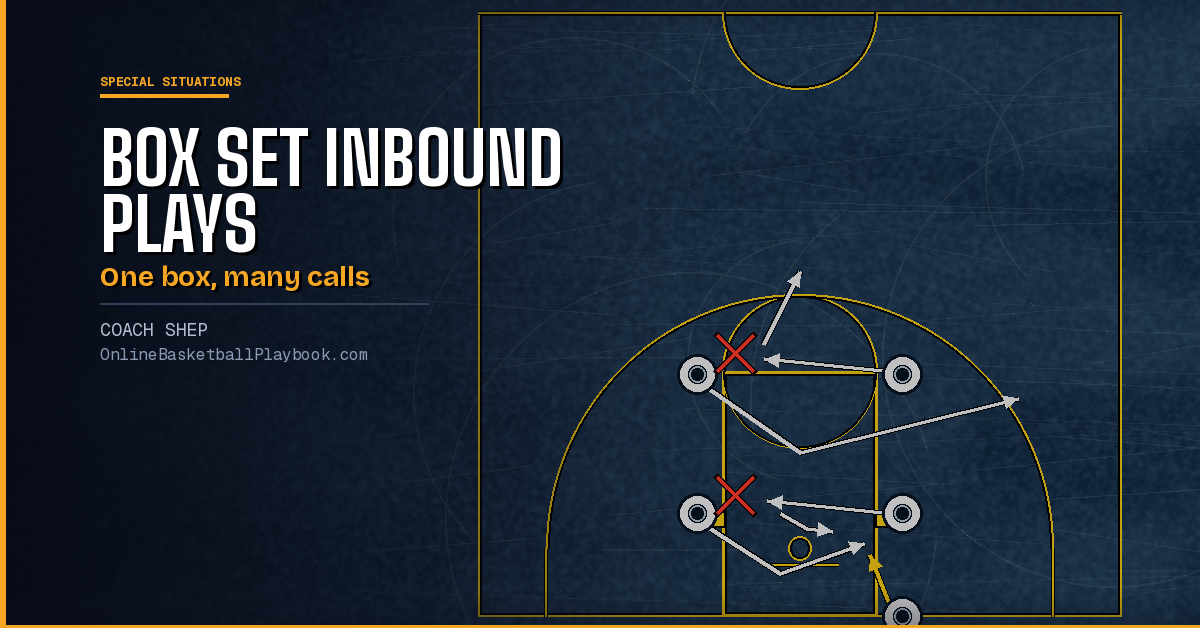
Box Set Inbound Plays: Cross Screens, Back Screens and Reads
Box set inbound plays from the baseline: the box shell and its variations, cross screens, back screens, plays for the inbounder, switch reads and how to teach them.
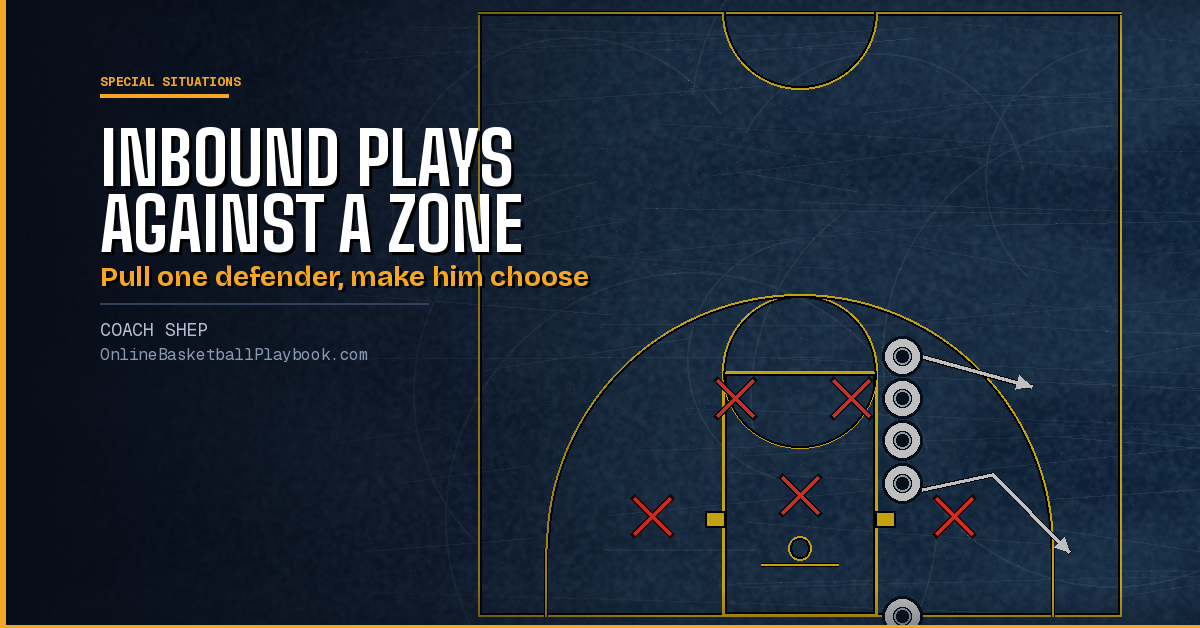
Inbound Plays Against a Zone: Baseline and Sideline Sets
Inbound plays against a zone from the baseline and sideline: the read, the stack near the elbow, short-corner pulls, split cuts, two-part sets and sideline answers.
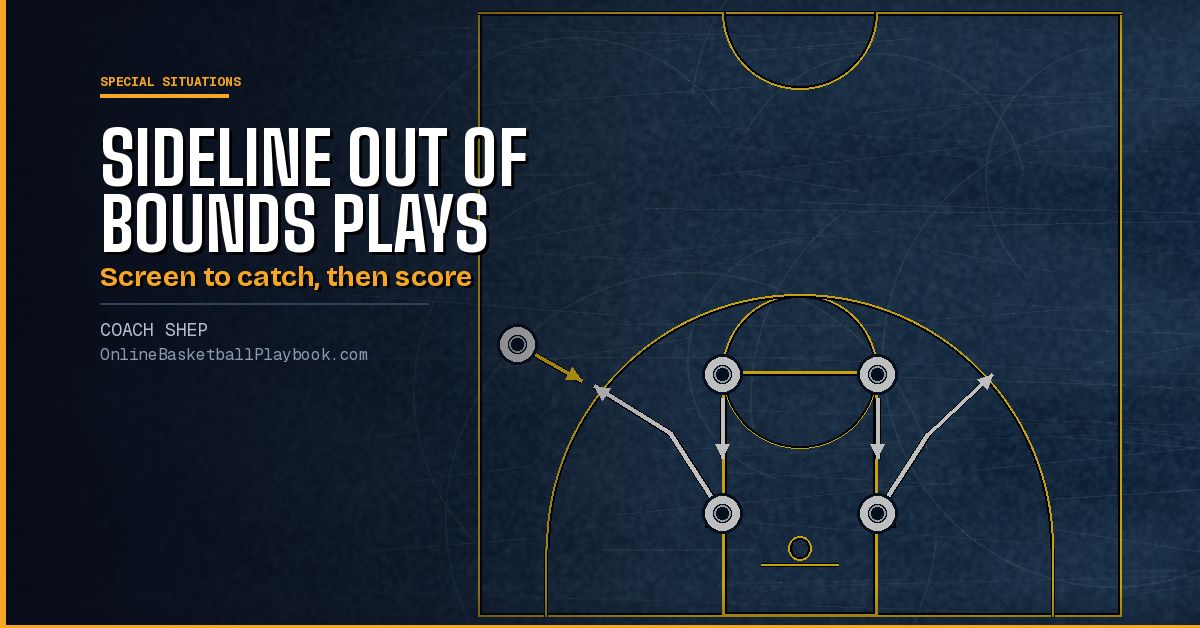
Sideline Out of Bounds Plays: SLOB Sets, Reads and Practice
Sideline out of bounds plays for coaches: SLOB sets from a box, stack and line, the inbounder's reads, plays against zone and denial, the clock and practice.