Youth basketball drills teach the most when they look like the game. A youth team often gets two practices a week, so every drill has to build skill and prepare for games at once. The answer is a ladder of live games from 1 on 1 full court up to 5 on 5. Pair it with the skill work in player development drills and the long-term plan in youth basketball player development.
Why Youth Basketball Drills Should Be Live Games
In this approach, live play fills 75 to 95 percent of practice. There is no 5-on-0 offense and no shell drill with offensive players standing still. Each practice grows from small-sided action up to 5 on 5, and it starts when the first players walk in rather than waiting for the whole roster.
Small-sided games give each player more room and more time on the ball. Young players need that room to learn a skill, while advanced players need tight spaces to sharpen one. The wider case is on small-sided games for skill development.
Youth games run up and down the floor, so with a full court open these games run full court and the defense picks up at once. Where most youth teams press, that steady pressure trains ball handling, passing, defensive footwork and conditioning in the same rep. The ladder rests on three things young players can do well: handle the ball, guard their man and play hard. Simpler games for younger groups are on basketball drills and games for kids. Let the game do most of the teaching.
The Four Core Games
Practice almost always opens with one of these four, picked by how many players are there.
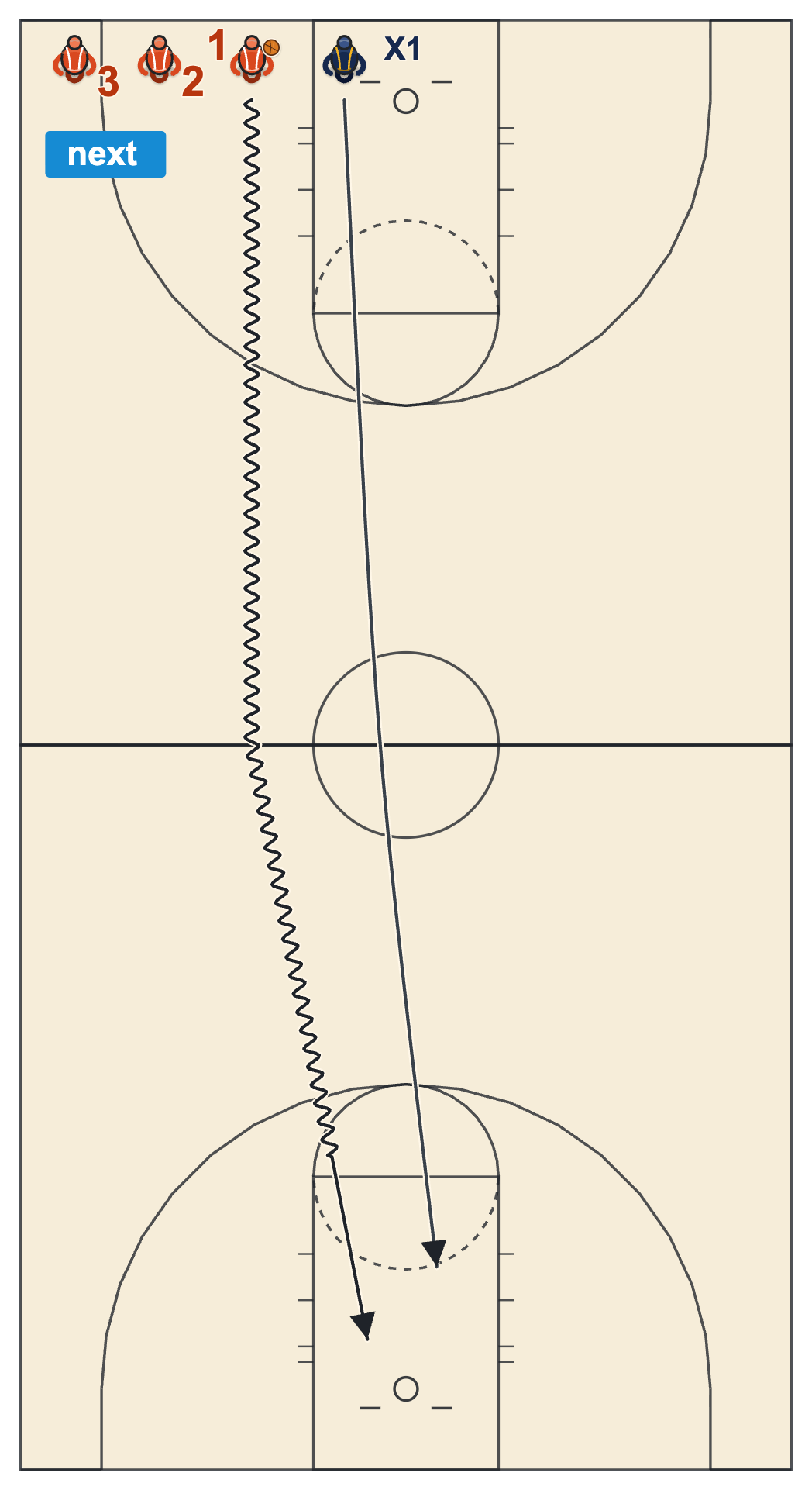
1 on 1 Full Court
- Set it up. An attacker and a defender line up together on the baseline.
- Play it. The offense attacks the length of the floor until it scores or the defense takes the ball. Both sprint to the back of the line and switch roles next turn.
- What it teaches. Handling under pressure, beating one defender and finishing a layup at full speed. On defense, stopping the ball and recovering.
- The question. After a lost ball, ask "What did you see?"
1 on 2
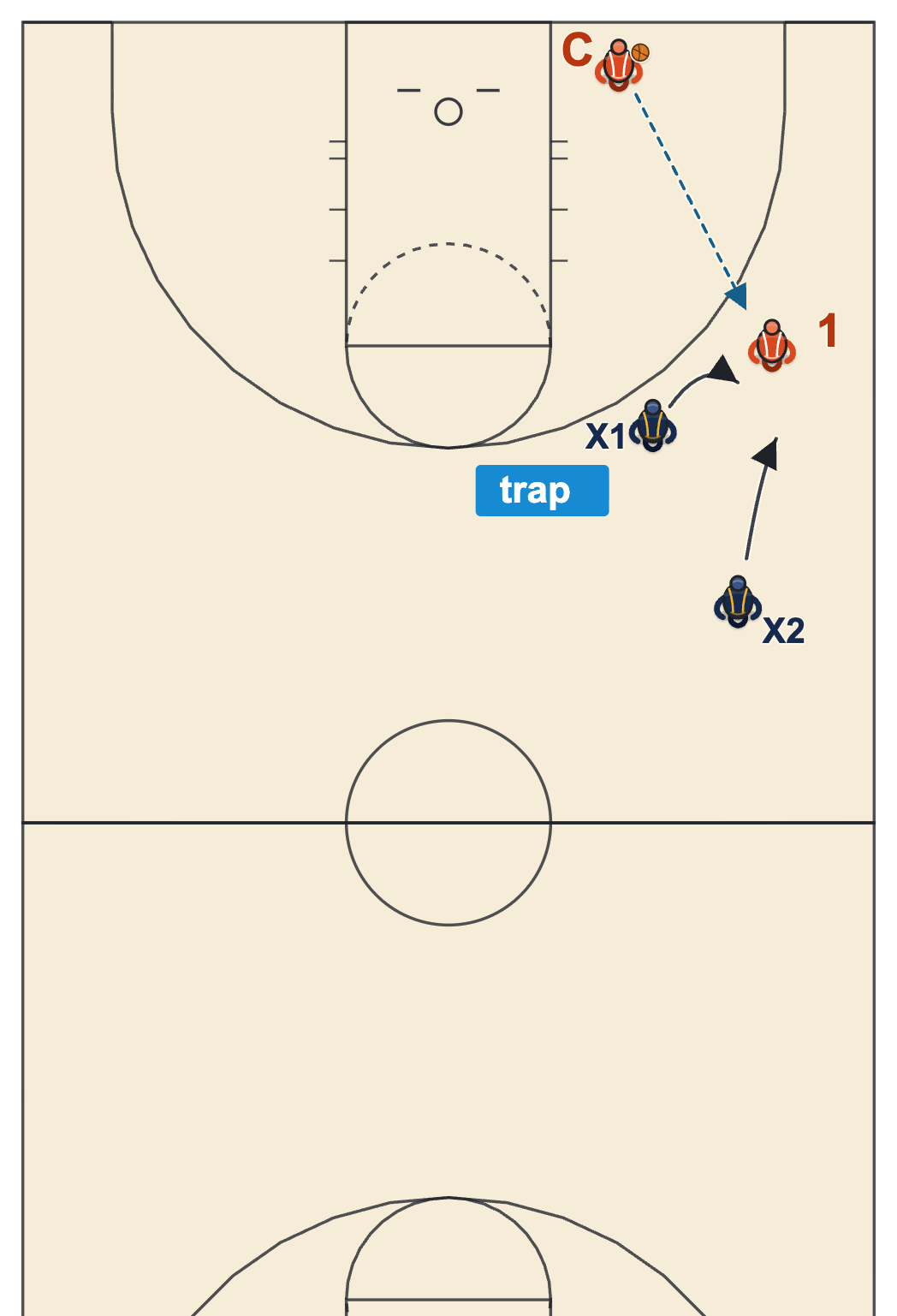
- Set it up. One offensive player against a team of two. The coach starts each rep by passing the ball in.
- Play it. The offensive player gets open, catches and attacks the pressure to score at the far end. The defenders talk, deny the catch and trap once the ball is in. On a change of possession the defense attacks at once, so a steal becomes a 2 on 1 the other way.
- Rotate it. The offensive player stays on for 2 or 3 possessions, then a new group goes. Each group goes three times so every player gets one turn on offense.
- What it teaches. Handling in small spaces, the instant switch to defense, defensive talk, trapping the back pocket of the dribbler and finishing a 2 on 1.
- The question. After the trap takes the ball, ask "Where was the defender's hand?" Where and when to trap is on trap defense in basketball.
2 on 2 Rugby Rules
- Set it up. Best with eight players in four teams of two, two teams on the floor.
- The rugby rule. No pass may go forward in the backcourt. Every pass goes sideways or back until the ball crosses half court.
- Play it. The team that gives up a basket goes out, and a new team comes on offense against the scorers. First team to five baskets wins.
- What it teaches. The player without the ball opens a passing lane, and whoever catches attacks the open floor right away. The defense traps, then recovers to stop the dribble. It rehearses the reversal pass against a press. More is on passing against pressure.
- The question. After a turnover, ask "Where should you have passed the ball?" Then ask why.

3 on 3 Hockey Rules
- Set it up. Best with 12 players in four teams of three, rotating like rugby rules.
- The hockey rule. A forward pass is legal in the backcourt, but the ball must cross half court on the dribble, so nobody throws it over the top.
- Defend it. The defense traps and recovers. The defender outside the trap picks steal or contain.
- What it teaches. How to space and pass when the ball gets trapped, how to beat a press, and on defense how to trap and get back.
- The question. When a pass gets picked off, ask where the pass belongs when the defender is backing up.

Pick the game that fits the number of players in the gym and start.
Closeout Scoring Games
These games train attacking a defender 1 on 1, reading the defense and getting to the rim. In the 2 on 2 game, both defenders start in the lane holding the ball, while one attacker waits at half court and his teammate sits in the corner. The top defender passes out to half court and closes out, and the bottom defender closes out to help or to deny.
- Two passes. The offense attacks the basket and may make two passes.
- Score it. 2 points for a layup, 1 for a defensive foul, 1 for a made three.
- Stay on. A score keeps the offense on. The defense needs a stop to go to offense, and a new team then comes on to defend.

The offense follows simple rules. A defender in a hard deny, or one who turns his back on his man, gets an automatic backdoor cut. The corner player holds the corner until the help commits, then slides up the three-point line. After a pass, the passer fills a corner. The 3 on 3 game adds a player in the slot and allows three passes. When a driver passes up an open lane, ask "What did you see?" Closeout technique is on closeout basketball, and the questioning habit is on teaching basketball decision-making. Keep score every rep.
Defensive Footwork Between the Games
Footwork is one of two places, with shooting form, where practice steps out of live play for a short breakdown, and not every practice. It gets taught, then trained inside the games, 1 on 1 full court above all. More is on basketball defensive footwork.
- Push drill. In an athletic stance, push off the trail leg once, then three times and stop on balance, then three slides each way, then follow the coach's point.
- Mirror defense. Partners face each other. The leader moves sideways and the defender keeps his nose on the leader's chest for 20 to 30 seconds.
- Hip turn. A quick hop that swings the hips a quarter of the way toward the new direction, used instead of a plant and pivot or a drop step. Build it from foot-fire to a turn and one push, then three pushes, then a baseline closeout toward the coach, who stands at the top of the key and points the way to hip turn.
- Crossover step. Half a carioca: the crossing foot steps in front and never goes behind. Use it for 1 or 2 steps when the dribbler gains a step, and sprint if that does not catch him. Then take it to live 1 on 1.
Teach the feet, then let the games train them.
Transition Defense: Army and the Numbers Ladder
Army drill. Put 3 to 5 attackers along the baseline, each facing a defender who stands level with the free-throw line. One attacker gets the ball and the offense breaks. The defender across from the catcher touches the baseline before he retreats, and the rest sprint back to slow the break until he arrives. Play a set number of possessions and count baskets.

The numbers ladder. Start 2 on 1 one way. Each time the ball changes hands, two fresh players join and attack the other way: 3 on 2, 4 on 3, 5 on 4, and the last player joins for a two-minute 5-on-5 scrimmage.
- Alone against two. Fake at the ball, then drop between the two attackers so they have to pass, and contest the shot.
- Two back. One protects the basket and the other stops the dribble and turns the ball handler toward a sideline.
- Match up from the middle. Players coming back find the most dangerous man first, middle out.
More is on transition defense drills and the 3-on-2, 2-on-1 drill. Shrink the floor and make the offense decide.
Dribble Rules and the Passing Builds
- Go north and south. When the defender turns the dribbler's shoulders to the sideline, the defender is winning. Never dribble side to side.
- Dribble with a reason. Dribble only to get balanced or to go somewhere. Otherwise pass to a more open teammate.
The passing builds run at game speed with no defense, then go live. In the 2-on-0 corner build, the ball handler attacks from half court, passes to the corner player and shallow cuts to take his spot. Rep a backdoor bounce pass, a pitch and drive, a pitch and pull-up just inside the elbow, a catch and shoot three, and a deep drive that kicks to the corner. It leads into 2 on 2. More handling games are on youth basketball dribbling drills. Every dribble goes somewhere.
The Blood Ladder
Blood is a live transition series. Kampe's Blood 11, Walberg's Blood 22 and 32 and Calipari's version share one start rule: the defender on the ball waits at the center circle until the ball handler gets there. In zone terms, the rack is the rim, the drop is the stop spot around the free-throw line for a driver who cannot get to the rim, and the drag is the ground between, all laid out on dribble drive zones. The varsity version is on dribble drive drills.
Greg Kampe's Blood 11, 22, 33 and 44
- Blood 11. Two teams, one on each sideline, with players from both on the baseline. The coach throws to 1 as he runs. X2 starts chasing the moment the ball is thrown, and X1 cannot move until 1 reaches the jump circle. One shot, then a 2 on 1 comes back. Switch and repeat.
- Blood 22. 2 on 2. The coach throws to 1 or 2 as he runs, the possession lasts until a stop or a basket, then X1 and X2 attack going back.
- Blood 33. Live 3 on 3, one team on offense for a set stretch, four minutes in Kampe's example. A defense that steals it can run the break. 1 works to deliver the ball into a drop zone while 2 stays low and late in the corner.
- Blood 44. A fourth attacker in the other corner or at the top of the key. If 1 reaches the drop zone and 2 is not open, he turns and skips to the far wing.

Vance Walberg's Blood 22, 32, 33 and 44
- Blood 22. Continuous 2 on 2. Each team fills the 1 and 4 spots, and the other team's 1 and 4 guard them. 1 sprints up for the coach's bounce pass and attacks through the center circle, where X1 waits. He looks for the rack zone, and if he has not beaten X1 he stops in the drop zone. A stop in the drag zone counts as a turnover. One shot and a tip, then X1 stays on and attacks the other way.
- Blood 32. Each team adds a player in the 2 spot with a defender. On 2's side, 1 is limited to the rack and drop zones. On 3's side he may also use the drag zone.
- Blood 33. The 3 replaces the 2, and on 3's side 1 is limited to the rack and drop zones.
- Blood 44. 4 on 4 half court with two coaches. Short on players, go full court one way and keep the defense on until it gets a stop.
- The stakes. Games go to 8, and the losing team sprints the floor and back inside 10 seconds. The player who scored the winner must make a free throw, or the win does not count and his team does five push-ups.
John Calipari's 2 on 2 to 4 on 4
Calipari runs it 2 on 2, 3 on 3 and 4 on 4 with alternating possessions. 1 loops to the middle for the coach's pass, and X1 stands on the half-court line until 1 reaches the jump circle. Two corner rules teach spacing:
- Ball going away. Come up out of the corner.
- Ball coming at you. Wait until it reaches the three-point line, then burst out and meet it at about the wing.

His cue: fast feet, slow mind. Climb the ladder one number at a time.
Get the next coaching guide in your inbox
One email when a new guide or diagram set goes up. Free.
Running These Games in a Youth Practice
A youth team running this ladder practiced twice a week for two hours. A typical night:
- 30 minutes. 2 on 2 rugby rules.
- 20 minutes. Ball handling and shooting breakdown.
- 10 minutes. Full court layups.
- 60 minutes. Full court 3 on 4, then 4 on 4, 4 on 5 and 5 on 5.
With a full court open, nothing ran half court. With up to 15 players, one group worked on ball handling while the other shot, the only part of practice without a score.
The scrimmage ladder. To teach a trapping press, start 3 on 4: three defenders match up and a safety at half court takes away the pass over the top, which gives the trappers confidence. After a score or a steal the new offense attacks 4 on 3 and must create a 2 on 1. Then go 4 on 4, 5 on 4 and 5 on 5. Press rules are on full court man to man pressure.
When to stop play. Play through one mistake. If the same one shows up a couple of times, stop it the next time and walk through it while it is fresh. The younger the players, the more the coach leans toward letting them play.
Ask, then guide. Replace "That was a bad pass!" with a question about what the player saw.
Warm up moving. Open with a dynamic warm-up instead of static stretching: jogs, skips, lunges, carioca and bounds. More is on basketball warm-up drills, timed plans on youth basketball practice plans and more drills on basketball practice drills for youth. Keep them playing.
Questions Coaches Ask
What are the best youth basketball drills?
Live small-sided games run full court: 1 on 1 full court, 1 on 2, 2 on 2 rugby rules and 3 on 3 hockey rules, then closeout games and a scrimmage ladder up to 5 on 5.
What is 2 on 2 rugby rules in basketball?
A full court 2 on 2 game where no pass may go forward in the backcourt, so the off-ball player has to open a lane and the defense practices trapping.
What is the Blood drill?
A live transition series where the defender on the ball waits at the center circle until the ball handler reaches it. Greg Kampe's version climbs from Blood 11 to Blood 44, and Vance Walberg's adds zone rules and a free throw to validate each win.
How much of a youth practice should be live play?
In this approach 75 to 95 percent, with short breakdowns for shooting form and defensive footwork.
Want the printable playbook packs?
Playbook packs: zone attack, press break, press defense, out of bounds, quick hitters, practice plans and the youth turnover cure, each a printable PDF. Or draw your own version free in PlayDraw.
See the playbook packsMore Youth Coaching Guides
Back to Youth Basketball Player Development and every Player Development page.
Keep Building
Related breakdowns
Youth Basketball Player Development: Skills by Age
Youth basketball player development for ages 6 to 14: what to teach first, what each age works on, how practice splits, equipment by age and what to hold back.
Youth Basketball Dribbling Drills: Cone Drills and Games by Age
Youth basketball dribbling drills for kids: finger-pad work, eyes-up games, cone dribbling drills, line drills and harder drills by age.
How to Shoot a Basketball Left Handed: Form, Layups, Drills
The left-handed jump shot and layup as a mirror of the standard form: hand and foot set-up, step-in footwork, lefty mistakes and the drills that fix them.