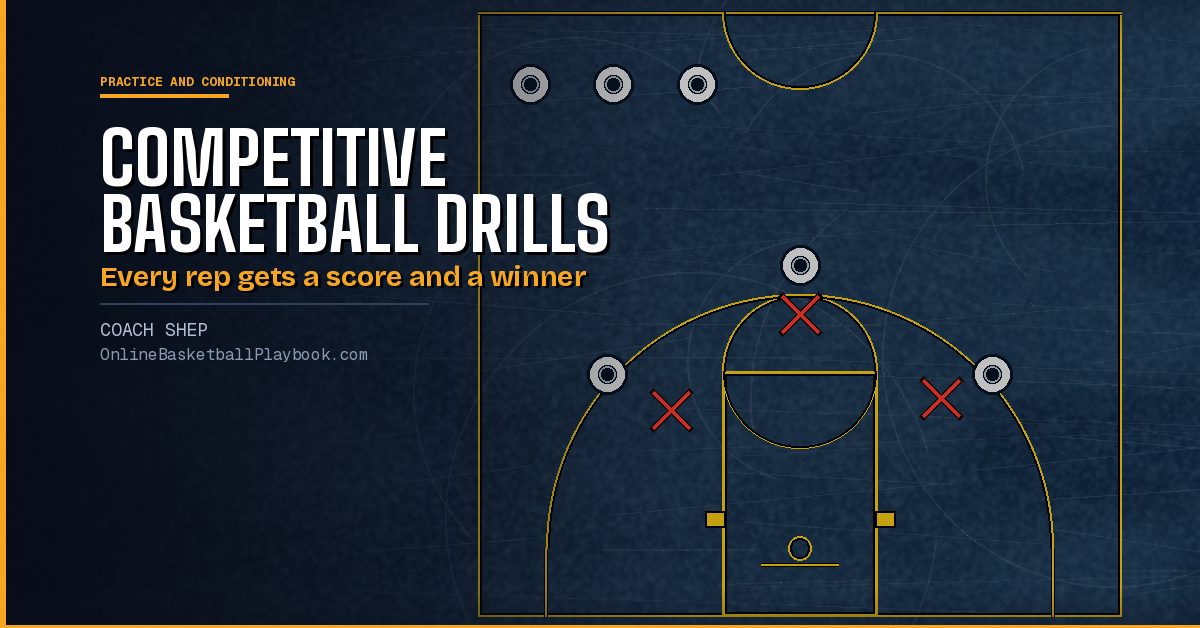
Competitive basketball drills give a practice rep a score, a winner, a loser and a cost for losing, so the drill does the correcting instead of the coach's voice. This page is the competitive practice hub for the practice and conditioning section. It covers the scoring formats coaches use, what the losers owe, the free throw that validates a win, how scored reps carry over to games, and where coaches disagree. The drills themselves sit on the guides linked from each section.
Why Competitive Basketball Drills Carry a Score
Put a score on every drill that can carry one. Jim Calhoun makes everything in practice competitive and says the head coach has to start it, with consequences and penalties. Another version makes every drill competitive with a penalty for the loser. The reasons: competition builds toughness and chemistry, moves a team toward being player-led and player-coached, and is the best way to fix problems.
There are four ways to make any drill competitive: a clock, an opponent, competing against yourself, and a goal. Another version builds every drill from two parts, point criteria (how it is scored) and innings (how many timed rotations it runs), and never uses more than three scoring criteria in one drill. One version picks the focus of the drill first, then docks points or possessions when the team fails it. Drill-building rules of this kind are collected on basketball drill design principles.
Not every coach scores everything, and not every coach scores from day one. That disagreement is laid out under Where Coaches Split.
The Scoring Formats
The drills on this page use one of four counts: makes, stops, possession blocks, or a plus and minus total. How points and possessions add up in a real game is covered on basketball scoring systems.
Makes
Streaks that reset. One version of a layup drill asks for as many makes in a row as the team has players, 12 with 12, and any miss or bad pass sends the count back to zero. A shooting version needs five straight makes at each of five spots. One free-throw version asks for 6 in a row within 5 minutes, raised to 8 for varsity boys.
Timed team targets. Make 10 to 15 threes in two minutes or the group runs. Two other coaches each want 80 layups in two minutes, and another wants 90 in four.
Individual counts. Counting makes, attempts or time removes the need to coach effort, so set hard goals on purpose to see who competes.
Stops
Only the defense scores. One 3-on-3 drill lets only the defense put up points. Privilege games pay the defense for its habits: one version pays 1 for a defensive rebound, 2 for a turnover or steal and 3 for a charge, and raises the charge to 5 if nobody is taking them. Another pays 1 for a stop and 2 for a turnover. Two clock games run the clock only while one team defends: a steal or deflection takes time off, and a score or a foul adds time. More of these are on competitive defense drills.

Earn your way off defense. One version makes the scrimmage defense get 4 to 6 stops before it may run offense, so there is no dummy defense. Several others want three stops, some of them three in a row. One screen-defense drill wants four stops and counts two turnovers as one. One version puts the rule on the 4-on-4 shell, and the drill itself is on the shell drill.

Possession blocks
Blocks of possessions. One pro version of 5-on-5 is a game to 2 where a point needs scores on 3 of 5 possessions, a foul counts only if both free throws fall, and a turnover flips possession. Play 4-possession and 6-possession games because they match real game sequences. The offense-defense-offense game is won 2-1 or 3-0.
Scoring the decision. One shot-quality game scores each possession 0 to 5 for the quality of the shot, plus the shot's value of 2 or 3. A wide-open missed three scores 5 and a made, contested mid-range shot scores 4. One shot-selection scrimmage keeps a secret score with a manager: 3 for a great shot even if missed, 2 for a good one, 1 for a shot-clock shot, 0 for a bad three, and minus 2 for losing the ball without a shot.
Plus and minus
Weighted scrimmage points. One scrimmage rubric pays plus 3 for a charge or an assist, plus 2 for an offensive rebound or a dive on a loose ball, and takes 2 away for a turnover or a foul. One scrimmage pays 3 in the paint and 0 for a made three, to push drives.
A ledger for the whole practice. In the squad version, two squads start the day at 50 points, every live drill scores against one point table, and the losers run three down-and-backs in 9 seconds each plus one 30-second sprint. In another, a manager posts a win sheet of tally marks per player after every practice. The way that ledger feeds playing time and standards is on accountability in your basketball practices.
Winners, Losers and Consequences
The versions differ on what, if anything, the loser owes:
- A timed sprint. Time every losing sprint so it cannot be jogged. A timed suicide works and a down-and-back does not.
- Push-ups. Several versions use push-ups as the price of a lost drill.
- A short sprint, never a running block. One version lists the downsides of a standalone running block, among them that players save effort earlier in practice when they know it is coming. It keeps one short sprint only as the price of a lost drill.
- The ball in every conditioning rep. One version does all conditioning with the ball and runs players only as punishment. Another bans any drill that exists only for conditioning.
- Run for the concept, not the loss. Jay Wright runs players for failed team concepts and never for losing.
- A random cost. Keep consequences random, so a player cannot weigh a known cost against skipping a job.
Who pays splits coaches too. In one European pro version the whole team runs when one player errs, so teammates talk to each other instead of to the coach. Other programs run only the losing squad. Dean Smith never substituted on a mistake when the player was trying, and ran sprints for pride, not punishment.
The cautions are specific: a token cost such as a down-and-back in place of a timed suicide, more than three scoring criteria, which is the most players can understand and execute, and a defense with nothing at stake, which gives the offense a false picture. Keep every scored drill to 4 to 6 minutes and prefer two 4-minute drills to one 8-minute drill. One version pairs every competitive drill with a debrief where players say what worked, and counts sportsmanship as part of competing. How to keep that edge without losing the room is on a competitive yet supportive coaching environment.
Get the next coaching guide in your inbox
One email when a new guide or diagram set goes up. Free.
The Free Throw That Validates the Win
Several programs make the winner prove it at the line. The versions differ in who shoots and what a miss costs:
- Version 1. The drill winner earns a free throw. The loser owes a timed sprint, and a missed bonus free throw costs the winners 10 push-ups.
- Version 2. The player who scores the winning basket has to make a free throw or both teams run.
- Version 3. In a scrimmage, the winning team has to make a free throw to lock in the segment.
- Version 4. Team and competitive drills end with made free throws, so players shoot under pressure while tired and the segment has a real finish.
- Version 5. The winners make a free throw and still have to get one more stop, or the win does not count.

Two programs use free throws as the only rest in a hard practice, 3 to 4 minutes of them every 30 to 40 minutes. Shoot pressure free throws between drills, with a miss costing two sprints. Free-throw games with a team stake are on free throw drills.
From Practice to the Game
The drop from practice to game is game slippage, and the team that slips less has a definite advantage. One version says habits are conditioned reflexes that do not change at tip-off, so whatever practice tolerates shows up in games. The fixes:
- Match the length of a game sequence. Short possession games, such as the 4-possession and 6-possession games above, or mini-games of 6 or 7 baskets, win by two.
- Budget time for situations. Mike Krzyzewski's 1988 split was 30 percent offense, 30 percent defense, 30 percent transition and 10 percent situations, in a practice never longer than two hours.
- End practice on a situation card. Keep 21 scenario cards (score, time, who has the ball, foul status) and pull one at the end of every practice, with coaches on the bench, timeouts, subs, a clock and officials.
- Officiate and chart the scrimmage. One version has assistants referee every scrimmage and keeps statistics with running totals, and says slippage starts in scrimmages nobody officiates or analyzes.
Whether to stop a live segment to teach is its own split. One version corrects only between segments. Another re-runs the failed possession at once against a dummy defense. Another stops and repeats a rep until it meets the standard, and one stops only to praise a possession. Late-game rehearsal is on drills for late game situations, and the scrimmage formats are on basketball scrimmages.
Ball Toughness Under a Score
Ball toughness is sureness with the ball under pressure: holding, passing, catching and dribbling with control while a defense reaches and traps. One version scores it directly. Its 3 on 3 gives no point for a catch unless the catcher rips or sweeps the ball, plays to 10 passes, and the loser runs the difference, a down and back per point.

Coaches price turnovers several ways. One version puts 15 balls on a rack and pulls one per turnover, and once the rack is empty every player runs a sprint per turnover for the rest of practice. Another keeps two balls in the rack and sets a consequence at three team turnovers. The other side, for honest errors: a turnover made with full effort and focus gets a correction of the read, not a punishment.
No-dribble passing games score the ball's movement. One version pays 1 per pass, 5 for a layup and takes 1 away for a turnover. Another plays four on four at 1 per pass and 5 for a layup.

The Formats in One Table
| Format | What it counts | One version | Guide |
|---|---|---|---|
| Streak | Makes in a row | 6 free throws in a row within 5 minutes, 8 for varsity boys | Free throw drills |
| Timed target | Makes on a clock | 10 to 15 threes in two minutes or run | Three-point shooting drills |
| Defense only | Stops | 1 defensive rebound, 2 turnover, 3 charge | Defense drills |
| Earn your turn | Stops before offense | Three stops to get out | Shell drill |
| Possession block | Scores per set of trips | 3 of 5 possessions for a point | Scrimmages |
| Shot quality | The decision | 0 to 5 for the shot plus its value | Scoring systems |
| Plus and minus | Weighted plays | Charge plus 3, turnover minus 2 | Accountability |
| Squad ledger | Every drill all day | Two squads start at 50 points | Practice plan |
Where Coaches Split
Score everything
Make every drill a contest, with a penalty for the loser. A drill without competition is a waste of time.
Compete after it is learned
One order runs Detail, Speed, Contest, so early reps stay slow enough for correct habits. Another makes drills competitive only after they are learned, and one teaching model puts competition fourth of five steps.
Big scrimmage or small games. One version's scored 5-on-5 scrimmage takes 20 to 30 minutes a day. Another wants fewer 5-on-5 scrimmages and more 1 on 1 to 3 on 3 games with rules that force touches, and the youth floor is 15 minutes of an hour in small-sided games. The case for small games is on reasons to use small-sided games.
Running as the price. The consequence list above is the split itself: timed sprints, push-ups, one short sprint, the ball in every rep, or running only for a failed concept.
Questions to Settle Before Practice
- Which count fits the block: makes, stops, possessions or a weighted total?
- How many scoring criteria, and are there three or fewer?
- How long does it run, and how many innings?
- What does the loser owe, and is it timed?
- Does the winner validate it at the line, and what does a miss cost?
- Who keeps score, and where is it posted?
Where the scored blocks sit in the day is on basketball practice plan, and the defensive breakdowns that feed them are on basketball defense drills.
Questions Coaches Ask
What are competitive basketball drills?
Drills with a score, a winner, a loser and a cost for losing. Coaches score makes, stops, possessions or a weighted plus and minus total.
How do you make a basketball drill competitive?
Add a clock, an opponent, a personal record or a goal. One version gives every drill point criteria and a number of timed innings, with no more than three criteria.
What should the losing team do?
Coaches differ: a timed sprint, push-ups, one short sprint, or no running for a loss at all. One version keeps the cost random.
What is a validation free throw?
A free throw the winner must make to lock in a drill or scrimmage win. In different versions a miss costs push-ups, both teams run, or the win does not count.
Want every diagram, printable?
OBP Pro members get the full diagram files for every drill and setup on this page, ready for a practice binder or a staff meeting. $9 a month. Or draw your own version free in the play drawer.
See what OBP Pro includesMore Coaching Hubs
- How to Run a Basketball Camp: Schedule, Stations and Drills
- How to Build a Basketball Program: Identity, Staff and Culture
- Basketball Leadership: Captains, Accountability and Toughness
- Basketball Scouting: How to Scout a Team and Build the Report
Back to every Practice and Conditioning page.
Keep Building
Related breakdowns
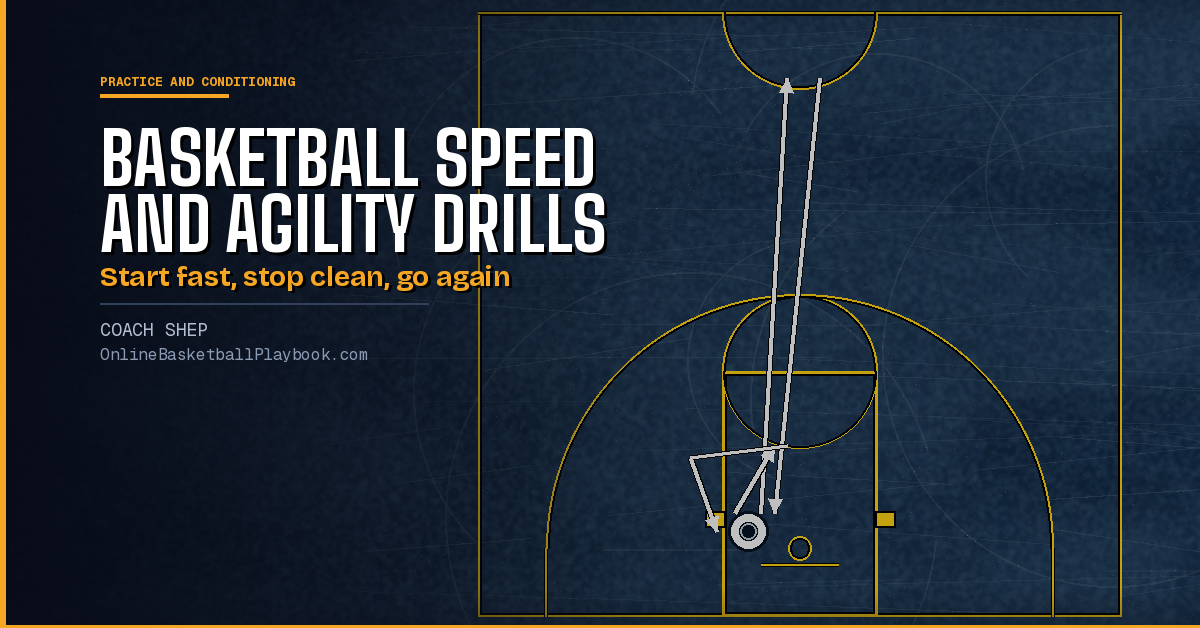
Basketball Speed and Agility Drills: Sprints, Starts and Stops
Basketball speed and agility drills for teams and players: short sprints, starts and stops, court drills with cones, an eight-week summer plan and how to dose rest.
Fun Basketball Games for Practice: Scored Games for Any Team
Fun basketball games for practice at any level: shooting games, defense-only scoring, rebounding contests and passing games, with scoring rules and records.
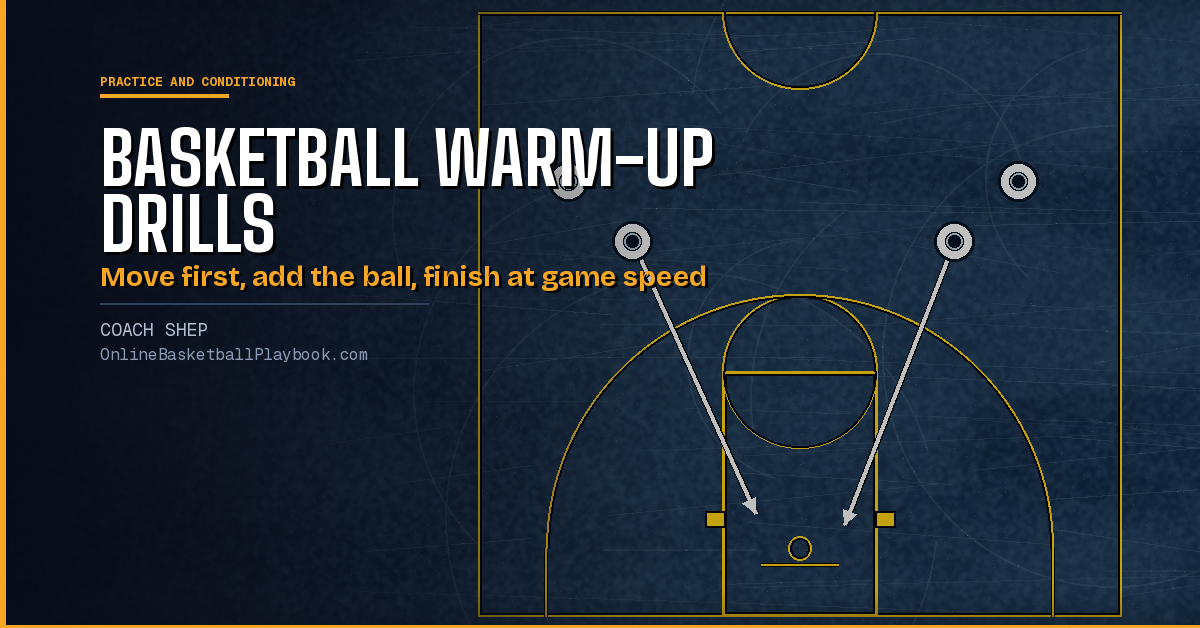
Basketball Warm-Up Drills for Practice, Games and Youth Teams
Basketball warm up drills from dynamic movement and ball work to layup, closeout and shooting lines, with warm-up lengths and the static stretching debate.