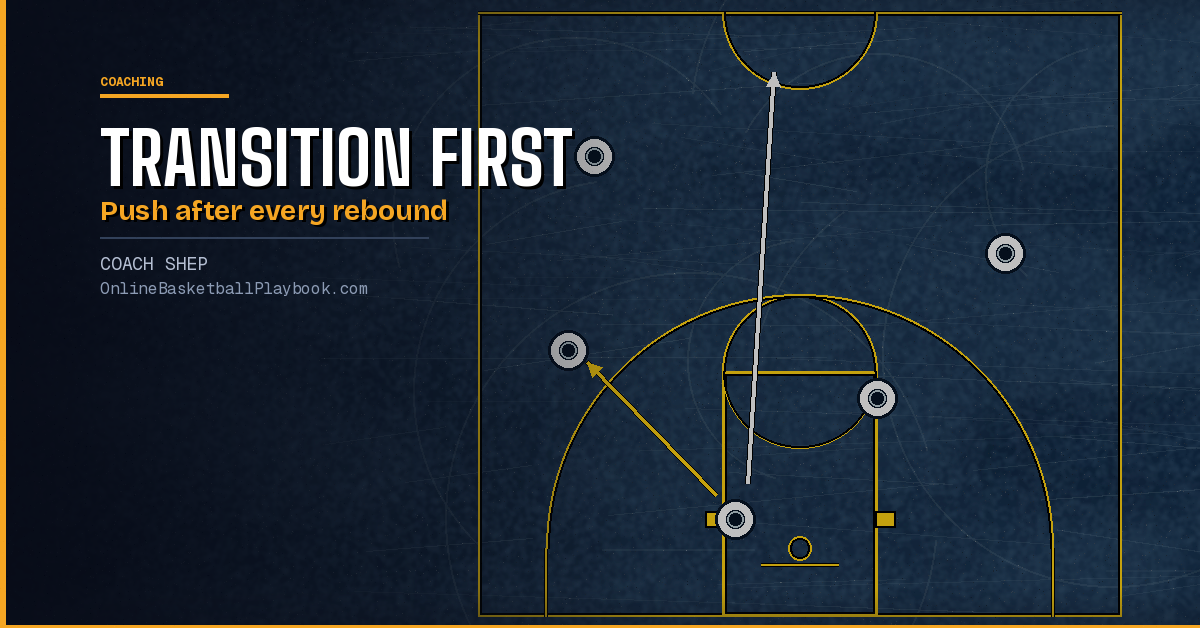
A transition first program model builds the whole program around one habit: push the ball up the floor after every defensive rebound and take what the defense gives. The offense, the defense, the practice plan and the standards all feed that habit.
This page lays out Coach Shep's version of the model, piece by piece: the beliefs, the break, the half-court offense, the defense, the practice day and the program around it. The fast break itself, lanes, reads and drills, is taught on transition offense basketball, and the wider program build is on how to build a basketball program.
The Three Core Beliefs
Pick the three areas the team must be best at, write them down and judge every decision by them. Coach Shep has put the same three areas in different orders:
- Ball, rim, shot. No turnovers, no layups, shot selection.
- Ball, shot, contain. No turnovers, great shot selection, contain the basketball.
- Value, discipline, contain. Value the basketball, disciplined shot selection, contain the basketball.
Taking care of the ball comes first in every order. His more recent list of play-style pillars runs six: shot selection, no turnovers, transition game, drive and kick, offensive rebounding and free throws.
Whatever three you pick, post them and coach every drill back to them.
The Transition First Program Model on the Break
After every defensive rebound, push the ball up the floor and see whether there is an advantage. A good shot is a layup, or an open shot for a very good shooter. Coach Shep has organized the push two ways:
- Anyone brings it up. There is no primary point guard. Whoever rebounds can push it.
- Outlet and run wide. The rebounder outlets to the point guard. The wings run their lanes wide and fill both corners, and the bigs run the lane on the side away from the ball and trail.


When the first wave has nothing, the team flows into a sideline push or a free-throw break. How a secondary break flows into the half court is on secondary break basketball, and the drills for the primary break are on how to run the fast break.
Run after every defensive rebound, and pull it out only when the defense is back.
Layups and Threes
The shot diet is the second half of the model. Think layups and three-point shots, in that order:
- Inside out. Work the ball inside out, attack the basket and earn free throws.
- Cut the mid-range. Eliminate most mid-range dribble-up shots.
- No bad odds. No contested shots and no one-on-two shots.
- Two shot calls. The call "One" means get a quick scoring opportunity. The call "Four" means move the ball and only look for layups.
Coach Shep's dribble drive version of the same diet allows pull-up jumpers for the point guard only. Shot choice in more detail is on basketball shot selection.
If it is not a layup or a good three, pass it again.
The Half Court: No Called Plays
When the break is stopped, the team settles into a 2-3 high motion offense with no called plays. Coach Shep gives three reasons for it: it attacks any half-court trap without changing alignment, it is hard to scout because nothing is called, and it runs on mental quickness, fundamentals and shooting rather than on remembering sets.
The rules every player learns:
- Cut more than screen. Cutting matters more than screening here. Find open space, set screens and read.
- Cut credibly. Look for the ball as you come open, then get back outside quickly.
- Stand judiciously. Float to an open spot and occupy your man.
- Ball in the air, feet in the air. Move while the pass is traveling.
- Do not run to the ball. Think change of direction, and think five players high.
- Dribble with purpose. The other four read the dribbler.
- Counter everything. There is a counter for everything the defense does. Any denial, cut backdoor.
- Hit the cutter. Use a bounce pass to the cutter, and a one-hand pass is fine.

Behind the rules sits a line Coach Shep repeats: unselfishness is more important than brains, coupled with discipline. A player who can pass, dribble and shoot dictates to the defense, and a player who cannot lets the defense dictate. The backdoor read is taught in full on cut or backdoor: reading the denial, and motion rules on motion offense basketball.
Teach the rules, not the plays, and the scouting report has nothing to read.
Get the next coaching guide in your inbox
One email when a new guide or diagram set goes up. Free.
Defense: One Contested Shot
The defense has one goal: force one contested shot each time down the floor. No layups, no second shots, no rhythm shots. The team target is 8 to 10 points allowed a quarter, and defense is a "we" job.
Five stages, built every day.
- Conditioning. Skills are useless without being in shape.
- Stance and footwork. The team is good when all five can stay down in a stance.
- The ball. One on one is the foundation. Contain the ball baseline to baseline.
- One pass away. Play the gap between the ball and your man, ready to help. This is not a denial team.
- Help side. Ball side makes the team tough, and help side makes it successful. Its three jobs are deny the flash to the post, slide through screens and stop penetration.
Move on the pass, not the catch. Take one big step off the line of the ball, keep a hand above the ball, move and then look.

The jump to the ball drill then adds cutters. After the pass to the wing, the passer cuts straight to the rim and the weak-side player cuts into the lane, where the helper bumps him, and he replaces to the top of the key.
Stay away from the player on the block, recover to help when the ball goes from the wing back to the top, and do not follow a man to the corner. Down screens, flash screens and UCLA screens come later.

The rest of the build.
- Closeouts without leaving the floor. Four successful closeouts with no baseline layups, staying in the stance and never jumping to block.
- Shell with an exit. 4-on-4 shell ends only after three stops with no offensive rebound.
- Ball screens every day. Six ball-screen coverages are taught daily.
- Pressure. Force the ball to the sideline and toward the baseline, which is an extra defender, trap from the blind side, and rotate zone looks during a game.
The teaching order Coach Shep has used is stance, conditioning and footwork, then on-ball defense with high hands, then jump to the ball, then screens with pads, then ball screens and penetration, and it goes live and competitive once it is learned. More on the drills is on man to man defense practice drills and the shell drill.
Give up one contested shot, rebound it, and run.
The Practice Day
Coach Shep's line is that 99 percent of games are won or lost on the practice floor. The clock rules:
- 1 hour 45 minutes. Enough when practice is hard and continuous.
- Free throws are the rest. The only break is 3 to 4 minutes of free throws every 30 to 40 minutes.
- Five-minute drills. No drill runs longer than 5 minutes.
- Ten-minute offense. No offense block runs longer than 10 minutes. If it needs more, split it into two blocks instead of drilling it until players go through the motions.
- Purpose and a winner. Every drill has a purpose, a winner and a loser.
- Open and close. A quote of the day, and practice ends on a positive note.
The week. Monday is defense and rebounding, the toughest day. Tuesday is offense and lighter. Wednesday is defense, Thursday offense, Friday defense and rebounding, Saturday a scrimmage.
A 10-minute block of two-man hustle drills sits in the same slot every practice. It is laid out on mental toughness in basketball.
Short drills, hard pace, and the clock never waits for the offense.
Score Everything
Every drill is scored between two squads. The winner earns a free throw, the loser owes a timed sprint, and a missed bonus free throw costs 10 push-ups. Competition builds toughness and chemistry and moves the team toward being player-led. Scrimmages use a performance rating:
| Play | Points |
|---|---|
| Made two or missed two | +2 or -2 |
| Made three or missed three | +3 or -3 |
| Made free throw or missed free throw | +1 or -2 |
| Offensive rebound or defensive rebound | +2 or +1 |
| Assist to a score | +3 |
| Turnover | -2 |
| Steal | +1 |
| Charge taken | +3 |
| Foul | -2 |
| Dive on a loose ball | +2 |
The table pays for the assist, the charge and the offensive rebound, and takes points away for misses, turnovers and fouls. Scored formats in general are on competitive basketball drills.
If it counts in the game, put a number on it in practice.
Standards, Scouting and the Pipeline
Four other full program models are on program culture case studies.
Coach and player. Coach Shep says he is a teacher first. Three questions run both ways between every coach and every player: can I trust you, are you committed, and do you care about me?
Discipline. Coach Shep calls discipline the key to teaching, coaching and life. A coach who is fair and consistent, with respect running both ways, cannot be too strict.
Scouting. Keep every game film and a file on each opponent. The written report marks each player as a shooter or a driver, the side he drives, and whether to deny him or sag off, then gives instructions for each kind of possession: transition, half court, under out of bounds and side out of bounds.
The game plan names the attack point against their best defender and the calls to run, and players review it on the bus. The report format is on basketball scouting report.
Game day. Report 90 minutes before the tip and shoot around with form shooting and free throws first. The bench stands and claps for every player leaving the floor, every time. Captains speak first at halftime. Every gym is our home gym.
The pipeline. The plan calls for a feeder program for ages 8 to 12, a clinic for the local youth league's coaches, middle school and freshman teams with players moved up the spring after eighth grade, summer camps, travel teams for all ages and open gym. The walls carry banners, player photos and quotes such as "Movement + Patience = Baskets." One warning Coach Shep gives players: too many games and not enough skill work is the first of five mistakes he sees.
Run the program the way you want the team to run the floor: fast, organized and the same every day.
Questions Coaches Ask
What is a transition first program?
A program built around pushing the ball after every defensive rebound and taking what the defense gives. Coach Shep pairs the push with a layups-and-threes shot diet, a no-called-plays half court, a defense that allows one contested shot and a fully scored practice.
Who brings the ball up in a transition first offense?
Coach Shep has run it two ways: no primary point guard, so anyone who rebounds can push it, or an outlet to the point guard with the wings running wide to both corners and the bigs running the lane away from the ball.
What shots does a transition first team take?
Layups and threes, in that order, worked inside out with trips to the free-throw line. Most mid-range dribble-up shots, contested shots and one-on-two shots are off the menu.
How long should practice be for a fast-paced team?
Coach Shep runs 1 hour 45 minutes with no drill over 5 minutes, no offense block over 10, and free throws every 30 to 40 minutes as the only rest. Practice lengths by month are on basketball practice length by month.
Want every diagram on the site?
OBP Pro members get the full diagram files for every guide on the site, ready for a practice binder or a scouting report. $9 a month. Or draw your own version free in the play drawer.
See what OBP Pro includesMore Program and Practice Planning Guides
- Small Sided Games for Skill Development: Formats and Rules
- Program Culture Case Studies: Four Programs, Four Models
- Basketball Season Planning: The Four Phases of the Year
Back to How to Build a Basketball Program and every Coaching page.
Keep Building
Related breakdowns
How to Build a Basketball Program: Identity, Staff and Culture
How to build a basketball program: identity first, written standards, staff roles, the season calendar, feeder programs and recruiting players who fit.
Program Culture Case Studies: Four Programs, Four Models
Program culture case studies from Obradovic, Dean Smith, Kelvin Sampson and John Beilein: the rules, routines and enforcement each one used, side by side.
How to Become a Basketball Coach: Paths, First Jobs and Steps
How to become a basketball coach: where coaches start, youth, school, club and college paths, entry jobs, coaching education, networks and mentors.