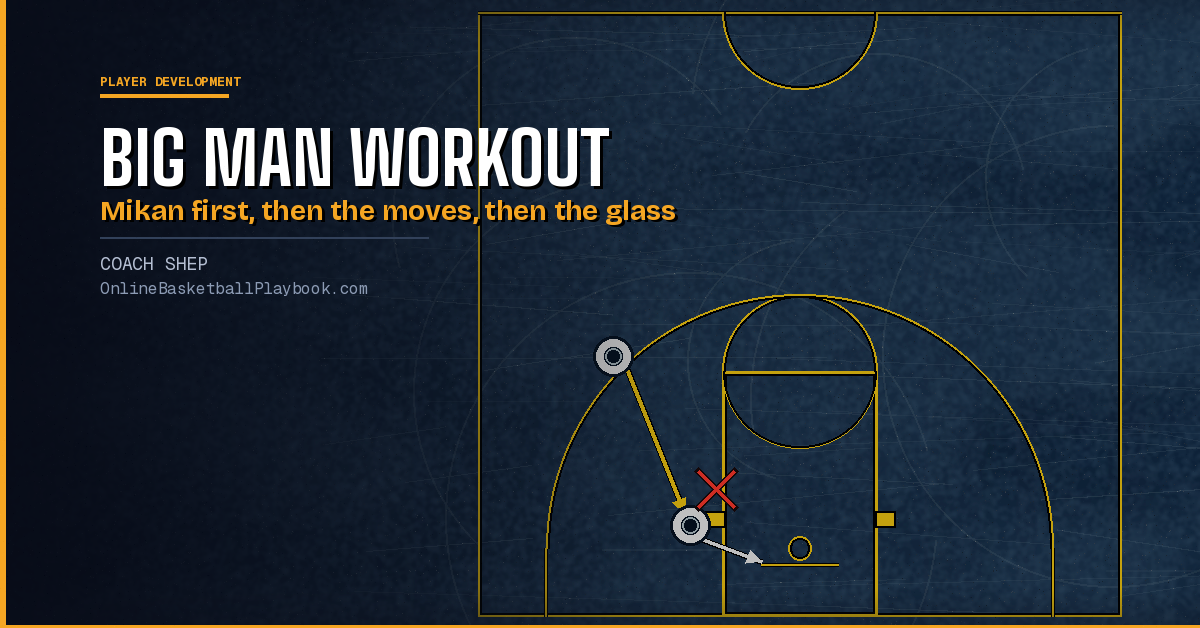
A big man workout in basketball is a post player's own session: finishing at the rim, catching, moves from both blocks, a face-up game, rebounding and free throws, each block with a number to beat. The moves themselves are taught on basketball post moves. This page is the workout that drills them.
The position itself is on the center position. Workouts for every position are on basketball workout plan, under player development.
What a Big Man Workout Has to Build
Build the player before the move list. The traits a post needs come first, and the workout is where they get tested every day.
- Heart, hands, head. Don Meyer wants all three in his posts. His ten traits are aggressive, loves contact, wants the ball, wants to score, points for the ball, strong, in condition, a blue-collar worker, a good free throw shooter and plays without fear.
- Hands you cannot coach. Rick Majerus looks for soft hands, strong hands and a soft touch, says you cannot coach hands, and says never cut bigs early because they develop late.
- The standards of a great post. Run the floor and win the race from foul line to foul line, rebound relentlessly, shoot free throws, and own a go-to move and a counter.
- Post across, not deep. Bigs who post too deep lose the baseline cut and the bounce pass. Post across the lane, not up it, and catch higher.
Pick the traits you will test and put each one in the workout.
Big Man Workout Basketball: The Order of a Session
A post workout runs in a set order, with a clock or a make count on each block. Whichever card you use, keep its order.
| Card | Order and time |
|---|---|
| Pat Summitt's Tennessee post workout | Ballhandling 5 to 6 minutes, quickness and explosion 5 to 6, footwork and finishing 4 to 5 (Mikan, make 20 in a row), explosion layups 7 to 8, shooting 25 to 30, scoring moves 20 to 25 |
| Iowa State daily post workout | Mikan, duck-ins, catch-turn-shoot, step-through, Sikma, short corner release, bounce drop step |
| Georgia Tech post sample | Mikan, flash to the elbow, 5 spots with 15 made, then a move series. Players work in groups of two or three, 45 minutes twice a week |
| Baylor forward menu | Ballhandling and passing first, then post fundamentals (Mikan, the Minnesota hand-strength drill, face and seal), then the paint, off-the-block and face-up series |
| Five-minute blocks | Jump hooks, turnaround jumpers, freeze fakes, up and under, double pivots and mixed moves, five minutes each on both sides |
| Free-throw penalty card | Mikan, reverse Mikan and a tip drill to warm up, then Superman, block-to-block moves and a perimeter cycle, with 10 free throws after every drill |
Choose one card and keep the same order every day.
Open at the Rim: Mikan, McHale and Superman
Start at the rim with both hands and no dribble. The finishing drills warm the big up and build the touch every move ends with.

- Mikan, every day. Majerus runs it daily with the head up and the ball high off the glass, and says a 30-30-30 Mikan takes two weeks to build. Summitt's players make 20 in a row. Georgia Tech runs 20 each way. The full drill is on the Mikan drill.
- Explode to the rim. Kevin O'Neill's cues: eyes on the rim, inside shoulder to the rim, plant the inside foot, kick the outside knee, full arm extension. Then take it out of the net with two hands above the shoulders and keep the ball high.
- Reverse Mikan. The free-throw penalty card warms up with 20 makes each side of the Mikan and 20 each side of the reverse Mikan.
- Four-way Mikan. The traditional drill plus two more layups at the front of the rim.
- Contested Mikan. The coach contests every shot, so the big finishes through contact.
- Power layup series. Go up with two hands, pound the ball on the backboard, keep it above the head coming down, then go back up and score. Ten makes, three sets, alternating sides.
- McHale drill. Majerus tips the ball on the glass while the off hand touches the rim, six tips each hand, and dunks the last one. For the advanced McHale, score on the tenth tap. Sean Miller makes the last tip a live tip-in.
- Superman. Mike Krzyzewski's big-man drill: catch the ball off the backboard and land outside the lane. The free-throw penalty card runs three one-minute rounds: rebound and finish, rebound with a power dribble and finish, and rebound with a power dribble and a reverse layup.
- Board taps and slams. Georgia Tech picks four a day from Mikan, board taps, board slams, one-dribble Mikan, quick dunks, Superman and quick spin.

Krzyzewski's full big-man list is jump and touch the rim, Mikan, Bad Pass, Reaction Pass, Two-Man Two-Ball, offensive rebounding (tip or shoot at once, no power move) and Superman. More finishing work is on finishing and footwork drills.
Make the rim drills the same first ten minutes every day.
Train the Hands
A big with a full move list still turns it over if he cannot catch. Meyer says a team can hide many things, but not a poor receiver, so catching gets its own block.
- Tennis balls first. Meyer's drill starts with one tennis ball, then two with flick passes, then basketballs with a mix of bounce and flick passes. Catch the ball with your eyes.
- Bad Pass. O'Neill's drill keeps a balanced, wide, low stance while the big catches a bad entry, with his hands in front of his chest. Krzyzewski's list adds Reaction Pass.
- Hard passes in volume. Catch 30 to 50 hard, difficult passes a day, the quick dump-offs a guard throws when he drives.
- Hand strength. Baylor's post fundamentals include the Minnesota drill for hand strength.
- Blind pass. The passer calls a name, the receiver turns, catches and finishes, switching hands every rep, with no gather and no pivot.
- Back to back. Billy Donovan sits two posts back to back with their feet always moving while coaches fire balls to them to catch and pass back.
- Two hands, every time. Gonzaga's post rules end with "ALWAYS catch with two hands."
Coach the catch before you coach the move.
Moves From Both Blocks
Run the move list from both blocks, fed by a coach or a partner, with a count for each move. Technique for each move is on post moves and the footwork under it on pivot footwork.

- Five of each, 1-on-0. Gonzaga runs drop step, up and under, jump hook, Sikma pivot and turn shot, five of each. Then a 1-on-1 series with token pressure, 20 reps.
- Ten from each block. Georgia Tech goes block to block, 10 makes from each block on each move: drop step, jump hook, quick spin, up and under, double drop step, turnaround jumper and Sikma.
- One minute a move. The free-throw penalty card gives each move a minute, with a partner rebounding: drop step baseline, turnaround short jumper, drop step middle into a jump hook, reverse pivot short jumper, up and under with one dribble.
- Thirty of each. Block-to-split-line scoring works four moves (jump hook, up and under, up and under into a second pivot, sell middle and spin back baseline) for 30 makes of each on both sides.
- Hold your ground. In 10 Across the big makes 5 moves baseline, 5 middle and 5 turnaround shots, then 5 turnarounds on the other side, holding his position the whole time.
- Rapid fire. Donovan's coach feeds ball after ball, 10 makes of each move, to the baseline or the middle.
- The chair workout. Two chairs near the block hold balls. The big slides side to side, posts up low, grabs a ball and makes a move, one minute at a time, starting with jump hooks.
- The spin-out. Spin the ball out from under the rim to a marker, then run one move: turnaround jumper, drop step, up and under, Sikma or spin. Alternate sides, baseline and middle, and start from the elbow on other days.
Butler asks a post to master two moves on each block before adding more. How many moves to teach is argued on the post moves page.
Whatever list you keep, finish every block from both sides.
Get the next coaching guide in your inbox
One email when a new guide or diagram set goes up. Free.
High Post, Face-Up and Pick-and-Pop Work
Give the big catches away from the block too. A post who can only score with his back to the basket is easy to guard.

- High post flash. Flash to the high post, catch, turn and go to a power layup, a pull-up off the glass or a spin counter. 20 makes on each side.
- High post to block. Start under the basket, flash to the high post to pivot and shoot, then flash back to the block for a drop step. 20 makes each side.
- Flash cut shooting. Donovan starts the big in the short corner, flashes him to the free-throw line, and has him shoot, rip through and drive the other way, or ball fake first.
- Quick reads at the nail. The big flashes to the nail, catches a toss from the coach, squares up and attacks with a shot fake and go, a jab and go, a rocker move and go, or a catch and shoot.
- Face-up series. Baylor's face-up series runs from 12 to 15 feet with the catch in the middle of the body and a pivot on the baseline foot. Guards come down to strip, so stay low and strong.
- Five-spot pick and pop. Pick-and-pop actions with the coach from five spots, the coach calling the next spot at a fast pace. 30 makes.
- Back screen to post up. Back-screen to clear a guard through, then post up with counters (sweep baseline, spin baseline off the middle, baby hook, one-dribble step-back jumper), 15 makes of each.
- Perimeter cycle. The big cuts to a perimeter spot and makes five moves: catch and shoot, catch and rip right with one dribble, rip left, shot fake and attack the rim, shot fake and shoot.
The modern big's passing and short-roll work is on center skills for coaches, and the high-low entry on high-low offense.
Give your big one catch away from the block every workout.
Contact, Rebounding and Running
A post workout without contact and rebounds is not a post workout. Add bumps, a pad and a missed shot to fight for.
- Toughness series. Sean Miller runs Mikans, reverse Mikans, the McHale with a live tip-in, backboard slams with the coach pushing and bumping, a baseline finish after a guard drives and the big flattens out, and an outlet and score drill.
- Offensive rebounding with a pad. O'Neill's big attacks the glass, spins against contact, keeps high hands and rebounds with two hands. Second shots are a dunk or off the backboard.
- War rebounding. Donovan's coach shoots and the bigs fight for position. A rebound is a point, the rebounder has to score for another, and the game goes to 10.
- Game simulation. Make a move and score it no matter what, outlet, sprint to block a shot, then come back and make a different move, for up to four sets. Then one-on-one with one dribble only and a different move each time.
- Catch it tired. Three board taps, an outlet, a sprint, then post up.

Rebounding technique is on rebounding fundamentals and more drills on rebounding drills.
Finish every workout with a ball your big has to fight for.
Make Counts, Free Throws and Standards
Count makes, not attempts, and attach a standard to the go-to move. A number turns a workout into a test the big can pass or fail.
- Made-shot cards. A basic post card totals 221 makes and an advanced card 360. A 355-make advanced card runs Mikan and reverse Mikan, block-to-block and short-corner shooting, a 50-shot move series from each block and elbow moves, then spot shooting.
- Free throws after every drill. The free-throw penalty card ends each drill with 10 free throws. Each make short of 8 costs 20 push-ups, so 7 of 10 means 20.
- A third from the line. Majerus says a third of a post player's points should come from the free throw line, and that wins come from the free throw line. Georgia Tech has every player shoot 50 foul shots a day.
- The 80 percent gate. Gonzaga's 1-on-1 competitive series asks the big to finish 80 percent of his moves. The go-to move should be finished 80 percent of the time against a player his size or shorter.
- A miss costs a sprint. In consequence shooting the big alternates elbow and short-corner jumpers, and a miss means a sprint to the opposite sideline before he goes on.
Coaches split on reps without a defender. Hubie Brown never runs post moves without one, while the volume cards above are mostly unguarded. The full debate is on post moves. Free throw work for every player is on free throw drills, and a full plan by position on individual basketball workout plan.
Post the numbers, and let the big chase his own record.
Questions Coaches Ask
What should a big man workout include?
Finishing at the rim (Mikan, McHale, Superman), catching drills, post moves from both blocks, a high-post and face-up block, contact and rebounding, and free throws, each with a make count.
How long is a big man workout?
Georgia Tech's small-group workouts run 45 minutes twice a week. Pat Summitt's post card adds up to 66 to 80 minutes across six timed blocks.
What is the best drill for big men?
The Mikan drill opens the Iowa State and Georgia Tech post workouts and anchors Pat Summitt's footwork and finishing block. Majerus pairs it with the McHale drill every day.
How many post moves should a big man work on?
Butler asks for two moves mastered on each block. Gonzaga's 1-on-0 list has five: drop step, up and under, jump hook, Sikma pivot and turn shot.
Should post workouts be guarded?
Coaches split. Hubie Brown always uses a defender. Gonzaga climbs from 1-on-0 to token pressure to a competitive 1-on-1 series.
Want every diagram on the site?
OBP Pro members get the full diagram files for every guide on the site, ready for a practice binder or a workout card. $9 a month. Or draw your own version free in the play drawer.
See what OBP Pro includesMore Post, Passing and Practice Guides
- Types of Passes in Basketball: When to Use Each One
- Game Situations in Practice: How to Build Them In
Back to Basketball Workout Plan and every Player Development page.
Keep Building
Related breakdowns
Basketball Workout Plan: How to Build One by Position
How to build a basketball workout plan: the blocks to include, the order, how long, make counts and game speed, position work, tracking, and where coaches disagree.
Basketball Ball Handling and Dribbling Workout
Basketball Ball Handling and Dribbling Workout