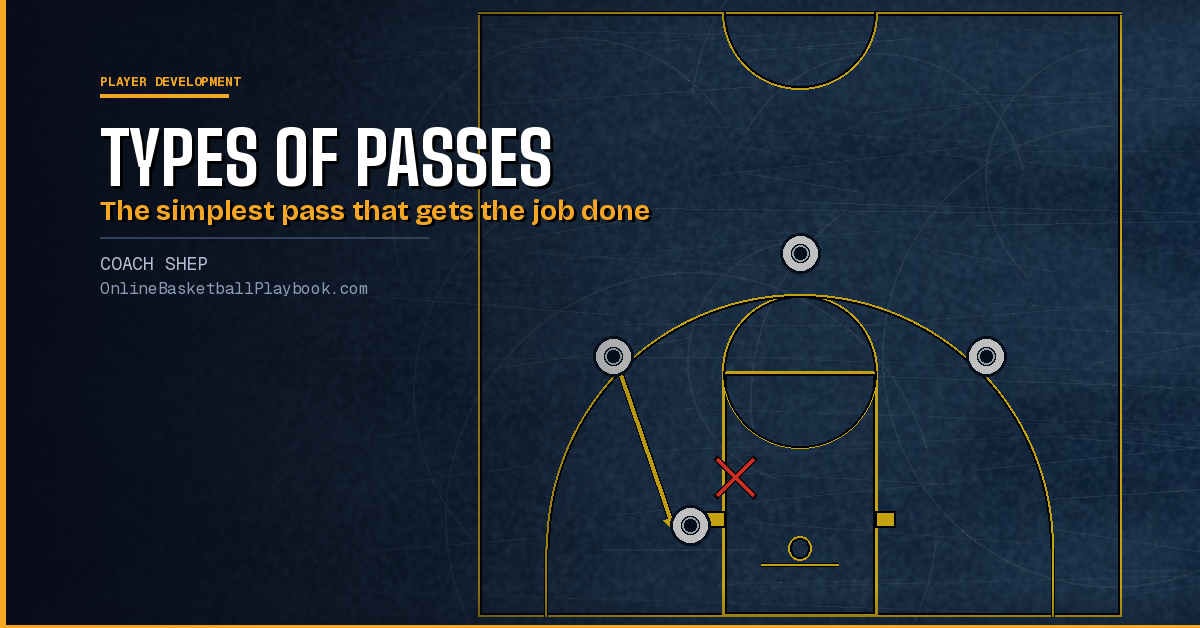
The types of passes in basketball start with three basic two-hand passes, the chest, bounce and overhead pass, and grow into the long baseball pass, the one-hand push, passes into the post and the passes named for what they do to a defense, like the skip and the pocket pass. Each one has a job. The skill is picking the right one before the ball leaves your hands.
The three basic passes each have a full guide: chest pass, bounce pass and overhead pass. Drills are on basketball passing drills, and passing safely under pressure on how to protect the ball.
Pick the Pass Before You Throw It
Pass selection comes before technique. Pete Carril's line: "the quality of the pass leads directly to the quality of the shot."
- The simple pass. John Calipari says make the simple pass that gets the job done and never pass into a crowd.
- See the defense, then pass away from it. The receiver's defender tells you which pass is open.
- Air first. The air pass comes first, because it travels in a straight line. Keep the bounce pass for backdoor, post and trap situations, and the lob for a fronted post or a breakaway.
- Flashy only when it is easiest. A behind-the-back pass is right only when it is truly the easiest read, such as a 2-on-1 break with the defender overplaying the ball side.
Teach the choice with every pass type, not after them.
The Chest Pass
Start with the chest pass. It is the fastest pass, because it travels in a straight line, and that also makes it the easiest for a defender to read.
- When. A quick, straight pass with no defender in the way. It is not ideal for long throws, which are hard to keep flat and hard, or close range inside the key, where it is easy to intercept and hard to handle.
- Form. Feet shoulder-width apart, the ball at the chest with the elbows tucked, a step forward with either foot and a push off the back foot.
- Target. The receiver's torso, the shot pocket, when he is a shooter. Lead a moving teammate to where he will be.
- Finish. Arms locked out and fingers pointing at the target, without holding the pose the way a shooter does.
- Not straight into a defender. A chest pass at a defender standing directly in front is easily deflected. Use the lateral or two-hand overhead pass instead.
A pass outside the target may still be caught, but it costs the receiver a beat. Hit the hands.
The Bounce Pass
The bounce pass is slower than the chest pass, so use it when a defender is in the lane over a short distance. It is the pass into the low post and to a back-cutter.

- Technique. Both hands on the ball at the chest, step forward (the dominant foot preferred), push off the back foot, and keep the back straight with a slight forward tilt.
- Past a defender. With a defender between passer and receiver, bounce the ball right next to the defender, so he cannot reach the low point.
- More lead. Because it is slower, a bounce pass needs more lead on a moving receiver than a chest pass, and more as the distance grows.
- Finish. Thumbs toward the floor with the arms fully extended, then move into the next action.
- Not against a trap. Against a press trap, the air pass is preferred, because a bounce pass is easier to intercept.
Coaches split on where the ball hits the floor with no defender in the way:
- About two-thirds of the way. The ball bounces two-thirds of the way to the receiver.
- Two-thirds to three-quarters. The ball comes up to the receiver at the waist.
- Three-quarters. The ball arrives between the waist and the chest.
Teach one bounce point and do not force the bounce pass when the play does not call for it.
The Overhead Pass
The overhead pass goes over the defense. It has more arc and power than a chest pass, which makes it harder to deflect across the floor.
- Over a tight defender. When the defender takes away the chest and the bounce pass.
- The long outlet. After a rebound or a turnover to start the break, or on the inbound after a made basket. On the rebound outlet, pivot to the sideline and throw a hard two-handed overhead pass.
- The skip. A cross-court pass over several defenders, with just enough arc to clear the hands without floating.
- Technique. Start the ball at the chest or above the head, step toward the target, push off the back foot, then step through, release and follow through.

Rep the overhead pass at full speed, because judging the lead on a long throw takes game-speed reps.
The Baseball Pass
The baseball pass is a long, one-handed throw, like a quarterback's. It creates more force than a chest or overhead pass and threatens the defense with a layup over the top.
- Start like a quarterback. Both hands on the ball, which protects it longer and keeps the option to pull the pass back.
- Spread the throwing hand. A one-hand pass loses some control, so spread the strong hand on the ball.
- To the ear. Bring the ball to the ear on the throwing side.
- Step into it. Rotate the hips and step with the back foot.
- Snap the wrist. Backspin makes the pass easier to catch.

It has three uses. Against full-court pressure, a press that brings all five defenders above half court gets beaten deep. Against a slow transition defense, the inbounder hits a teammate sprinting the floor after the opponent scores. Late in the game, a deep inbound may be the only way to get a good shot with a second or two left. Practice it with different players to find your best deep passers. The late-game throws are on full court last second plays and the press on press break basketball.
Find your deep passer in practice, not in the last two seconds.
One-Hand, Lateral and Step-Around Passes
Coaches split on how much to pass with one hand. Teach the team's base pass first, then add the others.
- Two hands for sureness. Make the sure, simple two-hand pass, and save one hand for a one-hand bounce pass into the low post or the fast break.
- The one-hand push as the key move. Teach the one-hand push pass as the most important passing move: "pass by the ear hole."
- One hand because it is harder to deflect. Push one-hand passes in drills, because they are less likely to be deflected.
- One hand with a hip roll. Teach mostly one-handed or push passes against a defense, rolling the hip toward the target instead of stepping.
Against a defender standing in the way, throw the lateral or the step-around pass:
- Lateral pass. Fake the opposite way, cross the far foot over, step and deliver the ball from the side.
- Step-around bounce pass. Fake an overhead pass to lift the defender's hands, then stride around him with the non-pivot foot and bounce it in.
Pick the base pass for your team, then teach the rest as answers to a defender.
Passes Into the Post
The post feed is its own pass. The angle matters more than the arm, and the target is set by the post.
- Hands down for a bounce. Don Meyer's posts show their hands down when they want the bounce pass.
- High, near the face. Post players struggle with passes below the waist, so feed the post high.
- Away from the defender. Throw the entry to the outside of the post's body, away from the pressure.
- Air when you can see his numbers. Throw to the outside shoulder, and do not bounce it if you can see the post's numbers.
- Make the angle first. Use a dribble to create the angle, then one committed fake the other way, not a string of them.
- The lob. Over a fronting defender. Off a ball screen, throw the lob over the screener's defender with high loft, "almost tossing a grenade," because a flat laser gives the roller no time.
Post feeding against every coverage is on feeding the post, and the high-low feed on high-low offense.
Let the post show the target, then hit it.
Get the next coaching guide in your inbox
One email when a new guide or diagram set goes up. Free.
Types of Passes in Basketball Named for What They Do
Some passes are named for the effect they have on the defense, not the way they are thrown. Learn the names so the whole team calls them the same way.
- Skip pass. Flips the court, pulls the defense off its shift to the ball and forces long closeouts. Against a zone it beats a defense that collapses, and the receiver should be ready to catch and shoot. See how to beat a 2-3 zone.
- Swing pass. The basic pass around the perimeter, the one young players underuse.
- Extra pass. Also called one more or one time. A kick draws a help defender, and the next pass turns a good shot into a great one.
- Hockey assist. The pass that sets up the scoring pass, worth valuing because sometimes the angle or timing for the direct pass is not there.
- Hammer. A baseline drive, a weak-side screen for a teammate, and the throw to the corner to the player who was screened. With no screen, the same drive and throw to the corner is a baseline drift. Other systems use hammer for the weak-side flare screen itself, so write the job next to the name.
- High-low. The ball goes from the top of the key into a post-up, also called a passing triangle.
- Inside-out. A post entry, a read of the help, then a kick out to a corner or wing shooter.
- Pocket pass. From the waist to the big on a short roll, the roll that stops early to catch.


When the help takes away the short roll, the pass goes back out to the perimeter. Ball-screen work is on drills to teach ball screen offense.
Name the pass in practice and players start looking for it in games.
Behind-the-Back, No-Look and Jump Passes
Advanced passes come after the basics, and only when they are the easiest read.
- Sidearm and behind-the-back. Both belong on the full pass list. Keep the behind-the-back for advanced passers.
- Hook pass. Mike Brey's passing groups work the chest, bounce, overhead and hook passes.
- No-look. Only after the basic chest pass is mastered. It hides the passer's intent from defenders who read his eyes.
- Specialty passes. Euro step passes, right-right and left-left lobs, left-handed pocket passes and late check downs to the corner, the last outlet when the driver is caught.
Coaches split on the jump pass:
- Never leave your feet. Leaving your feet to pass is a leading cause of desperation turnovers.
- Teach it on purpose. "Don't jump unless you have a solution."
Teams lose 3-on-1 breaks forcing behind-the-back passes. Earn the fancy pass with the simple ones.
Teaching the Pass Types
Teach the three basic passes with one technique and the same stance: step toward the receiver and extend the arms with the palms out and thumbs down. Snap the wrists and fingers for speed. Then rotate through every pass type in the same drills.
- Partner and wall passing. Work every pass type at 12 to 15 feet, and longer for the overhead pass. A wall target drill scores a point for every target hit in 60 seconds.
- Triangle passing. Three lines, step out to meet the pass, sprint to the next line, and rotate through chest, bounce and overhead passes.
- Passing groups. Three or four players in a triangle or rectangle over-exaggerate the fundamentals, then add pass fakes and a defender between two passers.
- Rebound and outlet. The coach throws the ball off the backboard and names the pass type, and the rebounder outlets with it.
Coaches cue the thumbs differently: thumbs down, thumbs finishing toward the receiver, or thumbs through the ball. Pick one cue and use it every day. More drills are on passing drills and the mechanics on passing fundamentals.
Every pass type is a tool. Teach players when to reach for each one.
Questions Coaches Ask
What are the types of passes in basketball?
The three basic passes are the chest, bounce and overhead pass. Add the baseball pass, the one-hand push, the lateral and step-around passes, the lob, and passes named for their job, such as the skip, swing, extra, hammer, high-low and pocket pass.
What are the 3 basic passes in basketball?
Chest, bounce and overhead. Each one steps toward the receiver and extends the arms.
When should you use a bounce pass?
Over a short distance with a defender in the lane, into the low post and to a back-cutter. Bounce it right next to the defender.
What is a skip pass in basketball?
A cross-court pass over the defense, usually an overhead pass. It flips the court and forces long closeouts.
What is a pocket pass?
A pass from the waist to the big on a short roll after a ball screen.
Want every diagram on the site?
OBP Pro members get the full diagram files for every guide on the site, ready for a practice binder or a workout card. $9 a month. Or draw your own version free in the play drawer.
See what OBP Pro includesMore Post, Passing and Practice Guides
- Big Man Workout Basketball: Drills, Make Counts and Order
- Game Situations in Practice: How to Build Them In
Back to Basketball Passing Drills and every Player Development page.
Keep Building
Related breakdowns
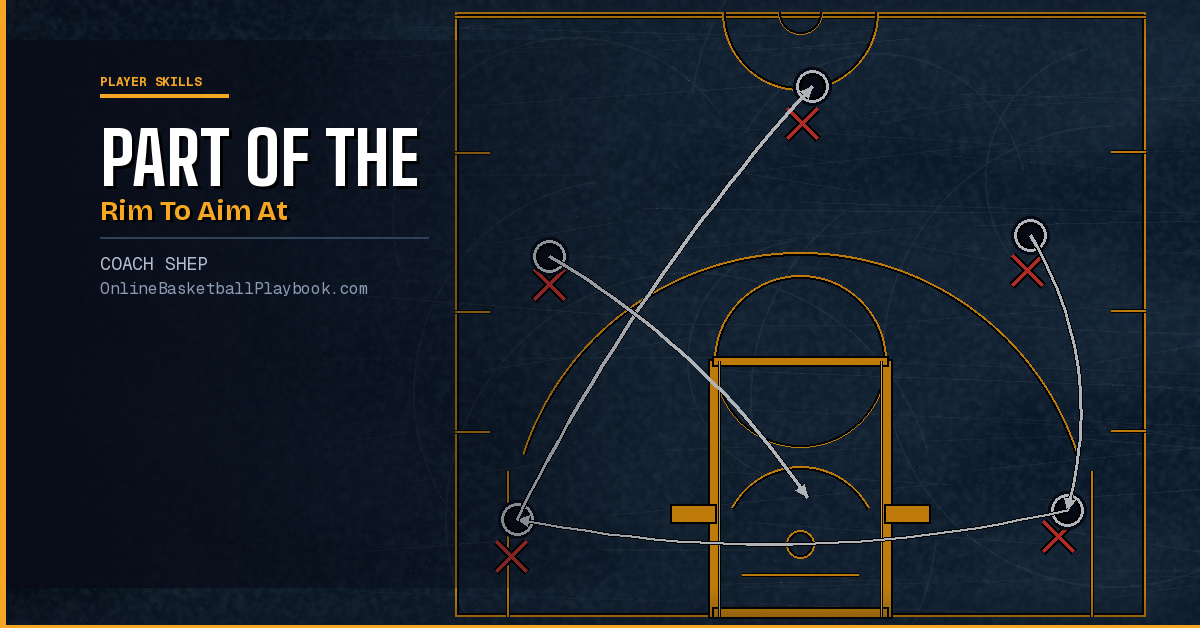
Which Part of the Rim to Aim At When Shooting
Which Part of the Rim to Aim At When Shooting
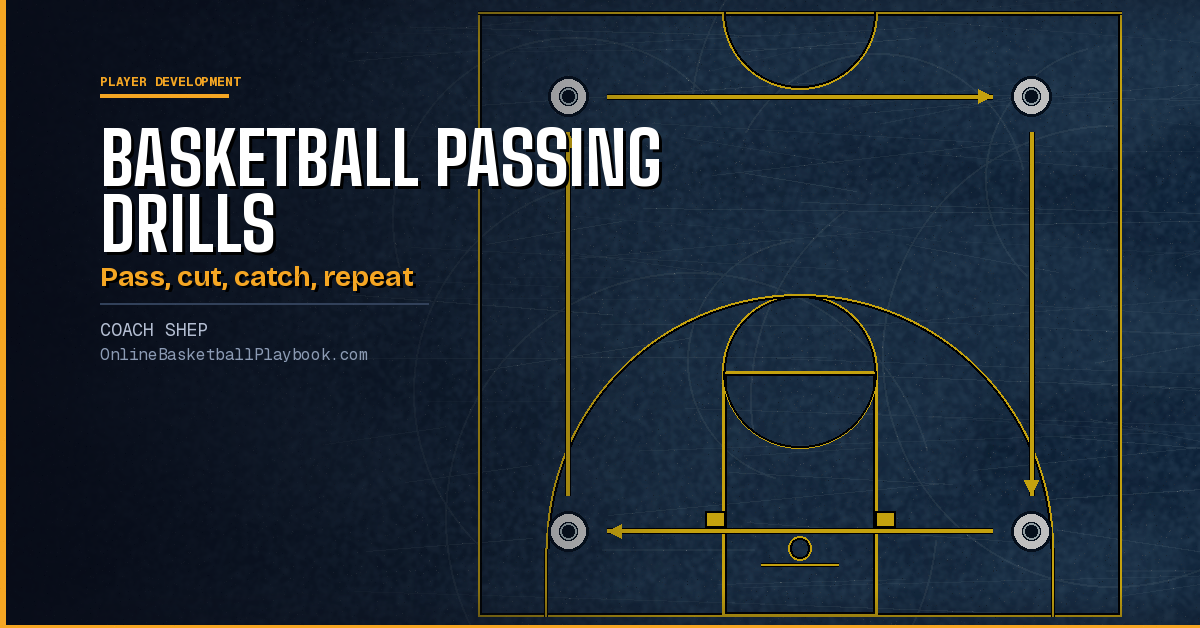
Basketball Passing Drills for Beginners and Full Teams
Basketball passing drills for beginners, partners and full teams: the basics to coach, drills with setups and coaching points, pressure drills and scored games.
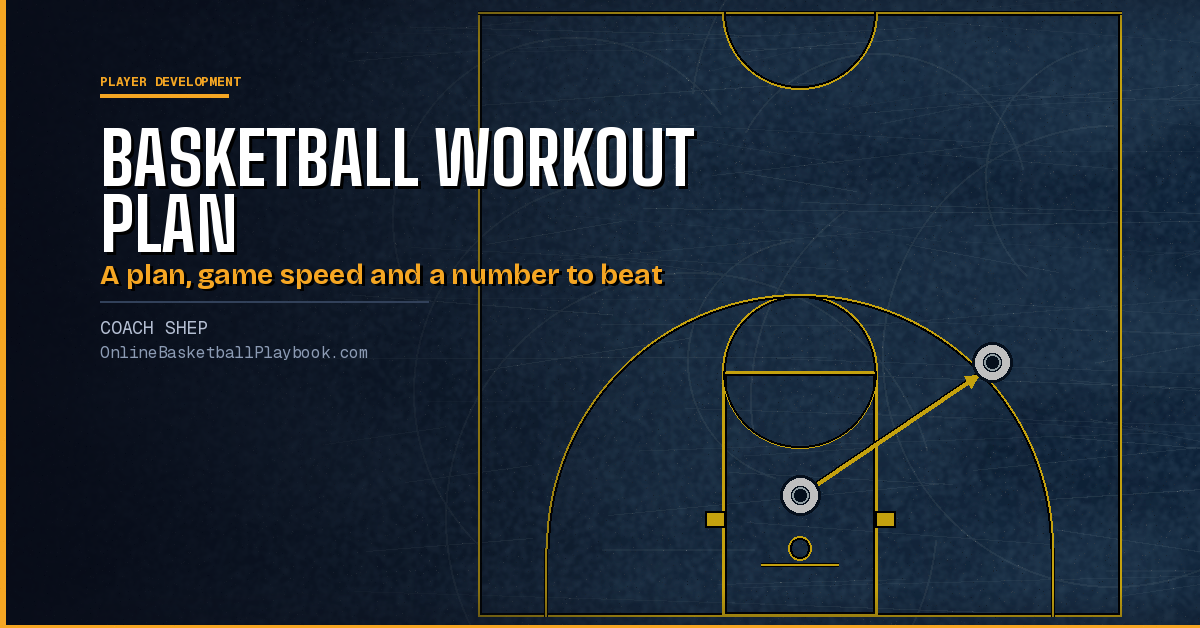
Basketball Workout Plan: How to Build One by Position
How to build a basketball workout plan: the blocks to include, the order, how long, make counts and game speed, position work, tracking, and where coaches disagree.