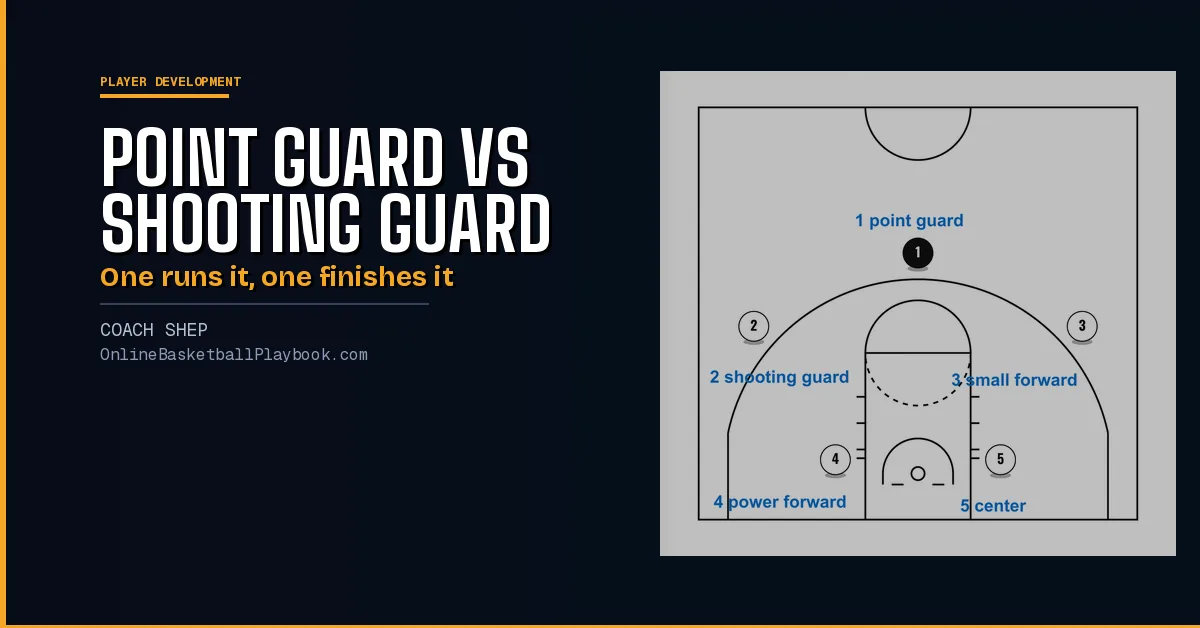
Point guard vs shooting guard comes down to who has the ball. The point guard, the 1, is the main ball handler and decision maker. He advances the ball and runs the offense. The shooting guard, the 2, is also called the off guard, because he plays off the ball and earns his shots by moving while the point guard starts the action. Both are guards, both defend the perimeter, and the modern game blurs the line between them more every year. Below, the two jobs are laid out side by side, with diagrams of what each one does on the floor.
Point Guard vs Shooting Guard at a Glance
| Point guard (1) | Shooting guard (2) | |
|---|---|---|
| Usually starts | Top of the key with the ball | On a wing |
| Main job | Bring the ball up, run the offense, set the tempo, create for others | Score at all three levels and space the floor |
| With the ball | Most of the time | Backup handler when the 1 is pressured or trapped |
| Without the ball | Knows where every teammate should be | Cuts, uses screens, relocates on the arc |
| Signature action | The pick and roll | Coming off screens for the catch and shoot |
| On defense | Pressures the other ball handler, fights over screens | Guards the best perimeter scorer, chases shooters through screens |
| Deciding trait | Basketball IQ | A shot the defense has to respect |
| Size | Usually the shortest player on the floor | Usually the second shortest |
Height matters less at the 1 than at any other position, and less at the 2 than at almost any other. At the 1, quickness, ball handling and decisions win the job. At the 2, a player who can shoot, move without the ball and defend can play the spot at nearly any size.
Where Each Starts

In a traditional 3-out 2-in set the 1 opens the possession with the ball at the top of the key while the 2 sets up on a wing. The 2 and the 3 are often called the wings for that reason. The numbers can also mean spots rather than players. In that convention the 2 is the right wing and the 3 the left wing, the 4 the right block and the 5 the left block, which young players learn as even numbers right and odd numbers left. Every spot and its name are on Basketball Positions Explained.
The Actions Each Runs


Point guard
The 1 calls the play and puts teammates in their spots before the action starts. He pushes when the numbers are there and slows it down into a set when they are not. He creates shots for others with the pick and roll, the drive and kick and the post entry, and he scores when the defense goes under a screen or loses him. The pick and roll is the action he runs most, so he has to know all of its reads: reject the screen, pull up, throw the lob or hit the roller with a pocket pass. Other jobs that show up in point guard teaching:
- Stay out of crowded spots on the floor, where turnovers happen.
- Change speeds. Slow to fast is harder to guard than fast all the time.
- Reach the paint inside the offense, not with ten dribbles of one on one.
- Know where each teammate likes to catch the ball, who is hot and who has a mismatch.
- Manage the clock, the score and the foul count late in games.
- Keep the dribble automatic and the head up, so the reads come first.
One target used for point guards is two assists for every turnover. Reads by coverage are on Pick and Roll Reads, and sets that put the ball in his hands are on Basketball Plays for Point Guards.
Shooting guard
The 2 is usually the team's best outside shooter, and his job starts with scoring: the three, the pull-up from midrange and the finish at the rim. A feared shooter also spaces the floor without touching the ball, because the defense will not leave him, and that opens driving lanes for everyone else. Since the point guard does most of the dribbling, the 2 earns his shots by cutting, using teammates' screens and moving constantly. He comes off screens to pop or fade, catches and shoots, and relocates along the arc when the ball moves. He is also the backup ball handler when the 1 is pressured or trapped, and some versions of the role also give him offensive rebounding duties. Shooter work is on Shooting Guard Basketball Drills and the screen itself on Down Screen Basketball.

Once a 2 is a known shooter, defenders overplay him to deny the catch. His answer is the backdoor cut: sell the cut toward the ball, then plant and go behind the defender to the rim. Reading that denial is covered on Cut or Backdoor: Reading the Denial. Whatever spot a player has, the habit is the same: read the man guarding you before you move.
Get the next coaching guide in your inbox
One email when a new guide or diagram set goes up. Free.
On Defense
Point guard
He usually picks up the other team's main ball handler and pressures him on every trip, without gambling or losing position. Opponents run the pick and roll at him all game, so he has to get over the top of screens or make the right choice to go under. He is often first back on defense in transition, and he directs traffic when the defense scrambles.
Shooting guard
He usually draws the toughest perimeter scorer on the other team. A shooter who never stops moving has to be chased over and around screens all game. Active hands in the passing lanes turn into steals, and steals turn into fast breaks the other way.
Both jobs ask for the same base: a guard who can stay in front of the ball and fight through screens. Matchups and help rules are on Basketball Defense Positions.
On the Fast Break

In a numbered break each number has a lane. Several numbered breaks send the 2 down the right lane and the 3 down the left every time. One version gives the 1 the sideline the ball was rebounded on. A skill-based version puts the best ball handler at the point and the most accurate long shooter on the right wing. For the 2, the rule in every version is the same: sprint the floor every trip. A guard who beats his man down the court gets easy baskets before the defense sets, and arrives in position to start the offense even when the pass does not come. The break itself is on Fast Break and Transition Offense.
Types of Point Guards and Shooting Guards
| Point guard types | Shooting guard types |
|---|---|
| Pass-first floor general: creates for others first, scores last | 3-and-D guard: makes open threes and guards the best perimeter player |
| Scoring point guard: the main handler and the best scoring threat at once | Movement shooter: always on the move off screens, shoots on the catch |
| Combo guard: can run the offense or play off the ball | Combo guard: a scorer first who can run the offense when needed |
| Swingman: a bigger guard who can play either the 2 or the 3 |
The combo guard sits on both lists, and many backcourts now start two combo guards in place of a classic 1 and 2. Both positions have also changed. For most of the game's history point guards were mainly passers who set up others, and many great ones could not shoot. Now they are expected to bend the defense with range. The 2 has moved from the midrange scorer to the three-point shooter, and shooting is becoming a requirement for every position, not a specialty for one.
Where Coaches Split
1. When to name a player a 1 or a 2.
- Position-free version: at lower levels, develop the skills to play every position. One age-band version says positions barely exist from 7 to 12, lean into natural tendencies without locking anyone in from 12 to 14, and specialize from 14 to 18.
- Specialist version: some coaches build the team around specialists and say a fully positionless system does not fit most high school rosters.
The age debate is on Youth Basketball Specialization.
2. Who gets the ball on the break.
- Fixed lanes: the numbered break gives the 1 the ball and the 2 the right lane every time.
- Interchangeable pairs: one break makes the 1 and the 4 interchangeable and the 2 and the 3 interchangeable.
- Free flow: another approach rejects numbered lanes for youth and high school teams, because players end up out of position after contesting a shot and assigned lanes stop them reading the floor. Its rule is that players ahead of the ball run wide, players behind it fill the middle, and anyone may push.
3. How much the 1 has to score. Both things hold at once. A point guard with no dependable jumper can still run a team at the top level, and a point guard who cannot score lets his defender sag off and clog the space everyone else needs. Today's point guards are expected to be scoring threats, and the job of organizing the team and creating good shots has not changed.
Which Spot Fits a Player
- Handles pressure, sees the floor, talks and leads: try him at the 1.
- Knocks down shots and moves well without the ball: try him at the 2.
- Can do some of both: he is a combo guard, and he can play either spot.
- A team with two combo guards: play them as a backcourt instead of a fixed 1 and 2.
- A young team: give every guard reps at both spots before deciding.
- A shooter who cannot guard the best perimeter scorer: someone else has to give up his own matchup to cover for him, so weigh that before naming him the 2.
Workouts for both are on Basketball Guard Development, Guard Skill Development Drills and Guard Workout. The ball screen the 1 runs is compared with its sibling on Pick and Roll vs Pick and Pop, and the offenses these guards play in are compared on Flex Offense vs Motion Offense and Triangle Offense vs Princeton Offense.
Questions Coaches Ask
What is the difference between a point guard and a shooting guard?
It comes down to who handles the ball. The 1 is the primary handler, so he advances it and runs the offense. The 2 works away from the ball as the team's main outside scorer and gets open by moving.
Is the shooting guard the 2?
Yes. The point guard is the 1, the shooting guard the 2, the small forward the 3, the power forward the 4 and the center the 5.
Can a point guard play shooting guard?
A combo guard does exactly that. He can run the offense or play off the ball, and many teams start two of them.
Which guard is usually taller?
The shooting guard. The point guard tends to be the smallest player on the court, with the shooting guard next, though height matters less at both spots than skill does.
Want the printable playbook packs?
Playbook packs: zone attack, press break, press defense, out of bounds, quick hitters, practice plans and the youth turnover cure, each a printable PDF. Or draw your own version free in PlayDraw.
See the playbook packsRelated Guides
- Flex Offense vs Motion Offense: Pattern or Rules
- Triangle Offense vs Princeton Offense: Side by Side
Back to Basketball Positions and every Player Development page.
Keep Building
Related breakdowns
Guard Development: Skills, Drills and Workouts for Guards
Guard development in order: balance, the handle, ball security, reads, finishing, shooting and on-ball defense, plus a sample session and first fixes.
Guard Workout: Handles, Reads and Finishing You Can Print
A guard workout you can print: a full session with its standards, plus handle work, jab, closeout and ball-screen reads, finishing and shooting off the dribble.