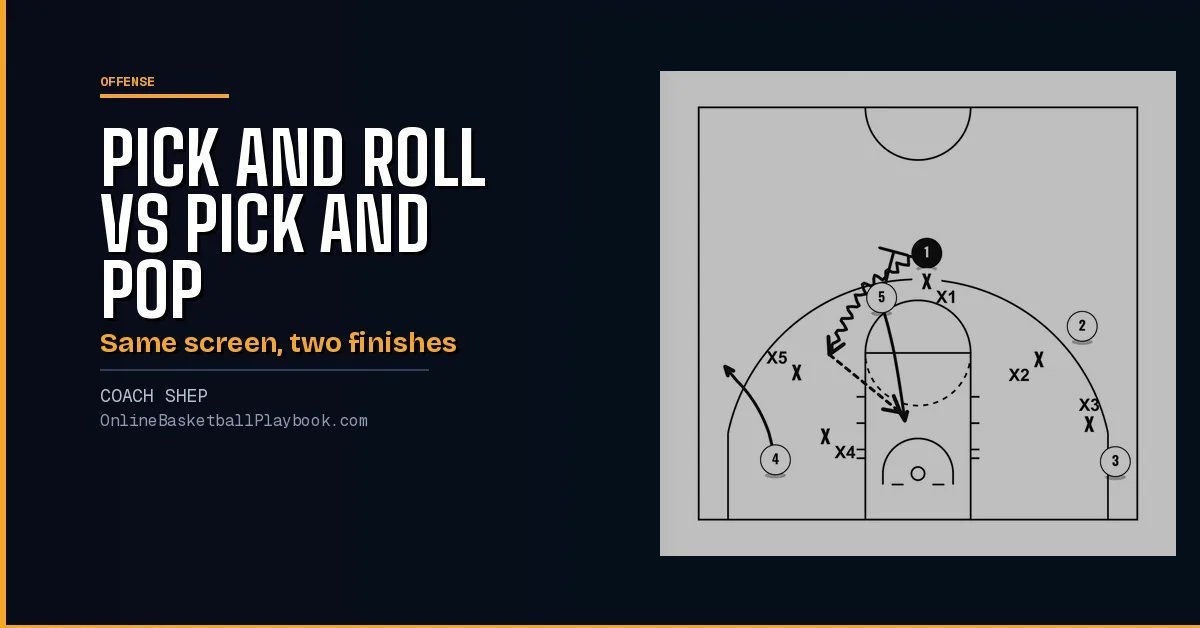
Pick and roll vs pick and pop is one decision made by the screener after the same ball screen. In the pick and roll he dives to the rim and the handler looks to hit him on the way. In the pick and pop he steps away to the arc and the handler throws it back for a catch-and-shoot. The screen, the handler's first move and the spacing are the same. Below, both are drawn from the same screen at the top of the key and on the wing so you can see where each finish opens.
Pick and Roll vs Pick and Pop at a Glance
| Pick and roll | Pick and pop | |
|---|---|---|
| Screener goes | To the rim | Out to the arc, near where the handler started |
| Screener needs | To finish inside | To shoot, with his shoulders turned to the basket as he moves out |
| Handler's job | Turn the corner, score first, then the pocket pass | Take several dribbles into the middle, then throw it back |
| Timing | Roll as the handler turns the corner | Pop after the handler's dribbles pull the big toward the ball |
| Coverage it hurts | Contain or drop in one version, a hedge when he rolls diagonally | A switch onto a smaller defender, drop coverage in one version, a slow big |
| How defenses guard it | Drop the big to take away the roll | Switch with an athletic big, or hedge and recover |
From a Screen at the Top of the Key


In the roll, the handler comes off at the level of the screen and attacks to score first. The screener rolls the moment the handler turns the corner, not before and not after. When the defense collapses on the drive, the pocket pass finds the roller. In the picture 4 lifts out of the short corner to keep a kick-out open behind the drive.
In the pop, the handler has to sell the drive. He takes several dribbles into the middle of the floor so the screener's defender cannot both help on the ball and get back to the popper. A hurried pass lets that defender recover in time to contest. The screener moves out with his shoulders already turned to the basket, so he is ready to shoot on the catch. The read is simple. If the big chases the pop, the handler has a lane or a pull-up. If the big stays home, the popper is open.
From a Screen on the Wing


On the wing the pop goes back toward the spot the handler left. The handler drives toward the middle, which pulls the screener's defender with him, and the throw back is behind the help. The roll goes the other way, straight down the lane. One spacing rule lifts the ball-side corner into the open spot on every wing screen, as a rule and not a read.
Get the next coaching guide in your inbox
One email when a new guide or diagram set goes up. Free.
The Coverage Decides


The screener reads his own defender, and in one version he reads him before contact. If the big hedges high, he slips to the rim. If the big contains or drops, he rolls hard. If the defense switches or sags, he pops. In that version the pop against a switch is a rule: a shooting big who pops makes the switch pay without a play call.
Drop coverage is where the two finishes compete. The big sits low to protect the rim, so one version sends the screener to the rim hard, and another says the pop is especially strong against drop, because the dropped big faces a long closeout. A big, slow post defender who would rather guard the paint than close out in space is a good pop target. The full coverage menu is on drop coverage, hedge and how to defend the pick and roll.
The Other Screener Options


Roll and pop are two of six. The full screener list is roll, pop, short roll, re-screen, flare screen and roll to the opposite block. Against a trap the handler takes retreat dribbles and the screener short-rolls into the space behind it, and the offense plays four on three. Against a high hedge the screener slips before the screen is set. Every one of them is on screener reads: roll, pop, slip.
Personnel
Pick and roll: a screener who finishes inside, and a handler who can score off the screen, because the first read is to score. The rest of the floor is spaced so a help defender who tags the roller leaves a shooter open.
Pick and pop: a post who is a better shooter than he is a scorer at the rim, often an undersized or perimeter-skilled big. The handler has to attack the paint with several dribbles before he throws it back. One spacing version runs a middle ball screen with a shooting 5 who stays behind instead of rolling.
With two bigs, the double-screen versions below assign the roll and the pop before the play starts.
Where Coaches Split
- Against drop coverage.
- Roll version: contain or drop means roll hard.
- Pop version: the dropped big has a long closeout, so pop.
- Against a switch.
- Pop version: the shooting big pops to three, and that is the whole switch counter.
- Seal version: the screener seals the smaller defender and rolls or posts him.
- Throw-ahead version: Ettore Messina throws the ball ahead against a hedge or switch and sends the roller on a diagonal, which makes the weak side help from farther away.
- How the roller moves.
- Open-up version: wait until the handler is fully off the screen, open up, never turn your back on the ball and roll diagonally to the low block.
- Pivot and sprint version: pivot and sprint to the rim with no pause.
- Lob version: turn your back and sprint for a lob, inside a dribble-drive system.
- Two screeners at once.
- By order: the first screener pops and the second rolls.
- By skill: the non-shooter always rolls and the shooter always pops.
- By position: the 5 rolls and the 4 pops.
- Who decides.
- Coverage read: the screener chooses before contact from his defender's height.
- One in, one out: a corner turned by the handler sends the screener to spot up, and a distance dribble sends him diving.
Pick It When
- Your screener finishes at the rim and his defender plays contain: pick and roll.
- Your screener shoots better than he finishes: pick and pop.
- The defense switches and your screener can shoot: pick and pop in the switch-pop version.
- The defense switches and your screener is strong inside: roll or seal the smaller defender.
- The defense drops a big, slow center: pop, or roll hard, by the version your team runs.
- The defense traps the handler: short roll and play four on three.
- The big jumps out before the screen is set: slip.
- You have one roller and one popper: run a double screen and let each do his job.
Full guides: pick and roll, pick and pop and every coverage read on pick and roll reads. A whole offense built on the screen is on spread pick and roll offense, and all screen types are on basketball screens. Other side-by-side guides: box and 1 vs triangle and 2 and diamond press vs 2-2-1 press.
Questions Coaches Ask
What is the difference between a pick and roll and a pick and pop?
Both start with the same ball screen. In a pick and roll the screener dives to the rim after the screen. In a pick and pop he steps out to the perimeter for a catch-and-shoot.
Is the pick and pop good against drop coverage?
One version says the pop is especially effective against drop, because the dropped big is left with a long closeout. Another version rolls hard against drop.
How do you defend the pick and pop?
Switch it when your big can guard out on the perimeter. The switch keeps the ball out of the lane and keeps a defender on the popper. If your big moves poorly, hedge and recover, or go to zone when he cannot defend in space at all. The switch-pop version reads that same switch the other way: a shooting big who pops makes the switch pay.
When should the screener roll?
As the handler turns the corner. Rolling before that, or the handler using the screen before it is set, is one of the two most common youth errors, and either one leads to a moving-screen call.
Want the printable playbook packs?
Playbook packs: zone attack, press break, press defense, out of bounds, quick hitters, practice plans and the youth turnover cure, each a printable PDF. Or draw your own version free in PlayDraw.
See the playbook packsRelated Guides
- Box and 1 vs Triangle and 2: Junk Defenses Side by Side
- Diamond Press vs 2-2-1 Press: Full-Court Presses Compared
Back to Offense and every Offense page.
Keep Building
Related breakdowns
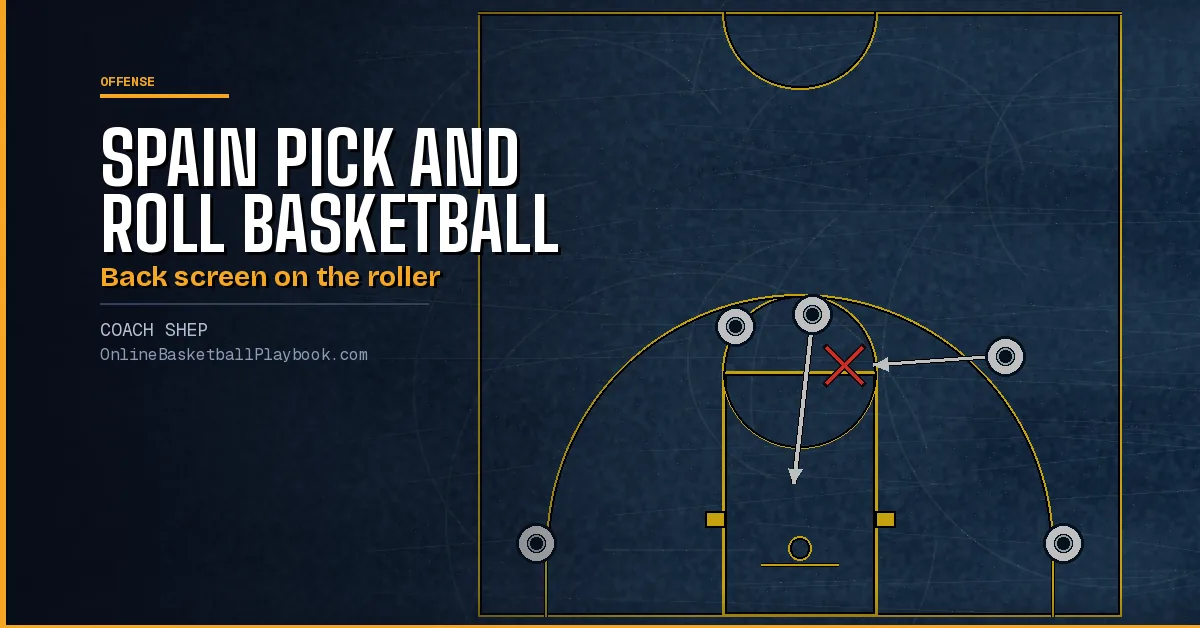
Spain Pick and Roll Basketball: Screen the Screener
The Spain pick and roll explained: a ball screen plus a back screen on the roller's defender, the pop, the hedge counter, the versions and the coverages.
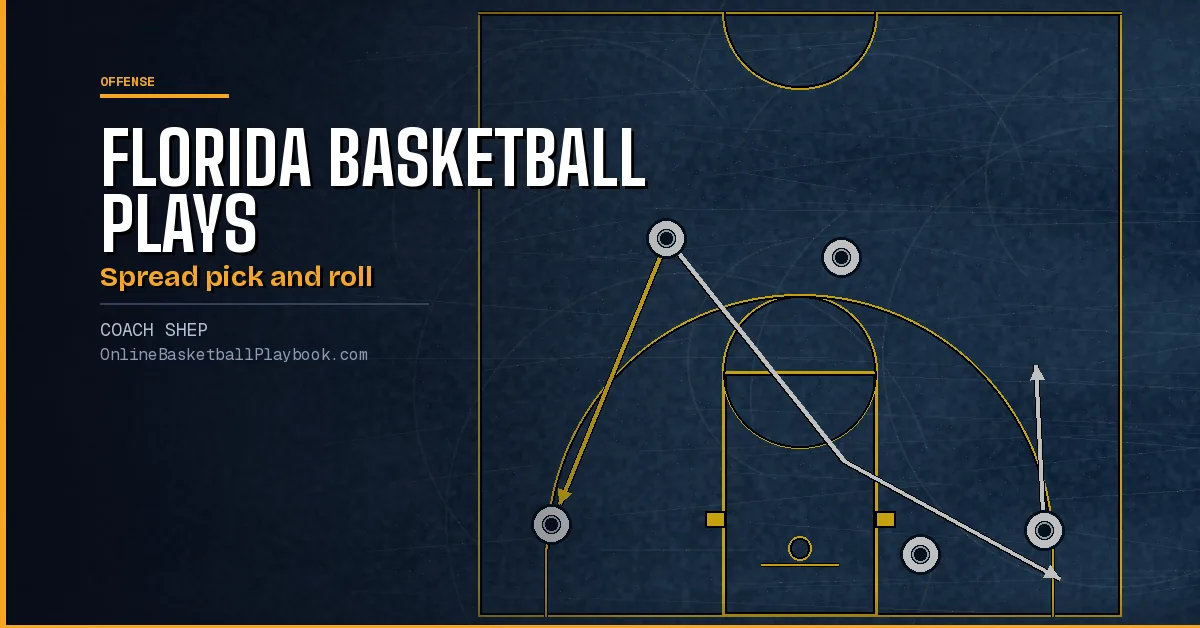
Florida Basketball Plays: Billy Donovan Spread Pick and Roll
Florida basketball plays from Billy Donovan's spread pick and roll offense: the series, its counters and sets, drawn frame by frame.
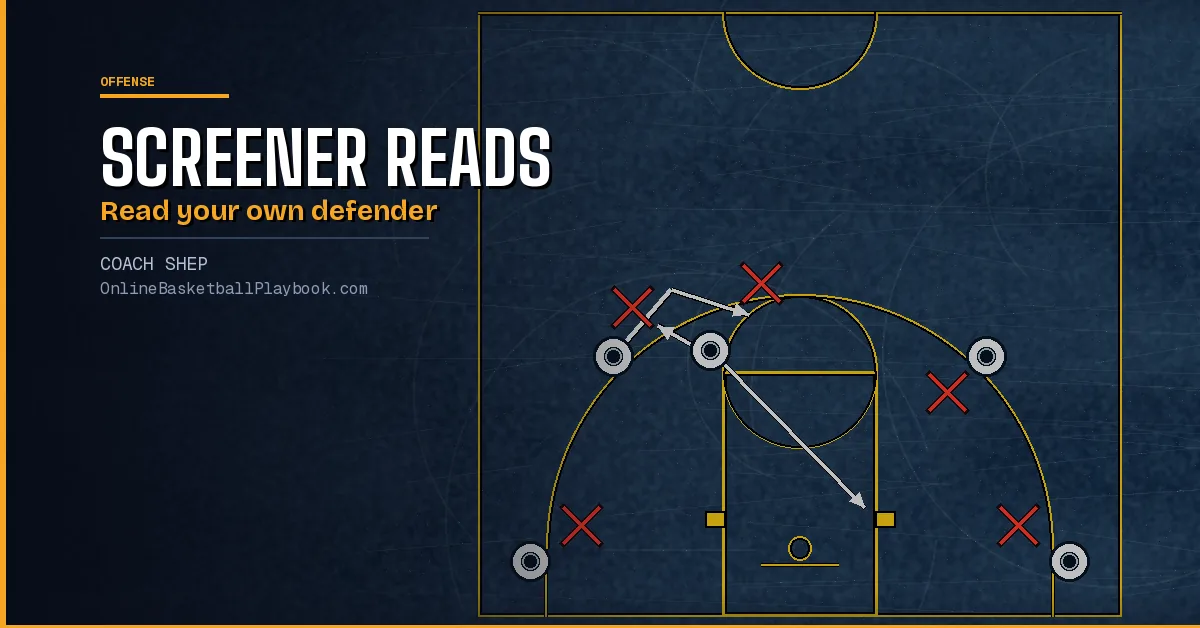
Screener Reads in Basketball: Roll, Pop, Slip and Short Roll
Screener reads after a ball screen: when to roll, pop, slip or short roll, three ways to read the screener's defender, and the technique for each finish.