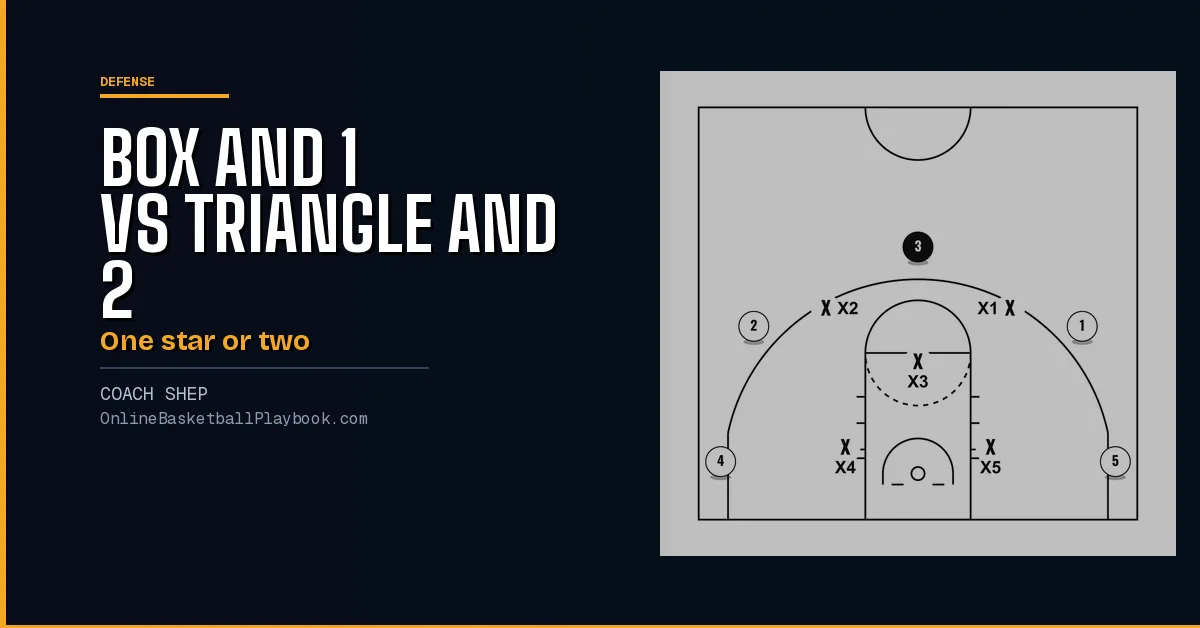
Box and 1 vs triangle and 2 is a question about how many scorers the other team really has. Both are junk defenses: one or two chasers deny specific players everywhere on the floor while the rest play a small zone behind them. The box and 1 sends one chaser and keeps four in a box. The triangle and 2 sends two chasers and keeps three in a triangle. Below, the two are drawn at the same ball spots so you can see what the extra chaser costs the zone.
Box and 1 vs Triangle and 2 at a Glance
| Box and 1 | Triangle and 2 | |
|---|---|---|
| Chasers | One | Two |
| Zone behind them | Four in a box, two high and two low | Three in a triangle, one on top and two low |
| Built for | One perimeter or driving star with weak shooters around him | Two scorers with three average teammates |
| Who guards the high post | The two high box defenders | The top of the triangle, alone |
| Thin spots | The middle of the box, skip passes, a star post player | The middle, the whole arc if anyone else can shoot, a star post player |
| Simple offensive answer | Run your zone offense | Run your man offense |
Both are game-plan calls, never a season-long base. They come out for a few possessions or a special situation, then the team goes back to its base defense. The full family, including the diamond and 1 and the 1-3 with a chaser, is on junk defenses.
Ball at the Top of the Key


With a role player holding the ball up top, both defenses let him have it. In the box nobody guards him. The high pair sits near the high post to discourage the entry, each low defender keeps a foot in the lane, and passing around the arc is allowed. Another box version does guard him: the on-ball defender steers the ball toward the side away from the chaser.
In the triangle the top defender sits between the ball and the high post with no heavy pressure, since an outside shot by a role player is what the defense wants. The bottom two front any post player. The box has two players up high. The triangle has one, and he pressures a high-post catch alone to force it back out.
Ball in the Corner


The corner rotation looks alike in both. The ball-side low defender takes the corner. The weak-side low defender comes across to cover the ball-side block. In the triangle he plays behind the post, not in front, so he can still close out on a skip.
The box has a fourth defender, the strong-side high man, and he has three choices:
- Drop back toward the ball-side block area.
- Hard-deny the pass back out of the corner.
- Trap the corner with the low defender.
The triangle has no defender to spare for that choice. Its top man drops just below the ball-side elbow to help on the drive and the entry.
When a Scorer Catches It


The zone players ignore the star until he catches, then act. In both defenses the base answer is to collapse. All four box defenders pull in tight to the box, or all three triangle defenders set back into the triangle, so the scorer sees bodies and open teammates and gives it up.
Get the next coaching guide in your inbox
One email when a new guide or diagram set goes up. Free.
Where Each One Is Thin
Box and 1
The middle of the box is soft. Outside the corners, the arc belongs to just two high defenders, so any skip becomes a long sprint to close out. The worst one goes from the top of the key to a corner, more so with a screen on the low defender who has to get there. Against a post star the box crowds the lane, and the chaser is picked for denial and is weak guarding the post. A balanced team with several real scorers breaks it.
Triangle and 2
With only three in the zone, any other shooter on the floor is a problem, because three cannot cover the arc. If one of the two scorers works in the post, the lane gets crowded and two defenders end up in the same spot. Triangle rotations are usually the weak link, and the chasers start from a standing spot.
Both defenses rebound the same way: one defender contests the shot and three form a rebounding triangle. In the box the chaser always boxes out the star.
From the offense side, the quick answer is zone offense against the box and 1, man offense against the triangle and 2. The full plans are on how to beat a box and 1 and how to beat junk defenses.
Personnel
Box and 1: the two tallest play low, where they guard the low post and the corner, help on the weak side and rebound. The two quickest play high, where they keep the ball out of the high post and do a lot of sprinting. The chaser is a smart, hard-working player with the discipline to ignore the shoves, the elbows and the trash talk.
Triangle and 2: two bigger players go to the bottom. With the ball above the free-throw line they front the low post. Once it goes below the line, they take the ball. The top spot needs a quick, good on-ball defender. Another version gives the top spot to the best athlete and sends the best post defender to the side the opposing center likes. The two chasers have to avoid fouls, because a frustrated scorer under full denial draws them.
Whichever one you run, decide before the game what you switch to if the chasers pick up fouls: straight zone or straight man.
Where Coaches Split
- Who chases.
- Disciplined denier version: a composed player, with two or three sharing the job in a game.
- Fresh legs version: two chasers, and never your best scorer.
- Lockdown version: the top on-ball defender takes the star and gives no help.
- Out-of-bounds triangle and 2: the weaker defenders take the two shooters, since denial is their only job.
- What happens on the catch.
- Collapse version: the zone pulls in so the scorer passes.
- Double version: the top or point defender sprints in to double the star.
- Drive-double version (triangle and 2): two defenders double a driving scorer while the other chaser keeps denying.
- Screens on the chaser.
- Fight-through version: stay off the ball side, where a screen can peel him off his man, and battle through every screen.
- Switch version: switch any ball screen that involves the star.
- A star post player.
- Avoid version: do not run either one against a post star.
- Post-double version: put a chaser on the post and the triangle doubles him automatically.
- Diamond version: switch to a diamond and 1 with the chaser fronting the post.
- A two-guard front against the triangle. Invert it so two defenders take the elbows and one plays low. The shifts then run like a 2-3 zone.


The diamond and 1 is the box's own variation, used against a one-guard front, against better shooters, with one dominant rim protector of your own, or against an all-around star. If the corner becomes a problem, go back to the box. Whichever version you teach, rep it until the switch into it is automatic.
Pick It When
- One perimeter or driving scorer, weak shooters around him: box and 1.
- Two scorers, three average teammates: triangle and 2.
- One star in the post with shooters around him: diamond and 1 with the chaser fronting, or a different defense.
- The opponent plays a two-guard front and you want two chasers: inverted triangle and 2.
- Several players can shoot: neither one. Play your base man or zone.
- A baseline out-of-bounds play built for one or two shooters: either one, set before the official hands in the ball.
The single-chaser breakdown is on box and 1 defense and the two-chaser one on triangle and 2 defense. Inbounds work is on defending baseline out of bounds. Two other side-by-side guides: diamond press vs 2-2-1 press and pick and roll vs pick and pop, which matters here because the switch version of chaser defense switches ball screens on the star.
Questions Coaches Ask
What is the difference between a box and 1 and a triangle and 2?
The box and 1 has one chaser and four defenders in a box. The triangle and 2 has two chasers and three defenders in a triangle. The box takes away one scorer with more help behind him. The triangle takes away two scorers with less.
Which is better against a team with two good shooters?
If those two are the only shooters, the triangle and 2 is built for them. If a third or fourth player can also shoot, neither one fits, because the zone behind the chasers cannot cover the arc.
How long should you stay in a junk defense?
Short stretches, often three to five possessions, then back to the base defense. One triangle and 2 version uses a scoring count: stay in it after one basket, maybe switch out after two, always switch after three.
Should youth teams play a box and 1 or a triangle and 2?
With young players, the advice is to teach man-to-man first and leave junk defenses for later. From the offense side, most teams that lose to a box and 1 never practiced against one.
Want the printable playbook packs?
Playbook packs: zone attack, press break, press defense, out of bounds, quick hitters, practice plans and the youth turnover cure, each a printable PDF. Or draw your own version free in PlayDraw.
See the playbook packsRelated Guides
- Diamond Press vs 2-2-1 Press: Full-Court Presses Compared
- Pick and Roll vs Pick and Pop: When the Screener Rolls or Pops
Back to Types of Defense and every Defense page.
Keep Building
Related breakdowns
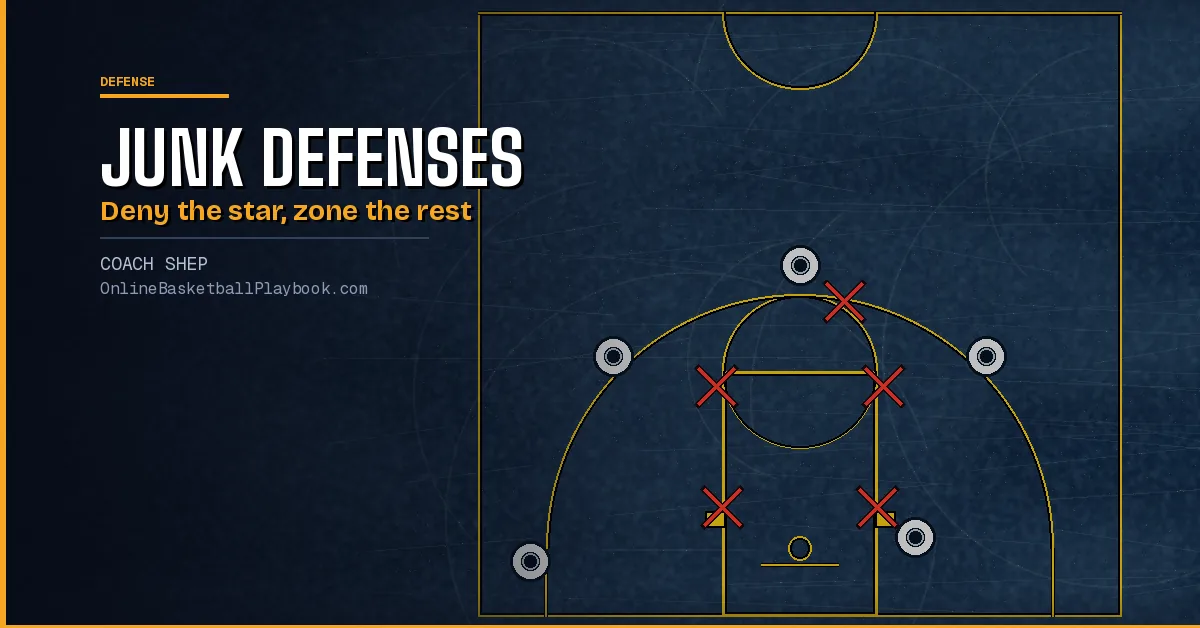
Junk Defense Basketball: Box and 1, Triangle and 2, When to Use
Junk defense basketball explained: the box and 1, diamond and 1, triangle and 2 and inverted triangle, when to call one, what it costs and how offenses beat it.
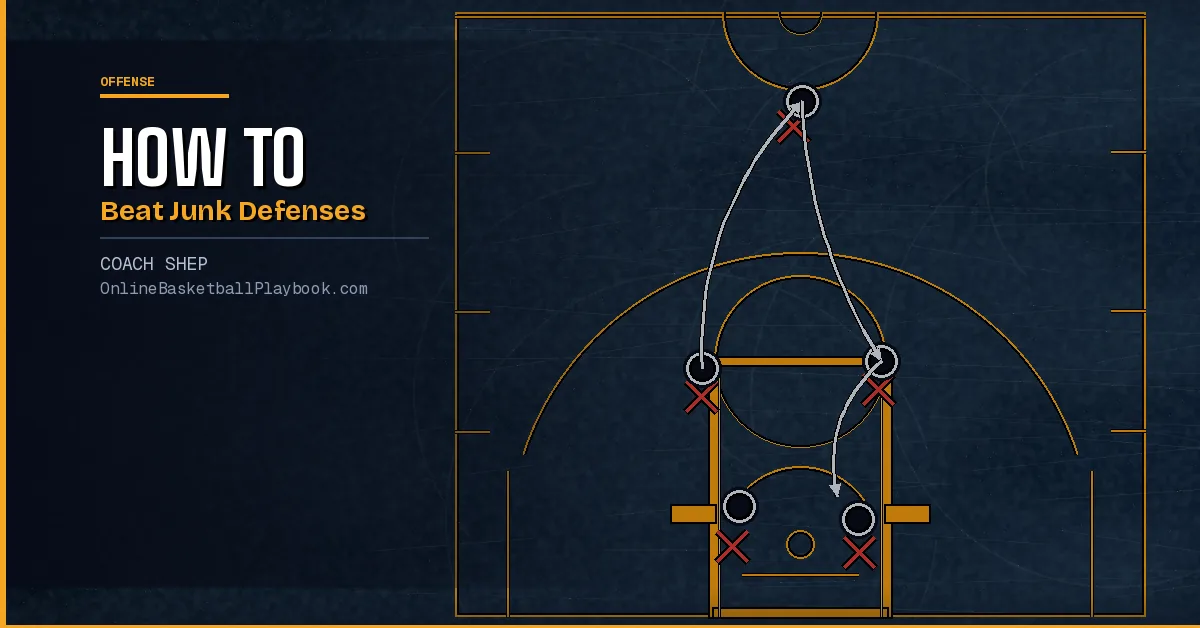
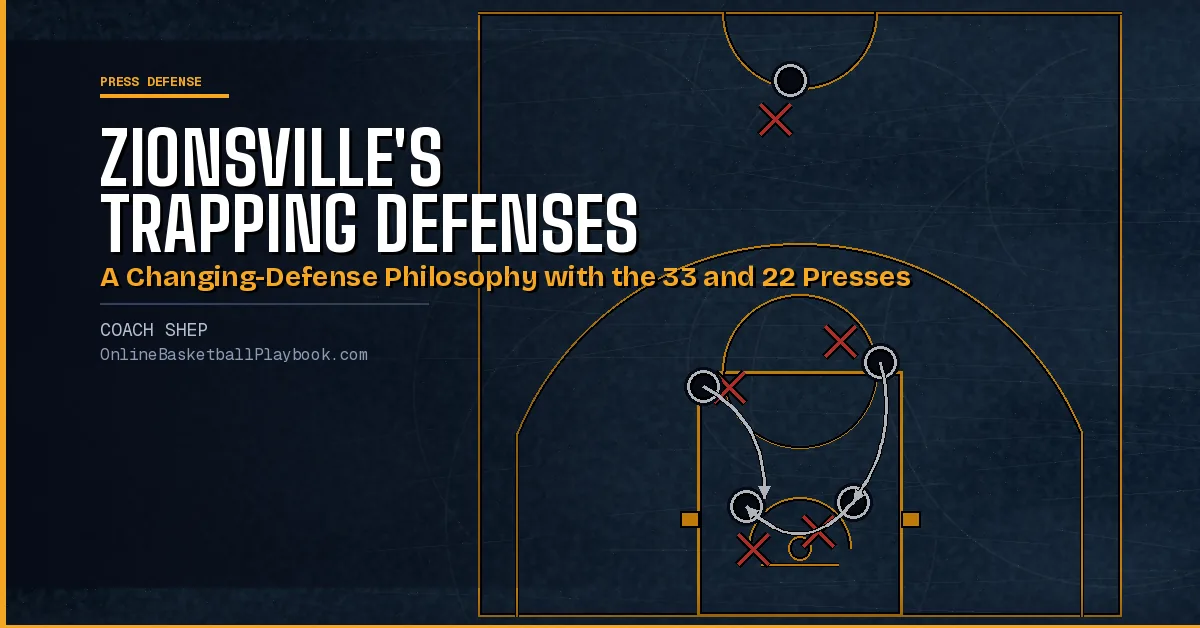
Changing Defenses in Basketball: Three-Quarter and Half-Court Traps
A changing defense taxes an opponent's prep time: a three-quarter 1-3-1 trap, a half-court trap, and a Run & Jump variant that ends in deny-everywhere.