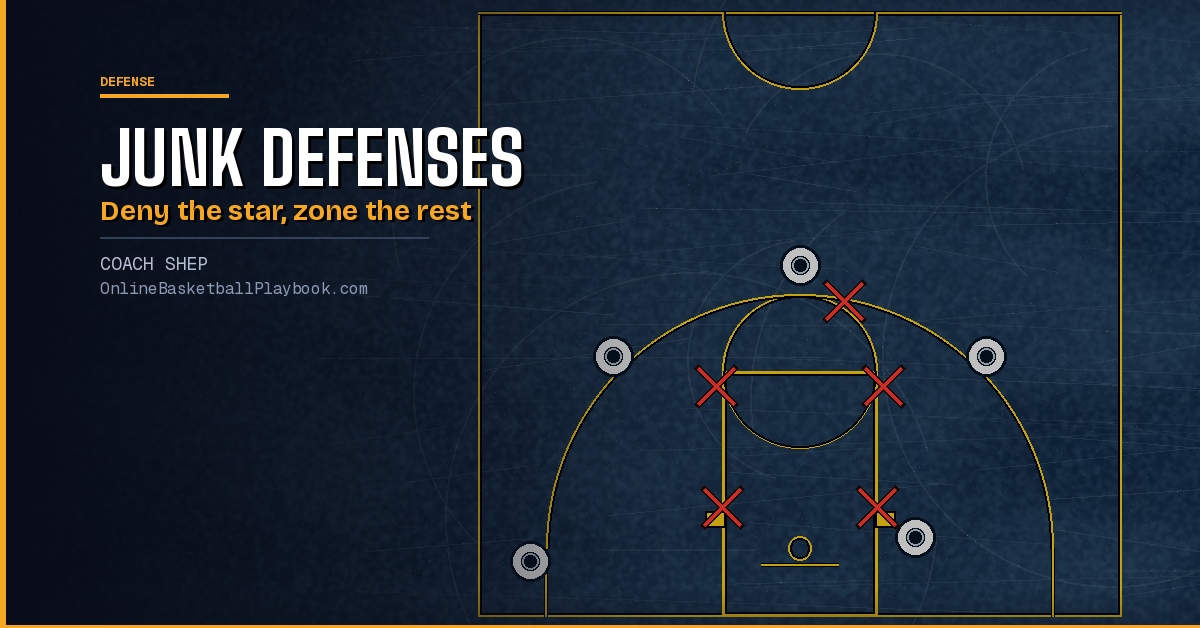
In junk defense basketball, one or two defenders guard specific opponents in full denial and the rest play a small zone behind them. The common shapes are the box and 1, the diamond and 1, the triangle and 2 and its inverted form. Coaches also call them combination defenses or alternative defenses. They come out against a team built around one or two scorers, to change the look for a few possessions, on an out-of-bounds play or on a last shot. Coaches treat junk as a situational call, not a base defense for a whole season. This page is the junk defense hub for the defense section, sitting beside types of defense in basketball.
Junk Defense Basketball Starts With the Chaser
The chaser has one job: total denial of the ball, with no help duties and no zone rotations. One version adds that he never lets his man catch a pass or grab a rebound, and says that denial is what breaks the opponent's set plays and continuities. The zone players behind him ignore the star until he catches.
Three questions about the chaser get different answers:
- Who chases. Version 1: a smart, disciplined, hard-working player who does not react to pushing or talk, with two or three players rotating through the job. Version 2: two chasers to keep the role fresh, and never your best scorer. Version 3: your best on-ball defender locks on and never helps.
- Screens on the chaser. Version 1: never get routed to the ball side, where he can be screened off, and fight through screens all game. Version 2: switch any ball screen that involves the star. Version 3: when the star dribbles out of a trap, the point defender switches onto him and becomes the new chaser.
- Fouls. Full denial of a frustrated star invites fouls. If the chasers get in foul trouble, the defense loses its core, so the staff decides before the game whether to go to straight zone or straight man.
Box and 1
Shape: one chaser on the star, and four in a box behind him, two high and two low. One version sets the box with two on the blocks and two at the elbows. Another puts the two tallest low, for the post, the corner, weak-side help and the glass, and the two quickest high.
Takes away: the star's touches, and with them the opponent's set plays.
Gives up: the arc. Two box defenders cover the whole perimeter outside the corners, so every skip pass needs a sprint closeout. One version names the skip from the top of the key to the corner, with a screen on the low box defender, as the pass that kills it. The middle of the box is also soft.
The rules inside the box: a high-post catch is doubled by the two high box defenders in one version, never by a low man, because the baseline cannot be left to one defender. Low defenders front the post when the ball is on their side. On every shot one defender contests, three form a rebounding triangle, and the chaser boxes out the star.

Full guide: box and 1 defense.
Diamond and 1
Shape: one chaser, and four in a diamond: one top, two wings, one inside.
When to pick it over the box: coaches give four different reasons. Version 1: against a one-guard or odd front. Version 2: against better shooters, because three defenders cover the perimeter. Version 3: when your own team has one dominant rim protector. Version 4: against an all-around star.
Gives up: coaches disagree here too. One names the high post and the glass. One names the high post and the corners. One names the corners and the middle, and switches back to the box if the corner becomes a problem.

The diagram shows one version's answer to a star post player: the chaser fronts the post, and the defender between the ball and the basket doubles with him.
Triangle and 2
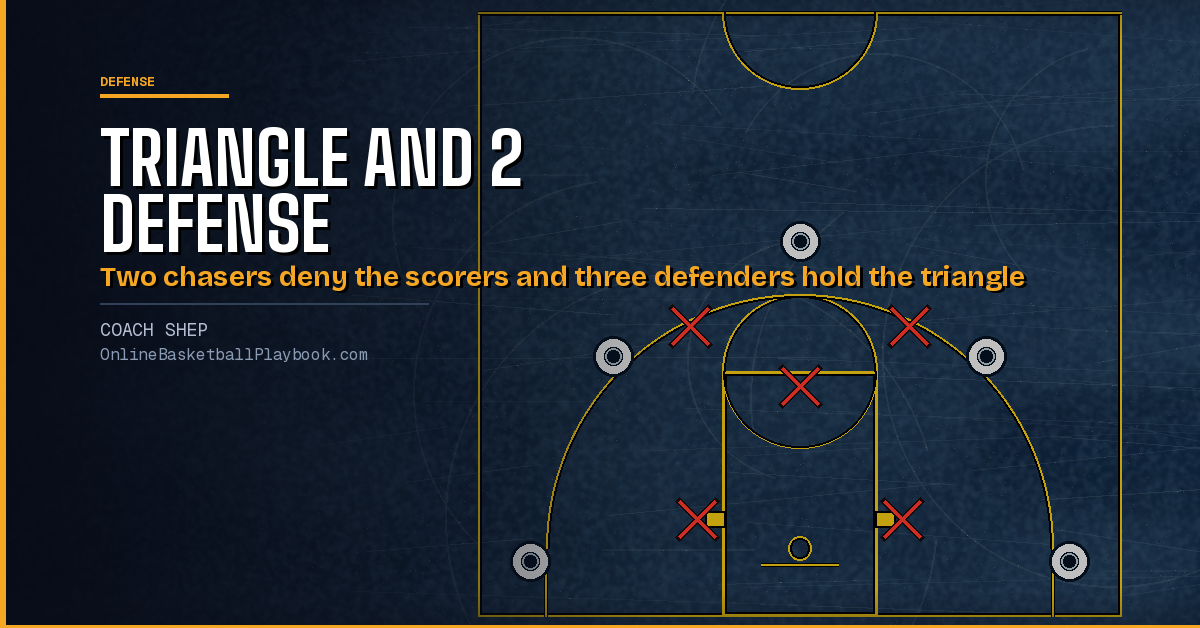
Shape: two chasers on two scorers, and three in a triangle behind them, one high and two low.
Takes away: two scorers at once. It fits an opponent with two good players and three average ones.
Gives up: the perimeter, because three triangle defenders cannot cover the arc either. One version calls triangle-and-2 rotations usually weak.
The rules inside the triangle: one version puts two bigger players low and a quick on-ball defender on top. The low defenders front the post when the ball is above the free-throw line and guard the ball below it. The top defender pressures the high post alone. Another version puts the best athlete on top and the best post defender on the center's favorite side. The same one-contest, three-rebound rule as the box applies.

Full guide: triangle and 2 defense.
Inverted Triangle and 2
Against a two-guard front, two versions flip the triangle: two defenders at the elbows and one low. One of them says the flipped triangle then shifts like a 2-3. The chasers stay on the two scorers.

Get the next coaching guide in your inbox
One email when a new guide or diagram set goes up. Free.
Other Members of the Family
- 1-3 and a chaser. Three across the blocks and one at the free-throw line behind the chaser. It is for a team with weak outside shooting and a stronger post, and good shooting beats it.
- 3-1 and a chaser. It pressures the wings and the high post and is weak at the low post, so it is for a star point guard with good shooters and an average post. One version switches from the 1-3 to the 3-1 when the opponent starts hitting from outside.
- The combo. Three outside defenders in full denial and two inside in a baseline zone, against spread or drive-and-kick teams, to make the two non-handlers handle the ball.
- Amoeba-style shapes. One Amoeba starts out looking like a diamond and 1. One Amoeba-style hybrid is built to run a full game, the exception in a family meant for short stretches. See amoeba defense.
When to Use a Junk Defense
The scouting trigger is a top-heavy opponent: one or two great players and limited role players, so the role players have to beat you. One version adds a ground rule: if your team is simply better, play your good man or zone instead.
Other reasons coaches give:
- Short stretches. One version runs it for three to five possessions. Another calls it a diversion and a gamble you must be ready to drop quickly. One comes out after a timeout, a quarter break or a made free throw, because the opponent has no play ready for it.
- Late in the season. One version brings out the box and 1 and triangle and 2 late in the season. Another installs a new wrinkle for tournament time because every opponent has scouted the regular-season menu.
- Out of bounds and the last shot. Out of bounds is the one time the defense has five on four, so a combination defense is one of the baseline answers in one version. It also sits on that version's last-shot list.
- A list of reasons. Five of them: take out a star, control tempo, make teams prepare for you, take away a special set, and steal a timeout.
What It Costs
- Good shooting teams. Two box defenders cannot cover the arc, and three triangle defenders cannot either, so two of the guides say not to run it against good or multiple shooters.
- A star big man. The box crowds the lane against a post star, and the triangle ends up with two defenders in one spot. One version says not to run the box or the triangle against a post star at all.
- Balanced teams. A team with several double-figure scorers breaks it.
- Too many looks. Too many junk defenses overload your own team, and switching looks only works if your players are less confused than the opponent.
- A late set on an inbound. A defense that is not set before the ball is put in play gives up a straight cut to the basket.
For where junk fits beside the regular zones, see best zone defense for your team.
How Offenses Beat Them
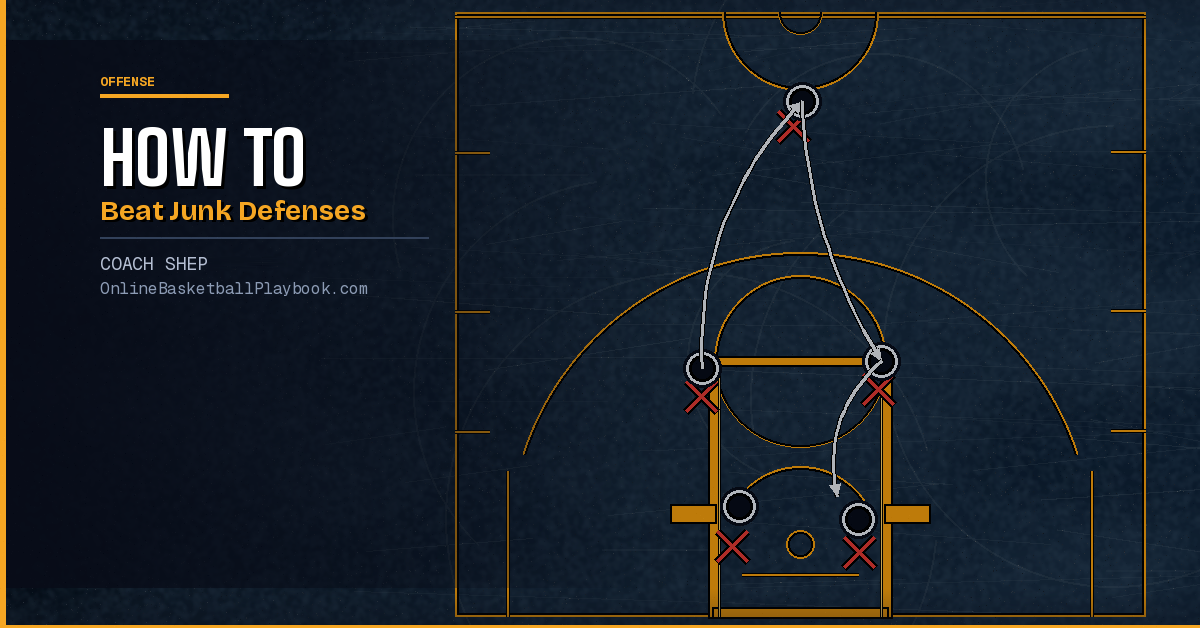
The offense's counters show where each shape is thin. One short rule is to run your zone offense against a box and 1 and your man offense against a triangle and 2. Screens for the star confuse the zone defender, who is unsure whether to leave his area. The chaser is a denial specialist, not a post defender, so several counters isolate the star in the post or at the high post. Another counter parks the star far from the ball so the other four play four on four.

One version adds that most teams lose to a box and 1 because they never practice against it. The full offensive plans are on how to beat a box and 1 defense, how to score against junk defenses and the zone offense hub, how to beat a zone defense.
Every Junk Defense in One Table
| Look | Shape behind the chaser | Chasers | Aimed at |
|---|---|---|---|
| Box and 1 | Two high, two low | 1 | One perimeter or driving star, weak shooters |
| Diamond and 1 | Top, two wings, one low | 1 | Depends on the version: odd fronts, shooters or a post star |
| Triangle and 2 | Two low, one top | 2 | Two scorers, three average teammates |
| Inverted triangle and 2 | Two at the elbows, one low | 2 | Same, against a two-guard front |
| 1-3 and a chaser | Three low, one at the free-throw line | 1 | Star perimeter player, weak outside shooting |
| 3-1 and a chaser | 3-1 zone | 1 | Star point guard |
| Combo | Two-man baseline zone | 3 in denial | Spread or drive-and-kick offense |
Where Coaches Split
What the zone players do when the star catches. Version 1: all four collapse to the box so the star sees help and passes, leaving teammates open on purpose. Version 2: in one triangle defense, the point defender sprints in to double the star. Version 3: two defenders double a driving star while the other chaser keeps denying.
Soft on the ball in the box
Nobody guards the ball at the top of the key, wing closeouts use an even stance with no forcing, and perimeter passing is allowed.
Push the ball away
The on-ball defender pushes the ball away from the chaser's side, and the next defender forces the catch to a sideline spot.
A star post player. Coaches split five ways: a diamond and 1 with the chaser fronting the post, a 1-3 and 1, a 1-3 and 1 with a smaller, quicker defender fronting and a safety shadowing him, a chaser on the post inside a triangle and 2 so the triangle doubles him automatically, or no box and no triangle at all.
Disguise. Disguise the call as zone or man. Another shifts a zone to man on a pass count, with defenders yelling "stay" so the offense hears no change.
Questions Coaches Ask
What is a junk defense in basketball?
A defense that puts one or two defenders in full denial on the opponent's best scorers while the other defenders play a small zone behind them. The box and 1 and the triangle and 2 are the common ones.
When should you use a box and 1?
Against a team built around one great scorer with limited role players, for short stretches, and not against a team with several good shooters.
What is the difference between a box and 1 and a triangle and 2?
A box and 1 has one chaser and four zone defenders in a box. A triangle and 2 has two chasers and three zone defenders in a triangle.
How do you beat a triangle and 2?
One short rule is to run your man offense against it and use screens to free the two scorers.
Want every diagram, printable?
OBP Pro members get the full diagram files for every alignment, action and drill on this page, ready for a practice binder or a scouting report. $9 a month. Or draw your own version free in the play drawer.
See what OBP Pro includesMore Coaching Hubs
- How to Beat a Zone Defense: Every Zone and Where to Attack It
- Basketball Screens: Every Type of Screen and How to Read It
- Transition Offense Basketball: Lanes, Reads and Early Offense
- Basketball Workout Plan: How to Build One by Position
Back to every Defense page.
Keep Building
Related breakdowns
Triangle and 2 Defense: How It Works and How to Beat It
Triangle and 2 defense explained with the chaser and triangle roles, rotations by ball location, the inverted version, when to use it and how offenses attack it.
Trap Defense Basketball: When, Where and Who to Trap
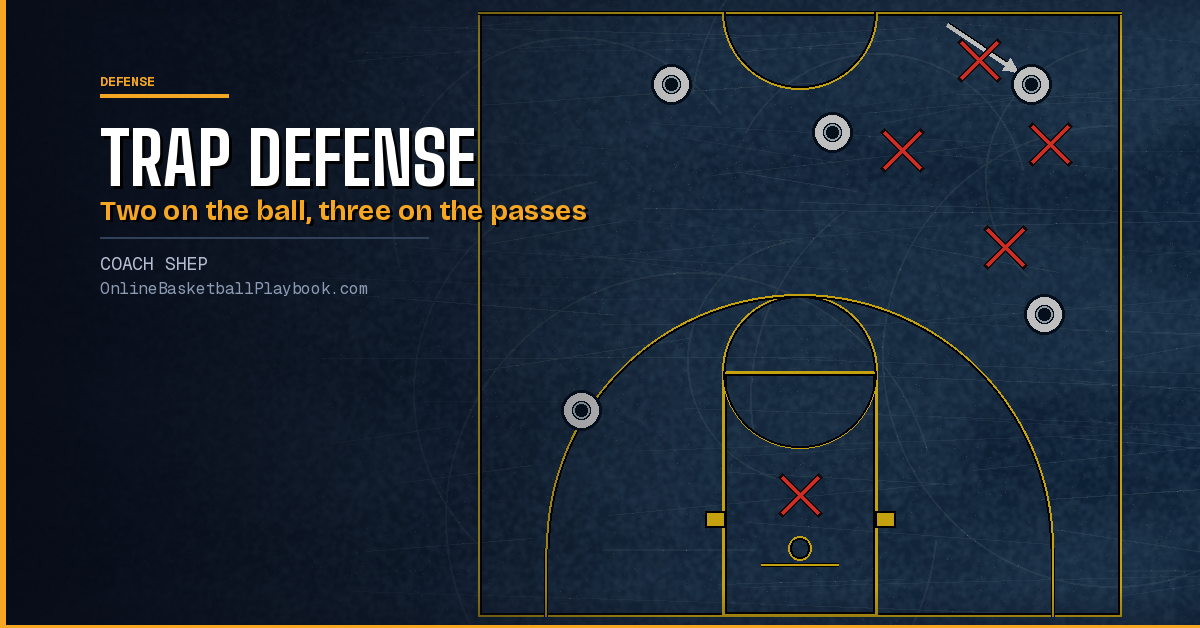
Trap defense basketball explained: how two trappers close, when to spring the trap, the spots on the floor, the interceptors and goaltender, and every version.