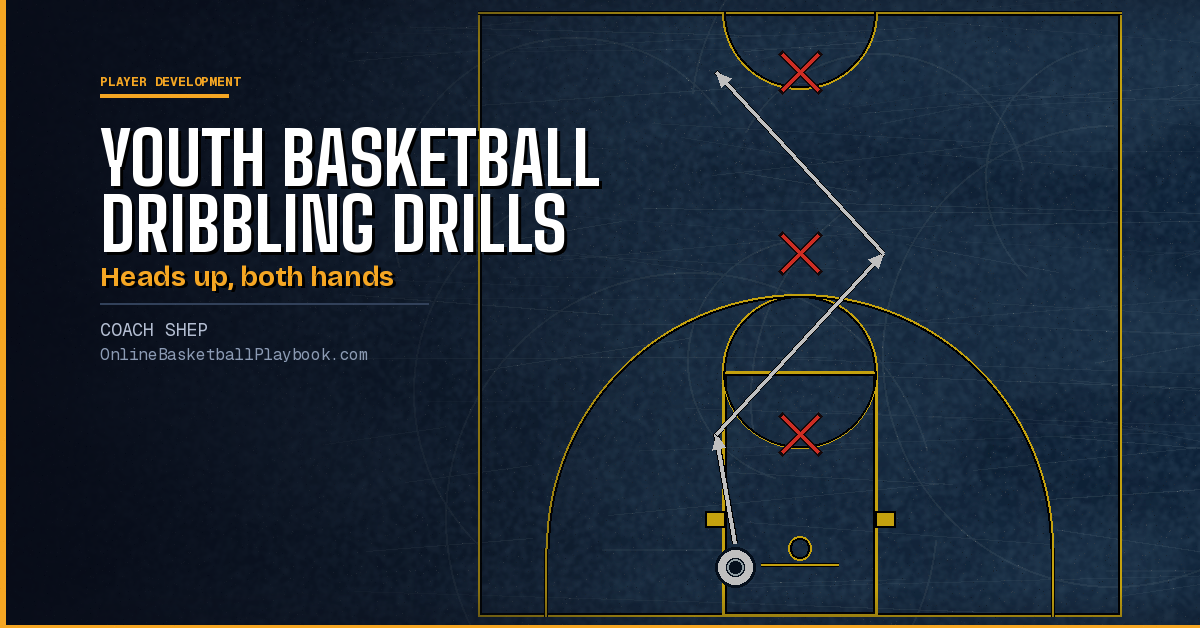
The first job of youth basketball dribbling drills is to get a young player to keep the ball close while he moves, with his head up and either hand. Most new players push the ball too hard, so it bounces too far away and another player takes it. The drills on this page are built for kids, from about age 5 to the middle school years. They are sorted by what they teach: the feel of the ball, eyes-up games, cone dribbling drills, line drills, and harder drills for older players. The full progression for every level, including two-ball and pressure work, is on basketball dribbling drills, and this page links to it rather than repeat it.
Youth Basketball Dribbling Drills by Age
Youth coaches set different targets at different ages.
| Age | What to teach |
|---|---|
| About 5 to 8 | Dribbling through games. One version plays small-sided games with a four-dribble limit and no score. Another counts it as success when a first or second grader who could not dribble at the start of the season dribbles better and makes a jump stop in a game by the end |
| 1st to 3rd grade | One ball, then two balls, the control dribble, the speed dribble and one dribble move |
| 4th to 6th grade | The same base plus a full-court dribble moves drill |
| Under 10 | Both hands |
| Under 12 | Harder dribbles and more work on the weak hand |
Young children also need short drills. One version keeps each drill to 3 to 5 minutes. Another, written for 5 to 8 year olds, keeps every player moving at the same time and each drill to no more than 5 to 10 minutes, because idle time is when young players are lost. Daily amounts run from about 15 minutes of dribbling a day for every player, post players included, to a 20-minute block. How practice is laid out by age is on basketball practice drills for youth.
What to Coach in Every Drill
Pick the cue words that fit your players and repeat them in every drill.
- Head up. Look up, not at the ball.
- Fingertips, not palms. One version adds that you should never hear the hand slap the ball.
- Waist high and low. A waist-high dribble in a low stance. Dribble low to prevent steals.
- Keep it close. The ball stays near the body as the player runs where he wants to go.
- Start in triple threat. Hold the ball beside the hip so the first dribble goes outside the foot on that side.
- End with a jump stop. Pick up the dribble with a jump stop and land in triple threat.
Teach the rules as you go. Explain traveling and double dribble from the first practices. Some youth leagues call both at the youngest ages without taking the ball away, so check your league's rules. See double dribble and how to dribble a basketball for the technique in detail.
Feel Drills for Young Players
Before a child can dribble well he has to find the pads of his fingers. These drills come before, or alongside, the first dribbling.
Spider push-ups. Each player puts one hand on the other, pads only, and moves the fingers like a spider doing push-ups. Then he picks up the ball and dribbles with the pads. Go back to the spider after a few minutes of dribbling as a review.
One-finger pad dribble. From one knee, the player dribbles with one finger at a time, playing the ball like a piano. Move on to figure eights and around one leg, then the other. Add a second ball, or challenge one finger and the opposite hand.
Copy cat dribbling. Spread the players out, each with a ball, and have them copy the coach in place: high and low with the right hand, high and low with the left, front to back, side to side, alternating hands every dribble, around each foot, around both feet, figure eights, and crossovers between the legs and behind the back.
The timed routine. A set circuit of ball handling: three times each way around the head, the waist and each leg, three rolling figure eights each way, and a stop with a crab dribble. Time each player the first time, write it down and compare it later.
More ball-handling patterns for a circle or a line, such as slaps, tips and kills, are on ball handling drills, and the beginner feel and circle drills are on basketball dribbling drills for beginners.
Eyes-Up Dribbling Games
Eyes up from the start is the common rule, and games are how young players learn it. Sharks and minnows, red light green light, dribble tag, dribble knockout and balloon dribbling are written up on basketball drills for kids and sharks and minnows. These are different ones.
Head up dribbling. Each player dribbles while watching the coach, who gives silent hand signals: one finger for the right hand, two for the left, and a point to the right, left, forward or back for the direction.
Traffic cop. Everyone starts on one baseline with a ball, spread out. The coach directs them without words: thumbs to the chest means dribble forward, fingers pointed at the players means dribble back, a point left or right means that way, and a stop signal means dribble in place. Add tasks on the stop, such as figure eights or between the legs. It can be a race to the far baseline, where a player who loses his dribble or misses a signal goes back to the start. Change signals faster as players improve.

Red, yellow, green, purple light. Players dribble around the court and react to the call. Red means stop and dribble in place, green means go quickly but in control, yellow means slow down, and purple means stop dribbling, set the ball down and run a circle around it.
Spacing dribble. Players spread out evenly inside a square and dribble around it, trying to keep the same distance from each other that they started with.
Follow-the-partner dribble. Partners each have a ball. One dribbles in front and the other follows one to two yards behind, keeping that distance as they move around the area.
Sneak up on the coach. The coach turns his back and walks away while the players dribble after him. When he turns around and chases, they stop, change direction and dribble back to the start line.
Ping pong catch. Two players 5 to 8 feet apart each dribble a basketball while tossing a ping pong ball back and forth underhand. A player who misses dribbles to get it. Then switch to the off hand.
Cone Dribbling Drills
Cones give young players a target and a turn without a defender. These cone dribbling drills run from the youngest players up.
Dribbling around cones. Split the team into two or three lines and set three or four cones about 5 yards apart in front of each. On the command, each player dribbles around his cones. Two versions: shoot at the basket after the last cone, or make it a relay, where the first team to finish, shoot and sit down in a straight line wins.

Cone crossovers with a count. Two lines, each with five cones about 10 feet apart, and one ball per line to start. Two players go at a time at a comfortable speed, not a race. Down with the right hand on the right side of the cones and back on the other side, then the same with the left hand, then a weave with a crossover at each cone, treating each cone as a defender. A coach stands past the cones and holds up fingers, and the dribblers yell out the number as it changes. Coach the details: cross over quickly, speed up just before each cone, stay low, and end with the ball outside the foot farthest from the cone. If players get sloppy, a coach can stand at a cone and poke at the ball. Then run it as a relay, where the ball is handed to the next player, never passed.

Two-line cone weave. For 3rd to 6th graders. Every player has a ball. Set cones in a three-sided rectangle and split the group into two lines. Both lines weave through the cones and through the other players to the other line, heads up. Keep it under control at first, not a race. A version without cones has two lines on two sides of a square dribble across at the same time, weaving through each other.
Dribble around defenders. Line up several players down the middle of the court as defenders. They cannot move their feet, but they can move their hands and lean for the ball, with their hands up the whole time. The dribbler weaves past them on alternate sides to the other end without losing control or letting the ball be touched.

The cone and chair drills for players who already have a handle, such as tight chairs and the speed-change loop, are on basketball dribbling drills.
Get the next coaching guide in your inbox
One email when a new guide or diagram set goes up. Free.
Line Drills With Commands
Line drills teach the named dribbles. One line-drill version teaches six: the control dribble against pressure, the speed dribble to push the ball up the floor, the retreat dribble to back away from pressure, the crossover, the whirl pivot dribble and behind the back. The players form lines two deep on the baseline or sideline, with one ball per line and cones or chairs as stop and change points. They start in triple threat, start, stop and change on the coach's voice or whistle, jump stop and pivot at the turnaround, come back with the other hand, and finish with a jump stop, handing the ball to the next player. The coach stands in front of the lines and holds up fingers for the players to shout out.
- Righty, lefty. The whole team dribbles to half court with the right hand, then switches and finishes with the left.
- Go, stop, change, go. On go, speed dribble with the right hand. On stop, control dribble with the right. On change, switch the control dribble to the left. On go, speed dribble with the left.
- Speed and retreat. On the command, two or three dribbles backward against an imaginary defender, then speed dribble again.
- Speed and crossover. Lines face each other, dribble toward each other and cross over when they meet, then explode up the floor.
- Dribbling on the move. Four lines go the length of the court, comfortable at first and faster as they improve: low dribble with each hand, backward, sliding sideways, between the legs on each step, and crossovers with a change of speed and direction at the cones.
The move list and its teaching points are on basketball dribbling moves.
Harder Drills for Older Players
Cone moves with a finish. Two lines, one under each basket, with cones at the free-throw line extended and at half court. The player makes the called move two steps before each cone, explodes out of it and finishes with a layup. This version adds that every player needs a go-to move and a counter to it.

One-on-one dribbling. Partners share one ball. The dribbler starts on the baseline and the defender about 3 feet away. The dribbler tries to reach half court, and the defender tries to steal the ball or stop the dribble.
Two balls in place. Each player dribbles two balls at once, trying not to look at them: high, low, front to back, side to side, all four directions, and spinning in a circle. It makes young players use both hands equally.
For a 12-year-old the next step is in basketball drills for 12 year olds, and a solo or small-group plan is on kids basketball training workout.
Want every diagram, printable?
OBP Pro members get the full diagram files for every play, drill and frame on this page, ready for a practice binder or a team meeting. $9 a month. Or draw your own version free in the play drawer.
See what OBP Pro includesWhere Coaches Split
- General handling or specific moves. Some versions keep younger players on general handling, two-ball work, follow the leader and mirror dribbling, with few specific moves. One version teaches one move to its youngest group. Others drill a full list of moves.
- Two balls and how young. One version starts two-ball work in first grade. Versions for the youngest players lean on games and a dribble limit instead.
- Drills or games first. Some open with stationary drills every day. Others teach the skill inside a game, play first, then drill what the players could not do, then play again.
Questions Coaches Ask
What are good dribbling drills for kids?
Games that keep the head up, such as head up dribbling, traffic cop and red, yellow, green, purple light, plus simple cone drills. Every child should have a ball and every drill should be short.
How do you teach a child to dribble a basketball?
Start with the finger pads, spider push-ups and the one-finger pad dribble, then dribbling in place by copying the coach. Keep the ball waist high and close, and add moving games once the child can hold a bounce.
What are cone dribbling drills in basketball?
Drills where players dribble around or weave through a line of cones, often with a crossover at each cone, a count of the coach's fingers to keep the eyes up, and a shot or layup at the end.
How long should youth dribbling drills last?
Short. Keep each drill to about 3 to 5 minutes, or no more than 5 to 10, with every player moving at once.
Should kids dribble with their weak hand?
Yes. Run each drill with the weak hand too. One version sets both hands as the target for under-10 players.
More Guides From This Batch
- Horns Basketball Play: The Horns Set, Actions and Reads
- How to Become a Basketball Coach: Paths, First Jobs and Steps
- How to Draw Basketball Plays: By Hand and Online Free
Back to Basketball Dribbling Drills and every Player Development page.
Keep Building
Related breakdowns
Basketball Dribbling Drills: Beginner to Advanced
Basketball dribbling drills from beginner to advanced. Stationary series, moving drills, two-ball work and pressure drills, with how to run each block.
Basketball Drills for 12 Year Olds: Dribbling, Passing and Games
Basketball dribbling drills for 12 year olds, passing and cutting drills, decision games and a 90-minute practice, all written for players this age.
Basketball Dribbling Drills for Beginners and Other Basics
Basketball dribbling drills for beginners first, then the shooting, passing, footwork and finishing drills new players need, with how each runs.