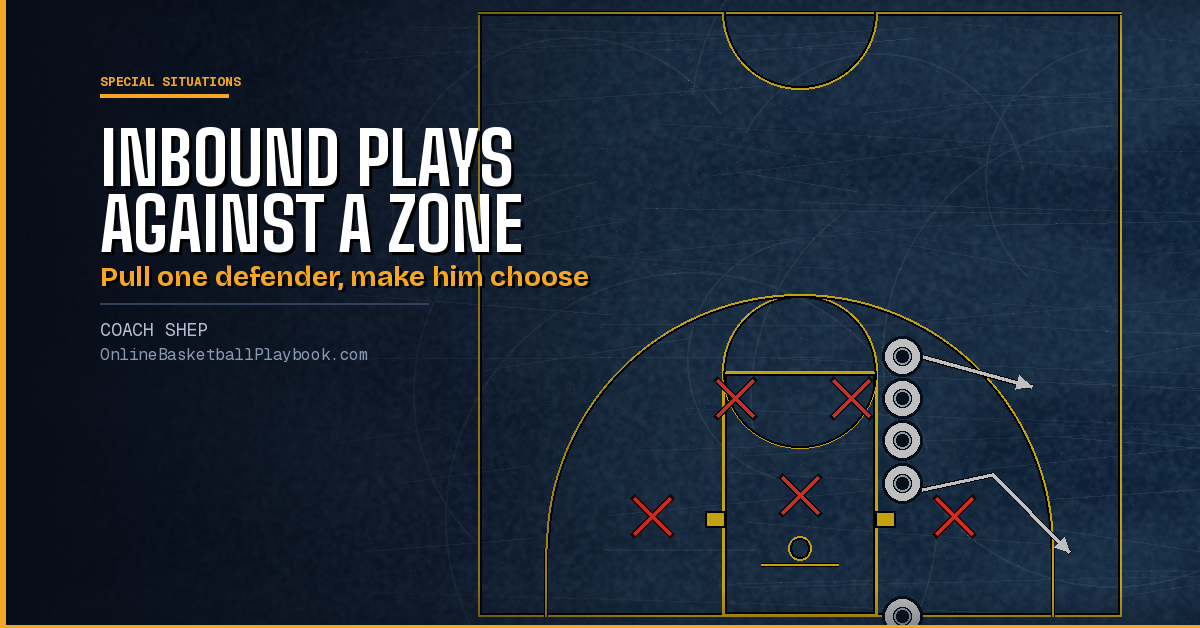
Inbound plays against a zone are built for the defense many teams sit in on a baseline throw-in, the 2-3. The job is the same in almost every one of them. Pull one low defender out of the paint, then make him choose between two players. Whichever one he takes, the other is open.
The man-to-man baseline calls are on baseline out of bounds plays, every throw-in spot is compared on basketball inbound plays, and the rest of the dead-ball pages sit under special situations. The half-court side of the same problem is on how to beat a 2-3 zone.
Inbound Plays Against a Zone Start With the Read
Knowing whether the defense is in man or zone before the ball is inbounded is one key to every out-of-bounds play. Teams often switch defenses after a dead ball, so a sideline call should work against man, an even-front zone and an odd-front zone.
Coaches answer the switch in three ways:
- One call that works against both. A box screen-the-screener play runs against man and zone. Tandem baseline screens free a shooter against either. A triangle call works against either. In Tom Izzo's screen-the-inbounder play, the screener takes the middle low defender of the zone in place of a man.
- Adjust the man play. A box play for the inbounder works against a 2-3 if the screener down-screens the zone's outside low defender, and from a line, the post can call a zone rotation.
- A separate zone call. Keep one or two plays built only for the zone, like the ones drawn below.
The man-to-man versions of these shapes are on box set inbound plays and stack inbound plays.
Look at the defense before the ball is handed over, and make the call before the count starts.
Two Ways to Break a Zone on the Baseline
Coaches split on how to break a zone from the baseline:
- Flood the seams. Put two cutters in adjacent gaps of the zone so the help defender cannot cover both.
- Screen one defender. Screen or seal a specific zone defender, then read the defender who is left. Most of the plays below work this way.
The rules help the second way. In NCAA men's and women's rules, the three-second rule is not in effect while a team controls the ball for a throw-in, so a post can set up in the lane before the ball comes in. For high school, the NBA and FIBA, check your league or state association rulebook.
Pick one way for your team and build every zone call on it, so the players learn one read.
Stack Near the Elbow
A stack on the ball-side lane line, started near the elbow and not too low, sends the best shooter to the corner and a post into the gap behind him.


The inbounder reads the low defender. If he follows 2 outside, the pass goes inside to 4. If he stays inside, 2 is open in the corner for the three.
- Seal and run to the corner. 5 sets up above the blocks, between the ball-side low defender and the middle defender and seals the inside one. The best shooter runs around a screen to the ball-side corner, and if the low defender closes out, the screener slides down the lane into the gap. It is drawn on baseline out of bounds plays and on basketball inbound plays.
- Hold it for the postseason. The corner-and-gap play is a good one to hold back for the postseason, when opponents have seen the rest of the menu twice.
Watch the low defender, not the cutter. He tells the inbounder where the ball goes.
Pull the Low Defender to the Short Corner
A cut to the short corner calling for the ball drags a back defender out of the lane. The post who screened for that cutter then seals the defender left inside.

2, in the far short corner, can also steal the inside position of the defender there, and 1 is the outlet as the safety. Other ways to empty the lane:
- Seal two defenders. Seal the low and the middle zone defenders to free a corner three or a post shot from midrange.
- Screen the middle man. From a box, 5 screens the middle man of the zone and 4 cuts to the hole.
- Occupy, screen, slip. 2 sprints along the baseline and cuts to the corner to occupy the low defender on that side, 3 and 4 screen the other two back defenders, and 5 slips into the gap.
- Call a name. The point guard inbounds and calls a teammate's name. That player flashes to the strong-side corner, 5 seals the middle man and 4 clears to the weak side, which leaves a corner three or a one-on-one post-up for 5.
- Inbound away, step the post in. Inbound to the side away from the alignment, and the post steps into the middle off the point guard's screen.
Make the cutter call for the ball loud and early. The defender has to believe him.
Split the Shooters, Cut the Middle
Start the shooters low and the posts high, then reverse them. When the shooters split to the corners, the two back defenders have to go with them or give up a three, and the posts cut into the space.

If the low defenders stay home, the corner three is there instead. The same idea in other shapes:
- Flare and split early. Both guards flare to the wings at the same time, and the 4 and 5, stacked at the free-throw line, split to the blocks. Whoever cuts to the weak side goes a split second early to freeze the middle defender.
- Four low cutters. Send four cutters low so three zone defenders have to cover four spots.
- Clear two low defenders. Clear the two low zone defenders out to open a gap for a midrange shot.
- Pop the bigs. The 4 and 5 pop to the corners, the 1 goes back as the safety, and the 2 cuts down the lane line.
- Corners and a dive. Both guards go to the corners while a big dives into the lane. The 4 stays patient until the zone's guard steps out to the corner and a spot opens in the paint.
- Run at the rim, walk to the elbow. The 5 runs hard at the rim calling for the ball to draw his defender, while the 4 walks to the elbow and then dives to the block.
- Make the guard choose. An inverted set asks the zone's guard which cutter he takes, and either choice leaves 2 open.
Run the split from both blocks so the zone cannot cheat to one side.
Two-Part Zone Sets
Some zone calls do not score on the first action. They move the zone once, reverse the ball, and attack the rotation with a second screen.
- Corner cut, reverse, back screen. 5 screens the top of the zone for a corner cut, the ball is reversed, and then 1 back-screens the back side for a lob or a dive. In the second part of the series, 5 seals the back side after his screen and 1 exits on a back cut.
- Loop and follow. 4 carves out space on the opposite block to draw the middle man. 3 starts at the weak-side elbow and loops off 5's screen out to the ball-side wing, and 2 follows the same path. The ball-side guard's defender chases 3, the next defender is caught on 5's screen, and 2 comes open.
- Catch high, then ball screen. Both guards begin in the corners with the posts on the elbows. 4 screens the guard at the top of the zone so 1 can catch the inbound pass up high, then 4 ball-screens for 1 for a pull-up at the free-throw line. 3 seals inside for a dump-down pass or rebounding position, and 1 can kick out to 2 or find 3 if the guard at the top of the zone drops to help.
- Lure and X. 4 steps for a catch to lure the ball-side forward, 1 passes across the court to 3, and 1 and 4 run an X to screen the side of the zone.
- Screen the back after the reversal. 1 screens the back of an overloaded zone after the ball is reversed.
- Cross screen for the 4. 5 cross-screens for 4, who cuts across the lane to take the pass.
More half-court zone actions to borrow are on how to beat a zone defense.
Teach the second action on the same day as the first.
Sideline Inbound Plays Against a Zone
Against a zone on the sideline, move the ball before you attack. Hubie Brown's checklist for a sideline play against a zone:
- Space. Spread the floor.
- Reverse the ball. Get it to the other side as fast as possible.
- A short and a long pass. The inbounder needs both.
- Replace. When you leave an area, replace it.
Coaches split between one sideline call for both defenses and a separate call for each zone:
- One play for man and zone. All five players move at the same time, the 5 seals the middle against a zone, and a ball screen frees the 1 to throw back to the 2.
- A call for each look. Against a 2-3 or 3-2, the 2 becomes the runner along the baseline to reverse the ball. Against a 1-3-1, the 4 steps out and the 5 is isolated in the triangle, and the 1 often gets a backdoor cut. Against a matchup zone, a triple-post look. Against a zone or a matchup, a separate box call.
- Pull the guard, free the shooter. From a sideline box against a 2-3, 1 comes to the ball to pull the zone's guard out, and 2 cuts under 4's screen on the forward.
- Trail along the baseline. 1 comes up to the free-throw line and trails 2 along the baseline.
The rest of the sideline menu is on sideline out of bounds plays. The half-court answers for the other zones are on how to beat a 1-3-1 zone defense and how to beat the matchup zone.
Reverse the ball first, then attack the gap the zone leaves.
Teaching Zone Inbound Plays
A zone inbound play is a read, so teach the read. Run every zone call against a live zone in practice.
- Keep the menu short. A couple of baseline plays against man, one or two against zone and a sideline play is enough for a youth team.
- Practice against defense. Plays that only work five on zero fail in games.
- Start on the handoff. Do not spend part of the five-second count on a slap. The count by level is on basketball out of bounds rules.
The defensive side of these plays, including the zones built only for the throw-in, is on 1-3-1 baseline out of bounds defense and how to defend inbounds plays.
Carry one zone call the team can read under pressure, then add the next.
Get the next coaching guide in your inbox
One email when a new guide or diagram set goes up. Free.
Questions Coaches Ask
What is a good inbound play against a 2-3 zone?
A play that pulls one low defender out and makes him choose, such as the stack near the elbow, where the best shooter cuts to the corner and a post slides into the gap behind the defender who follows him.
Should you run the same inbound plays against man and zone?
Some plays are built to work against both, like tandem baseline screens and a box screen-the-screener play. Others are zone-only calls. Read the defense before the ball is handed over and call the play that fits.
How do you inbound the ball against a 1-3-1 zone?
From the sideline, a call built for the 1-3-1 has the 4 step out so the 5 is isolated in the triangle, and the 1 often gets a backdoor cut.
Can a post stand in the lane before a throw-in against a zone?
In NCAA men's and women's rules the three-second rule is not in effect while a team controls the ball for a throw-in. For high school, the NBA and FIBA, check your league or state association rulebook.
Want every diagram on the site?
OBP Pro members get the full diagram files for every guide on the site, ready for a practice binder or a scouting report. $9 a month. Or draw your own version free in the play drawer.
See what OBP Pro includesMore Inbounds Plays
- Box Set Inbound Plays: Cross Screens, Back Screens and Reads
- Stack Inbound Plays: Splits, Rubs, Lines and Reads
Back to Basketball Inbound Plays and every Special Situations page.
Keep Building
Related breakdowns
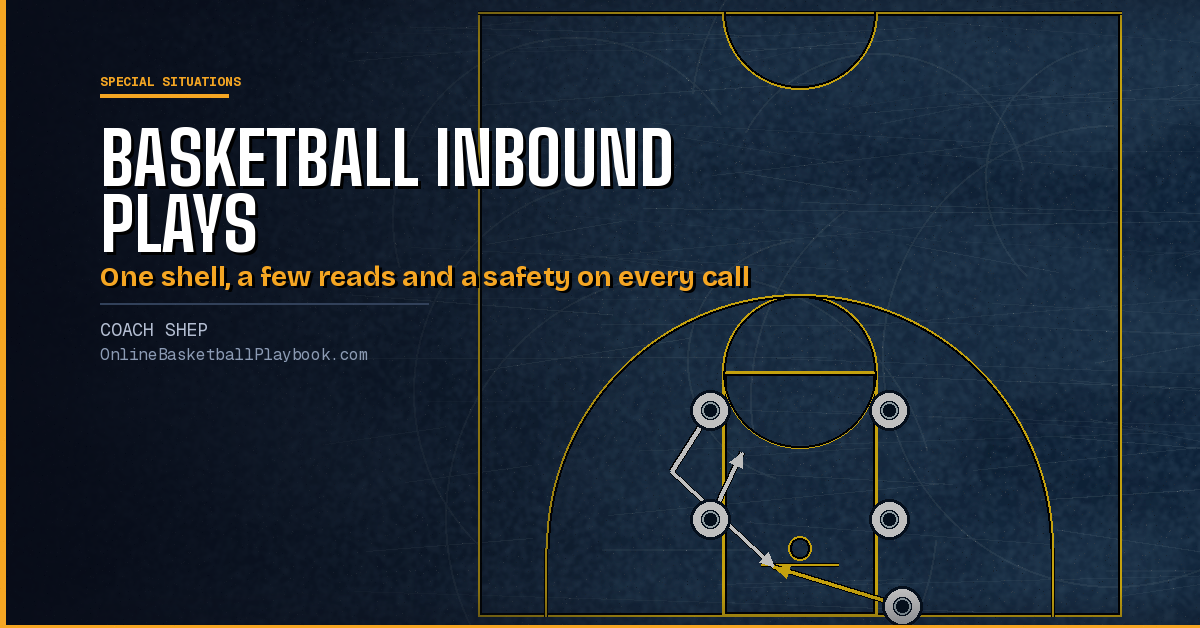
Basketball Inbound Plays: Baseline and Sideline Sets to Run
Basketball inbound plays for baseline and sideline throw-ins, with six drawn sets, simple plays for youth teams, zone looks and where coaches disagree.
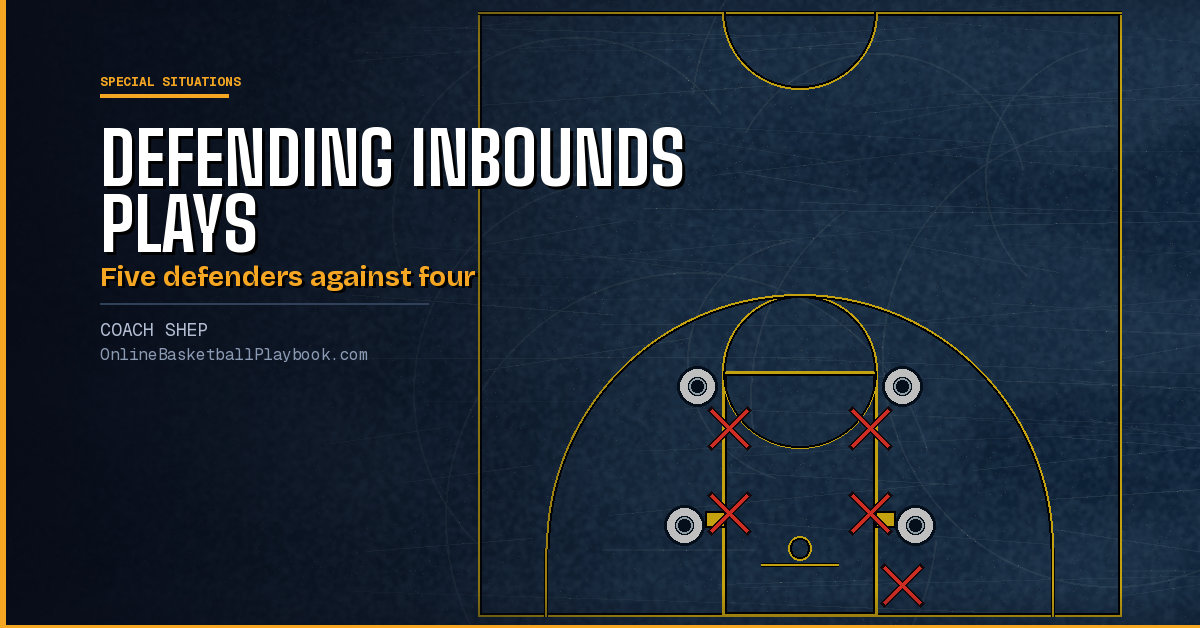
How to Defend Inbounds Plays: Baseline and Sideline Options
How to defend inbounds plays: the 5 on 4 edge, what to do with the inbounder, Jam, Jump Switch, Trap and zone options, sideline answers and late-game calls.
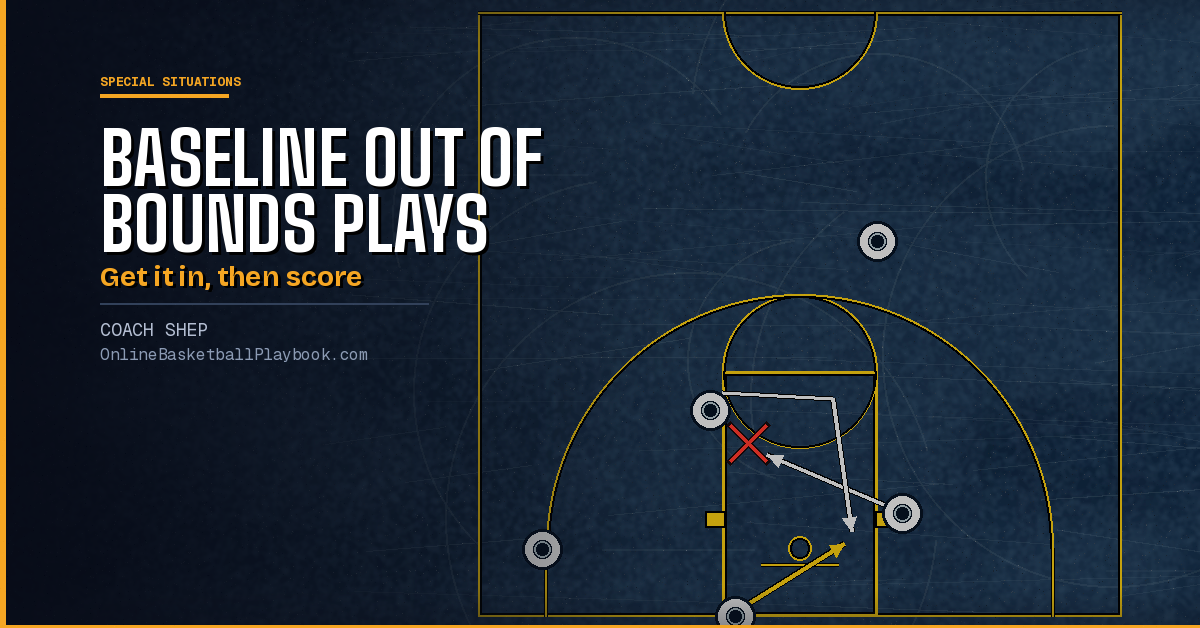
Baseline Out of Bounds Plays: Sets vs Man, Zone and for Youth
Baseline out of bounds plays drawn step by step: a box back screen and roll, Pick the Picker, the double stack, a 2-3 zone play, youth one-pass plays, the rules and the reads.