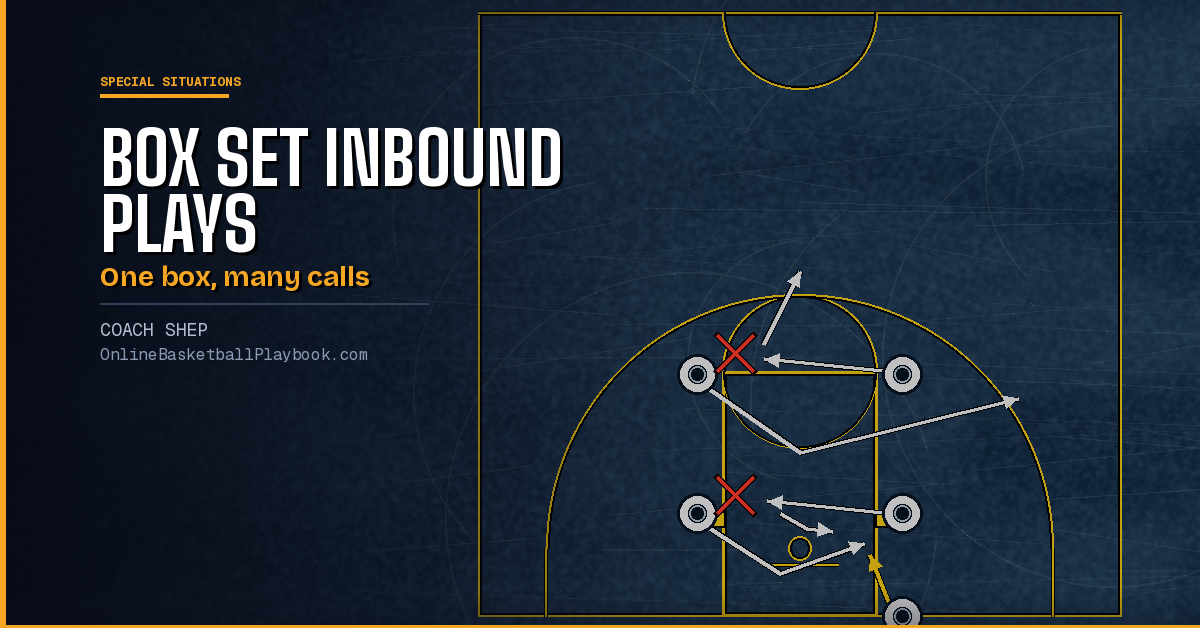
Box set inbound plays start four players in a box under the basket, two on the blocks and two at the elbows, with the fifth throwing the ball in from the baseline. One picture holds a back screen for a lob, a stagger for a shooter, a cross screen for a post and a step-in for the inbounder.
The wider baseline menu is on baseline out of bounds plays, every throw-in spot is compared on basketball inbound plays, and the rest of the late-clock and dead-ball pages sit under special situations.
The Box Set Inbound Shell
Every play on this page starts from the same four spots, so the defense sees one picture whatever the call. The shell has a few forms:
- Standard box. Two players on the blocks and two at the elbows.
- Wide box. The two posts line up wide of the usual block and elbow spots, which gives the screener a better angle. Box Wide is drawn on basketball inbound plays.
- Extended box. 4 and 2 start a few feet above the free-throw line, 1 on the ball-side block, 5 on the far block and 3 inbounds. Every call runs from this one fixed shape.
- Box and 1-4 low together. Every baseline call runs from a 1-4 low that morphs from a box if the defense denies it, with the calls printed on a card sewn into the players' shorts and a new card each game.
The shell does the hiding, so the call can change without the setup changing:
- Same screens, new ending. Two box calls can share every screen and cut and differ only in the last read. One ends in a post layup and the other in a corner three for the inbounder.
- Same play, new name. A box play named for its two posts, 54, is also called 45. It is the identical action under a second name, to confuse a team that scouts your calls.
- Name the go-to players. Every box play gets a primary and a secondary go-to player by number, so the coach can see which play fits which lineup.
- Draw it both ways. Diagram every box play twice, entering from the right and from the left.
Teach the box before the plays, and every new call is one more ending on a picture the team already knows.
Cross Screens From the Box
A cross screen at the blocks puts two posts at the rim, the cutter and the screener who seals behind him. It can run at both levels at once.

- Cross at both levels. 4 screens across for 5 while 1 screens across for 2. 5 cuts around the screen to the ball-side block, and 4 seals the defender he screened for inside position. 4 is often the one open for the pass and layup. 2 cuts to the wing for a three, and after his screen 1 pops out to the top of the key.
- Baseline screen, over the top. 5 sets a baseline screen for 4, who goes over the top looking for a high feed from the inbounder, while 3 screens for 1 out front. If the defense switches, the inbounder feeds 5. If neither post is open, he inbounds to 1 and the team starts its continuity.
- Cross screen into a lob. 5 pops out and 4 cross-screens for 1. The inbounder hits 5, who relays to 1 coming off 4's screen, or throws straight to 1 on the wing. 1 reads a lob to 4 cutting off a smaller teammate's back screen first, then a shot for 2 off 5's baseline screen, then a post-up for 5.
- Read in order. 5 comes off the cross screen first, then 4 opens up and seals 5's defender, then 1 pops to the arc. The best decision maker inbounds.
- Inbound away, then cross. Throw the inbound away from the ball side, then cross-screen for the strongest post.
Every cross screen is two chances. Teach the screener to look for the ball after every screen he sets.
Back Screens and the Switch Read
A back screen from the box sends a post straight at the rim, and the play is built for the defense that switches it.

In 54 the two posts start opposite each other, and the inbound pass goes to the corner before the post cut. The likely answer is a switch, with 5's defender going with 4.

If neither post comes open, 2 has the three from the corner and 1 has it from the wing. The other back-screen calls from the box:
- Screen and roll. 4 screens for 5, who cuts to the opposite block, then seals the man he screened and rolls to the rim. It is drawn on baseline out of bounds plays.
- Back screen for the shooter, then screen the screener. 5 steps up and back-screens for the shooter, 2, then 4 screens for 5. The inbounder feeds 2 off the back screen or 5 cutting to the basket, and if neither is there he inbounds to 1 to start the continuity. A drawn Pick the Picker is on baseline out of bounds plays.
- Weak-side lob. 1 screens for 4 and pops out, and the inbounder looks for 4 or 1. Then the inbounder steps in and back-screens for 4, and 1 or 2 throws the lob.
- Post seal on the switch. From a wide box, 5 seals for a mismatch when the defense switches.
- Switch-busters. Build a call that flips the defense's assignments when it switches.
- Flare the post. Keep the X screen of the base play, but send the post flaring to the corner while the guards roll.
In the box family, the screener is screened right after the cutter uses his screen, so the inbounder almost always has two looks. How to set the screen itself is on back screen basketball.
Rep the switch before the play. A screener who seals on the switch turns the defense's best answer into a layup.
Box Plays for the Inbounder
Several box plays make the inbounder the shooter. Put the best three-point shooter on the ball and screen for him after the pass.


4 is the post outlet if the closeout takes the three away, and 5 is in rebounding position. The same action works against a 2-3 zone if 4 down-screens the zone's outside low defender. More box plays for the inbounder:
- Double screen for the corner three. The best three-point shooter inbounds. 1, starting on the block, fakes in and cuts to the corner for the catch while 5 cuts to the low block for a layup look, 3 cuts out high on the ball side and 4 works for inside position on the far block.
- Then the double. 1 passes to 3 on the wing and sets a double screen with 5, and the inbounder cuts hard around it to the corner for the pass back from 3.
- Single or double. The inbounder passes to 5 stepping toward the corner, or straight to 1 coming off 3's screen, then steps in under the basket. He comes off 5 and 3's double screen or 4's single baseline screen for the shot, and 5 passes back out to 1 if nothing is there.
- Same box, inbounder's three. The screens and cuts of the back screen and roll stay the same. The inbounder passes out to 3, V-cuts toward 5, then cuts to the ball-side corner for the three.
Choose the inbounder before you choose the play.
Staggers, Elevators and Doubles
Several box calls set two or three screens for one shooter, and some are built for a defense that is switching. Stack the screens where the shooter wants to catch it.
- Double elevator. 4 and 5 set an elevator for 2 to cut through for a catch and shot. Then 3 and 5 quickly reset a second elevator for 4 to cut through for a pass and layup. Box Elevator, labeled for a few seconds left, is drawn on basketball inbound plays, more late-clock calls are on buzzer beater plays, and the screen itself is on elevator screen.
- Triple stagger to the corner. A triple staggered baseline screen for a corner three, paired with a four-across spread of staggered screens as the two calls for a defense that is switching.
- Double baseline screen. With the bigs on the strong side, 5 and 3 screen up for 4 and 2, 4 passes to 1, and then 4 and 5 stand together on the baseline as a double screen for 2.
- Turn and screen, then a double. 5 turns and screens for 1, who goes to the corner. 1 then screens across for 3 and sprints through a double from 4 and 5.
- Screen down on the flat defender. 5 screens for 2, 3 dives to the corner, and 5 then screens down for 4. On a baseline throw-in, 4's defender is flat, which leaves him open to the screen.
- Screen and slip. 4 screens for 2 and slips his own screen.
Shooting off these screens is taught on basketball shooting off screens.
Put the shooter in the spot the screens were built for, every time.
Box Series That Flow Into Offense
A box play does not have to end when the first look is gone. Build the call so the ball goes back out and the team flows into its offense without resetting.
Run every set from the same box and look for the lob first. If the 3's defender has his back to the ball, the inbounder and the 3 make eye contact for a quick lob. The rest of the series:
- Corner catch into a ball screen. The 3 cuts to the corner off the 5 and catches, and the 5 dives. The 3 passes to the 1, the inbounder clears, the 4 down-screens for the 5, and the 5 comes off to ball-screen for the 1, who drives. The 4 fills the far corner and the 3 lifts so the roll is open.
- Wrap when the corner is denied. The 3 wraps around the 5 with his back to the basket, the 5 pops out for the ball and reverses it to the 1, the 2 and 3 fill the weak side, and the 4 screens and rolls.
- Screen up first. The 3 screens up for the 4, who cuts to the basket, the 5 flares the 3 to the corner, and the ball goes to the 3 and swings to the 1 for the 5's ball screen.
- Back cut on the denial. If they deny the 1, the 3 dribbles at him and the 1 back cuts.
Other ways to keep the box alive:
- Don't throw it. If the backdoor is not there, do not force the pass. Run a double reverse into a ball screen instead.
- Reverse to the point guard. End the play by reversing the ball out to 1 to start a set continuity, so the team never backs the ball out and calls a new set.
- Rub into flex. A box rub continues straight into flex. The flex sets are on flex basketball plays.
- Call it again. A box series built on screen the screener, stagger slips, and a stagger for 2 from 4 and 5, who then set a stagger for 3 and slip, pairs with one naming rule. Every counter is called "[play] again", so the defense sets up for the first action while the counter runs.
The ball screen at the end of these series is taught on pick and roll basketball.
Plan the second action before the first one fails.
Teaching Box Plays
Box plays live or die on the screens, so the teaching starts there:
- Screen the back or hip. Set the screen on the defender's back or hip so he cannot slip under it, and hold it until he fights through.
- Hide the cut. Never face the direction you are about to cut or screen.
- Time the second screen. The timing between the first and second screen is critical.
- Practice against defense. Plays that only work five on zero fail in games.
- Pick the start. Start on a player's "go" call, on the inbounder's slap, or the moment the official hands over the ball, because a slap costs time once the count is running.
- Keep the menu short. Three to four plays in total for a youth team, or two plays out of each formation.
- Hold one back. Save a favorite box call for the postseason, when conference opponents have seen everything else twice.
The count itself differs by level. NCAA men and women give the thrower-in five seconds to release the ball, the NBA five seconds from when he controls it, and FIBA five seconds. For high school, check your state association rulebook. The rest of the throw-in rules are on basketball out of bounds rules, and the defensive side of these plays is on how to defend baseline out of bounds.
Pick two or three calls, rep them from both sides, and add the next one only when the first is automatic.
Get the next coaching guide in your inbox
One email when a new guide or diagram set goes up. Free.
Questions Coaches Ask
What is a box inbound play?
A baseline out of bounds play that starts with four players in a box under the basket, two on the blocks and two at the elbows, so one shape carries many calls.
Who should inbound the ball in a box set?
It depends on the call. A good passer and shooter takes it out when the play can end in a three for him, and the best three-point shooter inbounds on the plays that screen for him after the pass.
How do you beat a switch on a box inbound play?
Write the switch into the play. The screener seals the defender he screened and rolls to the ball-side block while the first cutter clears out.
Does a box set work against a zone?
Some box plays do. More zone answers are on inbound plays against a zone.
Want every diagram on the site?
OBP Pro members get the full diagram files for every guide on the site, ready for a practice binder or a scouting report. $9 a month. Or draw your own version free in the play drawer.
See what OBP Pro includesMore Inbounds Plays
- Stack Inbound Plays: Splits, Rubs, Lines and Reads
- Inbound Plays Against a Zone: Baseline and Sideline Sets
Back to Basketball Inbound Plays and every Special Situations page.
Keep Building
Related breakdowns
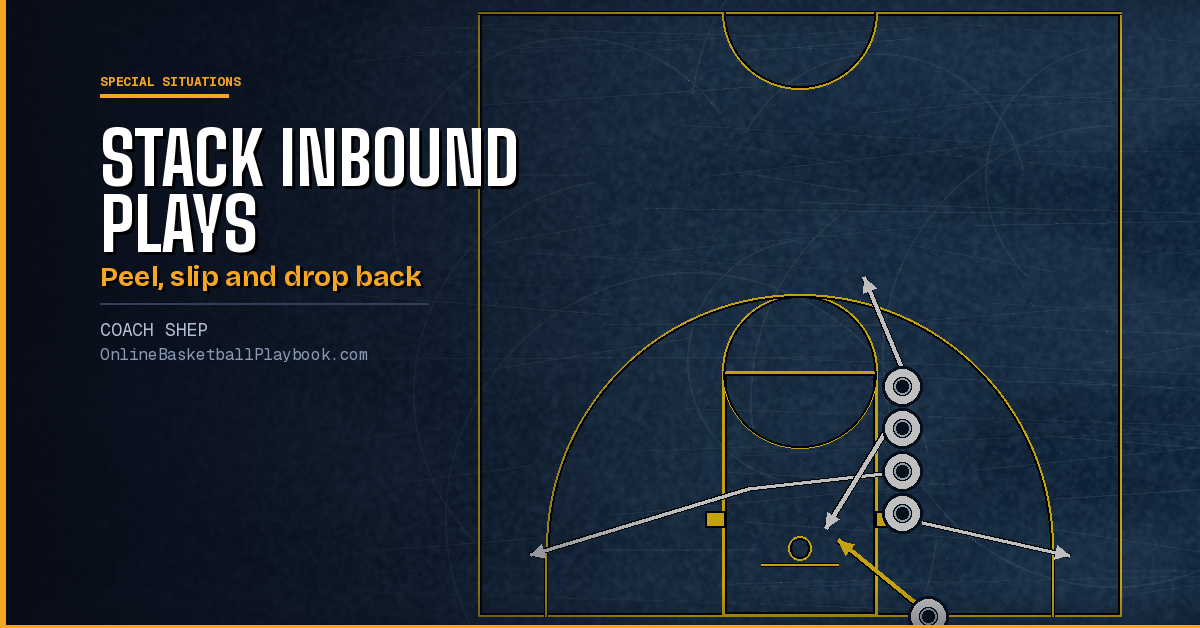
Stack Inbound Plays: Splits, Rubs, Lines and Reads
Stack inbound plays and line sets from the baseline and sideline: splits, stacks away from the ball, rubs, screens inside the stack, line plays and the reads.
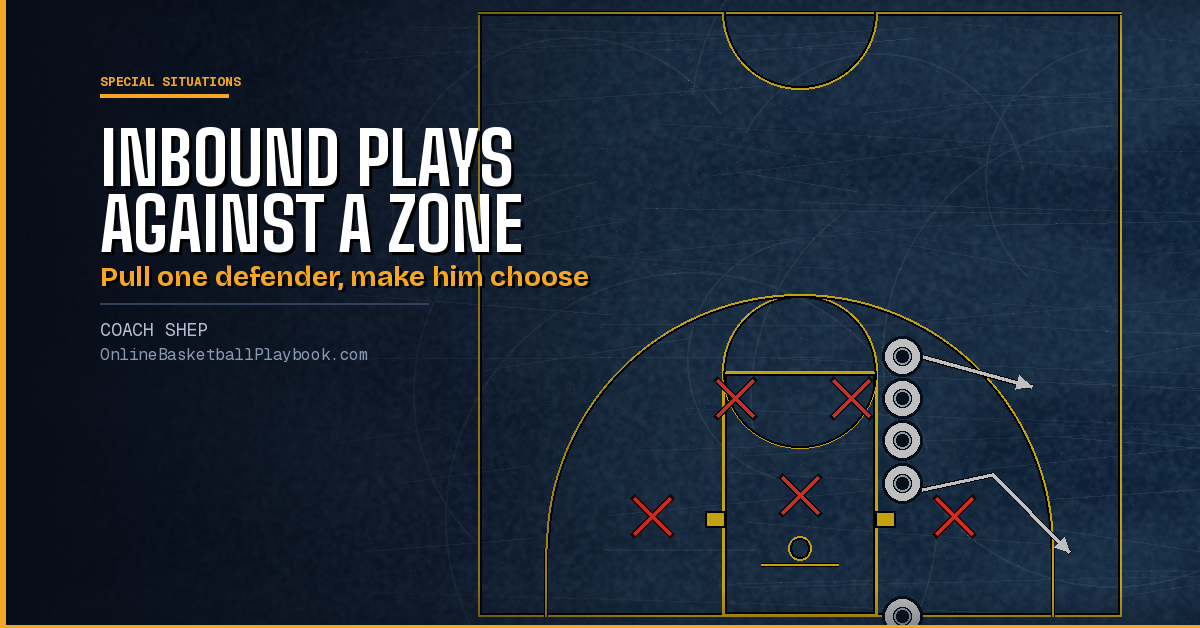
Inbound Plays Against a Zone: Baseline and Sideline Sets
Inbound plays against a zone from the baseline and sideline: the read, the stack near the elbow, short-corner pulls, split cuts, two-part sets and sideline answers.
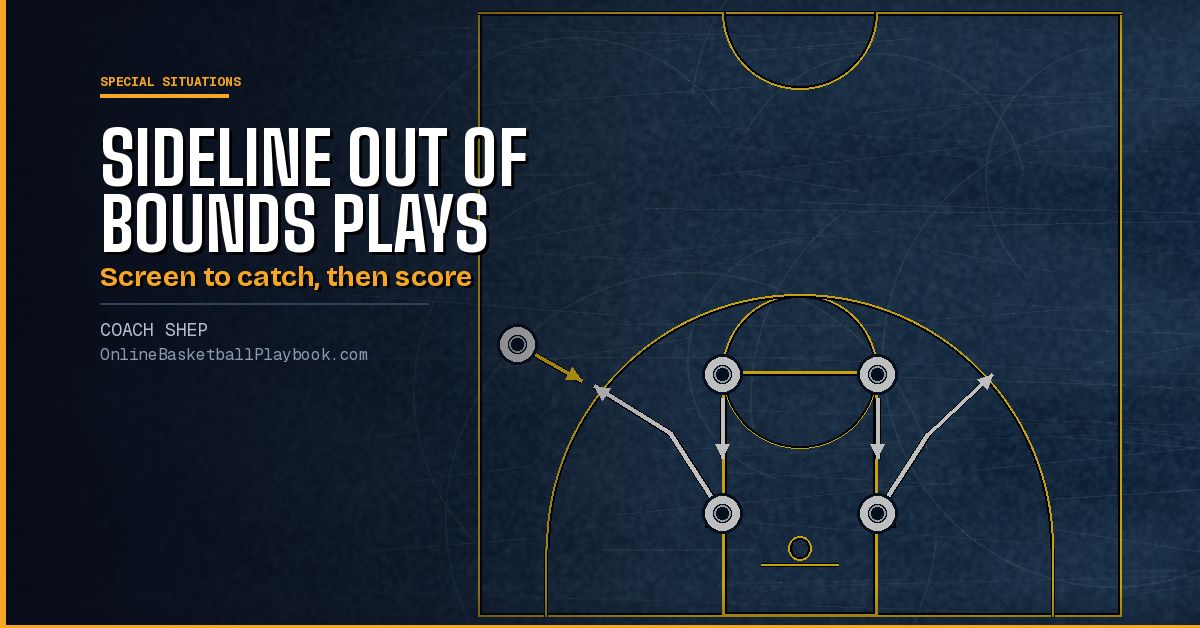
Sideline Out of Bounds Plays: SLOB Sets, Reads and Practice
Sideline out of bounds plays for coaches: SLOB sets from a box, stack and line, the inbounder's reads, plays against zone and denial, the clock and practice.