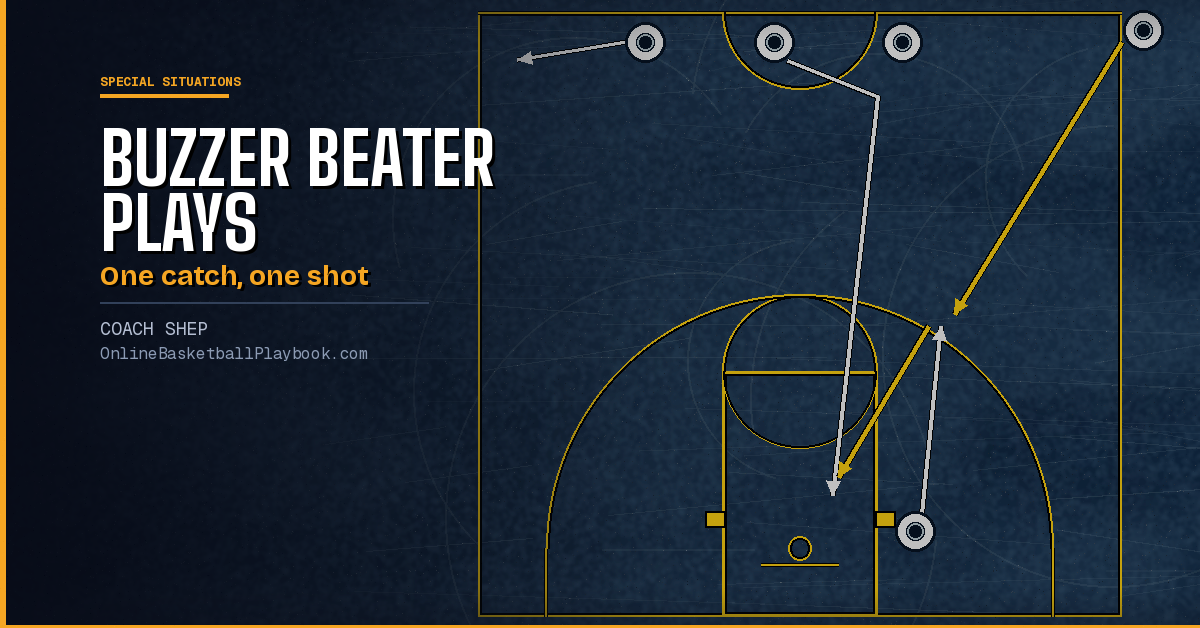
Buzzer beater plays from half court are the sets a team runs when the ball is out of bounds in its frontcourt, on the sideline or under its own basket, with time for one catch and one shot. The game is tied or close, there is no time to dribble, and the inbound pass often goes straight to the shot. This page draws five buzzer beater plays, sorts more of them by the shot they create, and lists the reads that save a play when the defense takes the first look away. The full-court versions are on full court last second plays, and every last-second spot is compared on last second basketball plays.
Buzzer Beater Plays Start With the Clock
NBA and college end-of-game libraries file these plays by the exact time left, and the bands are clear:
- Under 1 second. The inbound catch is the shot. Every set in that band is a catch-and-shoot or a lob off a back screen, because no dribble is possible.
- 2 to 5 seconds. One designed screen creates the shot: a triple screen, a flare, a zipper or a screen for the screener.
- Up to 10 seconds. Room for a two-part action and a read.
The time bands coaches use are compared on last second basketball plays.
Look at the clock, then pick the play, never the other way around.
The Rules Behind the Last Catch
- Clock start. At NCAA men and women, the NBA and FIBA, the game clock starts when a player on the court touches the throw-in. At NCAA levels, in the last 59.9 seconds of a period, at least .3 of a second comes off when the ball is touched and an official stops the clock at once. NFHS: check your state association rulebook.
- Five seconds. NCAA men and women, the NBA and FIBA give the thrower-in five seconds to release the ball. NFHS: check your state association rulebook.
- Three seconds on a throw-in. At NCAA men and women, the three-second rule is not in effect while a team controls the ball for a throw-in. Other levels: check your rulebook.
The one-second baseline lob below carries a note: with under four-tenths of a second left, the catch becomes a tap-in instead of a catch-and-shoot. Check the time rules for your level before you build a play around a tap. The violations around the throw-in are on basketball out of bounds rules.
Know how much time your level gives a catch before you draw the catch.
Fake Screen and Slip
The ball is on the sideline at the half-court line. Three players stand along the line, and the post sets up on the ball-side block bent over, hands on hips, as if he is tired.

The play has two versions, depending on who you want to take the shot:
- Slip for the point guard. Drawn above. 1 fakes the screen for 2 and cuts to the rim.
- Screen for the shooting guard. 3 sets the screen at half court instead, and 2 runs hard off it to catch 4's pass for a shot or a layup.
The fake screen and slip is the favorite of the two, and the cutter has been left wide open on it a number of times.
Sell the tired post and the fake screen, and the cutter does the rest.
Back Screens for the Posts
This one flips the usual jobs. The two three-point shooters start low on the blocks and the two posts start out on the arc. The shooters set the screens.

The options from the same start:
- Long pass for the layup. Drawn above.
- Screeners roll out for the three. If the defense switches and sags to deny the posts, or if you need a three, 2 and 3 roll back out to the arc for the pass and the shot.
- Swap the roles. The 5's defender often will not leave his man to help, so an athletic 3 who can catch and finish can take the 5's job, or a 5 who can shoot the three can take the 3's.
- The inbounder left alone. If the defense does not guard the inbounder and puts that defender in the lane against the long pass, run the same action and throw back to the inbounder for the three. That read is drawn on late game plays when they deny your best player.
Teach all three endings with the same start, and the defense cannot guess which one is coming.
The Box Lob From the Sideline
This play starts in a box: two players at the elbows and two on the blocks, with the inbounder on the sideline. The lob comes on the second look.


The inbounder throws the lob with a two-handed overhead pass. Lob sets from every angle are in sideline out of bounds plays.
Plant hard, then go, and the lob is there before the defender turns around.
More Sideline Buzzer Beaters
Sideline sets from the end-of-game libraries, by the shot they create:
| Version | Shot | The action |
|---|---|---|
| Back screen, then staggered down screens | Game-winning three | 5 back screens for 2, then 2 comes off staggered down screens from 4 and 3 for the three. |
| Clear the corner, screen the screener | Three at the top of the key | 1 clears to the corner, then 4 sets a screen for 5, who turns and screens for 3 cutting to the top of the key. |
| Fake the three, back cut | Layup | 4 down screens for 5 to catch, 3 clears the corner, and 2 cuts hard to the arc, then back cuts to the rim for 5's pass. |
| Triple stagger | Three | 1 comes off a triple staggered screen, and 2 cuts hard back to the ball after setting his screen. |
| Two actions at once | Three | 1 cuts off a screen from 4 while 2 comes off a screen from 5, two looks at once. |
| Down screen and lob | Lob | 2 rubs off 5's down screen, and 1 curls to the rim for the lob from 3. |
| Three-second sideline | Corner or top | 4 and 5 screen for 3, then 5 down screens for 2 flashing to the top of the key. The inbounder looks for 3 in the corner or 2 at the top. |
Hubie Brown's one-second sideline play, the diamond after a timeout, the back door for the wing and the half-second lob set are drawn and explained on last second basketball plays.
Run one sideline buzzer beater well before you add a second.
Baseline Buzzer Beaters
Under your own basket, the ball starts close to the rim and everyone knows who shoots from where. The one-second baseline play against man-to-man:

Other baseline buzzer beaters:
- Stagger, then the slip lob. Hubie Brown's one-second baseline play sends 3 hard to the corner while 2 comes off a stagger from 4 and 5. On a switch, 5 turns toward the ball and dives for a lob.
- Pull them to the corners. For about one second, stagger cuts pull every defender toward the corners, while one player makes a deep dive behind a back screen under the basket.
- Elbow lob with a counter. The 4 runs to the corner as a decoy, and the 5 starts toward the ball, then comes around 2's back screen for the lob. If 2's defender helps on the lob, the inbounder fakes it and passes to 2 for the layup.
- Corner shooter off two screens. For about five seconds, 2 starts on the far block and 4 and 5 screen for him along the baseline for a corner catch-and-shoot. If 2 is covered, the ball goes back to the inbounder off 1's screen at the far elbow.
- The finisher inbounds. The best leaper takes it out, the far-block player flashes high, the best shooter waits in the corner and 3 sets a pin screen on the inbounder's defender, so the inbounder can step in and curl to the rim for the lob.
The full baseline library, by formation, is on baseline out of bounds plays.
Near the rim, the decoy moves first and the lob comes second.
The Reads That Save the Play
- Shoot on the catch. Whoever receives the ball shoots it at once, with no pass or dribble. A dribble gives the defender time to recover.
- The slip beats the late switch. Some defenses switch every screen in the last seconds, so the screener slips or dives when he sees the switch.
- Read the shooter's defender. If he sags into the lane, screen him and step out. If he plays up, run the shooter off staggered screens.
- A lob for contact. If nobody is open on a sideline play, lob to the big inside, hoping for contact and a trip to the free-throw line.
- A clean inbound beats a forced one. A safe inbound pass matters more than the play.
Read the defense, then trust the catch.
Practicing Buzzer Beaters
Mike Krzyzewski uses only a few plays in game situations, tapes them and runs them with his top seven or eight players, not just the starters. Other practice formats are on last second basketball plays, situation scrimmages on drills to teach late game situations and the last-shot decisions on basketball late game situations.
Rep the play with the bench players too, because they may be on the floor.
Get the next coaching guide in your inbox
One email when a new guide or diagram set goes up. Free.
Questions Coaches Ask
What is a good buzzer beater play from half court?
One that gets a catch-and-shoot or a lob with no dribble. Sideline favorites include a fake screen and slip to the rim, back screens for the posts with the screeners rolling out for a three, and a box set where a post plants and back cuts for the lob.
What play works with 0.5 seconds left?
A lob or a catch-and-shoot off the inbound, because there is no time to dribble. Check your level's clock rules before you build a play around a tap-in.
Should the catcher dribble on a last-second play?
No. Whoever catches it shoots it. A dribble gives the defender time to recover, and the play dies.
Is a baseline or sideline inbound better for a last shot?
They do different jobs. Baseline plays are often used to get the ball in safely and sideline plays to score. The baseline also starts the ball close to the rim, so everyone knows who is shooting from where.
How many buzzer beater plays should a team have?
Coaches lean toward a few, well drilled. Pick two or three that fit your players and rep them until they are automatic.
Want every diagram on the site?
OBP Pro members get the full diagram files for every guide on the site, ready for a practice binder or a scouting report. $9 a month. Or draw your own version free in the play drawer.
See what OBP Pro includesMore Coaching Guides From This Batch
- Basketball Press Terminology: Trappers, Interceptors and Safeties
- After Timeout Plays: ATO Sets by Score, Clock and Spot
- Full Court Last Second Plays: Long Passes, Screens and Splits
- Late Game Plays When They Deny Your Best Player
Back to Special Situations and every Special Situations page.
Keep Building
Related breakdowns
Basketball Inbound Plays: Baseline and Sideline Sets to Run
Basketball inbound plays for baseline and sideline throw-ins, with six drawn sets, simple plays for youth teams, zone looks and where coaches disagree.
How to Defend Inbounds Plays: Baseline and Sideline Options
How to defend inbounds plays: the 5 on 4 edge, what to do with the inbounder, Jam, Jump Switch, Trap and zone options, sideline answers and late-game calls.
Sideline Out of Bounds Plays: SLOB Sets, Reads and Practice
Sideline out of bounds plays for coaches: SLOB sets from a box, stack and line, the inbounder's reads, plays against zone and denial, the clock and practice.