Late game plays against a defense that denies your best player have to score with someone else, or get the star the ball in a way the denial cannot stop. In the last seconds of a close game the defense knows who your best player is, and it may face-guard him, double him before the inbound, or switch every screen he uses. This page covers what defenses do to the star, the decoy idea many end-game specials are built on, where the star should start, the reads that punish the denial, and the coaches who say to give him the ball anyway. The full menu of last-shot sets is on last second basketball plays.
How Defenses Take Away Your Best Player
Know the defense's options before you choose a play. Late in a game, the inbound is the moment the defense can load up, because it plays five against four while the inbounder is stuck behind the line.
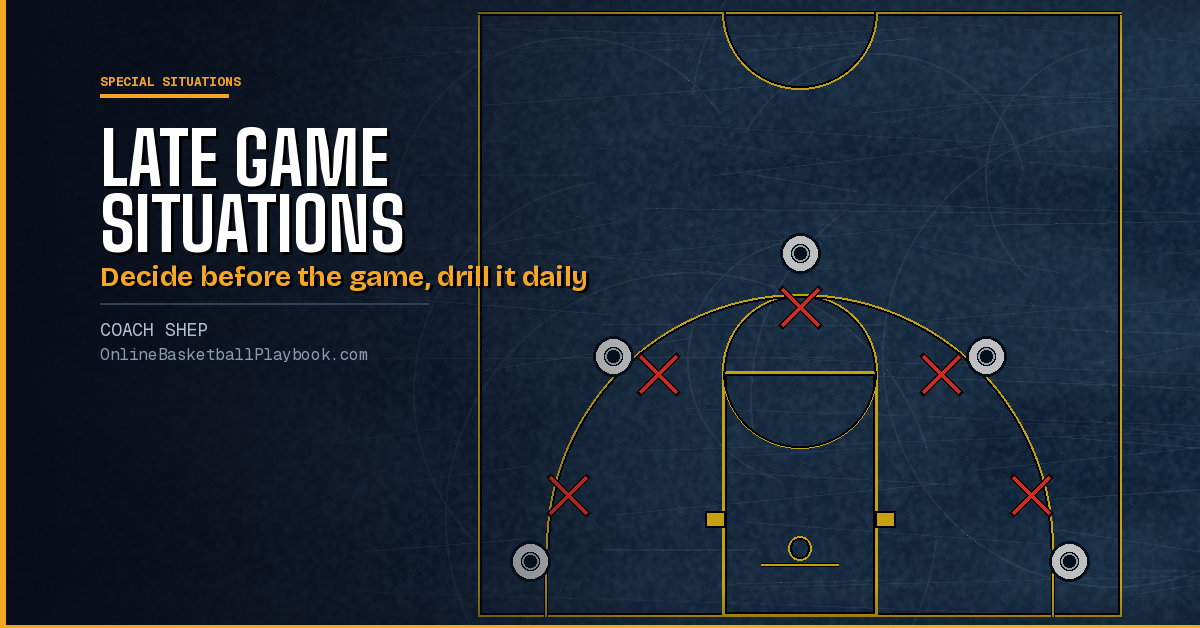
- Face-guard him. A chaser stays chest to chest on the best scorer from before the ball is live while the other four play a zone: a box against a two-guard front, a diamond against one guard, or a triangle with two chasers.
- Double him before the inbound. Two defenders lock up the primary ball handler before the pass while three deny their men.
- Deny every cutter. Hard, in-your-face denial on every receiver, no switching, looking for a five-second call or a charge.
- Switch everything late. Some defenses switch every screen in the last 10 seconds, so the star's screens never free him.
- Scout who it is for. Staffs chart every inbound an opponent runs to learn who the actions are for.
The defense's side of these choices is on how to defend inbounds plays.
Name the coverage on the bench, then call the play that beats it.
Late Game Plays That Decoy the Star
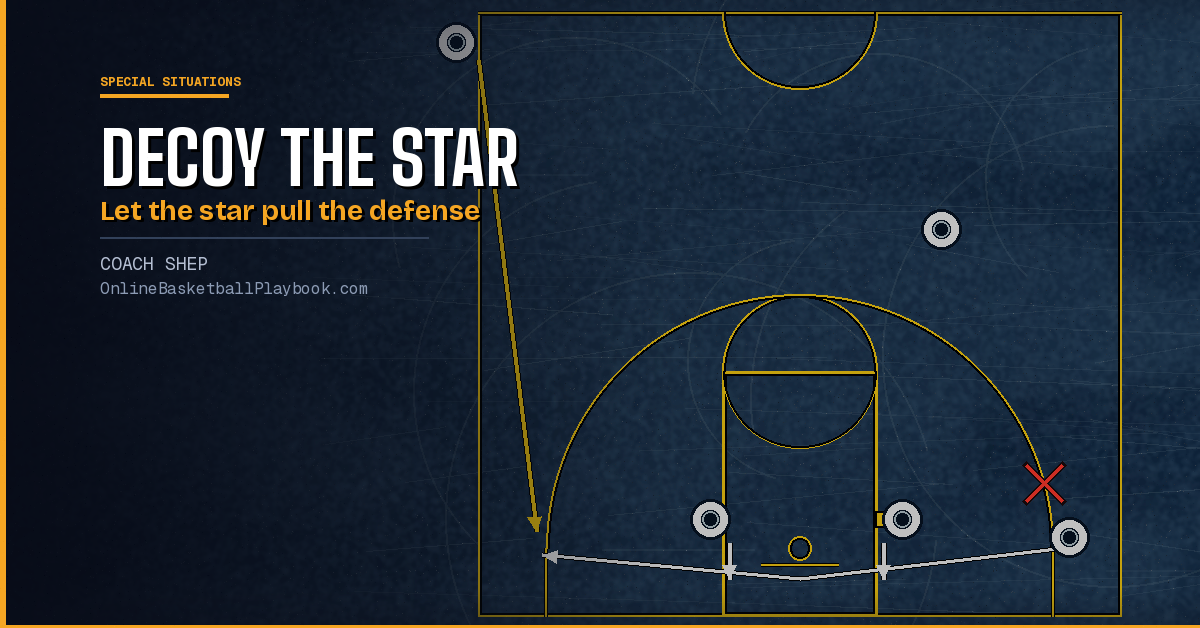
The decoy version of end-game specials rests on two rules. First, the defense locks onto the best shooter, so the real action goes to a second option: the point guard, the big or a role player. Second, clear the floor: send players to the corners so one back screen, down screen, flare or isolation has room. One game-winner built this way, down one with about four seconds, looked like a set for the two shooters and went to the big on a straight pass inside. It needed a 4 who could make that pass.
The same shape, from other end-game sets:
- Three screens for a decoy. Spain's baseline play at the 2024 Olympics screens three times for a player going to the corner who is mostly a decoy, while one screener slips to the rim and another joins a stagger for a wing shooter.
- A decoy cut to the rim. Brazil's baseline play uses a stagger for a decoy wing cut to the rim, the screener pops to the wing for the inbound, and a second screen gets the point guard to the top of the key.
- The decoy in the corner. In the half-second sideline set, 2 cuts under a double screen to the corner as a decoy, 1 cuts around the same screens to the top of the key, and 5 curls around 4 for the lob.
- The decoy on the baseline. In the elbow lob from the baseline, the 4 runs to the corner as a decoy while the 5 comes around a back screen for the lob. The full play is on buzzer beater plays.
- The passing big as decoy. An NBA set for under one second uses a back screen for the lob, with the big who can pass as the decoy.
The one-second baseline lob sends one cutter along the baseline to the far corner purely as a distraction while the lob goes to a player cutting into the lane. It is drawn on buzzer beater plays.
Make the star's cut look real, because the play only works if the defense believes it.
Where the Star Starts
Coaches split on where the star starts when the ball is out of bounds:
- Away from the ball, the second-best shooter inbounds. Mike Krzyzewski's 1988 late-game threes start the best shooter away from the ball and have the second-best shooter take it out, to free the star.
- The best shooter inbounds, then comes back in. In the NBA sideline three off two screens, the best shooter takes the ball out, passes in, then cuts off a back screen and loops back off another screen for the three.
- Never the inbounder. Get the ball to the best player and never let him inbound it.
Decide where your star stands before the game, not during the timeout.
Read the Sag and the Deny
This sideline play from half court has one read on the shooter's defender, and a play for each answer. The inbounder is on the sideline at the half-court line, the shooter is in the corner, and two players are on the blocks.

After the catch, 3 can shoot, or 3 and 4 can play two-man basketball with 4 posting on the block.

If that is covered too, 4 drops and screens for 1, 5 steps to the high post and screens for 1 as well, and 1 comes around the staggered pair to the top of the key. The inbounder can then pass to 3, 5 or 1, and if 2's own defender sags way off, 2 can get the return pass and shoot.
The receiver must be ready to catch and shoot at once, because there may be no time for a dribble or a pass. The deny-and-cut reads behind these plays are on cut or backdoor: reading the denial.
Teach the shooter one question: where is my man? The answer picks the play.
When They Leave the Inbounder Alone
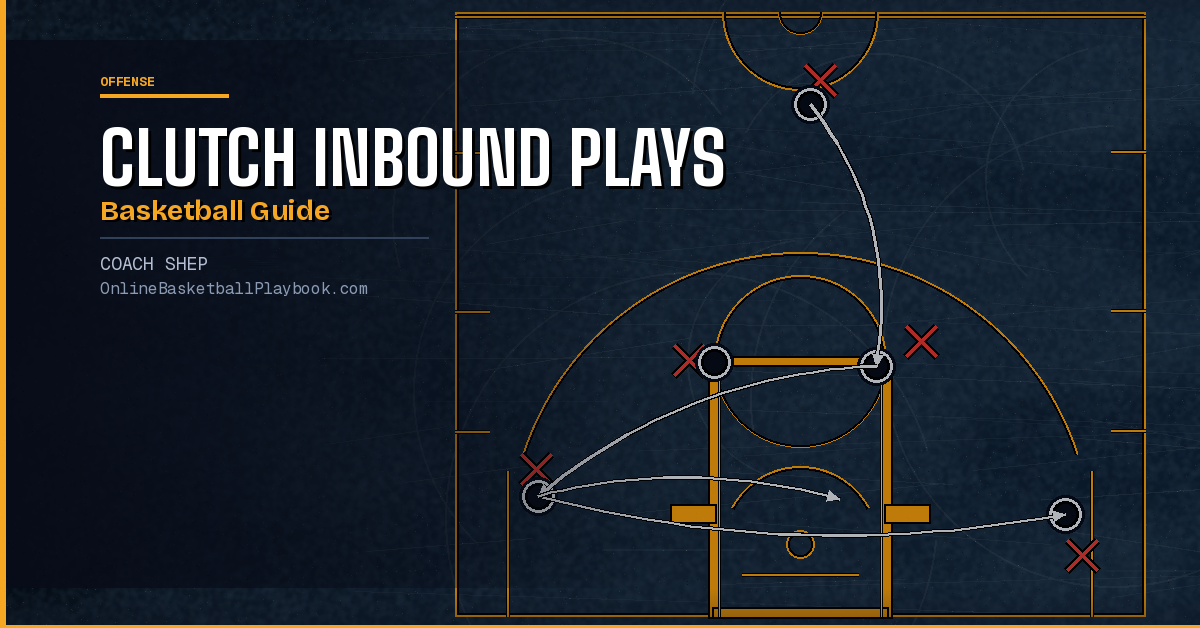
Some defenses guard the cutters and leave the inbounder free, putting his defender in the lane to stop the long pass. That makes the inbounder the open man.

In this version the inbounder is the point guard, and the team runs the same back screens it would against a guarded inbounder. To set it up, line up for the play, and if you see the inbounder is not being guarded and you have a timeout, call it and switch to this option. With no timeout left, a team that knows both options needs only one word from the bench.
The general rule for any throw-in goes further: when the inbounder is left unguarded, he passes in and cuts at once for the give and go.
An open inbounder is a gift, so make sure he knows to step in.
Back Door the Denial
The harder the defense denies, the more the back door is open. The two-second sideline version for a three clears the floor first and puts the athletic wing who will catch on the wing, not at the elbow and not drifting to the corner, because an early drift lets the help recover.

Other back door answers to a denied receiver:
- The built-in back cut. In Jay Wright's late-game sideline play, if 1 is denied he makes a hard back cut for the pass from 4.
- Fake the three, cut to the rim. A sideline set where 2 cuts hard to the arc, then back cuts to the rim for 5's pass.
- The automatics. Cut to the basket when a defender turns his back to his man, and throw the lob when a defender faces up with his back to the passer. Players signal with eye contact, never a voice.
- Two hard steps, then go. On the back door trigger the cutter takes one or two hard steps toward the ball, reads the defender's head and cuts when it turns.
The safety valve still applies: if the back door is not there, do not throw it. More back door sets are on backdoor triggers.
Deny hard enough and the rim opens behind you. Teach your shooter to look for it.
Against a Box and One or Triangle and Two
When a chaser takes the star and the other four play zone, the answers are simple and close to a set the team already runs:
- Box and one. A shuffle-cut entry isolates the star in the middle of the box against a chaser who is good at denial and not used to guarding the post: the high post back screens for the star while the ball handler drives and the post steps out. If the star cannot catch on the reversal, he back cuts while two teammates set a double screen. Hubie Brown's box-and-one offense uses the bottom two defenders as screeners for the guarded star.
- Triangle and two. Run the same single and double screen action from either wing, so the two chasers cannot pre-commit to one side. The shooter can fake the single screen and come back off the double.
The full plans are on how to beat a box and 1 and what is a triangle and 2, and other combination defenses are on how to beat junk defenses.
Keep the answer simple and close to what you already run.
Or Get Him the Ball Anyway
Not every coach decoys the star. The other side:
- Ball to the best player. Get the ball to the best player, let him decide, and never let him inbound.
- Tied, the best player shoots. Stan Van Gundy's rule when tied is to get the last shot to your best player.
- Players over plays. Don Meyer's lesson from Rick Pitino is to have good players with the ball in special situations rather than run plays, and he asks which helps more in March, a better player or a new play.
- Read, do not memorize. Željko Obradović keeps no fixed end-of-period plays. He reads the pick and roll's weakness or posts up a size mismatch.
Isolation sets are on isolation plays for star players, and the after timeout menu is on after timeout plays.
Whichever side you take, rehearse what happens when the star is covered.
Get the next coaching guide in your inbox
One email when a new guide or diagram set goes up. Free.
Questions Coaches Ask
What do you run when they face-guard your best player?
Use him as a decoy and run the real action for a second option, or attack the denial with a back cut. Against a box and one, isolate him in the middle or use the four defenders in the box as screeners for him.
Should your best player inbound the ball late in a game?
Coaches split. The second-best shooter can inbound so the best shooter starts away from the ball, the best shooter can inbound and come back in off two screens for the three, or the best player never inbounds.
What is a decoy play in basketball?
A play that sends the player the defense expects on a hard, believable action while the real shot goes to someone else. Spain's baseline play at the 2024 Olympics screens three times for a player who is mostly a decoy while a screener slips to the rim.
What if they leave the inbounder open?
Pass in and get it back. When the inbounder's defender drops into the lane, the inbounder steps in for a return pass and a three, or cuts for the give and go.
How do you beat a team that switches every screen late?
Have the screener slip or dive when he sees the switch, and draw that slip into the play from the start.
Want every diagram on the site?
OBP Pro members get the full diagram files for every guide on the site, ready for a practice binder or a scouting report. $9 a month. Or draw your own version free in the play drawer.
See what OBP Pro includesMore Coaching Guides From This Batch
- Basketball Press Terminology: Trappers, Interceptors and Safeties
- After Timeout Plays: ATO Sets by Score, Clock and Spot
- Full Court Last Second Plays: Long Passes, Screens and Splits
- Buzzer Beater Plays From Half Court: Sideline and Baseline
Back to Special Situations and every Special Situations page.
Keep Building
Related breakdowns
Basketball Late Game Situations: Decisions, Fouls and Clock
Basketball late game situations settled before tip-off: the score math, timeouts, fouling up three and behind, the last shot, protecting a lead and daily practice.