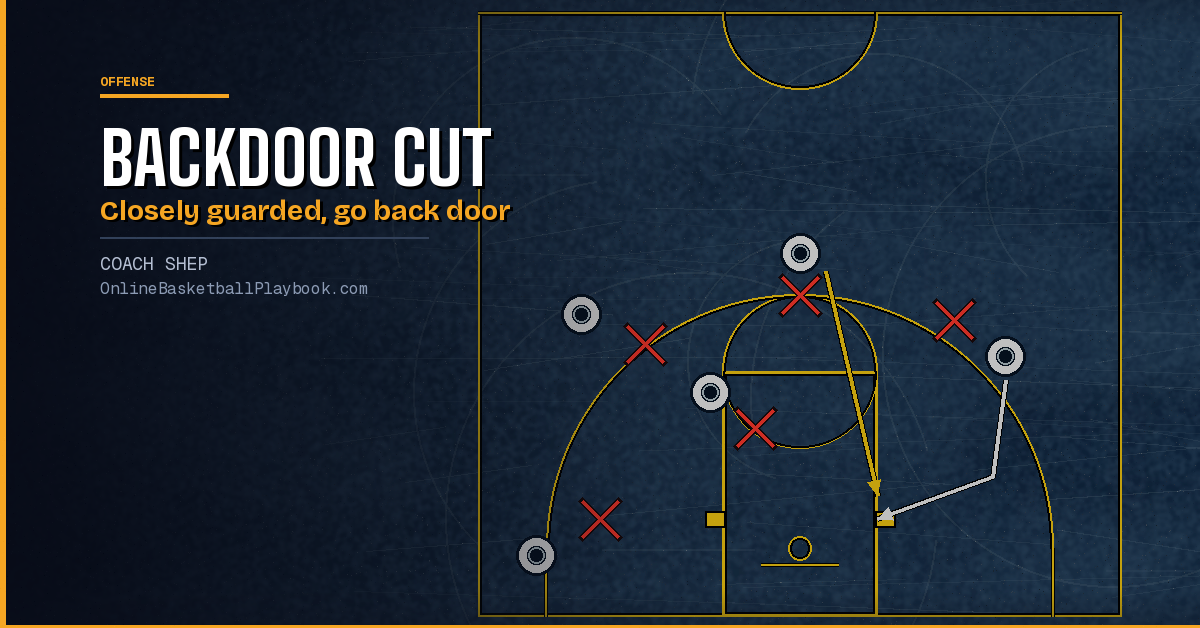
A backdoor cut is the cut a player makes behind a defender who denies him, overplays him or turns his head. Instead of fighting for the catch out on the wing, he goes the other way, to the rim, and takes the space the denial left. Pete Carril put the whole rule in one line: when closely guarded, go back door. Backdoor cut basketball is a read, not a play. This page covers the cutter's read of the denying defender, the front cut and rear cut read after a pass, the timing, the passer's half, the empty lane the cut needs, and what to do when the defender sags instead. The broader topic of cutting, every type of cut and the habit of cutting hard, lives on cutting in basketball. It sits under basketball offense in the offense section.
Backdoor Cut Basketball: The Read Behind It
Princeton teaching states the general case as "do the opposite of whatever the defense does" and the backdoor as its most common instance: go backdoor at once if overplayed, and do not go to the ball when closely guarded. The other half of the rule: played inside go outside, played outside go inside, and names the goal, layups and threes in that order. Carril pairs the backdoor line with a cue to watch the man in front of you, because he shows you what to do.

Sources split on whether the backdoor is a decision at all.
- Automatic. One numbered motion makes its #3 cut, the backdoor, automatic when a player is overplayed one pass from the ball. John Beilein's two-guard offense calls two backdoors on a post entry a sprint, not a read.
- Sudden or signaled. Beilein names two kinds. Sudden: the player reads the overplay and goes now. Signaled: the play is called, and the passer dribbling away and spinning back is the cue.
- A live read. Other sets leave curl or backdoor to the cutter, or make the back cut depend on a cleared help side.
When Is He Overplaying? Six Tests
Coaches teach different tests for the overplay, side by side here.
| Version | What the cutter checks |
|---|---|
| 1. Read line | The defender's lead foot crosses a read line, or past the three-point line |
| 2. Line to the ball | The defender steps over an imaginary line between the cutter and the ball |
| 3. Touch | The defender is between you and the ball, or you can touch him |
| 4. Hand plus passer | A hand in the passing lane and the passer is looking at you |
| 5. Head and eyes | The defender turns his head, or you see the back of it |
| 6. Pass fake | The receiver gets a pass fake and the defender jumps it |
The setup comes before the cut. The direction rule: if the defender is low, take him low and break high. If he is high, take him high and break low, which is the back cut. Change of speed is the setup in several more. One speed version cuts at about 75 percent toward the rim and full speed back out. Another goes slow into the move and quick out of it. The contact detail: step into the middle of the defender's stance without pushing off.
Front Cut or Rear Cut After You Pass
The read starts the moment a player passes. One read-based system has the passer cut to the basket off a read of his own defender. If the defender stays where he was, the passer front cuts, in front of him toward the ball. If the defender jumps to the ball or steps over the read line, the passer rear cuts behind him.


Four cuts follow the same logic. Quick cut if the defender does not jump the pass. Delay cut, two steps away then across his face, if he drops into the lane. Rear cut if he jumps. Back cut if he sits above the three-point line. The wing read after a post entry is a single question, does my man leave me? If he stays home, give and go to the rim. If he helps on the post, slide to the corner. The defender's jump to the ball, the move that sets up the rear cut, is on ball you man defense.
Timing and Commitment
Knowing whether to cut does not tell a player when. Coaches line up on cutting off the catch, not before it.
- In Chin the cutter does not leave until the ball leaves the passer before him.
- Beilein's offense says it is always better to cut late than early, because an early cutter telegraphs the play.
- In the Princeton wait version the guard waits until the forward catches, then cut back door.
Once he goes, he goes. Beilein's rule is "Do not fake a backdoor cut." A cutter who commits must finish, because pulling out fools the passer and causes turnovers. Another adds the footwork: push off the outside foot, reach the inside hand to the basket, and knock the defender's arm down with the outside arm. Carril's capitalized rule covers the rest: whenever you cut, look for the ball.
The Passer's Half
A backdoor is a two-man read. The trigger in one version includes the passer looking at you, so the passer is part of the signal. Other versions give the passer three jobs:
- Do not stare down the cutter. It tips the cut to the defense.
- Throw it low and lead him. A bounce pass stays low and away from the defender's hands and leads the cutter toward the rim, not to where he is now. A one-hand pass is fine.
- Hold until he wins. The Princeton hold has the passer wait until the cutter's top foot is past the defender.
The backdoor is uncommon in youth games because it depends on strong passing. The passing work behind it is on basketball passing fundamentals.
The Lane Has to Be Empty
The back cut is open when the defender denies and the help side is cleared, and not open with a help defender sitting in the lane. Offenses clear it in different ways:
- One set of backdoor plays starts from a double gap, two empty spots between the cutter and the ball.
- The empty-low version keeps the area below the foul line empty.
- One dribble motion flashes the opposite post to the elbow when a drive is picked up, so the overplayed wing has a lane.
- The shuffle version names a single guard the backdoor cutter so two guards do not clutter the low post.
A cut with no pass still does a job. Hard cuts pull help toward the rim, and in Princeton a hard backcut pulls the weak-side defender up and opens the post. After the cut the rule in several versions is get open or get out: fill the corner or an empty spot so the next action has room. The spacing behind this is on off-ball movement.
Get the next coaching guide in your inbox
One email when a new guide or diagram set goes up. Free.
Dribble-At and Post Flash Backdoors
A teammate dribbling straight at you is a trigger of its own, and it needs no defensive mistake. The Princeton rule sheet says look to go backdoor when dribbled at and played tight. The hold version has the player hold a second first, to freeze the defense, then back cut.

Coaches split on whether the dribble-at means a hand-off or a back cut:
- Back cut by rule. The youth motion version teaches the back cut as the answer. Another makes it the standing rule unless a hand-off is called.
- Hand-off by rule. Two motion guides make the hand-off the rule and the back cut the answer when the defense jumps it.
- Signaled. One read-based system uses a power dribble to signal the hand-off instead.
Beilein and Jay Wright both turn a jumped hand-off into a backdoor lob, and the hand-off itself is on dribble handoff.
When both wings are overplayed, one offense breaks the post high for a wing back cut. 5 flashes high, catches, and feeds the back cut.

Nearly every continuity ships a denial counter, and it is nearly always a back cut. The flex, the swing, the shuffle and Beilein's Chin all replace a denied pass with a back cut and refill the spot so the pattern resumes. The flex version is on the flex offense, and the Princeton version on Princeton offense.
When the Defender Sags Instead
The overplay answer is settled. The sag answer is not.
- V-cut. V-cut when the defender sags off.
- Knock on the front door. If there is no answer at the back door, knock on the front door: a hand-off or weave on the sag, and shoot the three if your man plays off.
- Flare. One Princeton walkthrough has a teammate flare-screen a defender who sags to the middle on a dribble-at.
- Shoot or swing. Answer sagging help with a catch and shoot or a quick reversal.
The V-cut itself is a split. The all-V-cut version makes every cut a V-cut and tells an overplayed player to back cut or re-screen rather than beg for the ball. One 5 out motion allows only a back cut or a down screen when denied, with no V-cuts. Another allows one V-cut, then the back door. Rick Majerus decides by the defender: blast to fill when he is in help position, V-cut when he is in denial.
Teaching the Read
Sources teach it one layer at a time. The 4 out motion version teaches back cuts second, right after pass, cut and fill, against a dummy defense that alternates deny and sag. The full pass-and-cut install is on pass and cut motion offense. One Princeton install puts the backdoor read on the third practice with a 2 on 2 denial drill. One progression runs cuts 2 on 0, then 3 on 0, then adds defense. One footwork progression isolates the front cut and the back-door cut before any reading. Princeton drill work is on drills to teach Princeton offense, and the defense's side of the same cuts on drills to teach defending cutters. How the backdoor fits the wider idea of taking what the help gives is on advantage basketball.
Questions Coaches Ask
What is a backdoor cut in basketball?
A cut behind a defender who is denying or overplaying the pass. The cutter goes away from the ball toward the rim and catches a bounce pass behind the defense.
When should a player go backdoor?
When the defender is between him and the ball, has a hand in the passing lane, or turns his head. Coaches use different tests, listed in the table above.
What is the difference between a front cut and a back cut?
A front cut goes in front of the defender, between him and the ball. A back cut, or rear cut, goes behind him. The passer front cuts if his defender stays and rear cuts if his defender jumps to the ball.
How do you draw a backdoor cut on a basketball diagram?
Draw the defender between the cutter and the ball, the cut as a line behind him to the rim, and the pass as a dashed line to where the cut ends. The diagrams above show it from the wing, off a dribble-at and off a post flash.
What if the defender sags instead of denying?
The versions differ: V-cut, take a hand-off, use a flare screen, or catch and shoot.
Want every diagram, printable?
OBP Pro members get the full diagram files for every read, position and rotation on this page, ready for a practice binder or a scouting report. $9 a month. Or draw your own version free in the play drawer.
See what OBP Pro includesMore Core Coaching Guides
- Advantage Basketball: Reading the Help and Keeping It Alive
- Ball You Man Defense: Off-Ball Positions by Passes Away
- Closeout Basketball: Technique, Angles, Shooter Reads and Drills
- Help Defense Basketball: Help Side, Stunts, Rotations and 911
Back to Basketball Offense and every Offense page.
Keep Building
Related breakdowns
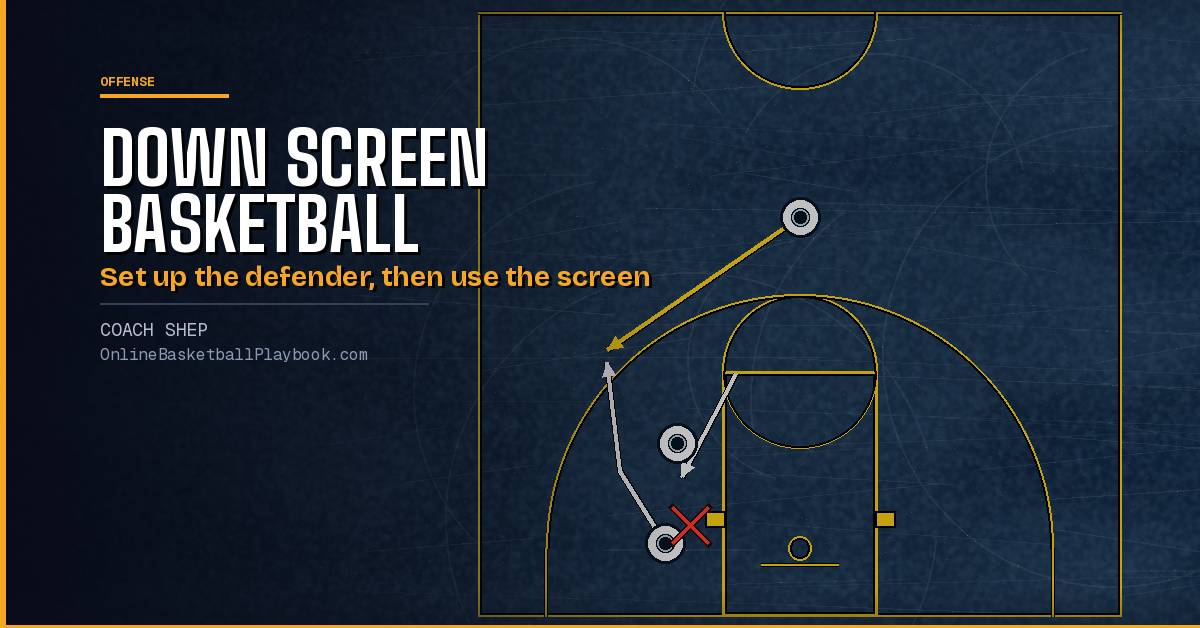
Down Screen Basketball: How to Set It, Use It and Read It
Down screen basketball for both players: how to set it, how the cutter uses it, the curl, pop, back cut and slip reads, and where coaches disagree.
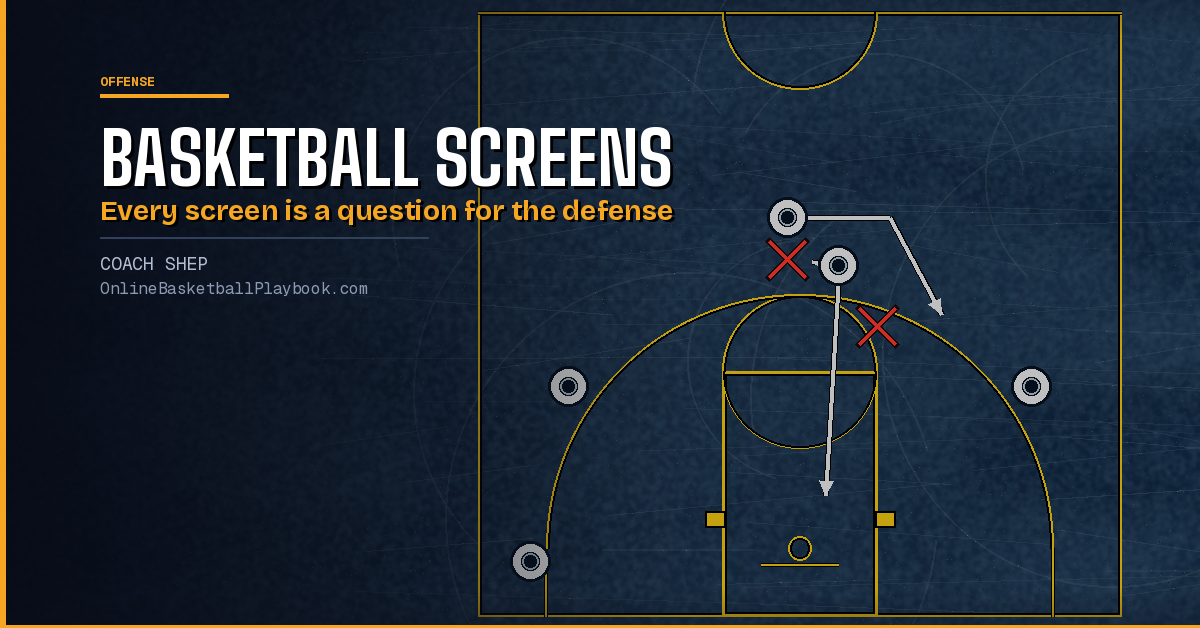
Basketball Screens: Every Type of Screen and How to Read It
Basketball screens explained by type: on-ball, down, flare, back, pin down, cross, stagger, elevator, screen the screener and hand-off, with each read and counter.
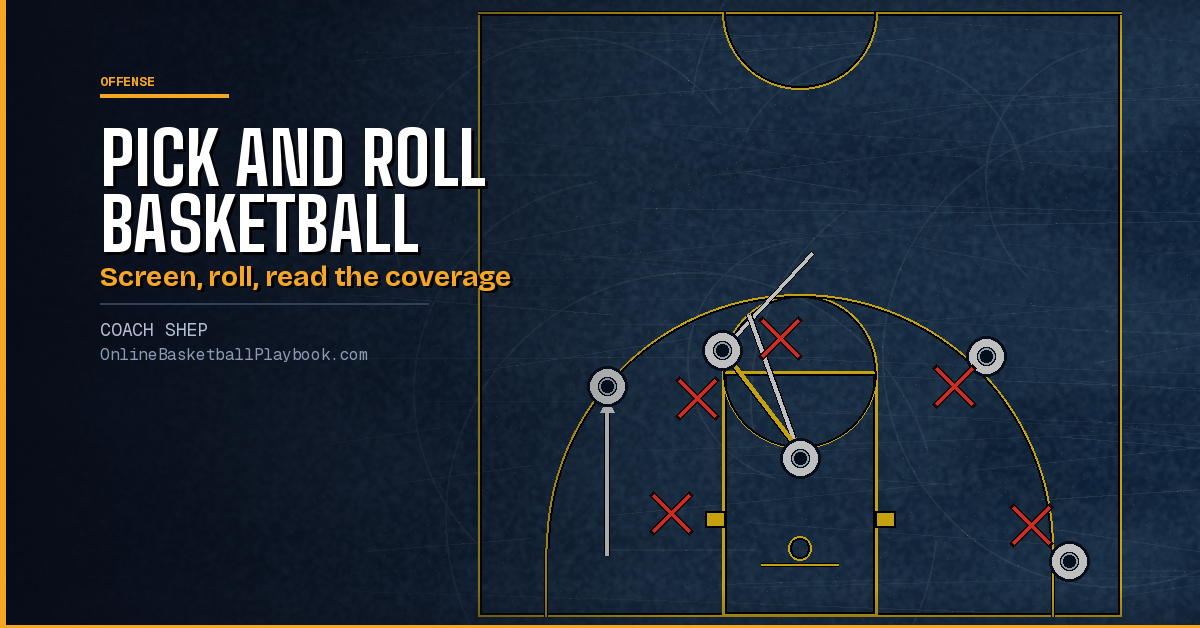
Pick and Roll Basketball: How to Run It and Read It
How to run the pick and roll in basketball: the screen and its angle, the handler's reads, roll, pop, slip and short roll, spacing, and a youth teaching order.