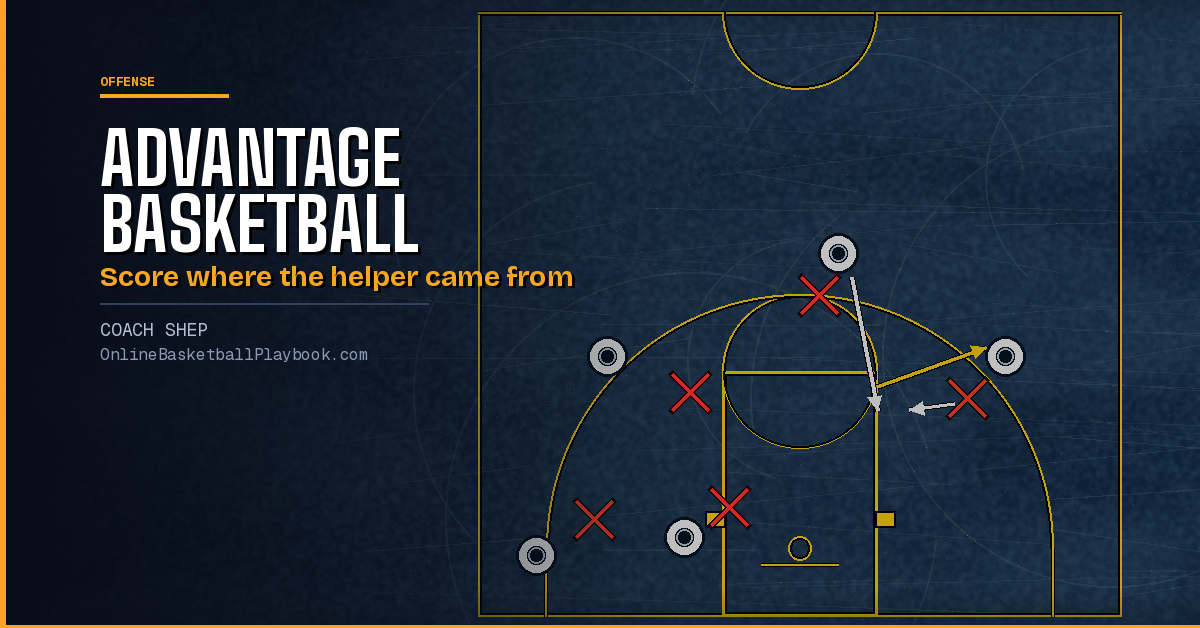
Advantage basketball is offense built on one idea: beat a defender, or make a second defender leave his man to help, then use that edge before the defense recovers. Man-to-man gives every defender one player, so the offense has to pull a helper out of position and score where he came from. The read is simple to say and hard to play: see who helped, and get the ball to the man he left. This page covers what counts as an advantage, how the ball handler and the other four read the help, how the advantage is kept alive through the next pass and the next drive, what to do once it is gone, and the versions different systems teach, side by side. It sits under basketball offense in the offense section.
What an Advantage Is in Advantage Basketball
The plainest definition comes from man-to-man offense. In man-to-man offense the aim is forcing help and pulling a second defender out of position. Ettore Messina shows the arithmetic: every helper who leaves his man opens a gap, and a pass and screen by a big who is not being guarded creates a short 2 on 1.
Drive-and-space lists what counts as an advantage on the catch:
- a tough or long closeout
- a catch after an attack
- a catch off a screen
- a defender in poor position
The same version gains the advantage three ways, by a dribble, a screen or a post feed. In modern pro offense every action aims at one of two results: one defender has to guard two players, or the defense switches early and gives up a speed or size mismatch. A constraint-led concept offense states the first one as a rule, one defender can never guard two, and has the off-ball player punish it the moment help collapses.
Spacing comes first. Messina says correct distance between the four players without the ball makes defensive rotation almost impossible, and the gap sizes behind that are on spacing in basketball.
Read Your Own Defender First
The first advantage is often the catch itself. Messina wants the receiver's eyes on the basket while he catches, with peripheral vision on his defender:
- Defender very late: shoot.
- Defender recovering off balance: shot fake and drive.
- Shot space gone: pass.
Aito Garcia Reneses adds that a receiver whose defender is sagging must shoot, not drive into the help again. Dribble drive reduces the read to three words before the drive: man up, drive for a layup or a foul. Man off, shoot the three. Neither, reverse the ball. Concept offenses ask the player to know shoot, pass or dribble before the ball arrives, and treat it as the one habit a team can add without changing the rest of its offense.
Read the Help: Who Left, and Where the Ball Goes
Once the drive draws a second defender, the rule across versions is the same: pass to the man whose defender helped. One dribble drive read tree runs it defender by defender. If the corner man's defender helps, kick to the corner. If the post defender stops the drive, dish to the post. If the post defender helps and the next defender drops, kick to the weak side. If the defender at the top of the key sags, kick back to the guard trailing the play.

The driver's first look is not always the pass. In drive-and-space the driver is going to get a bucket, and his eyes leave the rim only when the rim defender comes over. The 4 out 1 in drive game keeps driving straight until help truly cuts the ball off, close enough to draw a charge. Hubie Brown's point is that a guard who collapses the defense is an inside game on his own.

Systems order the looks differently. None is ranked here.
| Version | Order of looks on a drive |
|---|---|
| 1. Layup, rim runner, corner skip | Own layup first. Drop to the rim-running 5 when his man comes over. A skip to the corner if a defender cracks down inside the 5. |
| 2. Rim, post, corner, trailer, weak side | Finish at the rim, dump to the post, kick to the corner, pitch to the trailer, skip to the weak side. |
| 3. Rim, foul, roll man, corner, weak side | Finish, draw the foul, hit the roll man if there is one, kick to the open corner, skip to the weak side. |
| 4. Read the corner and post helpers | Corner defender helps: the corner shooter steps up for three. Post defender helps: dish to the post. Neither: attack the rim. |
The drive reads behind these orders, including where the drive stops and what each stop means, are on dribble penetration reads and dribble drive motion.
Keep the Advantage Alive: The Next Pass and the Next Drive
Motion teaching splits every read into two steps: create the advantage, then use it before the defense recovers. The second step is the one teams fail. In Princeton teaching, holding the ball causes selfishness and blindness and lets the defense recover and erase the edge.
Messina says that at a high level the first penetration forces help but rarely produces the shot. The second or third penetration finds the open man, so patience and rhythm matter, and he credits that style to Yugoslav and Russian teams. After the kick, his driver keeps cutting to the corner, where he often gets a second catch while the defense chases the first receiver.

Two programs write the chain down as an order.
- The drive-and-space order. On a catch with an advantage: shot, layup, pitch if the ball-side wing helps, shot pass if the center helps, a jump skip when the center helps and the far wing pinches in too, kickback, then skipback.
- The concept offense chain. Its read-rules fire in order, Zero Seconds, then One Defender Can't Guard Two, then Floor is Lava. Each fires only when the one before it did not produce an advantage. Floor is Lava means the player who kicks the ball sprints to space at once, and in its small-sided games the first passer cannot get the ball back until he is outside the arc again.
The same family of offenses sums up the whole idea: once an advantage is triggered, keep driving, kicking or passing until the team gets a great shot.
The Other Four: Move Opposite the Help
The driver can only pass to a teammate who is where the help left. Messina's clock rule, which he credits to an earlier Italian coach, sets the direction. On a baseline drive the player on the far side moves away from the line of the drive to open the passing lane. On a middle drive, players move toward the baseline behind the beaten defenders, and the post slides along the baseline when his man helps.

Three more rules appear in several systems:
- Drift to the corner on a baseline drive. The weak-side wing or slot slides down to the corner for the skip.
- Keep a safety behind the drive. Messina wants a player behind every penetration, on the arc if he shoots or at the top of the elbow if he is a big. One version is the exception. It keeps both other perimeter players spotted on the arc so the driver always has two targets.
- Nobody stands. Messina warns that young players flood the baseline and corner on a drive, which puts three defenders in a wall and makes recovery easy.
Not every system moves the same way. One read-based system teaches circle movement, everyone moving the way the drive goes, which is close to the opposite of the clock rule. The off-ball cut that answers a defender who turns his head to watch the drive is on backdoor cut basketball.
Advantage and Disadvantage: When the Edge Is Gone
An offense spends part of every possession without an advantage. The drive-and-space program frames the offense as two states. With an advantage, from a dribble, a screen or a post feed, it plays its drive game. Without one, it goes back to its screening game. On a catch without an advantage the rule is to keep the ball moving: work the feet and swing it, dribble at the next teammate for a backdoor or a throw behind, or snap back to where the dribble started.

Drive-and-space calls the answer to a lost drive a protection plan. The driver bounces out from the top of the key or lifts from a wing. Two counters keep the dribble alive: the Barkley turns it into the driver's own post-up, and the Nash dribbles under the rim looking for a drift, a slot pass or a yo-yo game. The program above lists both moves by name as protection plans.
Two drive guides set the moment to give it up. One says pick up the dribble and pivot out if your shoulders are not past the defender's shoulders at the drop zone line. Another says when you see a chest, pass.
Get the next coaching guide in your inbox
One email when a new guide or diagram set goes up. Free.
How Systems Build Advantage Basketball
| Version | How it makes the advantage | How it keeps it alive |
|---|---|---|
| 1. Dribble drive | Spread four out with the post opposite, drive the gaps | Reads set by where the drive stops, kick and drive again |
| 2. Drive and space | A dribble, a screen or a post feed | The seven-option order on every catch, protection plans when it is lost |
| 3. Concept offense | Triggers by player count when no advantage exists | Read-rules in a fixed priority, Floor is Lava after every kick |
| 4. Messina's penetrate and kick | 1 on 1 in motion, screens, penetration, the post | Second and third penetration, the clock rule, the safety behind the drive |
| 5. Princeton | A denial or a sag read by the player in front of you | A backdoor against the overplay, a three against the sag |
Pete Carril's version starts from the other end of the floor: the defender's overplay is the advantage, and the backdoor cut takes it. That read is on Princeton offense. Motion systems teach the same create-then-use idea through rules, which are on motion offense and 5 out motion offense. The full man-to-man attack, including ball screens and post feeds, is on how to beat man to man defense.
Teaching the Reads: Advantage Games
Several versions teach the read by starting the offense ahead and making the defense recover for real.
- Manufacture an advantage, then let it decay. One decision drill allows only catch and shoot or catch and pass, 2 on 1 up to 3 on 2. A ball-screen version has the screener's defender touch a cone first to create a moment of 2 on 1.
- Dial the size. The constraint version sets the advantage by where the coach hands the ball to the attacker, the outside hip for a baseline drive and the inside hip for a middle drive, and by how close the defender starts before a hi-5 release.
- Shrink the space. Messina runs quarter-court 2 on 2 and 3 on 3 so reads come fast, and a diagonal half court that stresses the pass behind the penetration line.
- Say the read. One version adds live 1 on 1 after workouts, with a dribble limit, a bad shot scored as a turnover, and both players saying the read out loud after each rep.
The closeout the offense attacks in these games is the defense's side of the same rep, covered on closeout basketball, and the help it reads is on help defense basketball. Reading the defense in general is on how to read the defense.
Questions Coaches Ask
What is an advantage in basketball?
A moment when the defense cannot guard everyone: a defender beaten off the dribble, a long or late closeout, a catch off a screen, or a help defender pulled off his man. The offense then scores where that helper came from.
What does "one defender can't guard two" mean?
When one help defender is covering both the ball and an off-ball player, the off-ball player is open. The rule tells him to move at once so the passer can find him.
Where should the ball go when help comes on a drive?
To the man whose defender helped. If the corner defender helps, kick to the corner. If the post defender helps, drop it to the post.
What should the driver do when the advantage is gone?
Do not force it. Bounce out from the top of the key or lift from the wing and keep the ball moving with a swing, a dribble-at or a snap back.
Want every diagram, printable?
OBP Pro members get the full diagram files for every read, position and rotation on this page, ready for a practice binder or a scouting report. $9 a month. Or draw your own version free in the play drawer.
See what OBP Pro includesMore Core Coaching Guides
- Backdoor Cut Basketball: How to Read the Denial
- Ball You Man Defense: Off-Ball Positions by Passes Away
- Closeout Basketball: Technique, Angles, Shooter Reads and Drills
- Help Defense Basketball: Help Side, Stunts, Rotations and 911
Back to Basketball Offense and every Offense page.
Keep Building
Related breakdowns
Simple Basketball Offense for Youth and Beginner Teams
A simple basketball offense for youth, middle school and beginner teams: a spacing set, the three-rule 5-out, 4-out options, a zone answer and a press break.
Basketball Offense: Systems, Actions and Sets Explained
Basketball offense explained as three layers, systems, actions and sets, with the formations, spacing numbers and a map of the major offenses and their pages.