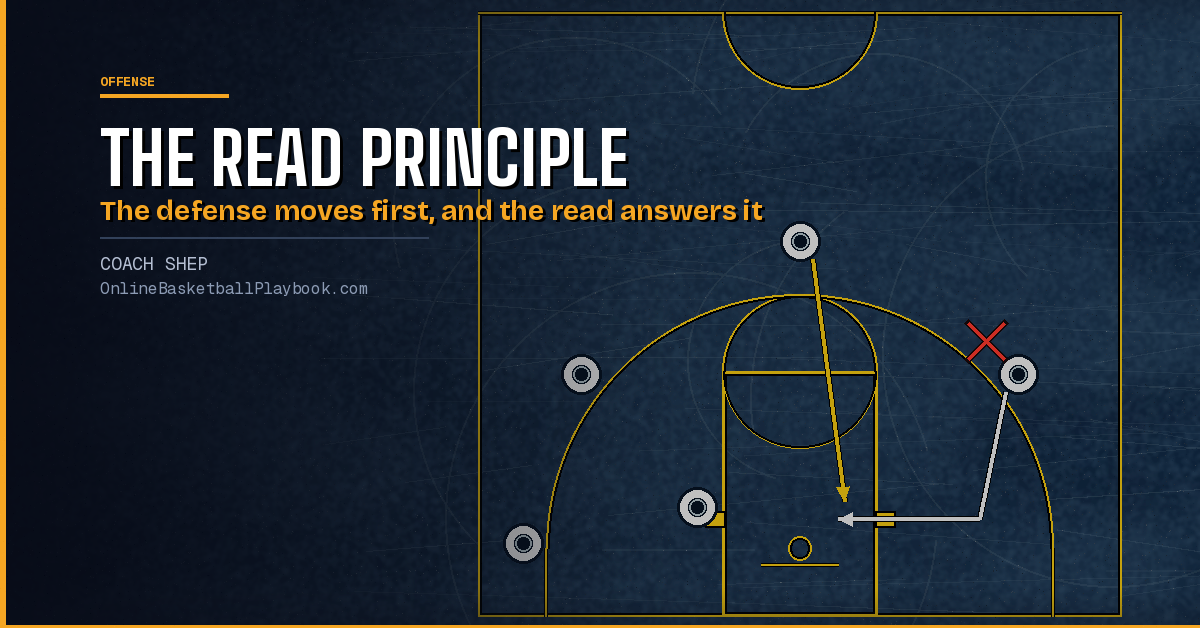
The read principle in basketball is one rule: the defense commits first, and the offense does the opposite. A defender who overplays gets beaten behind his back. A defender who sags gives up the shot. A helper who leaves his man has told the passer where the ball goes. Pete Carril built the Princeton offense on it, and the same rule runs through motion offense and the dribble drive under other names. This page covers the rule itself, the triggers players learn to see, the answer to each defensive choice, why an offense of reads gives a scout so little to chart, and how coaches install and test it.
The Read Principle in Basketball: Do the Opposite
The plainest written form is in the Princeton player rules. Rule 9 says to do the opposite of whatever the defense does, and four other rules turn that into cases a player can act on:
- Rule 4. If you are overplayed, go backdoor right away.
- Rule 5. If you are played inside, go outside, and if you are played outside, go inside.
- Rule 11. If a teammate dribbles at you and you are played tight, look to go backdoor.
- Rule 15. When you are closely guarded, do not go to the ball. Go backdoor.
The same list opens with skill. A player who can pass, dribble and shoot dictates to the defense, and a player who cannot is dictated to. Carril said it the same way at a 2006 clinic in Madrid: offensive skills dictate what happens, and without them the defense dictates. His two shortest rules were "When closely guarded, go back door" and "Watch the person in front of you."

The rule set also says where the read leads. Rule 17 ranks the shots the reads are for: layups, then threes, in that order. The cut-by-cut detail of the backdoor is on backdoor cut basketball.
One Rule, Several Offenses
Each system states the rule in its own words, and the defensive commitment that triggers it changes with the system.
- Princeton. The backdoor is live in every set, and any overplay anywhere is a trigger.
- Dribble drive. Every help rotation opens a different cutter or shooter, so taking away one option hands the driver the next one. That chain is on dribble drive reads.
- Screen-away motion. The cutter reads his own defender off the screen: straight cut if he sags, curl if he trails, flare if he goes under, back cut if he overplays. The screener reads the cutter's choice and goes the other way.
- Concept-based offense. Once an advantage starts, the team keeps driving and passing so each defensive commitment opens the next action. That version is on concept based offense.
How Princeton and motion organize the same reads differently is laid out side by side on Princeton offense vs motion offense.
Triggers a Player Can See
Coaches give players physical cues instead of judgment calls. The cues for the back cut itself are on backdoor cut basketball. For younger players the cue is to notice before the catch whether his defender is denying, sagging, watching the ball, overplaying or has lost sight of him.
Triggers come from two places:
- The defender. His feet, his hands and his distance tell the player what to do. A denial, a trail, a sag, a jump to the ball.
- A teammate. A dribble at you, a pass fake, a screener's angle, a driver's stop. These tell the player where to go, and the defender's reaction tells him what to do when he gets there.
The dribble-at sits between the two families. The teammate starts it, and the defender decides it. If he stays tight, the receiver back cuts. If he sags toward the middle, a teammate sets a flare screen for him instead of the back cut.

Flare mechanics are on flare screen basketball, and the dribble-at signals that call other backdoors are on backdoor triggers.
The Answer to Each Defensive Choice
Read-based set offenses can pair each defensive behavior with one named answer, and side by side the menu barely changes from play to play.
| The defender does this | The answer |
|---|---|
| Denies or overplays the receiver | Backdoor or rear cut |
| Plays you inside | Go outside, and go inside when he plays you outside |
| Stays tight when a teammate dribbles at you | Back cut |
| Sags to the middle on the dribble-at | Flare screen instead of the back cut |
| Sags off a screen away | Straight cut |
| Chases and trails over a down screen | Curl |
| Goes over the top of the screen | Fade to the baseline |
| Cheats over early | Back cut |
| Goes under the screen | Flare, or pop back out for the shot |
| Shows and recovers on the screener | Slip the screen |
| Switches | Roll or post up the smaller defender, or isolate |
| Helps on the drive | Pass to the man he left |

The help row is the read every offense shares, and it gets its own page: advantage basketball: reading the help. Screen types behind the other rows are on basketball screens.

Reads also live inside called plays. A screener can read his own defender in a set and slide to the block if his man helped or clear to the weak-side elbow if his man stayed attached. A passer can get a return layup, a post feed if his defender helps, or a screen away.
Get the next coaching guide in your inbox
One email when a new guide or diagram set goes up. Free.
Why a Read Offense Is Hard to Scout
A scout charts what a team does again and again. An offense of reads gives him less to chart, because the next action depends on what his own defenders do. Hard to scout shows up on lists of motion's strengths, and the same lists say a patterned continuity is easier to scout and easier to disrupt. A continuity survives a scout by carrying counters for those denials.
Coaches attack the scout in several ways, and they fall into two groups.
Have no call to steal.
- Run reads instead of plays. A quick hit does not have to be a call from the bench. It can be a read the team makes together.
- Rotate roles. In the shuffle offense, all five players move through five roles, so a player's job changes from one possession to the next.
Disguise the call you do have.
- Same action, different alignment. Bob McKillop's rule at Davidson was to change the alignment for the same play, running one action from a 1-4, a box and a stack.
- One alignment, several finishes. Other coaches do the reverse: one picture every time, and the rotation or a one-word tag picks the finish.
- Rename or rotate the signal. Plays get color or number codes, and one coach changes the backdoor signal every week.
- Hide the signal in ordinary motion. McKillop called out-of-bounds actions by pulling his tie or his socks, and all five players gave the signal back.
- Save the second look. Run the first option until it works a couple of times, then the screener fakes the same screen and cuts to the ball.
Scouting from the other side is on basketball scouting.
How Much Structure Around the Reads
The systems differ on who supplies the answer to an overplay.
| Version | Who picks the answer | What it costs |
|---|---|---|
| Rules only (motion) | The players, from a short list of rules taught once | The coach gives up control of every dribble and pass, and young players find the reads hard at first |
| Continuity with counters (flex, swing) | A repeating pattern, with coded releases for the denial and the trap | Without the releases, pressure and scouting break the pattern |
| Set plays with counters | The bench calls the play, and each play carries an automatic answer to each overplay | A team that runs set plays almost all the time gives players little chance to read the defense |
| A call that overrides the read | A hand signal turns a dribble-at into a hand-off, or calls a counter to a switch | The signal has to reach all five players |
The dribble drive warns against coaching too tightly. A coach who tries to rein the drivers into a few pre-set options will not get the full value of the offense. The flex, the swing and the UCLA high post sit at the other end: each answers a denied entry with an automatic. Those systems are on flex basketball plays and swing offense.
Teaching and Testing the Read
One read at a time. A coach who shows a play in its finished form trains players to force the last option, because they never see the first read rewarded on its own. The fix is to show only the primary option until it is automatic, then add the counter, the way a quarterback checks down. Layered read offenses do the same thing on a larger scale, one layer at a time, each automatic before the next.
Name the answer, or make them find it. Coaches split here. The plain-words approach describes actions in plain words, not numbers, and avoids even "back cut" or "use the screen," so players read the man in front of them. The opposite approach names every reaction and demands that players go exactly where they were drilled.
Drill the cue, not the pattern. A guided defender gives the cue and the offense answers it. In one game the defender drops the ball left or right and the offense reads which way. In another he chases over a cone and the offense attacks the opposite side. Every rep has a decision in it. Moving each concept into live play, from small groups up to the full five, makes players read real defenders instead of cones.
Test it live and say it aloud. Isolated drill reps can leave players unable to read closeouts, help or screens in a game. The talk-it-back version of live 1 vs 1 fixes that: run it after workouts, vary the start, score a bad shot as a turnover, and have the offense and the defense say the read out loud after each rep, such as the defender saying he went under the screen, and the cutter answering that he should have flared instead of curling into him. A coach can ask the same two questions in any scrimmage. What did your defender do? Where was the help?
Drills that install these reads inside the Princeton system are on drills to teach the Princeton offense, and the defender's side of the same reads is on how to defend the Princeton offense.
Questions Coaches Ask About the Read Principle
What is the read principle in basketball?
The rule that the defender's position decides the cut or the pass. The offense does the opposite of what the defense commits to: overplayed, go backdoor. Played inside, go outside. Help comes, pass to the man it left.
What does "do the opposite of the defense" mean?
It is rule 9 of the Princeton player rules. Whatever the defender takes away, the offensive player takes what he left. A defender above you leaves the rim open, and a defender under the screen leaves the shot open.
Is the read principle only for the Princeton offense?
No. Motion offense reads the defender off every screen, the dribble drive reads the helper on every drive, and set plays often carry an automatic answer to each overplay.
Why is a read offense hard to scout?
The next action depends on what the defense does, so a scout cannot chart a fixed sequence. Hard to scout appears on lists of motion's strengths, and the same lists say a patterned continuity needs counters to survive a scout.
How do you teach players to read the defense?
One read at a time. Show the primary option until it is automatic, add one counter, drill it against a defender who gives the cue, then test it live with players saying the read out loud after each rep.
Want every diagram on the site?
OBP Pro members get the full diagram files for every offense guide on the site, ready for a practice binder or a scouting report. $9 a month. Or draw your own version free in the play drawer.
See what OBP Pro includesMore Offense System Guides
- Princeton Offense vs Motion Offense: Compared by Principle
- Dribble Drive Zones: Rack, Drag, Drop and Breakdown Explained
- Dribble Drive Reads: Kick Up, Kick Back, Loop and Dump
- Dribble Drive Named Plays: Drop, Quick, Pop and Corner Sets
Back to Princeton Offense and every Offense page.
Keep Building
Related breakdowns
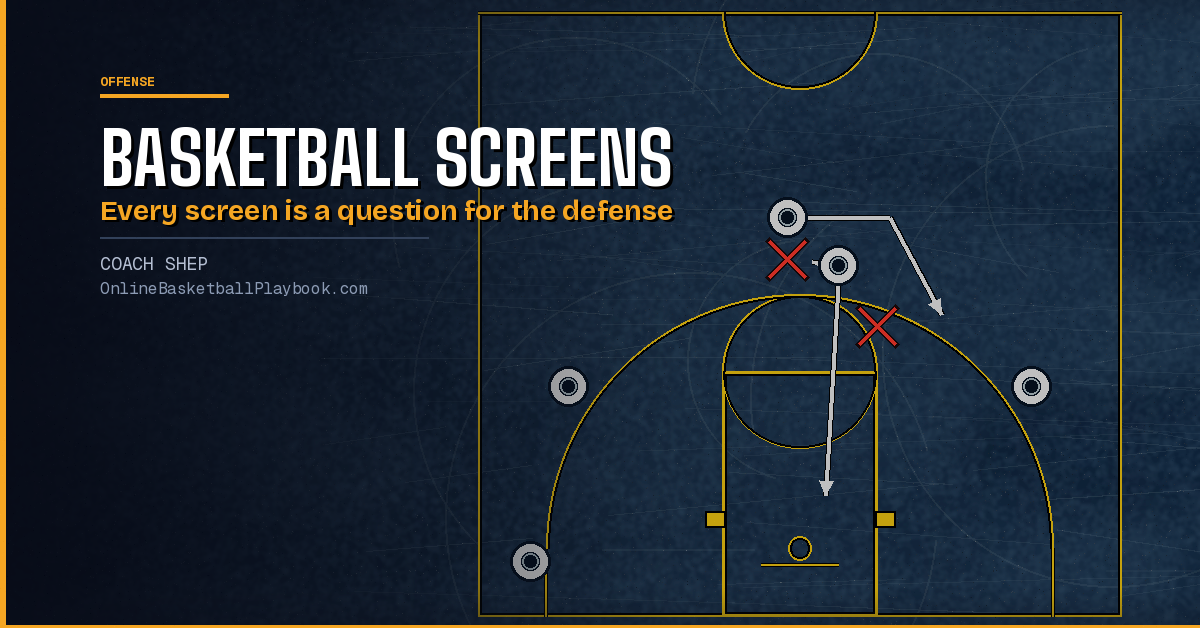
Basketball Screens: Every Type of Screen and How to Read It
Basketball screens explained by type: on-ball, down, flare, back, pin down, cross, stagger, elevator, screen the screener and hand-off, with each read and counter.
Princeton Offense vs Motion Offense: Compared by Principle
Princeton offense vs motion offense, side by side: spacing, the post's job, cuts and screens, reads, the dribble, called sets, personnel, shots and the install.
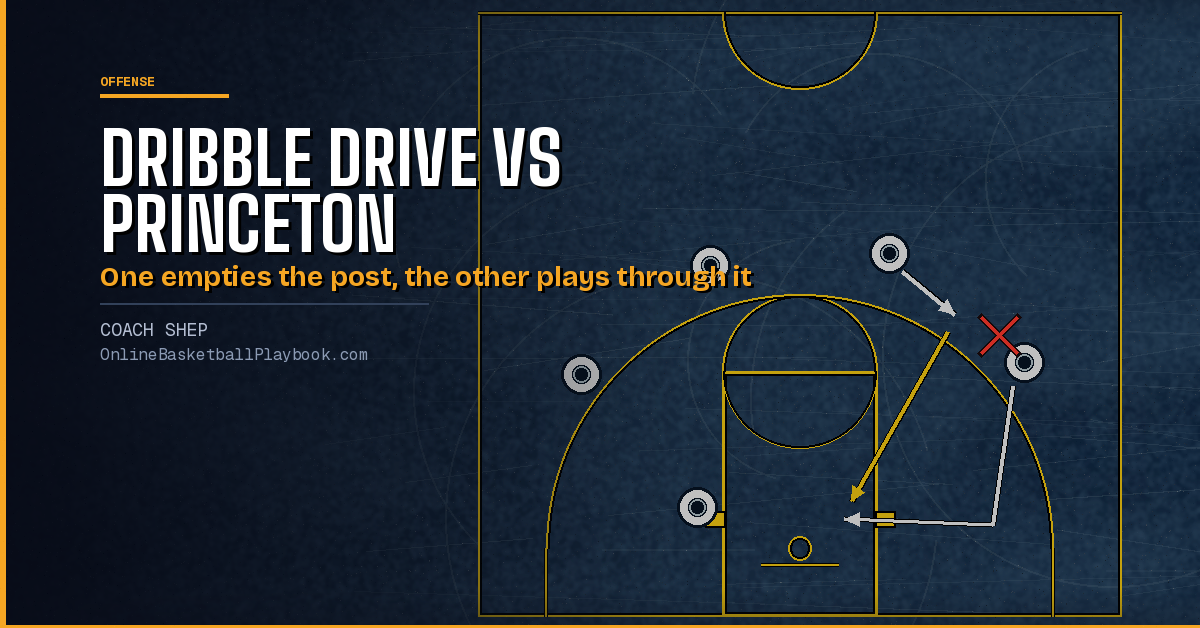
Dribble Drive vs Princeton Offense: Compared by Principle
Dribble drive vs Princeton offense, side by side: the post, spacing, dribble or cut, the backdoor read they share, screens, shots, tempo, personnel and borrowing.