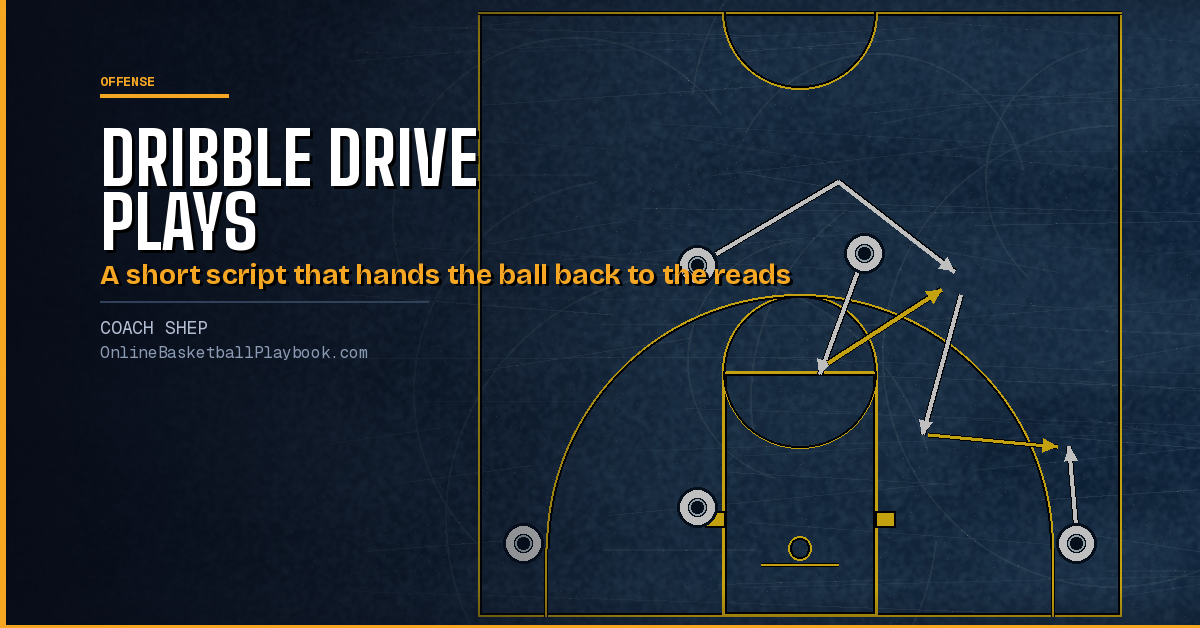
Dribble drive named plays are short scripts called out of the dribble drive motion offense. Each one is one to three steps from normal 4-out 1-in spacing, and each ends by handing the ball back to the drive-and-read offense. Vance Walberg built the system to be played without calls, and his line was to learn to play, not run plays. Even so, his own teams carried a short list of set plays, and later versions name many more. This page draws the most common calls, explains how the numbers in a call work, lists the words that mean different plays in different versions, and covers when coaches reach for a set at all.
When Coaches Call a Set
The short-list rule is part of the Walberg system, which puts players over plays. It allows three or four set plays in all, with one of them run each day in practice. The sources give three reasons to call one:
- The defense has read you. Walberg carried twelve quick hitters at Fresno City College, numbered Special One through Special Twelve, each two or three steps from the normal formation. He used them when a defense started reading the free-form drives.
- The post has gone untouched. A post-touch rule calls a post quick hitter every three trips when the post is being ignored.
- The gaps have closed. Coaches who add entries say teams guard the dribble drive better now, so they add entries built to lift the post's defender out of the paint and move the defender at the nail, which reopens a gap to drive.
The calls below come from several versions. The numbering in each is the one that version uses: 5 is the post and 4 the second guard who trails the ball, unless a caption says otherwise.
Drop Calls: the Backdoor Series
A Drop is a drive by a player who cannot get past his man, so he stops in the Drop zone near the elbow. The Drop calls are backdoors keyed by that stop, and the call names the player. Walberg's lists include Drop 2, Drop 3, Drop 23 and Drop 32, and in 2007 he called Drop 2 the backdoor.

In the version drawn here, the 1 stops in the Drop zone and the 2 cuts behind his man from the corner, carrying on to the far corner when the pass is not there. Meanwhile the post drops under the far block, the 4 fills the spot the 1 left, and the 3 lifts two steps from his corner. In the second step the post gap-cuts, the 4 fills for the 2, and the 3 catches the 1's pitch back to shoot first and drive second. The action can repeat.
- Drop 3. The mirror of Drop 2 on the 3 side, started with a back dribble instead of a drive.
- Drop 2 and Drop 3 with a loop cut. The same starts with the loop cut added, where the passer loops behind the man he passed to.
- Drop with a post flash. Off the same stop, the 2 goes backdoor, the 4 fills behind the 1, the 3 lifts to the wing, and the 5 flashes high for the catch. If he cannot beat his man, the 5 gives it to the 4 and dives to the block.
A wrinkle against a hard overplay has the passer reverse pivot and hit a teammate for a quick backdoor. The reads behind every backdoor are on backdoor cut basketball, and other backdoor sets are on backdoor triggers.
Drag Calls: the Skip Series
Drag calls are skips off a drive into the Drag zone, again named by the receiver. Walberg's 2007 calls:
- Drag 3. The skip to the wing early in the Drag zone.
- Drag 34 or 35. The skip, then a feed to the post.
- Drag 5. A euro loop, the guard trailing the drive out to the arc. In his outside-Drag version, Drag 5 is the second point guard dragging behind a Drop zone stop.
Another Walberg list adds Drag 2 and Drag 24. The Drag 3 skip is drawn on dribble drive zones.
Quick 4 and the Quick Entries
Quick 4 pairs a middle drive with a pitch back. The 1 drives to the middle of the lane, and in the jump-stop version he stops in the path of the 4's defender. The 4 fills in behind him and catches the pitch, then penetrates to the rim or drops it off to the 2 as he steps up out of the corner.

The jump-stop version also gives the 4 a lob to the 5, or he can reverse pivot and kick the ball back out to the 1 for a three, a move credited to Don Meyer as the European cut. Other Quick calls start with a quick pass, an entry to the 2 or the 3, who has to come a step or more out of the corner for the catch:
- The quick entry into a post-up for the 3. The 2 comes out of the corner for the 1's pass and the 1 basket cuts. The 4 fills behind him, the 3 lifts to the wing, and the sequence ends with the 3 posting up.
- The quick entry into a post-up for the 4. Same start, finishing with a post-up read for the 4.
- Swing. The ball goes from the 1 to the 4 as the 3 lifts out of the corner. The 4 finds the 3, and the 3 feeds the 5 as he ducks in.
Pop 5: Post Flash and Stagger
Pop 5 appears in two versions with the same shape: the 5 flashes high, the guard cuts, and two players stagger-screen for a shooter. In the version drawn here, the 1 dribbles at the 2 and pushes him all the way across to the far corner. The 3 lifts high from his corner, the 5 flashes to the elbow, and the 1 feeds him.

Next the 1 looks for a backdoor. When he has cleared, the 5 attacks his man off the dribble while the 4 and the 3 stagger-screen for the 2. A 5 who gets stopped kicks to the 2 for the shot. With no shot for the 2, the other four spread out to give the 5 a release.

A second ending trades the drive for a hand-off. Once the stagger is run, the 5 dribbles at the 2 and hands it off, then stays high while the 4 dives to the block on the ball side. The 2 then has the 4 on the block, or a swing back up to the 5 for a high-low look. Pop 4 runs the same play with the 4 as the post who flashes. Stagger screens are on basketball screens, and the hand-off on DHO basketball.
Get the next coaching guide in your inbox
One email when a new guide or diagram set goes up. Free.
Hand-Off, Cut Through and a Corner Ball Screen
This set from a 4-out look ends in a pick and roll in the corner for the point guard. The 1 dribbles at the 2 for a drop pass or hand-off and keeps going to the far corner. As the 3 lifts to the wing and the 4 fills the top of the key, the ball swings back to him around the top. The 5 screens the 3 out of that side, then sets the ball screen in the corner.

Off the screen the 1 can shoot, hit the rolling 5 with a bounce pass or a lob, or kick it out. The 4 slides left as he comes off it, ready for a kick back. When the 4 catches it, the 1 heads up to the top of the key and the 5 goes to the far block, which clears the side for the 4 to attack. Swinging it back out puts the team in 4-out spacing again, to rerun the set or go to the drive offense.
A version for the 4 starts the same way. After his pass to the 2, the 1 skips the cut and screens for the 4, who curls around him to the rim and out to the far corner. The ball comes back around to the 4 there, the 3 clears, and the 5 sets the corner ball screen for him. Pick and roll reads are on pick and roll.
One Entry, Four Finishes
The one-entry series uses the same start every time and lets a one-word tag pick the finish, so the defense sees the same start on every possession. The 1 dribbles to the drop box and kicks up to the 2, then clears hard to the corner as fast as he can to keep the spacing. The big, here the 4, sprints up to the elbow for the 2's pass.

| Finish | What happens after the pass to the 4 | If nothing is open |
|---|---|---|
| Down screen and slip | The 2 down-screens for the 1 and slips after setting it. The 5 down-screens for the 3 to keep the defense busy | The 4 hands off to the 1 and rolls. The 1 attacks the nail |
| Flare and slip | The 1 sprints to flare-screen for the 2 and slips. The 3 flares the 5, who goes to the corner | The 4 hands off to the 2 and rolls |
| Speed cut and hand-off | The 2 speed-cuts to the rim and the 1 follows in his wake to take a hand-off from the 4. The 5 down-screens for the 3 | The 1 attacks the nail, the 4 pops, and the 2 clears to the corner off the 5's screen |
| Screen the post and dive | The 2 screens for the 5, who comes off looking for the pass from the 4, and the 2 dives to the rim. The 3 rises and the 1 stays spaced | The 4 hands off to the 3 and rolls. The 3 attacks the nail |
How Dribble Drive Named Plays Are Numbered
Most calls are a word and a number, and the number usually names a player:
- The cutter. In one five-play backdoor series, Drop 1 through Drop 5 are named for the player who gets the backdoor. Walberg's Drop 2 and Drag 3 work the same way.
- The player isolated. In the same version, isolation calls 10 through 50 name the player who gets the isolation.
- The screener and the ball handler. Its ball screen series has 41 as a ball screen by the 4 for the point guard and 51 as a middle ball screen by the 5 for him. Fist calls any ball screen, and Flat calls a flare screen.
- The entry. Another system calls entries with numbers such as 100, 200 and 300 and combines them with one-word action names (Quick, Loop, Nail, Wave, Jet, Rub, Brush, Arrow, Blast), as in "100 quick 2."
Walberg's own specials were numbered and not word-coded. The pages that survive are diagram-only, with no written reads.
Same Word, Different Play
One call word can name different actions from version to version. A staff that borrows from two of them has to rename one.
| Word | Version | What it means |
|---|---|---|
| Drop | Drop zone stop | A driver who cannot get by his man stride-stops in the Drop zone |
| Drop | Backdoor series | Drop 1 to 5, named for the player who gets the backdoor |
| Drop 5 | Post flash | The 5 flashes high to catch after the Drop zone stop |
| Drop 5 | Backdoor lob | The 5 flashes to the elbow and seals for a back-side lob |
| Quick | Quick entry | A fast entry to the 2 or 3 as he steps out of the corner |
| Quick | Pass and cut series | Pass and basket cut, with a back screen by the 5 for the 4 |
| Loop | Loop cut | After his pass, the passer loops behind the receiver and takes his spot |
| Loop | Elbow kick | The point guard jump-stops at the elbow off the drive, kicks to the wing and fills the corner |
| High | High post start | The drop-and-loop entry with the far post high from the start |
| High | Running pick and roll | The 5 flashes to the top of the key for a pick and roll on the move with the 2 |
| Rack | Zone | Past the Drop zone, where the driver commits to scoring |
| Rack | Guard quick hitter | The point guard drives straight to the block |
The drop-and-loop entry with the far post high or low comes from the same version as Quick 4 and Pop 5. It runs to either side: the 1's drive drops the corner man, the 1 loop-cuts, the corner man comes straight up, and the far post starts high or in his usual spot. In the brush-screen post entry, the 1 T-cuts as a brush screen and the 5 comes off his back into the post. The drills that install these calls are on drills to teach the dribble drive motion, and the defense's view is on how to defend the dribble drive motion offense.
Questions Coaches Ask About Dribble Drive Named Plays
Does the dribble drive offense use set plays?
A few. Walberg built it to be played without calls, but his teams kept a short list, and one rule is to keep three or four set plays and run one a day in practice. Each set is a short start that ends in the normal drive reads.
What is Drop 2 in the dribble drive?
A backdoor for the 2. The 1 drives into the Drop zone and stops, and the 2 back cuts from the corner. In one version he runs on out to the opposite corner if he is not open, and the 1 pitches back to the 3.
What is Quick 4?
A middle drive by the 1 and a pitch back to the 4, who fills in behind him. The 4 then attacks the rim or drops it off to the 2 as he steps up out of the corner.
What were Walberg's Fresno Specials?
Twelve numbered quick hitters, Special One through Special Twelve, each two or three steps from the normal formation. He used them when a defense started reading the free-form drives. The surviving pages are diagrams with no written reads.
Want every diagram on the site?
OBP Pro members get the full diagram files for every offense guide on the site, ready for a practice binder or a scouting report. $9 a month. Or draw your own version free in the play drawer.
See what OBP Pro includesMore Offense System Guides
- The Read Principle in Basketball: Do the Opposite of the Defense
- Princeton Offense vs Motion Offense: Compared by Principle
- Dribble Drive Zones: Rack, Drag, Drop and Breakdown Explained
- Dribble Drive Reads: Kick Up, Kick Back, Loop and Dump
Back to Dribble Drive Motion Offense and every Offense page.
Keep Building
Related breakdowns
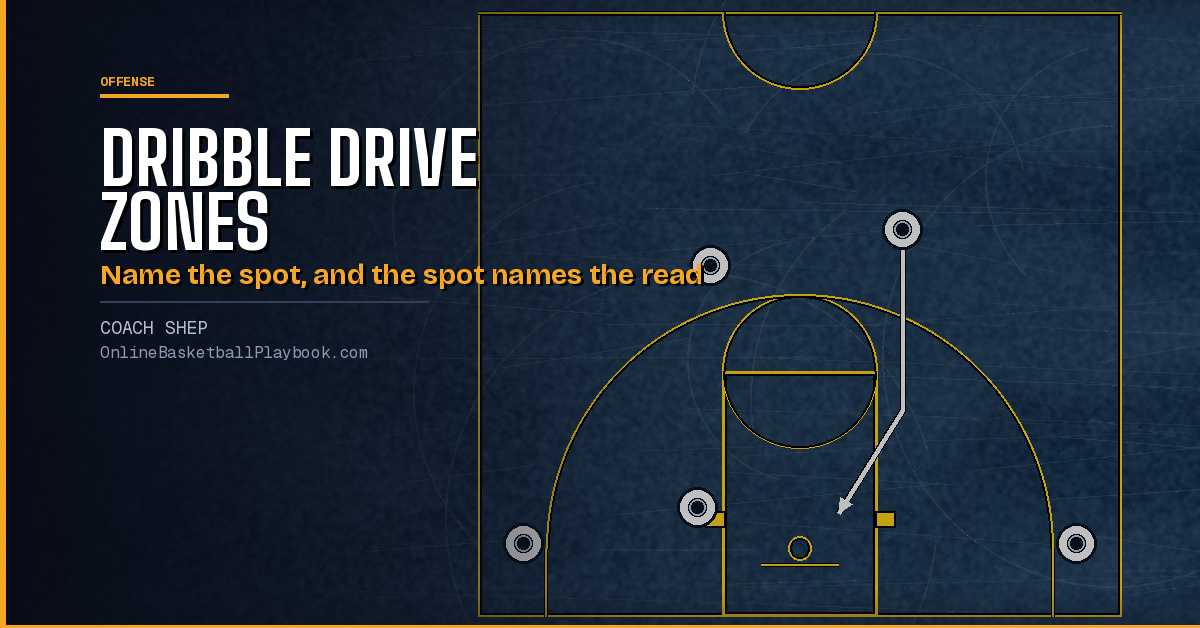
Dribble Drive Zones: Rack, Drag, Drop and Breakdown Explained
Dribble drive zones explained: the maps of the Rack, Drag, Drop, Breakdown and Blow Out zones, what to do in each, the stops, and the call words built on them.
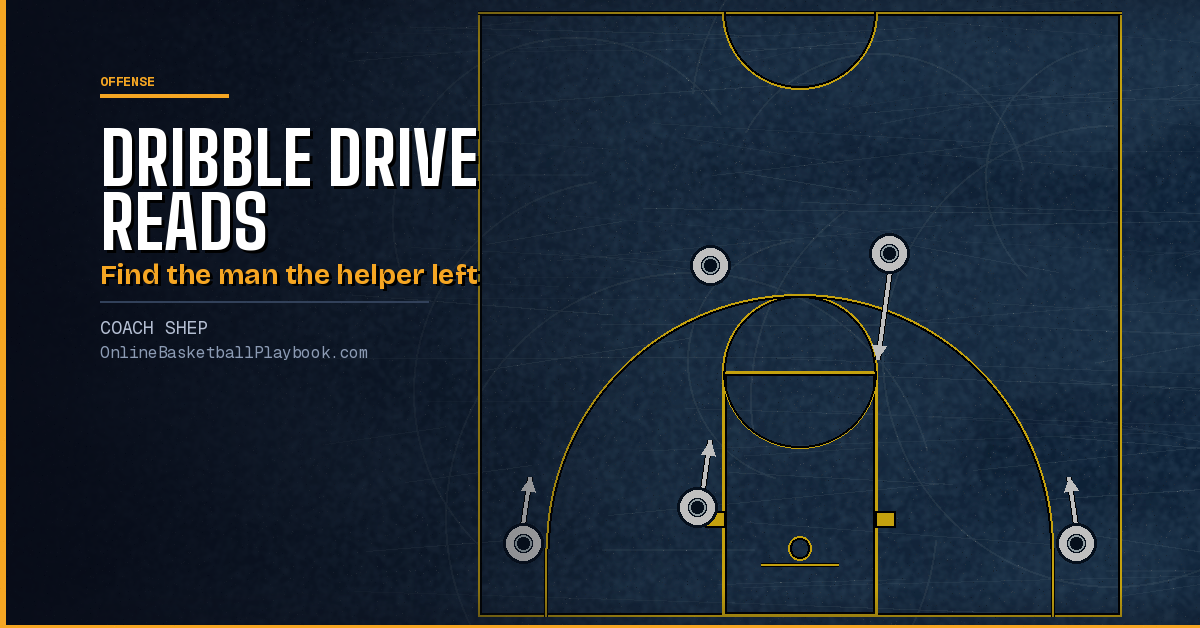
Dribble Drive Reads: Kick Up, Kick Back, Loop and Dump
Dribble drive reads for the driver and the four players around him: the helper tree, kick up, kick back, loop cut, dump, baseline drive jobs and the passing rules.
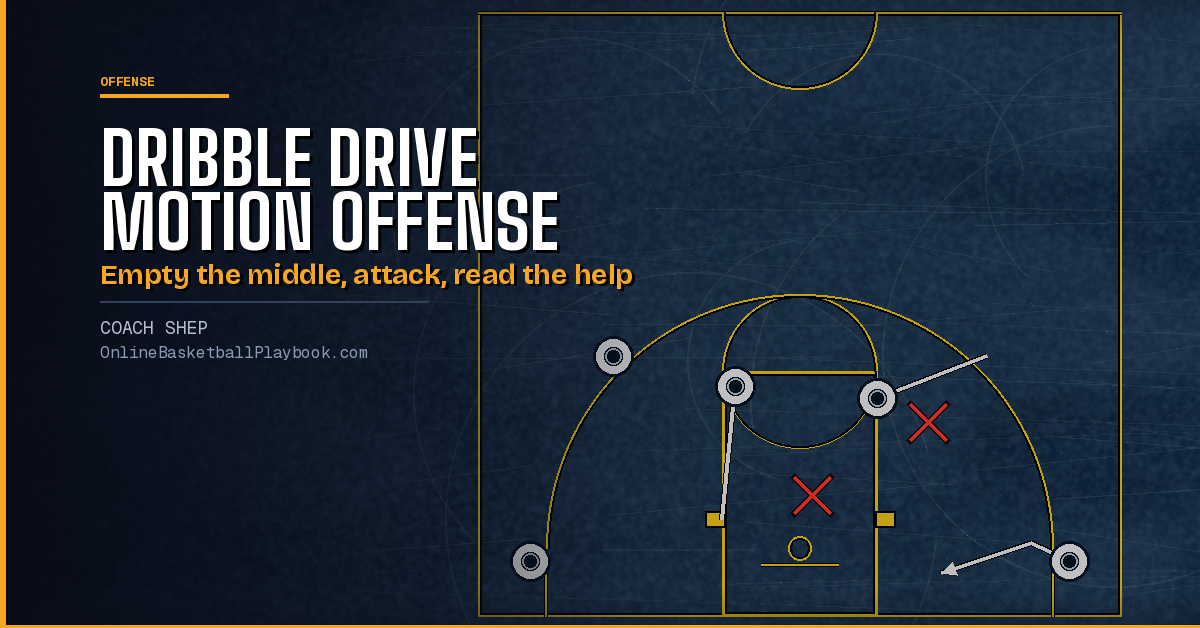
Dribble Drive Motion Offense: Spacing, Reads and Install
The dribble drive motion offense explained: 4-out 1-in spacing, the Drop, Drag and Rack zones, the read off a drive, shot diet, weak spots and the install.