The dribble drive system is more than an alignment. Vance Walberg, who built it, treats the offense, the full-court press, the shot rules, the rotation and the practice plan as one package, and he gives a reason for each part. This page covers where the system came from, why it presses, the points-per-possession math behind the shot diet, why it calls so few plays, how it uses depth, and how practice carries it. The floor itself is on the dribble drive motion offense hub, the floor words on dribble drive zones, the decisions on dribble drive reads and the called sets on dribble drive named plays.
Where the Dribble Drive System Came From
Walberg dates the offense to 1997, at his high school program in Fresno, California. He had two explosive point guards who could beat their men, but a traditional offense left the paint too crowded for them to finish. His answer was spacing. He moved the post to the weak-side block so the lane was open. If the post's defender stepped over to stop a guard, the guard passed to the post for a layup. If neither the layup nor the post was there, he kicked the ball out for a three, and if that shot was not there, the next player attacked again so the defense never got a rest.

He named it for what it does: Attack, Attack, Skip, Attack, Attack, or AASAA. The name changed when John Calipari took it to Memphis. Walberg writes that he visited Calipari's Memphis practices for a week in 2003, the two spent hours on the offense over dinner, and Calipari studied it for the next few years before installing it with his 2005-06 team. Along the way it became the Dribble Drive Motion. Calipari's own nickname for it was "Princeton on Steroids," a comparison taken apart on dribble drive vs Princeton.
Walberg also says the offense grew out of his press. Early on he could not fit his half-court offense and his full-court press into the same practice. He would run one, stop, and work on the other. The dribble drive came from building one fast style that served both ends.
Pressure on Both Ends
Walberg wants pressure on both sides of the ball, and he rejects pressing and then dropping back into a pack-line or a standard half-court defense. His teams press after makes, misses and dead balls. He gives three reasons.
- More trips. A normal game has about 60 trips. His press pushes it to about 80 to 85, and most opponents have no backup point guard to rest the starter.
- Tired guards. The aim is fatigue and hurry, not steals. One version of his press puts it plainly: a point guard can beat it and lay the ball in, but how many times can he do that and still defend the other end? Walberg says the press is run correctly only 15 to 20 percent of the time, ball pressure covers the mistakes, and he would rather the ball be dribbled up the floor than passed ahead.
- Different shots. A rushed opponent takes different shots than his own team takes.
The cost is stated out loud. His press concedes some early layups, and he asks coaches whether they can live with a few easy baskets and play the bench. Players can only go full speed for about a minute and a half, so he carries two or three ball pressure players, the controllers.

The controller's job is measured in turns. One turn of the dribbler in the backcourt means he did his job, two means a great job, and none means he sits next to the coach. The controller is never the best scorer, and Walberg keeps three of them in the rotation. The 2-2-1 alignment itself is covered on 2-2-1 press.
The Shot Diet and the Math Behind It
Walberg calls "3 or the key" the biggest secret of his system. He bans shots from 15 to 17 feet, and his slogan for every team he coached is that they like threes but love layups. A perfect shot chart, in his words, has every shot at the rim or behind the arc.

He sells the rule with points per possession. He says good teams score about 1.1 points a trip, then prices each shot:
| Shot | Percentage used | Points per possession |
|---|---|---|
| Free throws | 70 percent | 1.4 |
| At the rim | 60 percent | 1.2 |
| Three | 40 percent | 1.2 |
| Mid-range, a typical team | 35 percent | 0.70 |
| Mid-range, Calipari's two-year Memphis chart | 28 percent | 0.56 |
The free throw and the rim sit at the top, and Walberg ties them together, since the way to the line is through the rim. In 2007 he priced a 35 percent three at about 1.05. The same year he concluded that the real prize is getting fouled, and the three-point threat is what opens the lane for it. He and Calipari add that a team can take 35 threes and still shoot 30 free throws.
Walberg turns the math into a target box score:
| Target | Number |
|---|---|
| Forced turnovers | 25 |
| Offensive rebounds | 35 percent of misses |
| Threes | 10 made of 30, 30 points |
| Other field goals | 20 made of 60, 40 points |
| Free throws | 20 made of 30, 20 points |
| Total | 90 points on 33 percent shooting |
Making the rule cost something. A pull-up mid-range jumper means running in practice and a seat on the bench in a game. He has also said any three taken with a foot on the line makes the whole team run. One version adds a call, Black down, that means layups only. The team keeps passing until it gets one. Another account says he counted mid-range shots as turnovers in practice. The general case for the shot chart is on basketball shot selection.
Where the lineage splits. In 2007, Calipari's own order ran free throws, layups, wide-open threes, wide-open mid-range shots, then contested shots and turnovers. That keeps an open mid-range shot that Walberg bans. One version of the offense keeps the 15-foot jumper outright. Its coach likes the offense mainly for the free throws it earns.
Ten Assumptions and the Four Factors
A program running the system wrote its case as ten assumptions. They are that program's summary, not lines from Walberg's own talks:
- One on one in open space favors the offense.
- Teams that make a lot of free throws win a lot of games.
- A defender who is recovering commits more fouls and allows more second shots.
- Second shots turn into points and trips to the line.
- A turnover wastes a possession.
- A player who catches already squared up shoots a better percentage.
- Dribble penetration is the hardest thing to defend.
- Teams fall off after their fifth or sixth player.
- Players are not built to handle pressure for a whole game.
- A faster pace of decisions forces more mistakes.
The same program ties them to the Four Factors, shooting percentage, offensive rebounds, turnovers and free throw rate, and argues the system attacks all four at once. It claims the system wipes out the usual disadvantages of a team with no size, no star and no post.
Players, Not Plays
Walberg does not call a set play every trip down the floor, and he writes that neither does Calipari. Control moves to the players. His goal, in his words, is "to teach players how to play basketball, not how to run plays," and he says that means the coaches have to teach more in practice, not less. The offense uses very few ball screens. He boils it down to a Big Three:
- A mind-set of getting to the rim.
- Gaps opened up.
- Spacing kept wide.
His numbering follows the same idea. The 1 and the 5 are both point guards, drivers first and shooters second, the bookends of the offense. He first had his big take the ball out, but when teams doubled the point guard and the ball went back to the big, the offense slowed, so his second point guard became the 5. The 2 and 3 are shooters first. The big is called a 4, because, Walberg says, most 5s want to be 4s, and the name keeps him happy while he stays inside.
The skip pass is the piece he says coaches leave out. He calls it the backbone of the offense and says most coaches who run the system underuse it, which leaves a one-way drive and dump. A player who catches and cannot attack skips the ball and the next player attacks.

Players over plays does not mean no plays. Walberg kept 12 numbered quick hitters for when a defense starts to read the offense, and one version of the system runs one play a day in practice and keeps three or four sets in all. Those calls are on dribble drive named plays.
Get the next coaching guide in your inbox
One email when a new guide or diagram set goes up. Free.
Depth, Substitutions and the Streak Call
Depth is part of the plan. Walberg plays 10 or 11 players a game, and a player who jogs comes out. His written rules ask for at least 10 players, some who play 26 minutes and some who play 2. His versions share one idea: the five best players do not start together, and the best players finish the game. The details change from version to version:
| Version | Who starts | Best players' shift | Other rules |
|---|---|---|---|
| Skill and toughness start | Three skill players and the two toughest | Two to three minutes, then 30 seconds of rest | Best players on the floor for the last four minutes. Two first-half fouls means a seat |
| Bench-first start | Sometimes the 7th and 8th players, for a couple of minutes | Two and a half to three minutes, then 30 seconds of rest | Players 8 to 10 get three first-half chances, 11 and 12 one or two. One of the top two guards and one of the top two shooters always on |
| Three scorers always on | Never the five best | About three and a half minutes | Three top scorers always on the floor. The first wave of three subs comes at the 18-minute mark |
| Two-minute waves | Not stated | A sub every two minutes in the press | Fresh legs keep the pressure on and push opponents into bad lineups |
Substitution patterns in general are on basketball substitution patterns.
Streak instead of a timeout. When the other team makes a run, Walberg yells "Streak" instead of calling time. The team slows down and only named shooters may take threes, while everyone else looks for layups and fouls. The versions differ on who those shooters are: the best player alone, the two best, or designated players picked before the game or at a timeout. He once charted every shooter, gave a green light at 70 percent or better and kept players between 50 and 70 percent from shooting on a Streak call.
Fouls. In 2005 the rule was do not foul, and two first-half fouls meant a seat. By 2007 he told players to take their fouls in the backcourt, not on drives and shooters, and let only the controllers play on with more than two.
Practice Carries the System
Walberg says every drill in his practice is a building block for the offense, and that the offense means nothing without the drills. Most of his drills are full-court transition drills run at high speed, because wearing the opponent down is a key of the system. Two habits run through all of them:
- Everything is scored. The loser sprints baseline to baseline in 10 seconds. The winner shoots one free throw to validate the win, and if he misses, the winners run too.
- Conditioning comes through drills. Sprints are only for mistakes. His ladder is down and back in 10 seconds, then two trips in 21.
He keeps the Blood drills out of the drill book he sells, because he considers them the best drills there are for starting both offense and defense each day. The drills themselves are drawn on dribble drive drills, and the scoring idea is on competitive basketball drills.
One standard. Walberg asks the best players to be the hardest workers and tells coaches not to be afraid to sit the best player. He has credited hustle, practice, rebounding, free throws and out-of-bounds plays for his wins, not the offense alone. His top tip for coaches was to watch a college team practice in October rather than go to clinics.
Who the System Fits
The system began with two quick guards who could not reach the rim through a crowded lane. Walberg's own warning is about shooters. He faulted Calipari for recruiting athletes but not shooters, because a shot chart of layups and threes only pays when the threes go in. The system is not built for a team that plays through a dominant big. Coaches who run it name the sagging, pack-line defense as its weak spot, covered on how to stop dribble drive motion. A fast cousin with a rim-running center is on drive and space offense, and tempo as a plan is on basketball pace and tempo.
Questions Coaches Ask About the Dribble Drive System
What is the philosophy of the dribble drive offense?
Pressure on both ends of the floor, shots only at the rim or from three, and players taught to read and attack instead of running called plays. Walberg backs each rule with points per possession.
Who created the dribble drive motion offense?
Vance Walberg, with his high school team in 1997, under the name AASAA. John Calipari studied it with him and installed it at Memphis for the 2005-06 season, and it became known as the Dribble Drive Motion.
Why does the dribble drive avoid the mid-range shot?
Walberg's math puts free throws at 1.4 points a possession and shots at the rim or 40 percent threes at 1.2, while a 35 percent mid-range shot is worth 0.70. He bans the shot and punishes it in practice.
What does AASAA stand for?
Attack, Attack, Skip, Attack, Attack. Every catch looks to attack, and a player who cannot attack skips the ball so the next player can.
Why do dribble drive teams press?
Walberg says the offense came from the press. Pressing raises the number of trips, tires the opponent's point guard and rushes its shots, and he plays 10 or 11 players to keep it going.
Want every diagram on the site?
OBP Pro members get the full diagram files for every offense guide on the site, ready for a practice binder or a scouting report. $9 a month. Or draw your own version free in the play drawer.
See what OBP Pro includesMore Dribble Drive Guides
- Dribble Drive Drills: Breakdowns, Blood and Scramble
- Dribble Drive vs Princeton Offense: Compared by Principle
Back to Dribble Drive Motion Offense and every Offense page.
Keep Building
Related breakdowns
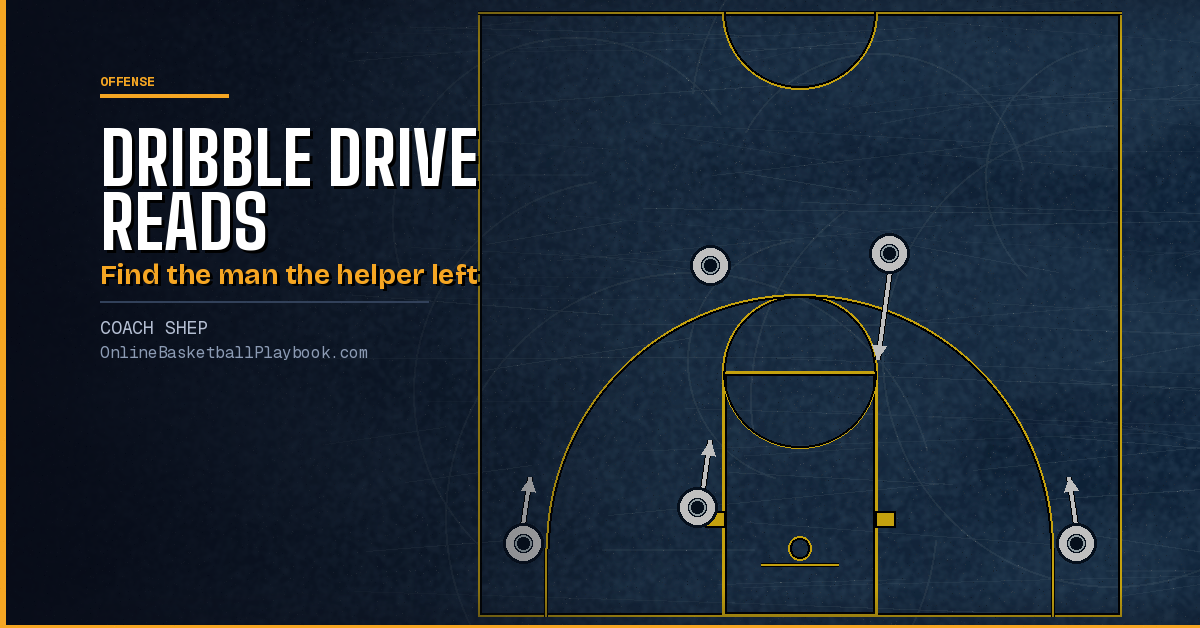
Dribble Drive Reads: Kick Up, Kick Back, Loop and Dump
Dribble drive reads for the driver and the four players around him: the helper tree, kick up, kick back, loop cut, dump, baseline drive jobs and the passing rules.
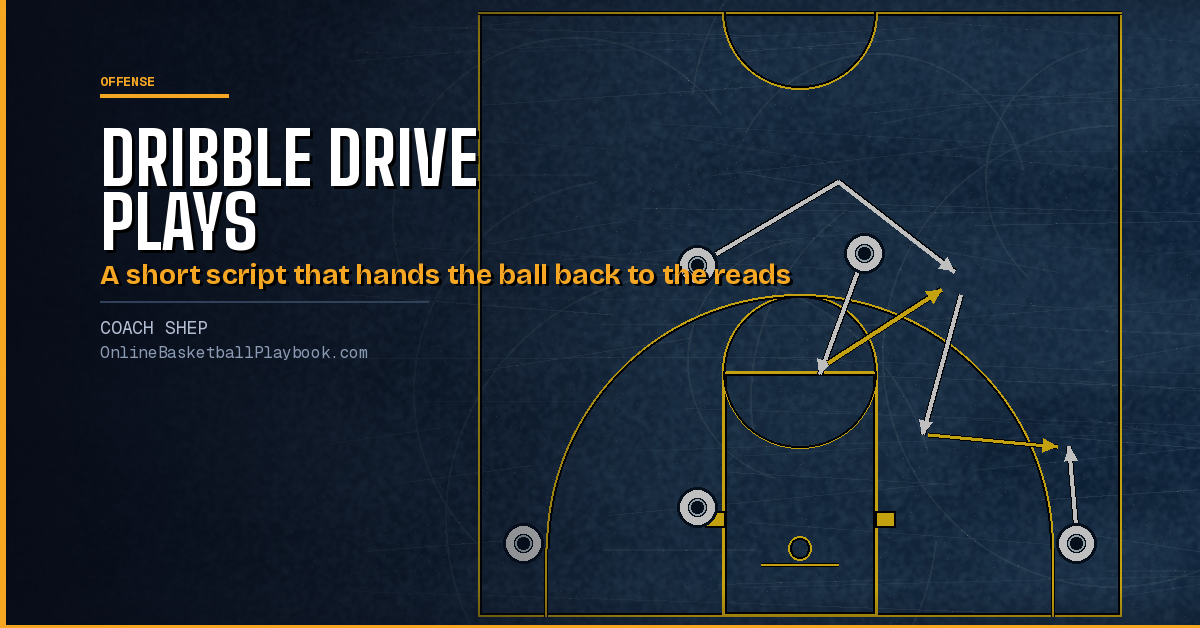
Dribble Drive Named Plays: Drop, Quick, Pop and Corner Sets
Dribble drive named plays, each drawn: Drop, Drag, Quick and Pop calls, a corner ball screen set, one entry with four finishes, the numbering and when to call one.
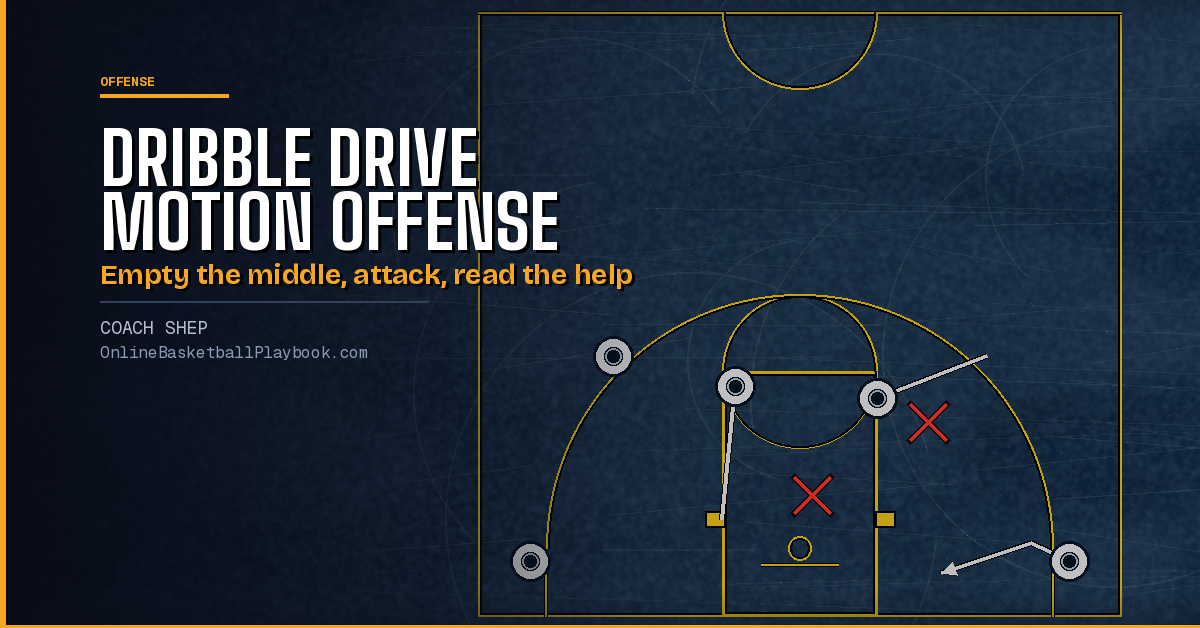
Dribble Drive Motion Offense: Spacing, Reads and Install
The dribble drive motion offense explained: 4-out 1-in spacing, the Drop, Drag and Rack zones, the read off a drive, shot diet, weak spots and the install.