
The Vance Walberg full court press is a role press: five defenders take five jobs instead of five men, and the jobs move with the ball. It lines up as a 2-2-1, and once the ball is dribbled it turns into a trapping, run-and-jump defense. Walberg says his dribble drive offense grew out of this press, and why he presses at all is covered on the dribble drive system philosophy page.
The basics of pressing are on full court press defense. Other press systems are compared on best full-court press, and every defense page is listed under defense.
How the Vance Walberg Full Court Press Works
The goal is an attack dribble, not one dribble and a pass. Walberg would rather be beaten by the dribble than by the pass ahead.
- Pressure the ball hard. A straight-line pass, with no deflection and no turn, means the ball pressure was bad. A lob is a good job by the defense.
- Get to your quarters. All five defenders shade to the quarter of the floor the ball is in. Walberg calls this his fix for most press problems.
- Make them dribble. The press starts on a hard dribble, not a standing one. Dribbling into pressure is what tires the point guard.
His press sheet runs it from man, a 1-2-1-1, a 2-2-1 or a 2-1-2. The 2-2-1 shape itself is on 2-2-1 press.
Pressure, quarters, dribble: say the three rules before every press drill until players say them back.
The Five Jobs on the Floor
The Controller guards one man. Everyone else guards two. The names are defined on press terminology.

- Controller. The toughest, high-motor player, and never the best scorer. He keeps the handler from seeing the floor and forces at least one turn before half court. One turn means he did his job, two means a great job, zero means he sits next to the coach. Walberg keeps three players who can play it.
- Gapper. One pass away, on the Controller's line and below the ball. He cannot be gapped, stays between the ball and the next pass, and becomes a trapper on the dribble, always from behind. If the press starts to break, his job is "see it and fix it."
- Taker. On the ball side, ahead of the ball, playing the high side. He takes away the sideline pass up the floor and does not come up to trap. Walberg calls it the easiest spot and puts his weakest defender there. Once the sideline pass is gone he settles into the 50-50 passing lane.
- Reader. The best and smartest defender, up the floor on the weak side. He anticipates, stays on the line and up the line, stops flashes to the middle and picks off misplaced passes, like a free safety.
- Teaser. The deep man, usually the big. He does not guard the inbounder. He stays long and opposite the ball, moves the moment the inbounder's arm cocks back, and creeps toward half court when the ball is held low or is in the handler's weak hand. He baits the long pass, takes it away and protects the rim like a goaltender.
The jobs travel with the ball. On a guard-to-guard pass, or whenever the ball switches sides, the Controller and the Gapper trade jobs. On a middle drive, the Reader and the Taker trade.
A press that gives each defender a man on the inbound instead of a job is on match-up press.
Fit each player to a job, and hide your weakest defender at Taker.
Floor Zones and Quarters
Two maps tell every defender where to be: three zones up the floor and four quarters across it.
In his 2007 defense talk Walberg names three zones from the inbound end:
- Pressure zone. The backcourt to the hash. On-ball pressure that forces the dribble.
- Cushion zone. The middle third. Defenders give ground and look for a vertical trap off a sideline pass. Second traps on a sideline pass are compared on three-quarter court press.
- Umbrella zone. The frontcourt, where the beaten press becomes a shell around the basket. His press sheet calls this third the vertical trap zone, for the trap that happens there.
The quarters split the floor lengthwise, using the volleyball sidelines extended and the line from basket to basket: outside, inside, inside, outside. With the ball in an outside quarter, all five defenders are on that half of the floor. When it is in an inside quarter, all five are in the inside quarters.

Inside those maps, the body rules are short. Guard with an open stance, never a deny stance. Play the high side, above your man and in line with the ball. Move on angles, never in straight horizontal or vertical lines, and move during the flight of the pass, before the catch. Two names cover the errors: a hugger is too close to his man to react, and a sniffer trails behind the ball handler instead of getting ahead.
When the press looks broken, get to your quarters first.
The Inbound, Strong and Weak, and Gold
While the ball is out of bounds, the front two defenders take two jobs. Strong, on the ball side, plays full denial and starts wearing down the point guard before the clock runs. Weak, away from the ball, plays an angle deny with the rim behind him. If the inbounder runs the baseline, Strong and Weak flip.
His 2006 notes add a side front from the inside out, to force the catch in the corner and push the handler to his weak hand.
Walberg's pressure sheet sets the answer by how many players the offense brings up for the inbound:
- One up. Full denial.
- Two up. Force the catch to the corner.
- Three up. Deny the middle.
- Four up. Two defenders play two players and the Taker handles the long pass.
The three-up and four-up rules apply only after a score. Otherwise the team plays man to man. If an opponent beats the press with one or two players, deny the inbound, and study how they break it in the first few possessions before adjusting.
Gold is the change-up. Off the inbound, the defense acts as if it will trap and does not. Walberg added it because teams learned his trap came after the second dribble, so they took one dribble, picked it up and tried to reverse the ball. His press sheet also tells coaches to color-code intensities, so one word changes the pressure level. Other ways to show one look and play another are on disguised press defense.
Decide the inbound answer before the free throw is in the air, and save Gold for the team that has figured out your trap.
Trap the Sideline, Jump the Middle
One decision rule runs the whole press. Ball to the sideline or the baseline: trap. Ball to the middle: run and jump, and switch.

- Trap from behind. The trapper comes from behind the handler's line of sight, a "punch-out" style trap, not the up-traps a defense sets side by side. His rule sheet says it plainly: if you see the back of the dribbler, go double him. If he can see you coming, do not go.
- Trap only a dribbler. Do not trap a player who is not dribbling.
- Jump the middle. When the dribble goes middle, the Gapper runs at it and jumps it, and the Controller switches to the Gapper's man. No double team forms. The full move is taught on how to coach the run and jump press, and the hand-signal version is on scramble press.
- Chase when beaten. If the dribbler gets by, chase the ball and punch it out from behind.

Walberg names two mistakes he calls the two terrible threes: three defenders on the ball, and three defenders behind the ball. Two behind the ball is fine, if both are pressuring and hunting the punch-out. The same rule carries into the half court: a baseline drive gets trapped, a middle drive gets a run and jump, and a slot drive gets a stunt and a crack down while the defense covers its quarter and never gives up the corner three.
Sideline means trap and middle means jump, at both ends of the floor.
The Vertical Re-Trap
Walberg calls this the most important part. When the ball goes over the heads of the front trappers, most teams think the press is over. In his press it is just starting.

- Cushion on the catch. The defender on the new ball jabs and retreats, giving a cushion until help arrives.
- Sprint ahead and trap from behind. The trappers sprint forward, staying in the ball-side quarter, and the defender in the lane of the ball traps with the player on the ball.
- Vertical, not horizontal. Re-trap only when the ball moves forward. When the ball moves sideways, the defense is in man to man.
- See it and fix it. The defenders behind get back and play off the quality of the trap.
The chain can repeat more than once down the floor, so one beaten trap does not end the possession.
Beaten once is not beaten. Sprint ahead and trap again.
The Umbrella
The umbrella is the press's exit. After a bad beat, the Reader forms it on the high side, not under the basket, and the Teaser joins the Taker and the Reader when the press is beaten.
In the half court the umbrella becomes a shell around the basket that traps every pick and roll. His 2006 notes add the half-court rules:
- Pressure the ball.
- Deny one pass away.
- Force the sideline.
- Front the post.
- Trap ball screens. The help side steps up the lane.
- Rotate on drive and kick. Rotate instead of helping and recovering.
In 2007 he switched every screen except the in-out screen. Other ways to trap a ball screen are on blitz and trap ball screens, and a full set of man pressure rules is on SOS pressure defense.
When the press breaks, nobody stops to watch. The umbrella forms and the pressure keeps going.
The Wear-Down Clock
Walberg's press is built to wear a team down and then win at the end. The sheets behind this press put numbers on it:
- 28 and 4. His press sheet aims to make a 32-minute game feel like a 40-minute game: press for 28 minutes to break the opponent down, then finish the last 4 with fresh legs. His system notes say pressure is the game until the last 4 minutes, then win it.
- 32 minutes of wear-down. His pressure guidelines end with "32 minutes of wear you down pressure."
- 35 and 5. Played over a 40-minute game, the same five jobs wear the opponent down for 35 minutes, then win it in the last five.
The press sheet takes no first-half timeouts, so the opponent gets no breaks. The cost is stated out loud: extreme pressure gives up some layups and dunks, but the opponent does not run its offense.
Count the score at the end, not after the first easy layup the press gives up.
Sub and Foul Rules
A press this hard needs fresh legs, and Walberg plans the bench and the fouls before the game.
- Short shifts. He says players can go full speed for only about a minute and a half. His top players play about two to three minutes, then get a 30-second breather. His 2-2-1 notes sub every two minutes.
- Early waves. In a high school game his first three subs went in at the 6:30 mark.
- Sub the Controller. In the 40-minute version, a Controller who lets the ball up the floor twice in a row without forcing a change of direction comes out.
- Foul in the backcourt. In 2005 a player with two first-half fouls sat. By 2007 he took fouls in the backcourt instead of on drives and shooters, and let Controllers stay in with more than two first-half fouls. He does not call fouls in practice, to build toughness. His full depth plan, including starting three skill players and the two toughest, is on the philosophy page.
Substitution patterns in general are on basketball substitution patterns.
Write the sub waves before tip-off, and the press never runs on tired legs.
Walberg's Press Drills
Walberg's teaching order is the quarters first, then one position at a time, then 1 on 1, 2 on 2 and 3 on 3 before 5 on 5. He runs no traditional conditioning, no slide drills and no closeout drills. The press is the conditioning, and fly-outs and walk-outs replace closeouts.
- Full Court Shell. A four-man shell. Guards pass guard to guard while live defense adjusts to the quarters and the zones. Then add a live sideline or middle dribble after the pass. Guards cannot get split, and if they do, the defense falls into the umbrella.
- 10 Liners. Once a year. Two groups run down and back, touching lines, in under 10 seconds, for 10 good trips. Every player has to make the time for the trip to count.
- The 44 drill. Live from half court out of a gap set, fully live after any shot, with full-court man and a trap or a run and jump on the dribble. Pick up after makes and misses, and run an 11, up and back, if the defense retreats on a miss. Play to 11, no put-backs.
More press drills are on full court press defense drills, and building a whole team around pressure is on how to build a pressing team.
Press every day in practice, and the press becomes the conditioning.
Get the next coaching guide in your inbox
One email when a new guide or diagram set goes up. Free.
Questions Coaches Ask
What press did Vance Walberg run?
A 2-2-1 role press that turns into a trapping, run-and-jump defense on the dribble, with five jobs in place of man assignments.
What are the quarters in the Walberg press?
The floor split lengthwise into four strips, outside, inside, inside, outside, with all five defenders shading to the ball's half.
What does Gold mean in Walberg's press?
A change-up where the defense acts as if it will trap off the inbound and does not.
Want every diagram on the site?
OBP Pro members get the full diagram files for every guide on the site, ready for a practice binder or a scouting report. $9 a month. Or draw your own version free in the play drawer.
See what OBP Pro includesMore Press Systems
- Match-Up Press: Matching Up, Who to Trap, Calls and Drills
- Scramble Press: Hand Calls, One-Trap Looks and Drills
- Disguised Press Defense: Show One Look, Play Another
Back to Best Full-Court Press and every Defense page.
Keep Building
Related breakdowns
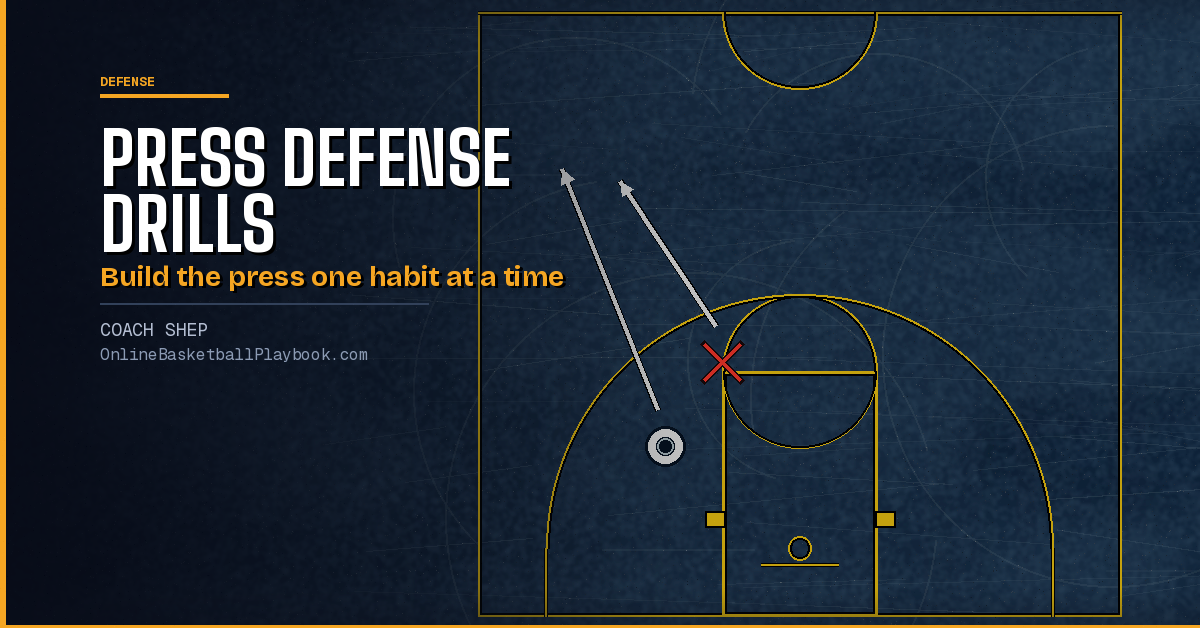
Full Court Press Defense Drills: Traps, Rotations and Live Reps
Full court press defense drills that build the press in pieces: footwork, trap drills, back-tips, sideline traps, rotation drills, live games and how to score them.
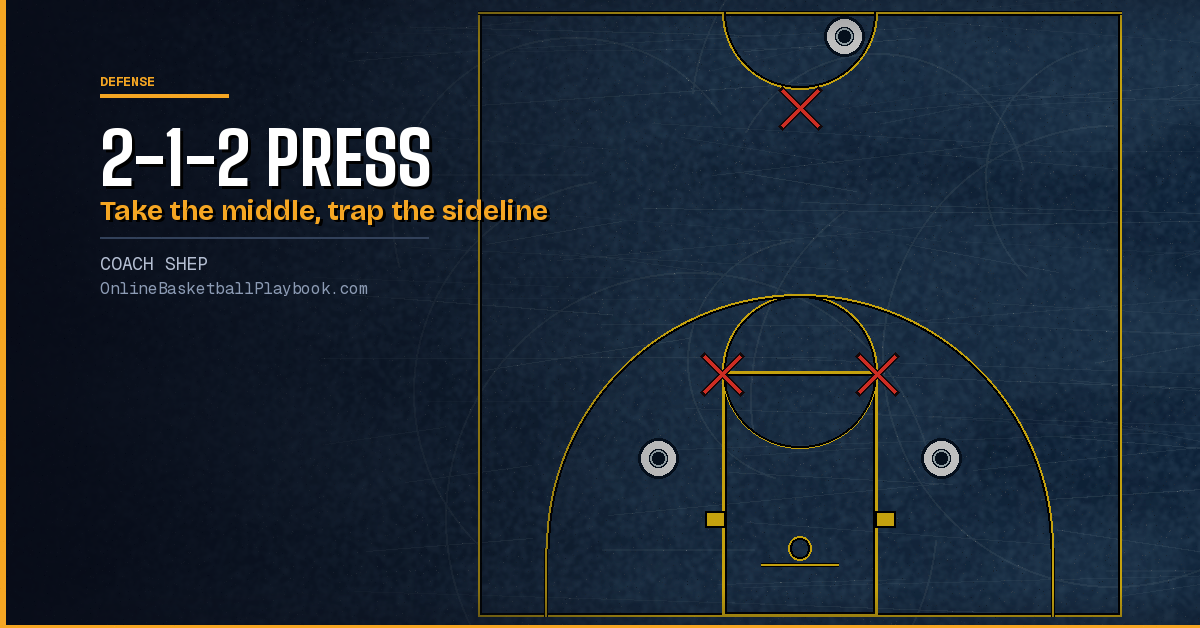
2-1-2 Press: Setup, Traps and Rotations of the Full Court Press
The 2-1-2 press explained: the full court setup, each line's job, the inbound, the first and second sideline traps, reversals and the match-up and tempo versions.
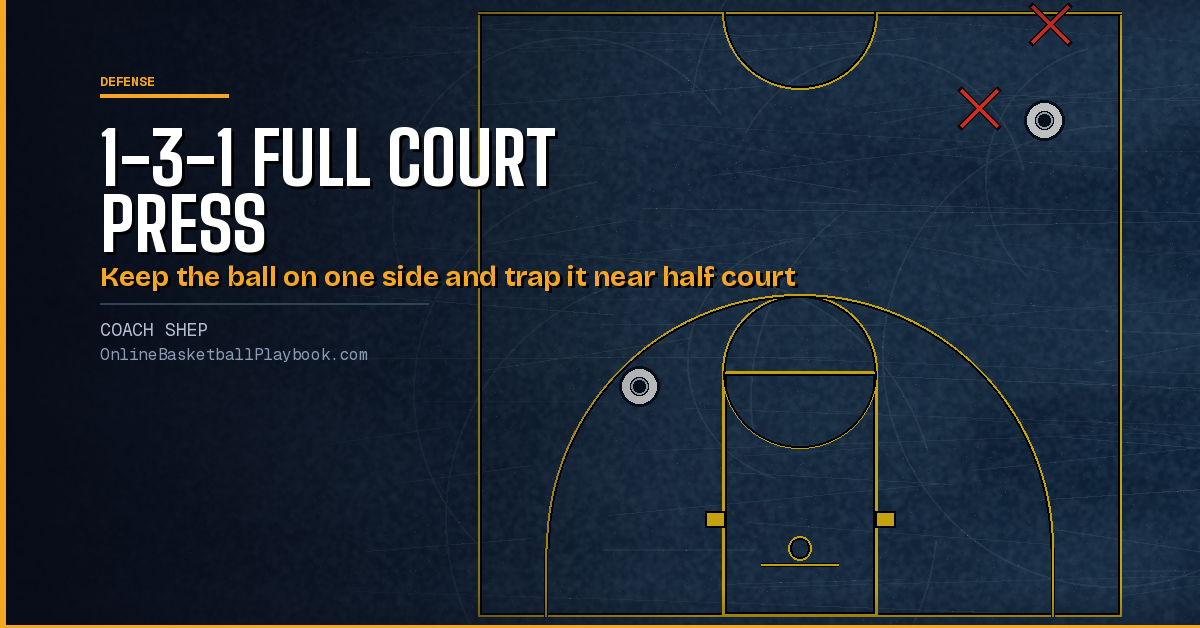
1-3-1 Full Court Press: Roles, Traps and Rotations to Install
The 1-3-1 full court press from setup to frontcourt trap: each role, the reversal rotations, an aggressive version, the costs and when coaches call it.