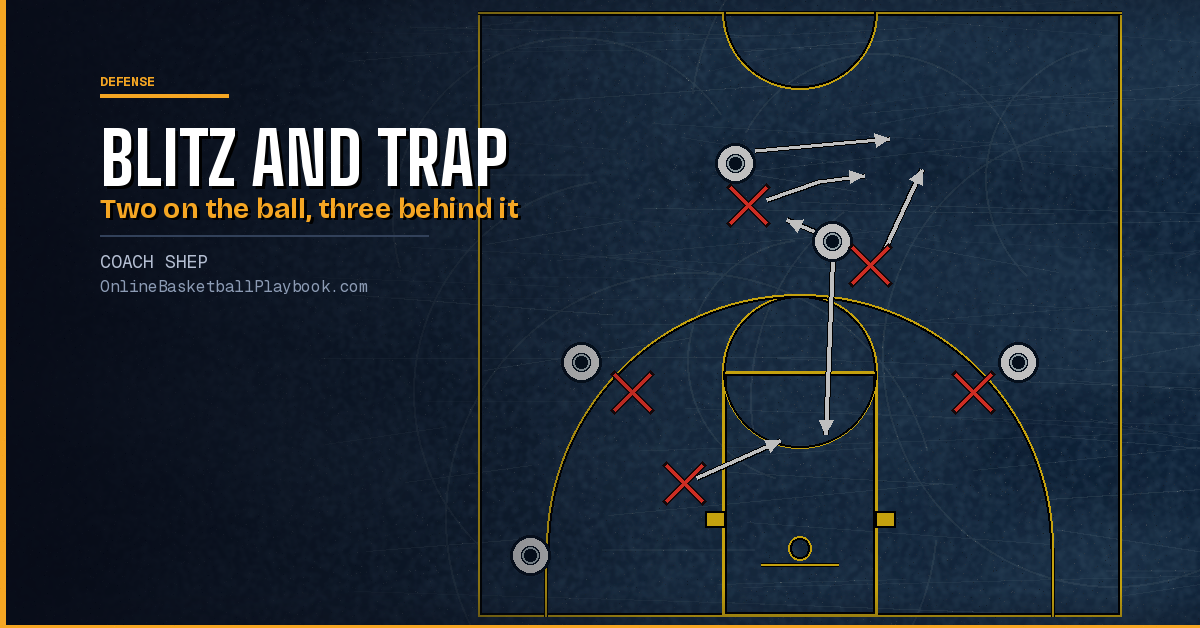
A blitz pick and roll defense traps the ball handler with both defenders as he comes off the screen. It is also called trapping the ball screen. The screener's defender steps up to the ball instead of staying with his man, so the two of them take the ball out of the handler's hands, and the three defenders behind them guard four offensive players until the ball moves. This page covers the trap technique, when coaches fire the blitz, the protection behind it, the rotation on the pass out, the offense's answers and the disguise. Trapping in general, in the half court and the press, is on trapping in basketball, and the other ball screen coverages are on the pick and roll defense hub.
Blitz Pick and Roll Defense: Why Teams Blitz
One NBA coach built a full blitz package because, he says, offense has outrun the base coverages against elite handlers. Four-out and five-out spacing and shooting centers make the pick and roll much harder to guard, and you cannot play a player like Luka Doncic in drop. His shot values set the goal:
| Shot | Points per possession (NBA, his figures) |
|---|---|
| Free-throw attempt | 1.54 |
| Layup | 1.32 |
| Corner three | 1.16 |
| Above-the-break three | 1.07 |
So the defense must not foul and must keep the ball out of the paint. He also says the reputation is a weapon. Once a team is known for the blitz, stars dread the matchup, and it does not have to trap every possession.

How to Trap a Ball Screen
Up to touch and flat. In his version the big steps right into the ball and gets flat, not upright, against quick guards. He gets lower than the ball with his head on the ball. The trap has to remove three things the scorer wants:
- The drive away from the trap to open space.
- The split between the two trappers.
- The dribble around the big, which he calls the killer.
Make him pass over or around. The trap must affect the ball. It forces a pass that hangs in the air over the trappers, with their hands high, or a pivot and a pass around them, and it never allows a snapped direct pass. The trappers trace the ball with one hand level with it.
No splits, by version. The trap teachers below all guard the gap between the two trappers:
- One pack line version keeps the trappers shoulder to shoulder and calls the split the worst sin in the trap.
- One version, in its post trap after a switch, has the trappers cross their feet so there is no gap, and trace the ball.
- One college coach teaches the trapper to step low into the hedge so he is not split.
- Another version lists the steps as turn him to the sideline, no splits, protect the paint, rotate on the pass, and pursue back to the bodies.
Deflect, do not reach. One college version wants its trappers to be deflectors who never foul and never hunt steals. Another college coach says his biggest trapping problem is the man on the ball not pushing up with pressure. The general trapping rules, angles and hand position, are on trapping in basketball.
When the Blitz Fires
Programs fire the blitz at different times. The versions:
| Version | When it traps |
|---|---|
| Blitz as the base | Every ball screen and handoff when a trigger appears: the ball is dribbled toward you, your man brings you to the ball, or the ball is dribbled to the baseline. The screener's defender calls blitz or switch, and blitz is the default |
| The star only | The star in the scoring area, not out high, and in the last five minutes of a game, when every possession is a high pick and roll or an isolation |
| Elite handler, release on the pickup | Only an elite handler, and the trap releases when he picks up the ball |
| By the corner | Corner empty, blitz. Corner filled, the corner defender calls it and the coverage is drop |
| By location | A middle screen below the free-throw line is doubled and one above it is contact switched. A side screen below the line is trapped before it is set |
| After the dribble dies | No blitz. The big contains at the level of the screen and the trap comes only when the handler picks up his dribble |
| Trap early | When both the handler and the screener are threats, the double comes before the screen connects |
The back-dribble. In the star-only version, if the star dribbles back away from the trap, the defense comes out of the double. The exception is the last five minutes with a lead of two to four points, when the trap stays on and denies the catch back to him. Late-game choices are on late game situations.
The Three Behind the Trap
The blitz leaves three defenders to guard four. His version treats them as a zone behind the ball that protects the paint:
- The low man owns the roll. After the call, everyone calls "low man," and the low man takes the roll and the short roll.
- The pick and roll is the priority. When the off-ball players exchange, the defenders do not follow them. They get organized, then cover whoever is there.
- Move as one. On every pass, everyone moves in the direction of the pass and sprints to the ball. The 5 always sprints back to the rim first, then finds his man.
- Do not over-help. Help only as much as needed. On a shooting 5 who flares, the low man stops the roll, then gets back to his own man, or the corner three is open.
The location version pre-rotates the weak side before the trap and moves on the release of the pass. Another version rotates by one rule for drives, ball screens and post traps: two interceptors and a goaltender, and bigs do not rotate to bigs. The help system is on help defense principles.
Get the next coaching guide in your inbox
One email when a new guide or diagram set goes up. Free.
The Rotation on the Pass Out
One rotation on the pass out of the trap:
- The bottom defender takes the pass.
- The big from the double sprints to the rim.
- On a forward pass, everyone gets back to his own man.

Other versions, side by side:
- The top of the I takes it. One weak blitz traps until the handler picks up his dribble, and the top defender of the weak-side I takes the first pass.
- The corner or weak side rotates. One pack line program that blitzes as its base has the big jump out to poke and trap, and the corner or weak-side defender rotates.
- The released trapper. One version has the released trapper guard the return pass to the handler.
Trapping the Side Screen
The location version traps a side screen below the free-throw line before it is even set. The screener's defender leaves early from the baseline side and the other three form a triangle to help. Another version doubles in an L shape that uses the sideline.

The Offense's Answers
The blitz leaves four offensive players against three defenders, and the answers attack that:
- Retreat and short roll. The handler takes two retreat dribbles away from the trap while the screener short-rolls one step, then the two play four on three.
- Two quick passes. One offensive version beats a blitz with two quick passes to play four on three.
- The split. Against a trap or a hard show, one version teaches the handler to split.
- The popping screener. One college staff does not worry about the popper in its blitz, and says a popped three is on the staff. If it were worried about him, it would switch instead.

The handler's and screener's full reads against two on the ball are on pick and roll reads.
The Disguise
The same NBA coach says stars solve a plain blitz by about game 1.5 of a series. His answer is to switch, then double:
- Call switch, and switch under.
- Escort the big who switched onto the star toward his teammates while the star dribbles two or three times looking for the matchup.
- Send the double.
It ends in the same picture as a blitz with three or four more seconds off the clock and no room for the star. He uses the same double call on a great wing in isolation. The help does not rotate until the ball moves, and the on-ball defender yells the call so the help knows the double is coming. The switch itself is on switching defense.
Teaching the Blitz
Install order. One install runs drop, then switch, then the blitz by day 3, then the blitz every day at three-quarter speed with full intensity, full talk and full detail.
One language. The same install uses the same words for every coverage and does not want players inventing their own. It tests the learning by whether the players talk the staff's language to each other.
Show, then chase into the trap. One NBA coach's two-minute drill block covers screen and roll with a call, a show and a chase into the trap. One progression starts with 2-on-1 and 1-on-1 to stop the ball, then 3-on-3 with a weak-side helper who pre-rotates to the roll, then 4-on-4 and 5-on-5. Its coach says his trap coverage needs that help-side rotation. More set-ups are on drills to teach ball screen defense, and the drop that comes before it is on drop coverage.
Questions Coaches Ask About the Blitz
What is a blitz in basketball?
A pick and roll defense in which both defenders trap the ball handler as he comes off the screen, and the three defenders behind them protect the paint until the ball is passed.
What is the difference between a blitz and a hedge?
In a hedge the screener's defender steps out to slow the handler, then recovers to the screener. In a blitz he stays and traps with the on-ball defender. The hedge is on hedge basketball.
When should you blitz a pick and roll?
Programs differ. Some blitz every ball screen, some only a star in the scoring area or late in games, some only with the ball-side corner empty, and some only after the handler picks up his dribble.
Who guards the roller when you blitz?
The low man, a help defender away from the ball. In one rotation the bottom defender takes the pass and the trapping big sprints back to the rim.
How do you beat a blitz?
Two retreat dribbles while the screener short-rolls a step, then play four on three, or two quick passes out of the trap.
Want every diagram on the site?
OBP Pro members get the full diagram files for every guide on the site, ready for a practice binder or a scouting report. $9 a month. Or draw your own version free in the play drawer.
See what OBP Pro includesMore Coaching Guides From This Batch
- Drop Coverage Basketball: How the Big Plays the Ball Screen
- Hedge Basketball: Hard Hedge, Flat Hedge and the Recovery
- Switching Defense Basketball: How to Switch Ball Screens
- Ice Basketball Defense: Push the Side Pick and Roll Down
Back to Pick and Roll Defense and every Defense page.
Keep Building
Related breakdowns
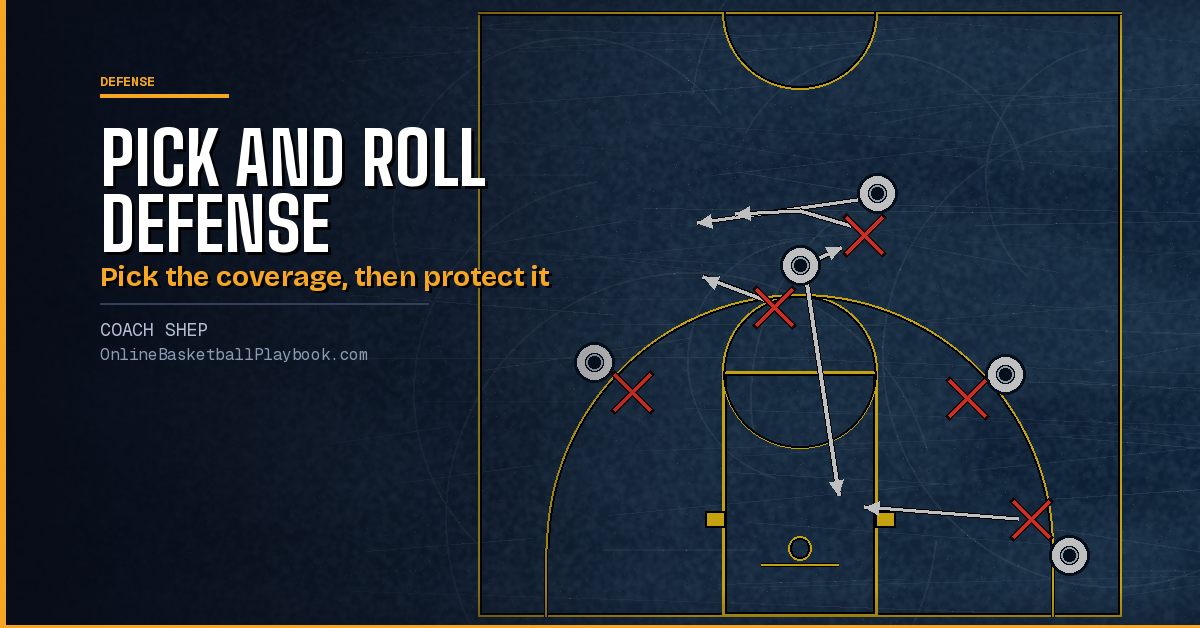
Pick and Roll Defense: Every Ball Screen Coverage Compared
Pick and roll defense compared: drop, show, blitz, switch, ice and under, what each takes away and gives up, the help behind it and how to choose.
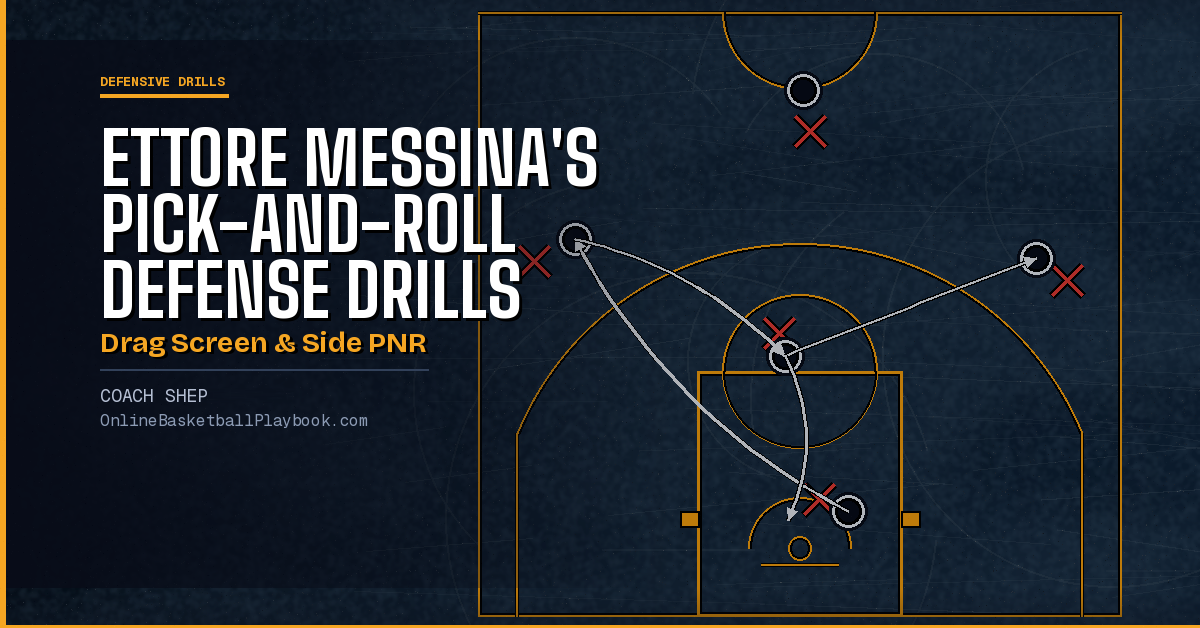
Ettore Messina's Pick-and-Roll Defense Drills: Drag Screen & Side PNR
Two 2-on-2 drills from Messina's clinic notes that fix the biggest reason teams give up easy buckets in transition: letting the ball handler reach the arc before the screen arrives.
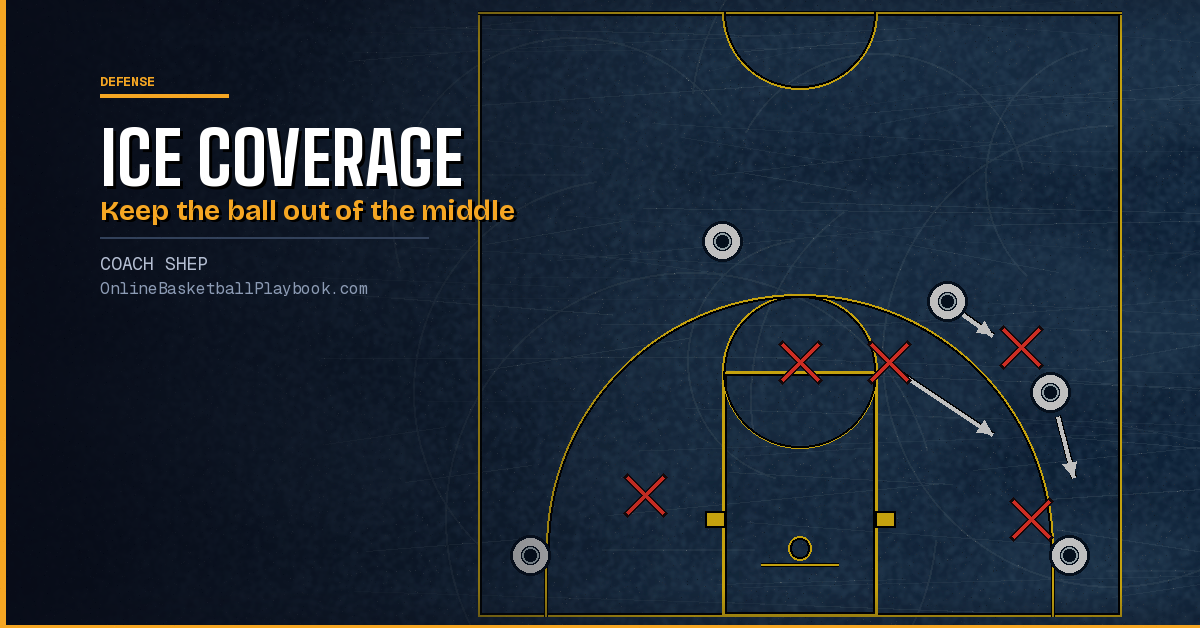
Ice Basketball Defense: Push the Side Pick and Roll Down
Ice basketball defense explained: how to ice a side pick and roll, both defenders' jobs, the box, the nail stunt, the rotation and weak on the middle screen.