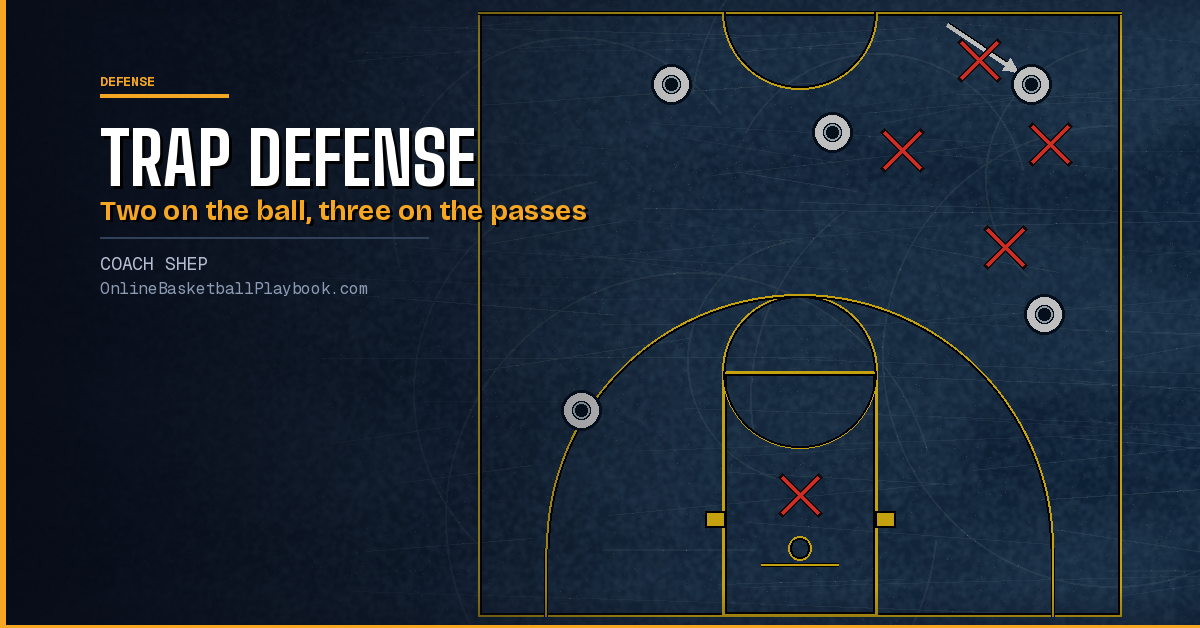
A trap is two defenders on the ball at the same time while the other three guard the passes out of it. The same move shows up in a full-court press, a half-court zone, a ball-screen blitz and a post double. Trap defense basketball comes down to a short list of decisions a staff makes before the game: how the two trappers close, what sets the trap off, where on the floor it happens, who gets trapped, and what the three defenders behind it do. This page covers each one with the versions coaches teach, laid out side by side. The specific presses own their own pages, from the 2-2-1 press to the 1-3-1 full court press. This page owns the trap itself. It sits under full court press defense in the defense section.
Trap Defense Basketball: Two on the Ball
Most coaches put exactly two defenders on the ball. One version never traps with more than two. Three on the ball is one of the three sins, next to getting split and running at a handler who has no defender on him. Tubby Smith and Bob Huggins both trap with two. A few coaches allow a third defender in one spot, the post. One half-court 1-2-2 triple-teams a pass into the post, and the Amoeba triple-teams the high post.
The two trappers have different jobs. In the block-and-attack version one defender blocks the dribbler's path and the other attacks the ball. If both attack or both contain, the handler splits them. Another version sends the second defender in only after the first has stopped the dribble.
The aim of the trap is a bad pass, not a steal by the trappers. Billy Donovan's line is trap on the ball, steal off the ball, and he wants a steal by the trappers only on a back-tip after the pass. Steve Clifford's blitz forces a high pass over the trap or a pivot pass around it.
How the Two Trappers Close
The approach
Coaches teach four ways into the trap.
| Version | How the second trapper arrives |
|---|---|
| 1. From behind | Vance Walberg traps from behind, off the handler's line of sight, so the handler does not see the trapper until contact. The ball defender jabs and gives ground until the trapper gets there. |
| 2. At a right angle | Come in at a right angle so the trap cannot be split. Another approaches at that angle with arms up and knees bent and traps from the outside in. |
| 3. Take a shoulder | Sylvia Hatchell's first trapper gets on the handler's outside shoulder and the second closes the gap. Rick Pitino has each trapper take one shoulder. |
| 4. Sell it open | The second trapper backs off a few steps so the path looks open, then runs at the ball. One 1-1-3 version plays cat and mouse with a sideline dribble before trapping at half court. |
Closing the gap
Every version shuts the seam between the two trappers. The picture each one teaches differs.
- Feet touching. Billy Donovan's trappers use short chopping steps with their feet touching. The first sin is getting split, so the trappers keep foot contact.
- Knee to knee. Knees together, on every trap.
- Lock the legs. Rick Pitino's trappers lock legs, and Bob Huggins locks the trap to stop the step-through.
- An L. Avery Johnson's trappers form an L and allow no split.
- Step to your teammate. Flip Saunders says step to your teammate's leg, not to the angle of the ball.
- A soft trap. Some 1-3-1 zones set the trap a couple of feet off the ball with stunts, and another keeps an arm's length away until the dribble is dead.
The hands
Nearly every version bans the reach. Rick Pitino's phrase is "fouling negates hustle." The hand picture splits four ways. Hands high, as Bob Huggins and Shaka Smart teach, with Smart asking for arms straight up and chest to chest. Hands at the height of the ball. Trace the ball, as Billy Donovan teaches. Or arms high and wide with the lower body taking the space.
One rule sits under all of it: commit fully or do not go. The rule is all or none: never a halfway trap, though a fake is allowed. The opposite caution: do not trap if you are not close enough to get there.
When to Spring the Trap
Some coaches trap off what the handler is doing, not where he is.
Trap the dribbler's state
The uncontrolled dribble: Tubby Smith traps only a player who needs a second dribble to beat his man, never one looking up to pass. Rick Pitino traps the speed dribble and backs off a handler under control. Lost vision: Vance Walberg doubles when he sees the handler's back, and Shaka Smart traps when he sees the back of the handler's head. One version springs a surprise trap the moment the handler turns his back.
Trap on a fixed trigger
On the catch: several presses trap the first inbound catch, and others trap only the first pass after the ball comes in. On the dribble: one 2-2-1 lets the ball in and traps once the receiver starts to dribble. At midcourt: one press never traps before the ball crosses half court. On air time: Avery Johnson traps a low-post catch from the nail while the pass is still in the air.
Two rules cover what not to trap. Vance Walberg never traps a player who is not dribbling. And never run at a handler who can see you coming. Running at a handler with no defender on him is a sin, because he lobs over the top and leaves three of your players behind the ball. Billy Donovan's answer when a defender is out of position is to stunt, not lunge: fake the trap, recover, and get back in front.
Where to Trap: Full Court and Half Court
The sideline, the baseline and the half-court line cannot be beaten, so most coaches trap near them. The spots they name differ.
| Version | Trap spot |
|---|---|
| 1. Corners and the halfway sideline | The deep backcourt corners and the sideline about halfway up the floor. |
| 2. The alley | One 2-2-1 calls the strip 5 feet from the sideline a blind alley and traps there at half court. |
| 3. Just past half court | Several presses like the spot just over the half-court line, where a pass back is a violation. |
| 4. The volleyball line | The first trap goes below the volleyball line. |
| 5. A zone map | The six corners of the court are the main trap zones. Another colors the floor and ranks highest the spots where the offense can no longer retreat across the half-court line. |
| 6. Location does not matter | It does not matter where the trap is set. |

Tubby Smith adds a direction rule: trap across the court, never up it. Most versions also close the middle of the floor. When the ball gets there anyway, coaches split three ways. Version 1: the press is broken, the nearest defender takes the ball and the rest sprint back. Version 2: trap the middle dribble, as Vance Walberg's 2-2-1 does. Version 3: one half-court press has its last defender push the ball back out toward a corner trap.
The later pickup that traps near half court is on three quarter court press, and a press that jumps the dribbler instead of doubling him is on the run and jump press.
Get the next coaching guide in your inbox
One email when a new guide or diagram set goes up. Free.
Who to Trap
Some coaches aim the trap at a person, not a spot. They aim it two ways.
Version 1: the best player
Bob Huggins traps the good players and makes the bad players play. One star-trap call sends the nearest defender the moment the star catches. One 1-3-1 zone hard-traps the star and soft-traps everyone else.
Version 2: the weak handler
One diamond press welcomes a pass back to an inbounding big. One trailer press reverses the ball to the big on purpose. One press traps only the side of the floor where the weakest handler is.
The Interceptors and the Goaltender
The three defenders not in the trap have fixed jobs. Sylvia Hatchell names two interceptors and one goaltender the moment the first trapper touches the ball, wherever the trap is. Larry Brown uses the same rotation for a baseline drive, a ball screen and a low-post trap: two interceptors and a goaltender, with bigs never rotating to bigs. Bob Huggins' 2-3 rule is two on the ball, two anticipators and one on the basket. Avery Johnson splits the gaps with two interceptors and keeps a safety on the basket.
How the two interceptors divide the passes differs by coach.
| Version | Interceptor jobs |
|---|---|
| 1. High post and reversal | One interceptor on the high post, the other on the pass back. |
| 2. 50/50 | One scramble press plays its interceptors half toward the first outlet and half to the middle, never fully committed. |
| 3. One plays two | Gary Williams has one interceptor cover both the middle and the reversal. |
| 4. High and sideline | Shaka Smart keeps one interceptor high and one on the sideline, both open to the ball, guarding three with two. |
| 5. Two of three lanes | Tubby Smith's up-court defenders cover two of the three passing lanes and the deepest man takes the deep pass. |
The steals come from the interceptors. The diamond press calls the interceptor the most important spot on the floor, ahead of the trappers. Sylvia Hatchell's interceptors watch the handler's eyes and body and anticipate rather than react, and Tubby Smith and Bob Huggins teach reading the shoulders.
The goaltender does not leave the rim. One full-court 1-3-1 keeps its back defender in the lane unless a steal is certain. The diamond tells the lone back defender in a 2 on 1 to give up the outside jumper before the layup.
After the first pass out, the defense is a man short, so the rule is to move while the ball is in the air.
Half Court Traps: 1-2-2, 1-3-1 and the Post
Zones trap at fixed spots, usually the corner. One zone version makes the corner trap the every-time trap once the team understands it, the wing trap a rare surprise and the top-of-the-key trap a called play. Jim Boeheim's 2-3 traps every short-corner catch to take away the next pass. Flip Saunders runs his corner trap only on a call.

The 1-3-1 traps the same corner with different players. In one version the ball-side wing and the baseline defender hard-trap the corner, the top defender drops to the high post, the middle defender fronts the block and the weak-side wing drops to the far block. Softer options for that corner: deny the pass out, or no trap and pack the lane against a dominant post. The full shape is on 1-3-1 zone defense, and the 1-2-2 shape on 1-2-2 zone defense.

Trapping the post
Who comes to double the post is the main choice, and one man-to-man version ranks the options. Its first choice is the opposite help-side wing, who already has a foot in the lane and traps the instant the ball goes in, while the low defender takes away the baseline, another defender denies the pass back out and a fourth fills the gap for the skip. It rejects the weak-side post as the trapper, because a quick pass to the man he left is a layup, and the ball-side wing, because he arrives late at a bad angle and leaves the passer open.

The blitz on a ball screen is a half-court trap too, covered on pick and roll defense.
After the Pass: Sprint Out, Trap Again or Fake It
The trap ends when the ball leaves. Tubby Smith, Rick Pitino and others say sprint out of it. Where the trappers go differs.
- Back-tip. Billy Donovan's trappers hold until the pass, then run through the ball from behind with the inside hand.
- The trapper who left rotates. Flip Saunders makes the defender who went to trap the one who rotates out.
- Chase from behind. Vance Walberg's beaten trapper chases and punches the ball from behind, and when the ball goes over his head he traps again.
Whether to trap a second time is a split. Version 1, trap again: one 1-2-2 press traps a late sideline pass from behind, and another keeps trapping a pass thrown down the floor. Version 2, one and done: one scramble press makes one trap and gets out, and one diamond press ends when the ball reaches the middle or crosses half court. Version 3, limit the count: do not trap four times in a row.
Fake traps keep the real ones working. The stunt is once up, two back: fake up, retreat and slow the handler. Press call words for fakes and traps are collected on press terminology.
What a Trap Costs
Open the press talk with a question: why are you pressing? Pressing has three costs: easy baskets when the trap is broken, fouls that hurt twice because pressing takes depth, and practice time. Hubie Brown builds every trap on an idea he takes from Bear Bryant's football defense: give up the small gain, keep a chance at a turnover, and make the end of the possession a jump shot, not a layup.
Fouls end a trap's value. A reach in the backcourt is a stupid foul, the result of swiping instead of moving the feet. Feet, not hands. When the trap breaks, the trappers become transition defenders, which is on transition defense. The offense's side of the same fight is on press break.
Younger teams get a separate answer. Two press guides keep youth teams in man-to-man pressure: one with no trap gambles, the other ruling out trapping zone presses.
Trap Drills
| Drill | What it trains |
|---|---|
| No-lob corner trap | Sylvia Hatchell's coach throws the ball to a player trapped in the corner and it goes live with no lob passes allowed, first with no dribble, then with the dribble. |
| Circle trap | Three on three around a circle. The two defenders next to the receiver trap and the third gaps as the interceptor, and the trap rotates with each pass. The circle can sit where the press traps. |
| 4 on 4 plus one | Bob Huggins' drill adds an offensive player so the defense learns the scramble after the first pass out of the trap. |
More press drill setups are on full court press defense drills. The man-to-man pressure system that traps before a side screen is set is on SOS pressure defense, and traps on dead-ball throw-ins are on how to defend inbounds plays.
Questions Coaches Ask
What is a trap in basketball?
Two defenders guarding the ball at the same time, usually against a sideline, a corner or the half-court line, while the other three defenders guard the passes out of it.
When should you trap in basketball?
Coaches differ. Some trap only an uncontrolled dribbler or a handler who has turned his back. Others trap on a fixed trigger: the catch, the first dribble, the half-court line or the pass in the air.
Where is the best place to trap?
Most versions trap near a line that acts as an extra defender: the sideline, a corner or just past half court. Another version says the spot does not matter.
What is half court trap defense?
A trap set in the half court, usually in a zone. The most common spot is the corner, trapped by two of the zone's defenders while the rest cover the pass back out, the post and the skip.
What does the interceptor do in a trap?
He guards a passing lane out of the trap, reads the handler's eyes and shoulders, and anticipates the pass rather than reacting to it. Many systems use two interceptors and one goaltender at the rim.
Want every diagram, printable?
OBP Pro members get the full diagram files for every trap, press, rotation and late-game call on this page, ready for a practice binder or a scouting report. $9 a month. Or draw your own version free in the play drawer.
See what OBP Pro includesMore Core Coaching Guides
- Three Quarter Court Press: Pickup, Traps and Rotations
- Transition Defense Basketball: Get Back, Stop the Ball, Match Up
- How to Defend Inbounds Plays: Baseline and Sideline Options
- Basketball Clock Management: Foul Up 3, Two for One, Last Shot
Back to Full Court Press Defense and every Defense page.
Keep Building
Related breakdowns
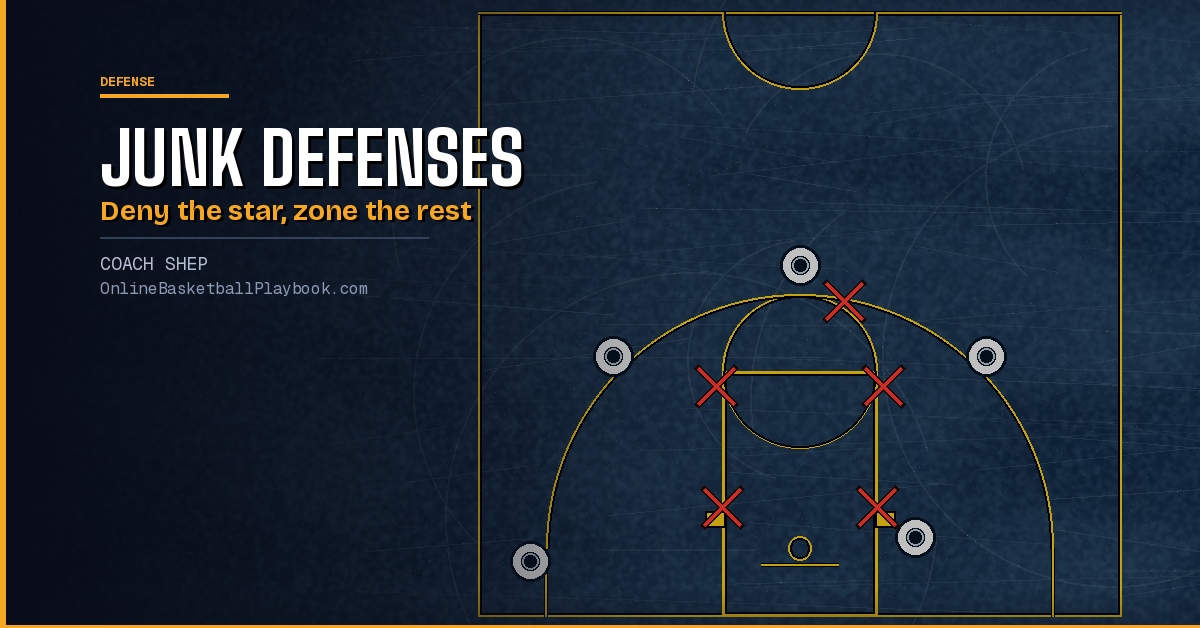
Junk Defense Basketball: Box and 1, Triangle and 2, When to Use
Junk defense basketball explained: the box and 1, diamond and 1, triangle and 2 and inverted triangle, when to call one, what it costs and how offenses beat it.
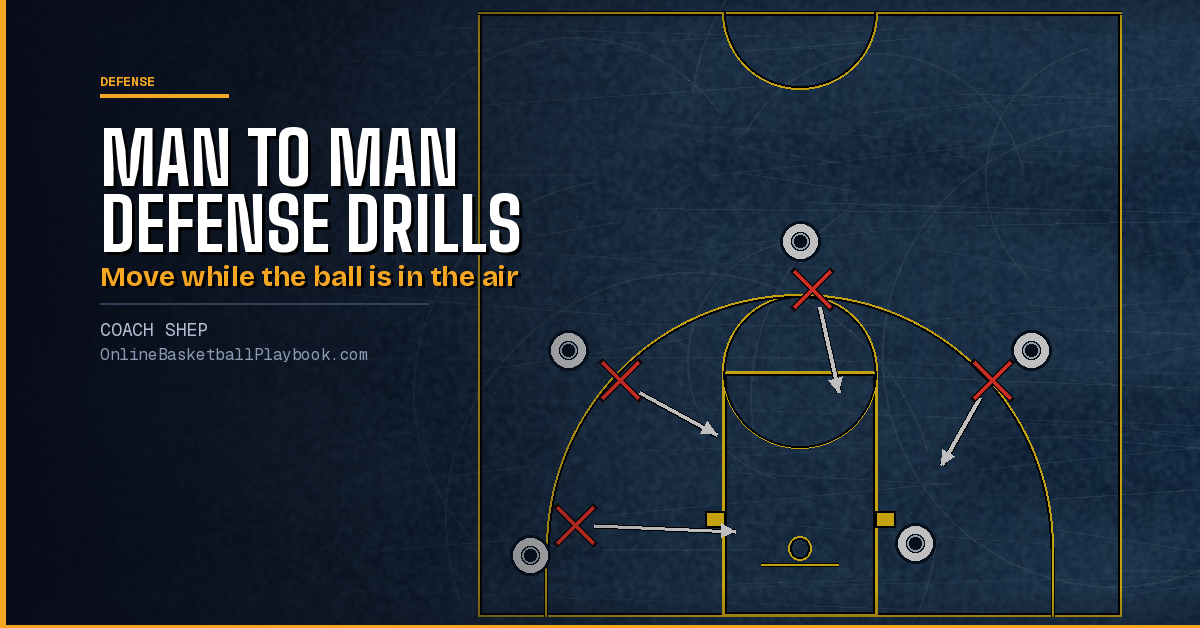
Man to Man Defense Drills: Ladders From 1 on 1 to 5 on 5
Man to man defense drills in teaching order: full ladders from 1 on 1 to 5 on 5, denial, help and recover, post and screen drills, scored games and youth versions.
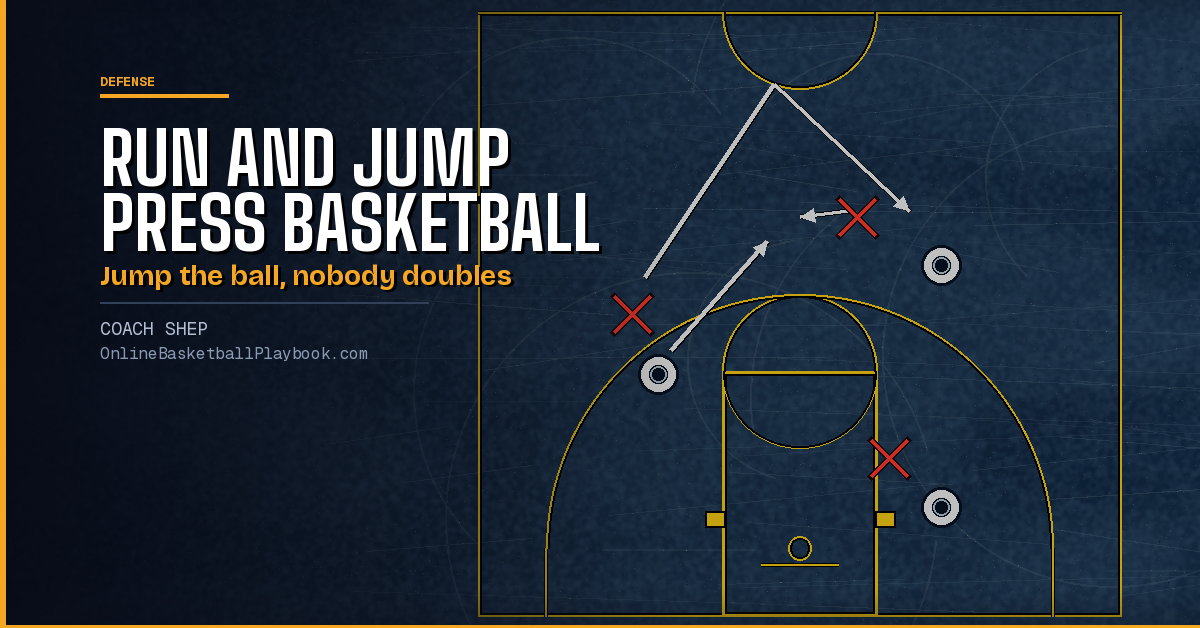
Run and Jump Press Basketball: Rules, Rotations and Drills
Run and jump press basketball explained: the jump switch, when to jump, middle or sideline, the rotation, when to call it, how offenses beat it and the drills.