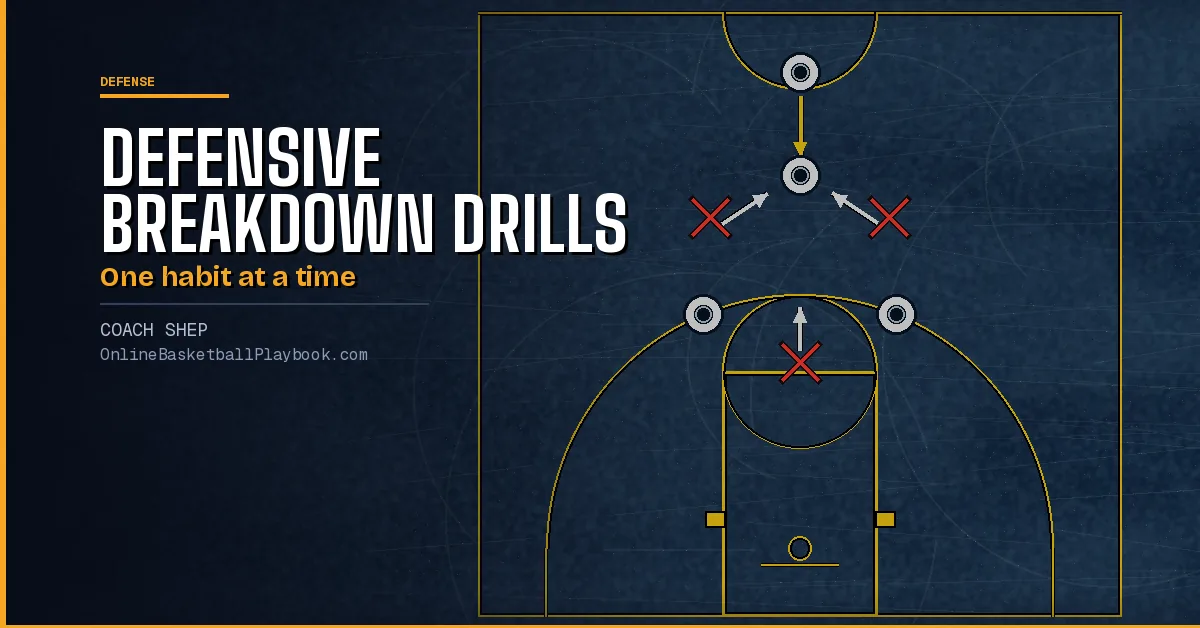
Defensive breakdown drills take one habit out of a defense and train it in a small drill, then bring the habit back into live play. This page covers the drills that build the pieces of a defense: stance, step slide, run and recover, circle trap, back-tip, wall up, vertical contest and closeout. Where coaches teach the same drill differently, each version sits in its own row, because the versions differ and none of them is the single right way. The page ends with the scoring games that pay the defense and with how long coaches run a drill. The full drill library is on defensive basketball drills, the teaching method is on breakdown drills, part to whole, and the offensive twin is on offensive breakdown drills.
Defensive Breakdown Drills: Whole, Part, Whole
The method has three steps. Show the whole defense, drill the pieces, then rebuild the whole defense live. Three versions of it are written down:
- Footwork ladder, then live 4-on-4. The ladder runs from stance to step slide to full-court movement, and the coach then watches live 4-on-4 for the previously drilled behaviors that vanish. The standard is transfer into play.
- Bob Knight. Break the skill into its parts, master each part, then assemble the whole.
- Billy Donovan's press day. Two segments, which vary by day. The first is an 8 to 15 minute breakdown of 1v1, 2v2, 3v3 and 4v4 plus back-pursuit, back-tip and stunt drills. The second is an 8 to 15 minute 5-on-5 full-court block.
The press version of this ladder, with its trap and rotation drills, is on full court press defense drills. Whatever the format, rep each piece until it is automatic and then ask whether it survived the live segment.
Stance, Step Slide and Run-Recover Side by Side
Four versions build the stance and the slide in four different orders. The rows below keep each version whole:
| Version | The stance | The drill order |
|---|---|---|
| Boxer-stance ladder | Heel to toe with a wide base, then a half-squat | Step slide with the butt down, leading with the lead foot and never bringing the feet together. Towels held overhead keep the defender low. Then one-step and two-step full court with a big first step and swinging arms, then run-recover |
| Six-checkpoint stance | Feet a little more than shoulder width and pointed straight ahead, weight on the balls of the feet with the heels still touching, hips down and knees bent inside the feet, back straight, hands up and out around shoulder height, eyes on the offensive player's waist | Stationary stance corrected one player at a time, then 1 vs 0 slides in a straight line or zig-zag, then a 1 vs 1 zig-zag where the offense starts at about 50 percent speed and builds to full speed |
| No-ball shuffle ladder (Jerry Tarkanian) | Heel-to-toe feet, hips low, one hand up and one down, a boxer's shuffle that jabs at an imaginary ball with the lower hand | Ape drill (palms on the floor, shuffling on the hands and the balls of the feet for up to ten minutes), upright shuffle with the hands behind the back, mock guarding with the hands, chaser drills, direction changes, then a wave drill of wide-angle zig-zags down the court |
| Push-step version | Inside foot slightly forward, hips down, head lower than the offensive player's head and level with his chest, no dropped back foot | Lead foot moves laterally 6 to 18 inches, power comes from the trail foot, feet stay at shoulder width. Three push steps stop the dribbler |
The no-ball ladder rests on one idea: defense is learned without the ball first, the way a boxer shadow boxes, because the body needs its own defensive skills before ball handling is a factor.
One footwork series opens with a lane slide, and it is the first frame below. The defender slides side to side in the lane in a defensive stance, hands interlocked behind the head, touching the free-throw lines, for 30 seconds.

When the defender is beaten
Three versions handle the beaten defender, and each one is its own drill:
| Version | What the defender does |
|---|---|
| Punch the cone | Get beaten, punch the cone, sprint, then take a big step to cut off the sideline. This is the run-recover drill at the end of the boxer-stance ladder |
| Turn and sprint | Slide with the weight on the balls of the feet in quick short steps, with no crossed feet and no hopping. If beaten, do not reach in and swipe at the ball. Turn and sprint after the opponent, then get back into the stance once in front of the ball handler |
| Push step, then run | Three push steps to stop the dribbler. If beaten, run to recover |
Stance technique has its own page on defensive stance in basketball, the footwork is on basketball defensive footwork, and the on-ball drills are on drills to teach on-ball defense.
Get the next coaching guide in your inbox
One email when a new guide or diagram set goes up. Free.
Circle Trap and Back-Tip Drills
Two circle-trap versions are written down, and they ask different things of the trappers:
| Version | The trap | The finish |
|---|---|---|
| Walk-under circle trap | Feet together and hands above the eyes. The trappers walk under to deny the split | Force a deflection or a hangtime pass, which buys recovery time. The steal comes off the ball, not on it, because reaching on the ball is a foul |
| Six-player circle | Six players, three per team, space around a circle and each steps back off the circle line to hold spacing. The coach passes to a player, and the two adjacent opponents trap at once with feet wide and adjacent and arms up and out. The third defender gaps the two remaining offensive players as the interceptor | The trapped player cannot dribble. He pass-fakes and pivots to escape and never raises the ball above his head, since a raised ball lets the trappers close in tighter. When the ball moves to a new player, the old interceptor sprints out to help trap and the other defender becomes the new interceptor |
The six-player circle runs at both ends with a 12-player team, and the circle can sit near the endline or at half court to match where the team likes to trap.

The geometry of the walk-under version is not described in the notes behind this page, so it is not drawn here.
Back-tip drills
Three versions of the back-tip each carry their own cue:
- Sprint through the ball. Sprint, run through the ball and never reach.
- Inside hand at full speed. In Donovan's press the trappers close, trace the ball and force a bad pass, with no reaching, grabbing or slapping, and the one steal he wants is a back-tip. The back-tip is a sprint with the inside hand, and slowing down to reach kills the pursuit.
- Chase-and-tip drill. Two defenders and one offensive player. One defender passes to the offensive player, who speed-dribbles to the far hoop for a lay-up while both defenders sprint to back-tip the ball from behind. The defender gets the hand low near the floor while sprinting and tips the ball from below with an upward motion, since tipping down from above usually draws a foul.

Wall-Up and Vertical Contest Drills
Three wall-up drills are in use, and each starts from a different setup:
| Version | The setup | The action |
|---|---|---|
| Chest wall-up, then vertical | The offensive player has both feet in the paint | The defender walls up with his chest, then goes to a full-extension vertical contest as the shot rises. He does not bite shot fakes and does not let the attacker into his hips. The cue on every contest is high-jump, not long-jump |
| Pivot-foot wall-up | The coach throws to player 1 | The defender takes away his pivot foot and never gives space, with arms up and spread and his chest touching the offensive player's shoulder. The coach then throws to player 2 and the drill repeats for a count of three. The coach throws back to player 1 and the defender takes a charge |
| Lob-off-the-backboard wall-up | The coach lobs off the backboard to an offensive post player, as on an offensive rebound | The defender walls up with his hands high and does not leave his feet. The post player battles for position with no shot attempts, then passes back to the coach for the other side |
The chest version pairs the contact with a plain goal: defend without fouling. Its coach corrects early body contact as a foul. This page gives no charge or contact rule, so check your own league's rulebook before you teach a charge, and see taking a charge in basketball for the technique. The lob version comes from a pack line install, and the rest of that system's drills are on pack line defense drills.

Closeout Drills
The closeout is the last piece of the stance and slide work, and four versions are written down:
| Version | The closeout | The drill |
|---|---|---|
| Sprint two-thirds, then chop | Sprint the first two-thirds with the shoulders back, then take choppy steps with the hands up to appear closer. The hands act as a pass deflector, and the defender never comes out of the stance on a pass fake | Three shooter types: run the shooter off the line, close and contest on the rise, or stay off and contest late |
| Sprint halfway, then stutter | Sprint halfway to the ball and close out short, then break down into stutter steps with both hands up and the inside foot forward. Prevent the drive first, then pressure the ball | The defender starts under the basket, passes to the wing and closes out. Options run shot only, then shot fake and drive, then live offense, then make-it-take-it |
| One-on-one with two dribbles | Challenge the shot and block out | The offense gets two dribbles and stays on offense if the defender fails to challenge or block out. It is one of five two-minute drills in a daily block |
| Helpside closeout to the wing | Close out in a stance, defend the triple threat, contest penetration and box out | Start in the lane in a helpside position and run it three times on each side |
The staged shell, which adds the closeout to a full rotation, is on shell drill basketball. The closeout technique itself, with angles and shooter reads, is on closeout basketball.
Score the Drill So the Defense Gets Paid
A breakdown drill that nobody keeps score in loses its edge. These formats pay only the defense, and each one pays it differently:
| Version | Format | How the defense wins |
|---|---|---|
| Ettore Messina, stop-score-stop | 5v5 full court | The game ends only when a team chains a defensive stop, a score or a foul, and another stop |
| Ettore Messina, validation | 5v5 full court, play to 5 or 7 | A team earns points only if it scores and then gets a stop on the very next possession |
| Winner stays on defense | Three or four teams of four, with all four defenders starting inside the paint under the net | The coach taps an offensive player to attack the baseline, and one skip pass and shot are allowed. A stop scores 1 point and a charge scores 4 |
| Defense stays until it earns a stop | Defensive scrimmage | A stop means no layups, no offensive boards and no uncontested shots. Charges still count 4 points |
Messina's point about validation is that the scrimmage puts the emphasis on defense without announcing that today is a defensive practice. His full drill is on Messina's 5-on-5 validation, and more formats are on competitive defense drills.
Want the printable playbook packs?
Playbook packs: zone attack, press break, press defense, out of bounds, quick hitters, practice plans and the youth turnover cure, each a printable PDF. Or draw your own version free in PlayDraw.
See the playbook packsHow Long and When to Run Them
Coaches differ on both questions, and the sources give each version without ranking them:
| Version | Drill length |
|---|---|
| Hubie Brown | No drill longer than 5 minutes, always run on the clock. A second version of his block is five two-minute drills a day, run in four corners with assistants |
| Bob Knight | Individual drills 5 minutes at most and team drills 10 at most, because players get bored and go through the motions if a drill runs long |
| Donovan's press day | 8 to 15 minutes of breakdown and 8 to 15 minutes of 5-on-5 |
| Version | When defense starts in the season |
|---|---|
| Defense first (Jerry Tarkanian) | The first three weeks of a five-to-six-week preseason go to defense before offense is taken up |
| Late-preseason start | Teach defense late in the preseason and not from September, because players tire of it by February |
How defense fits into the rest of the session is on basketball practice plans.
Questions Coaches Ask
What are defensive breakdown drills?
Drills that take one habit out of a defense and train it in a small group, then put it back into live 5-on-5. A press day can run 1v1 through 4v4 in one segment and 5-on-5 in the next.
What is a step slide drill?
In the boxer-stance version the defender sits in a half-squat, leads with the lead foot, never brings the feet together and keeps the butt down. Towels held overhead keep the defender low.
What is the circle trap drill?
In the six-player version, three offensive players and three defenders space around a circle. The coach passes to one offensive player, the two adjacent defenders trap him, and the third defender gaps the other two as the interceptor. The roles rotate when the ball moves.
What is a wall-up drill?
The defender walls up on the attacker with his chest first. In one version he then goes to a full-extension vertical contest as the shot rises.
How long should a defensive drill run?
Coaches differ. One caps every drill at 5 minutes on the clock, one caps individual drills at 5 and team drills at 10, and a press day runs 8 to 15 minutes per segment.
More Guides
Back to Practice Plans and every Defense page.
Keep Building
Related breakdowns
Defensive Basketball Drills: Slides, Closeouts, Shell and Games
Defensive basketball drills in teaching order, from stance and defensive slide drills to closeouts, pass denial, shell and scored games, with the versions coaches split on.
Defensive Stance in Basketball: Weight, Feet, Hands and Drills
Defensive stance in basketball: weight, feet, hands and eyes, the footwork out of the stance and the drills that build it.
Defensive Identity Basketball: Choosing What Your Team Will Be
Defensive identity basketball coaches build on purpose: deny or pack, switch, force, press, zone, crash or get back, plus the standards that make it stick.