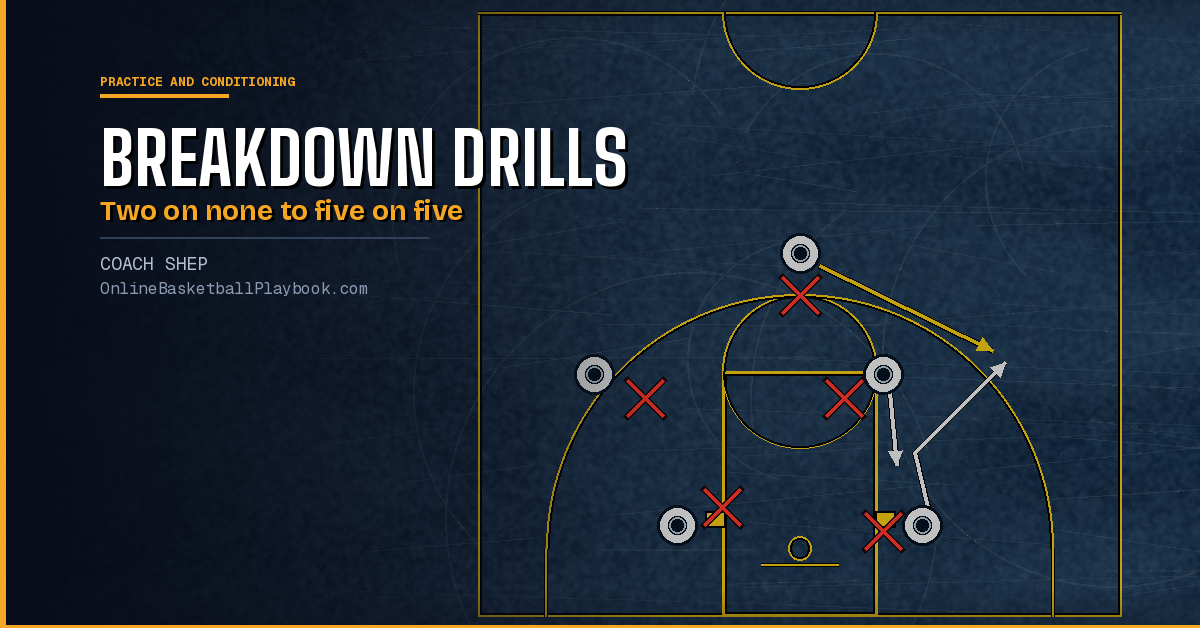
Breakdown drills in basketball take one piece of an offense or defense, teach it with fewer players, then put it back into 5 on 5. Coaches call the loop whole-part-whole: show the whole action, drill the part at 2 on 2, 3 on 3 or 4 on 4, then rebuild the whole. Bob Knight credits Pete Newell as the best part-whole teacher he saw, and John Wooden taught whole, then parts, then whole again. The coaches who write it down agree on the loop and differ on where to start, which counts to climb through and when the defense goes live. This page draws one down screen at every stage, then sets the versions side by side. The drill library itself is on offensive breakdown drills. It sits in the practice plans section.
Whole First or Parts First
The sources split on the first step.
Version 1: whole first
Rick Pitino puts in the whole first, then works on the parts, bringing in three or four players at a time in the off-season. Billy Donovan teaches the whole offense first, then each role in it. In the press-first version, the 2-2-1 goes in as the whole five-man shape first, then 1 on 1, 1 on 2, 2 on 3 and 3 on 4.
Version 2: parts first
The air-to-live version teaches a move on air, then faster than the player can control, then with an escort defender running beside him, then in a live 1-on-1 test, and says nothing sticks without the test. Tom Izzo's transition drill starts 2 on 1 and builds to 5 on 5.
Both versions end in the same place, live 5 on 5. No source compares the two on the same skill.
Breakdown Drills in Basketball: One Action, Five Stages
The frames below take one down screen up one ladder: 2 on 0, 2 on 2, 3 on 3, 4 on 4, 5 on 5. Bob Knight drills screening at 2 on 2 and 3 on 3 with five options off a down screen (over the top, back cut, flare, a reverse screen or jam, and a slip), keeps 15 feet of spacing, and has his 4-on-4 defenders switch.

Don Meyer's screening progression starts here: 2 on 0 without a ball, then with a ball, then four players at once. On a down screen his screener tells the cutter to wait.


Stages 4 and 5 are under the defensive buildup and at the end of the page. More screening drills are on down screen basketball.
The Ladders Side by Side
Coaches climb different ladders to the same 5 on 5. Each row is one version.
| Version | The stages |
|---|---|
| Advantage-at-every-count version | No defense, then a coach as defender, then a controlled advantage (2v1, 3v2, 4v3), then full defense, repeated at every count from 1 to 4, then 5 on 5 |
| Restriction ladder | Mass screening with rotating roles, 2-1 and 3-1 reading drills, 3-2 with a defender on the screener, 3-0, 3-3 and 4-4 with restrictions (no dribble, a minimum number of passes, a set shot or cut), then 5-on-5 entries |
| Pinch post version | The pinch post 2 on 0 and 3 on 0 before 2 on 2 and 3 on 3. Concepts played 3 on 3, then 4 on 4 without a post, then 5 on 5 |
| Partial-defense version | 2x0, 2x2, 3x3, 4x4, 5x5. A 3-out 2-in set is taught 5 on 2 (defense only on the posts), 5 on 3 (defense only on the perimeter), 5 on 4 (one offensive player unguarded and not allowed to score), then 5 on 5 with limits |
| Plus-one version | 1-0, 1-0+1, 1-1, 1-1+1, 2-2+1, 3-3, 3-3+1 |
| Fixed-skeleton version | An offensive organization block from 1/0 to 4/0, run before any team offense and labeled to be done in all drills |
| Mike Brey | 2/0 to 5/0 footwork and timing with guards and bigs together for five minutes before the stretch |
Ladders for motion offense are on motion offense basketball drills, and small-sided games that sit between the stages on reasons to use small-sided games.
Unopposed, Dummy, Then Live
A second way to break the whole down keeps all five players and changes the defense instead of the player count.
- Dummy-then-live version. New sets go in 5 on 0, then against a dummy defense, then live.
- Five-step motion version. Three-player reaction drills of about 90 seconds at the start of practice, 5 on 0 until pass and cut is clean, 5 on 5 against dummy defenders for 15 to 20 minutes, a 5-on-5 deflection game, then live 5 on 5. When players freeze, step back a stage. Five or ten minutes a day, it says, is not enough repetition.
- One-read-at-a-time version. Add one read at a time, run the action at full speed up to the new teaching point, then stop.
The Same Loop for Cuts and Ball Screens
Each family of actions gets its own short ladder.
- Cuts. Sherri Coale's cutting progressions run 2 on 0, then 3 on 0, then add defense, for every cut type: the V cut, L cut, basket cut, back cut and cuts off down, back, flare and pin screens. A continuous 3-on-0 version runs its cuts in rotation, players rebounding and then filling spots.
- Ball screens. One ball-screen version starts with two lines and one on-ball defender with no help, the screener popping for a second ball, then adds a second defender. Its 2-on-2 game starts every possession with a ball screen, the defense may not switch, and the scorer keeps the ball.
- Drive and kick. In Vance Walberg's 2-on-2, 3-on-3 and 4-on-4 drive-and-kick games, the half-court defender stays frozen until the guard reaches the edge of the center circle, and each trip gets one shot.
Defense Built the Same Way
Defensive installs use the same small-to-large order.
| Version | The buildup |
|---|---|
| Rick Pitino, press | 1v1 for angles and tips, 2v2 to trap only the uncontrolled dribble, then 3v3, 4v4 and 5v5 |
| Billy Donovan, press day | An 8 to 15 minute breakdown (1v1, 2v2, 3v3, 4v4 plus back-pursuit, back-tip and stunt drills), then an 8 to 15 minute 5-on-5 block |
| 2-2-1 press, whole first | The whole press first, then 1 on 1, 1 on 2, 2 on 3, 3 on 4, every drill with a winner and a loser, about 20 minutes a day |
| Fixed-skeleton man-to-man | Stance, footwork, 1-on-1 containment, closeout, screens, 3-on-3 closeout and Knockout, then 4-on-4 shell with three stops to get out and no offensive rebounds |

Shell stages are on shell drill basketball, press drills on full court press defense drills, and the rest of the defensive library on defensive basketball drills and man to man defense drills.
Get the next coaching guide in your inbox
One email when a new guide or diagram set goes up. Free.
Advantage, Then Even
Some breakdowns start the offense ahead and let the defense catch up.
- Build-up-and-back version. 2v1, 3v2, 4v3, 5v4, 5v5, then back down to 2v1, nine possessions in all, on the view that practice should be harder than games.
- Chaser version. A 2-on-0, 2-on-1, 2-on-2 series with a chaser who cannot leave the end line until the offense clears the top of the key.
- Controlled advantage. In the advantage-at-every-count version, 2v1, 3v2 and 4v3 sit between the coach-defender stage and full defense at each count.
Scored versions of these games are on competitive basketball drills.
Install Rules
- Compete fourth. A five-step teaching version runs presentation, repetition, reinforcement, competition, then evaluation.
- One option before a choice. One install rule says to pick one option and get players to execute it before giving them a choice of options.
- Teach both sides. Players do not flip sides on their own, because the footwork and the read both reverse, so each side is shown and drilled.
- The live defense earns the ball. In one whole-part-whole version the defense needs 5 or 6 stops before it runs offense, so there is no dummy defense in the live stage.
- One or two reads a day. The same version teaches one or two reads per practice in breakdown drills before going live.
How Long a Breakdown Drill Runs
| Version | Length |
|---|---|
| 55-second stations | 55 seconds per station |
| Phil Martelli | 2 to 4 minutes for opening drills |
| Hubie Brown | 2 to 5 minutes, never past 5, always on the clock |
| Bob Knight | 5 minutes for individual drills, 10 for team drills |
| Partial-defense version | 5 to 7 minutes for 1, 2 and 3 man drills, no more than 10 for 4 and 5 man drills |
| Vance Walberg | Never more than 6 minutes on one drill |
| Daily drive-and-kick block | 15 to 20 minutes a day of the same breakdown |
Where these blocks fall in the session is on basketball practice structure.

Questions Coaches Ask
What are breakdown drills in basketball?
Drills that take one part of an offense or defense, such as a down screen, a closeout or a trap, and teach it with fewer players before it goes back into 5 on 5.
What is whole-part-whole teaching?
Show the whole action, drill its parts in small groups, then run the whole again. John Wooden taught this way, and Bob Knight credits Pete Newell as its best teacher.
Should you teach the whole offense first or the parts first?
Coaches split. Rick Pitino and Billy Donovan put the whole in first. Tom Izzo's transition drill and the air-to-live version build up from the parts.
What order should breakdown drills go in?
Most ladders add one player or one defender at a time, for example 2 on 0, 2 on 2, 3 on 3, 4 on 4, 5 on 5. Some add a controlled advantage (2v1, 3v2, 4v3) between stages.
How long should a breakdown drill last?
Versions run from 55 seconds per station to 10 minutes for team drills, and one drive-and-kick block runs 15 to 20 minutes a day.
Want every diagram, printable?
OBP Pro members get the full diagram files for every practice block, breakdown stage and situation on this page, ready for a practice binder. $9 a month. Or draw your own version free in the play drawer.
See what OBP Pro includesMore Practice Planning Guides
- Basketball Practice Structure: Segment Order and Time Budgets
- Basketball Practice Length by Month: Preseason to Playoffs
- Basketball Practice Consequences: What Winners and Losers Do
- Game Situations in Practice: How to Build Them In
Back to Practice Plans and every Practice and Conditioning page.
Keep Building
Related breakdowns
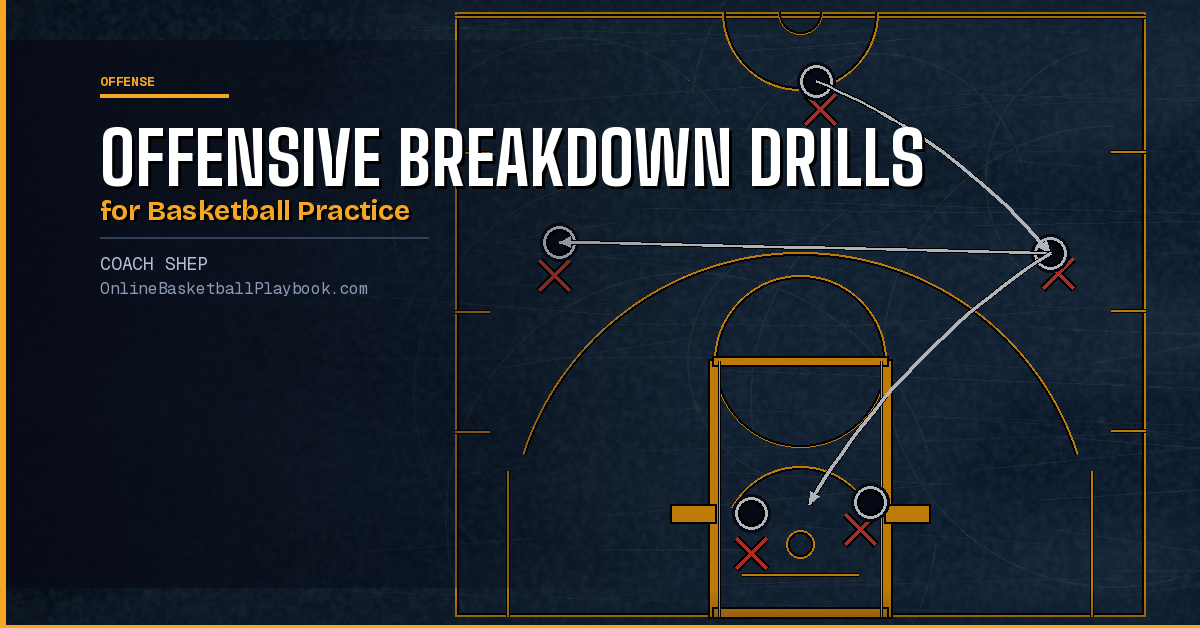
Offensive Breakdown Drills for Basketball Practice
Offensive Breakdown Drills for Basketball Practice
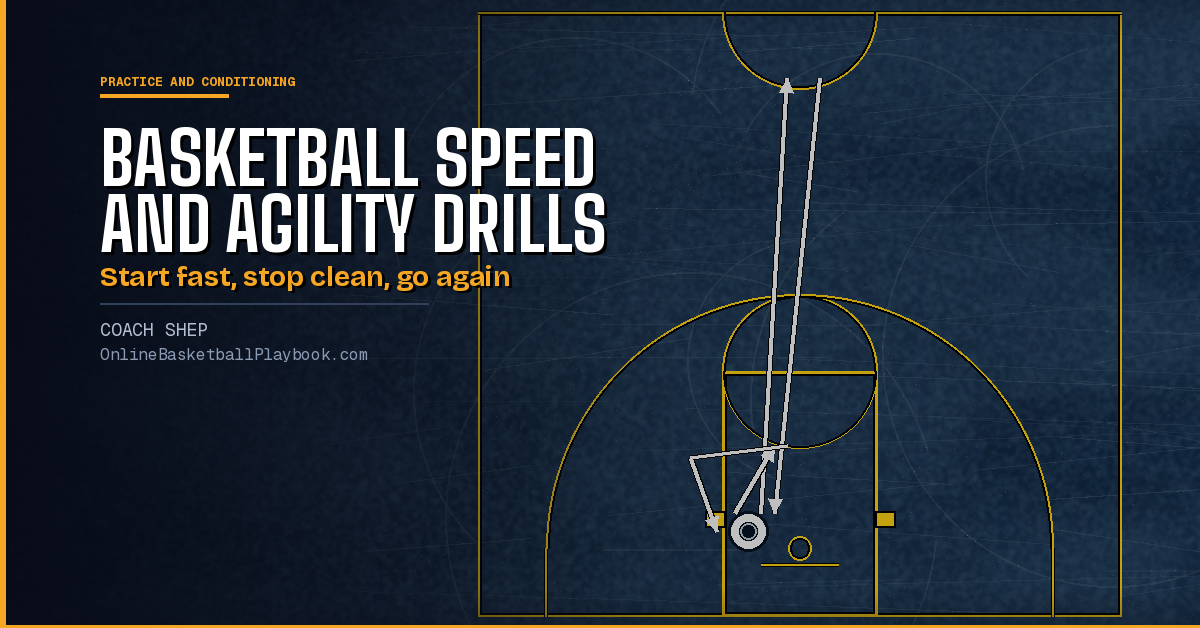
Basketball Speed and Agility Drills: Sprints, Starts and Stops
Basketball speed and agility drills for teams and players: short sprints, starts and stops, court drills with cones, an eight-week summer plan and how to dose rest.
Fun Basketball Games for Practice: Scored Games for Any Team
Fun basketball games for practice at any level: shooting games, defense-only scoring, rebounding contests and passing games, with scoring rules and records.