Basketball practice consequences are what happens after the score: what the winners earn and what the losers owe. Many coaches score every drill they can and attach a cost for losing, and they argue about nearly everything after that. Some run the losers, some use push-ups, some charge a lap for one missed box-out, and some refuse to run players for losing at all. This page sets each version side by side with what it does. The scoring formats themselves are on competitive basketball drills. It sits in the practice plans section.
Why Coaches Score Winners and Losers
The reasons on record, each in its owner's terms:
- Two-squad version. Make practice as competitive as possible because competition builds toughness and chemistry, moves a team toward being player-led and player-coached, and is the best way to fix problems.
- Jim Calhoun. Everything in practice is competitive, and the head coach has to start it with consequences and penalties.
- Ben Howland. Every drill competitive, with a penalty for the loser.
- George Raveling. Four things make a drill competitive: a clock, an opponent, competing against yourself and a goal.
- Kelvin Sampson. You achieve what you emphasize.
Keeping Score All Practice
A running score turns single drills into one contest that lasts the whole practice.
| Version | How the score is kept |
|---|---|
| Two-squad version | Two fixed squads all practice. The winner of each drill shoots a free throw and the loser owes a timed sprint |
| 50-point start | Two squads each start the day at 50 points, every live drill is scored on one point table, and the score carries all practice. The losers run three down-and-backs in 9 seconds each plus one 30-second sprint |
| Posted win tally | A manager posts each player's drill wins after every practice. The tally is used in playing-time talks with players and parents and for Friday prizes |
| Points and innings | Every drill has point rules and a number of timed rounds, and never more than three scoring rules in one drill |
| Ball-rack version | 15 balls on a rack, one pulled for every bad pass or turnover. When the rack is empty, every player runs one sprint per turnover for the rest of practice |
| 12-sprints-owed version | 12 sprints written on the board at the start, owed after practice. Hustle plays such as diving for a loose ball take sprints off, poor effort adds them |
The 50-point start explains its team-wide cost: peer pressure works because every player's actions hit the whole team. The three-rule cap in the points-and-innings version is there because three was the most players could follow and execute.
The 50-point start also gives its premise: telling a player to stop turning the ball over or to stop giving up a middle drive does not change much until a consequence is attached. Its point table pays the offense 2 for an offensive rebound, 2 or 3 for a made shot, 2 for perfect execution, 1 for drawing a common foul and 2 or 3 for drawing a shooting foul, and takes away 3 for no execution, 5 for a turnover and 2 for no talk. The defense earns 2 for a deflection, 5 for a charge, 2 for a show and go, 4 for a launching pad and seal down and 2 for a team block-out, and loses 3 for a middle drive and 5 for no talk. The coach changes the values and the categories from day to day, depending on what he wants to stress.
What the Winners Earn
A free throw that has to go in. In the two-squad version the winners shoot a bonus free throw, and a miss costs them 10 push-ups, so the reward carries its own cost. In one full-court drill version the player who makes the winning basket must also make a free throw or both teams run. Vance Walberg validates wins with a free throw too.

The floor. In stay-on games the winner keeps playing.
- Loser-stays version. In 1-on-1 continuous the loser stays on defense.
- Scorer-stays version. In another 1 on 1 the scorer stays on offense.
- King of the court. Make it, take it, to a target number.
- Earn the ball. In one scrimmage version the defense needs 4 to 6 stops before it runs offense. Chris Mack's cutthroat needs three stops in a row.

A pass on the running. Tim Floyd's deny-count drill is 90 seconds of 5 on 5 with no dribble and no screens. Each defender counts how often his man catches the ball, and the defender whose man caught it least does not run.

Points only the defense can earn. Some games pay the defense and nobody else, so the win itself rewards the habit.
- Defense-only 3 on 3. The defense scores a point for each stop that ends in a defensive rebound, a steal, a forced turnover or a forced bad pass. Baskets earn nothing. If the offense scores, the defense leaves the floor, the offense becomes the defense and a fresh team comes on. A defense that fouls is removed too.
- Defense-points 4 on 4 on 4. A defensive rebound earns 1, a turnover or a steal 2 and a charge 3. A stop sends the offense off, and an offense that scores earns the right to play defense.
Basketball Practice Consequences: What the Losers Owe
The cost for losing comes in several forms. Each row is one version.
| Version | What the losers do |
|---|---|
| Timed sprint | A sprint on the stopwatch, so it cannot be jogged |
| Timed suicide, not a down-and-back | A timed suicide counts as a real cost. A down-and-back is a token one that changes nothing |
| One short sprint | One suicide, about a minute, as the price of a lost drill, never as standing conditioning |
| Losers run, every rep scored | Nate Oats scores every rep (plus 3 for a three, plus 2 for a two, plus 1 for a putback, minus 2 for a turnover) and the losers run |
| Push-up version | Push-ups as the price of a lost drill. In one 5-on-5 game to seven the losers do five push-ups and each team adds one for every turnover. A rebounding variation adds two for every missed box-out or allowed offensive rebound |
| Run the difference | Bob Huggins plays 10 possessions, counts the stops and runs the difference. A pass-count game to ten runs the loser the difference too |
| Cost tied to one mistake | A lap for losing a box-out, and a lap for a bad outlet |

The lap version says the cost teaches players to box out quickly. Box-out technique is on box out basketball.
Coaches Who Limit Running
Several coaches keep running out of the losing column or out of practice altogether.
- Jay Wright runs players only when they fail to carry out team concepts, or when one player keeps making the same mistake and the team does not help him. Never for losing.
- Don Meyer never uses fundamentals as punishment, because it spoils the player's relationship with the skill.
- Conditioning-with-the-ball version. All conditioning is done with the ball, and running is kept only as punishment.
- No-conditioning-drill version. No drill exists only for conditioning. Hard work in real drills and scrimmage does that job.
- Vance Walberg runs a timed lines test once a year, as an accountability drill every player must finish, and lets daily pressing replace the rest of the conditioning.
One version that argues against standalone sprint blocks lists five downsides, among them that players save effort in earlier drills when they know a running block is coming. It keeps a short sprint only as the price of a lost drill. Running in the plan is on basketball conditioning drills.
Get the next coaching guide in your inbox
One email when a new guide or diagram set goes up. Free.
Fixed or Random, Team or Individual
Version 1: a fixed, announced cost
The two-squad version, the 50-point start and the 12-sprints-owed version all use a known, fixed cost. One pre-announced version sets the consequence before the drill starts, not after.
Version 2: a random cost
A random-cost version keeps consequences unpredictable so a player cannot weigh a known cost against skipping a job, such as missing class.
Who pays splits too. The 50-point start runs the whole team on purpose, for the peer pressure. A no-group-punishment version stopped running the whole team on the baseline for a few players' mistakes. No source tests either split against the other.
How Much to Score
- Score everything. Calhoun, Howland and the two-squad version compete in everything.
- Score at times. A keep-it-fun version keeps score only some of the time so repetition stays fun.
- Score after it is learned. One learn-then-compete version makes drills competitive only after they are learned, and a five-step teaching version puts competition fourth, after presentation, repetition and reinforcement, with evaluation last.
Where scored blocks sit in the session is on basketball practice structure, and how scoring fits pace and teaching on how to run an effective basketball practice. Defense-only scoring is on competitive defense drills, and scored games for younger teams on fun basketball games.
Set the Rules Up Front
A cost works only if players know the rule before they break it.
- Players help write the rules. One discipline version builds team rules with player input instead of handing them down, and posts them in the locker room or practice space as a constant reminder.
- Same rule for everyone. Another version holds the standard evenly, from the best player to the last player on the bench.
- Correct and reward. USA Basketball's life-skills material asks for consistent consequences for every player, and for rewarding good behavior as often as correcting bad behavior.
Missed Practice
One youth version writes its attendance consequence down at the start of the season: the first unexcused miss starts the next game on the bench, the second is a one-game suspension, the third a two-game suspension, and the fourth is removal from the team. It applies the same rule to stars and bench players alike. More on attendance is on players missing practice.
Questions Coaches Ask
What are good consequences for losing a drill in basketball practice?
The versions on record include a timed sprint, one short suicide, push-ups, running the difference in the score, a lap tied to one mistake, and no running at all for losing.
Should the losing team run in practice?
Coaches split. Many run the losers. Jay Wright runs players only for failed team concepts, never for losing, and Don Meyer never uses fundamentals as punishment.
What should the winners get?
Common rewards are a bonus free throw that has to go in, staying on the floor, getting the ball on offense, or not running.
Should consequences be fixed or random?
The two-squad, 50-point and 12-sprints-owed versions use a fixed, known cost. One version argues for random costs so players cannot weigh the cost against skipping a job.
Should one player's mistake cost the whole team?
One version runs the whole team on purpose for peer pressure. Another stopped group running for a few players' mistakes.
Want every diagram, printable?
OBP Pro members get the full diagram files for every practice block, breakdown stage and situation on this page, ready for a practice binder. $9 a month. Or draw your own version free in the play drawer.
See what OBP Pro includesMore Practice Planning Guides
- Basketball Practice Structure: Segment Order and Time Budgets
- Basketball Practice Length by Month: Preseason to Playoffs
- Breakdown Drills in Basketball: Part to Whole Teaching
- Game Situations in Practice: How to Build Them In
Back to Practice Plans and every Practice and Conditioning page.
Keep Building
Related breakdowns
Basketball Speed and Agility Drills: Sprints, Starts and Stops
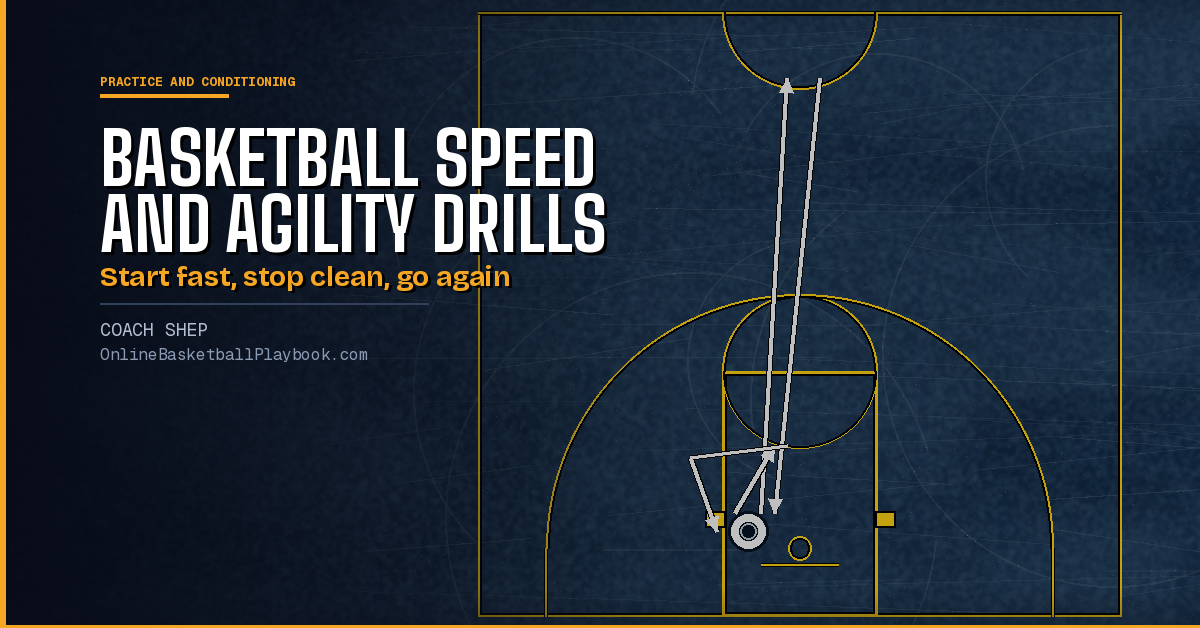
Basketball speed and agility drills for teams and players: short sprints, starts and stops, court drills with cones, an eight-week summer plan and how to dose rest.
Fun Basketball Games for Practice: Scored Games for Any Team
Fun basketball games for practice at any level: shooting games, defense-only scoring, rebounding contests and passing games, with scoring rules and records.