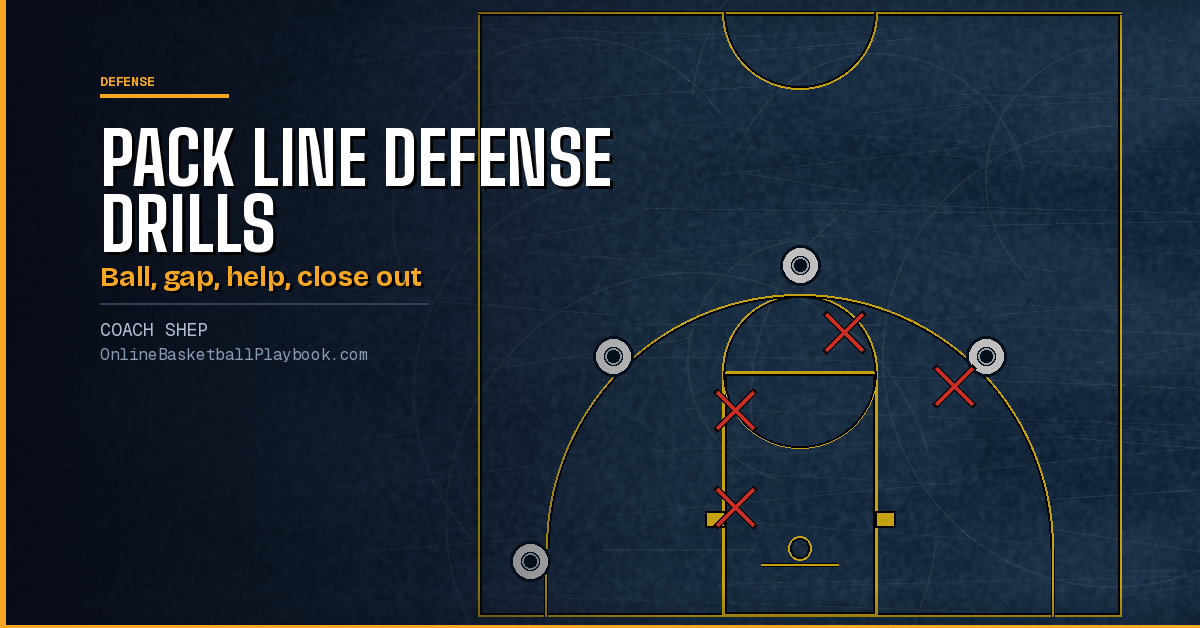
Pack line defense drills build a handful of habits: pressure the ball, keep your feet inside the line when your man does not have it, close out when the ball comes to your man, keep the ball out of the post, and get back in transition. Every drill below trains one of those habits, starting with one defender and building to five. The system itself, where the line sits, how to guard ball screens and how to double the post, is on how to coach pack line defense. This page is the drill book.
The Order Pack Line Drills Follow
The drill sets build from one defender on the ball to two and three defenders sharing the gap, then the four-man shell, then scored live play. The install orders different pack line programs use are on how to coach pack line defense.
| Habit | Drills on this page |
|---|---|
| Contain the ball | 1-on-1 three stops, Alley, sideline step slides, Close the Gate |
| Sit in the gap | 2-on-2 from four spots, 3-on-3 with a freeze, 2-on-1 Position |
| Close out | Vegas closeouts, chair closeouts, 3-line closeouts, 1-on-1 closeouts |
| Jump, bump and recover | Blackhawk, shell with cutters |
| Protect the post | 3 out 1 in, 1-on-1 wall up, crowding the post, post trap |
| Put it together | 3-on-3 and 4-on-4 Identity, defensive cutthroat, Protect the Paint, Change |
On-Ball Drills: Guard Your Yard
The gap behind the ball only works if the man on the ball does not get beaten in a straight line or along the baseline. The pack line term for it is guard your yard.
- 1-on-1, three stops. X1 hands the ball to the first offensive player, who gets three dribbles to score. A stop sends the next offensive player at the same defender. Three stops in a row wins, and everyone but the defender does five push-ups. A score sends the defender to the offense line and the scorer becomes the new defender.
- Alley. Partners go the full length of the floor, one dribbling and one defending. The defender angles the ball handler off with his chest, not his hands, and tries to turn him as many times as he can.
- Sideline step slides. A big first step to beat the dribble, a big second step to stop it, the full sideline and back.
- Close the Gate. A gate of cones, run first with no fakes and built up to live.
- First step. The defender hands the ball to a player pumping his feet, who attacks at a 45-degree angle with two hard dribbles. The defender works an exaggerated push step with his nose on the ball and stays low.
The footwork behind all of these is on basketball defensive footwork and defensive stance.
Gap Drills: 2-on-2 and 3-on-3
These drills teach the off-ball defender where to stand and how to trade jobs on a pass. In each 2-on-2, one defender pressures the ball and the other sits in the gap below the imaginary pack line, a good step off his man toward the ball, with a slightly closed stance so he does not lose his man. On the pass, the gap defender closes out with high hands and the old on-ball defender jumps toward the ball and drops into the gap. The offense passes back and forth several times, then the groups switch. Run it on both sides of the floor from four starts:
- Top to wing.
- Top to corner, where the closing defender also takes away the baseline.
- Wing to corner, again denying the baseline.
- Two-guard front.

One rule decides where the gap defender stands. When you are one pass away, you must be able to stop the drive and still close out to your man. The farther your man is from the ball, the closer you can play to the ball, because the pass to him is longer. Do not sag so far that you cannot recover on one pass. The scouting report moves the spot: against a player who does not shoot you can play closer to the ball, against a good shooter you play closer to your man.
The 3-on-3 positioning drill adds a third perimeter player. The offense stands still and passes around the arc while the defenders rotate into the gaps and close out. The coach-led version puts the ball with the coach, who dribbles from side to side while all three defenders stay inside the line. When he passes to a player, that defender closes out, the player passes back, and everyone resets. The coach can yell "Freeze!" at any point to check positions, and the offense is free to cut, screen and move.
Pack Line Closeout Drills
The closeout: two high hands with the elbows bent, low and square, the feet chopping in short steps, and an early "shot" call. Two hands instead of one discourage rhythm shots and quick passes over the top. The closeout technique and the other closeout drills are on closeout and recover. These are the versions pack line programs name.
| Drill | Setup | What it trains |
|---|---|---|
| Vegas closeouts | Three offense and three defense, each defender with a ball. The defender tosses it out and closes out. The offense catches in triple threat, jabs and rips the ball through. | The closeout itself, every day, in practice, shootaround and pregame warm-ups |
| Vegas closeouts, four stages | The same setup, built up in four steps: closeout with pressure and tracing the ball, then guarding one or two bounces, then contesting the shot and rebounding, then live with limits on the offense | Closing out into live defense |
| Vegas guard your yard | The same setup | Winning the race to the cone on the closeout |
| Chair closeouts | Six cones stand in for the offense. Three defenders are on the ball and three in help on the split line. The coach passes across the floor and on the air time the help defenders sprint to close out and the on-ball defenders sprint to help. | Moving on the air time of the pass |
| 3-line closeouts | Three closeouts in a row, to one wing, the top of the key and the other wing. The defender keeps active feet in the lane, closes out on "go" and traces the ball. Each player gets it right before the group moves on. | Closeout form, one spot at a time |
| 1-on-1 closeouts | Defender in the lane, offense at the top of the key. Toss the ball out and play live with a two-dribble limit. A score keeps the defender on against the next player in line. A stop sends him off, the offensive player moves to defense and the next player steps in on offense. | Closing out and stopping the drive |

Footwork differs a little. The Xavier version is two big steps, then a chop. The language-first version is sprint, chop the feet, then high hands to active hands. Closeouts also change with the shooter. The 3-line programs use three kinds. They close out short on a driver who does not shoot, hard to the shooting shoulder to run a shooter off the line, and with a regular closeout on a player who does both.
Blackhawk and 2-on-1 Position
Blackhawk runs gap position, bumping the cutter, the closeout and 1-on-1 defense in one sequence. X1 closes out on the player at the top of the key. That player swings it to one of the wings, and X1 jumps toward the ball into the gap with his outside arm out, looking to swipe. The passer then cuts through, and X1 bumps the cutter and goes with him to just below the free-throw line. The ball goes back from the wing to the top of the key, where the next player steps in from the line, and X1 closes out on him. After three or four closeout reps, the coach yells "Live!" and the player at the top attacks 1-on-1 with a limit of two or three dribbles. Then a new defender steps in.

2-on-1 Position puts one defender on one offensive player with the coach holding the ball. The coach can pass to the player, dribble him out or cut him through, so the defender plays on and off the ball for a set time. Nobody shoots. The coaching points are closeouts from ball to help and help to ball, jump and swipe, bump the cutter, protect against baseline and straight-line drives, and heavy ball pressure. Chris Mack, who ran both drills at Xavier, sets one rule above the rest: two feet inside the line whenever your man does not have the ball, except when he becomes a cutter or a ball screener.
Shell Drills for the Pack Line
Shell puts the off-ball habits together. Each defender calls his job out loud: ball, gap or help. The full shell setup is on the shell drill page. The pack line versions differ in what they add.

| Version | How it runs |
|---|---|
| Stationary shell | The offense moves the ball around the perimeter and holds it two to three seconds on each catch while the defense adjusts. Flip once every spot is worked. |
| Shell progression | Stationary first, then a cutter (the passer cuts on every pass from slot to wing), then screen away, then a flare screen, then a stagger. Each action runs until the coach is satisfied. |
| Change shell | On the coach's "change" call, the ball handler drives. The on-ball defender lets him go by and picks up a new man, and the other three rotate, stop the ball and get organized again. |
| Screen-by-screen package | It starts with jumping to the ball, then denies the cut and the flash, then works through the ball screen, the down, back and flare screens and cross screens, then the collapse on a drive to the rim, then a live 4-on-4 dead-ball drill in which everyone denies once the dribble is picked up. |
| Three-stop shell | The defenders sprint to the far baseline and back in 8 seconds before the coach tosses the ball in. They need 3 stops to get out, with less time to get back after each stop (6 seconds to the free-throw line extended, 4 seconds to half court). The offense gets 2 dribbles and a 10-second clock, and an offensive rebound costs the defense 10 push-ups. |
| Shell 4 around 0 and 3 around 1 | Four perimeter players with no post, then three perimeter players around one post, so the post rules get shell reps too. |
One in-season station runs shell against the next opponent's actions, for about six minutes. More rotation drills are on drills to teach help and rotation.
Get the next coaching guide in your inbox
One email when a new guide or diagram set goes up. Free.
Post Defense Drills
Pack line post rules start before the catch. The post defender plays three-quarter on the high side, uses an arm bar to keep his man out of the post box, and never gives up a post feed from the top of the key. Chris Mack's teams tape the box on the floor before every practice, a rectangle about 1.5 feet off the lane running across the second hash mark. If the post catches it, the defender pops back behind him and walls up, showing the referee his hands and staying on the floor.
- 3 out 1 in, guarded. Three perimeter passers, one post and one post defender. With the ball on the wing, the defender plays three-quarter on the high side and arm-bars the post out of the box. With the ball at the top of the key he plays up the line, but not so high that he gives up the lob. On the swing to the far wing he hits the post with the arm bar and peels back to three-quarter high side.
- 1-on-1 wall up. A coach lobs the ball off the backboard to the offensive player, who rebounds and battles for shooting position in the post box. The defender walls up and pushes him out of the box with his hips, hands showing and feet on the floor. After a few pivots the ball goes back to the coach and the drill runs on the other side. One finish has the defender take a charge.
- Crowding the post from the perimeter. The perimeter defenders sag in to pressure the post in an open stance, seeing both the post and their own man. The most likely pass out of the post goes to the top of the key, so a nearby defender jumps and swipes at that player to hold him up until his own defender closes out.
- Post trap. Three perimeter players and three defenders, with two coaches on the blocks to feed the post. On the entry, the ball-side wing defender locks the feeder and the other two talk, one dropping to protect the rim and one guarding the top. It starts with stationary rotations and builds to a live offense.

Which double to run after the catch is a game-plan choice, laid out on the pack line coaching page.
Scored Pack Line Defense Drills
The scored drills make the post box and the offensive glass cost something. The 3-on-3 Identity drill is the one Chris Mack's Xavier teams ran almost every day. The coach stands under the basket, the defenders start in the lane and the coach passes to one of three perimeter players. The defense sprints to its spots and the possession is live.

| Version | Rules | Scoring |
|---|---|---|
| 20-second Identity | Offense can do anything but ball screen, three dribbles per touch. Early season 4 to 5 possessions a team, in season 2 to 3. | 3 for a three, 2 for a two, minus 1 for a turnover, minus 1 for a defensive foul (same possession), 2 for an offensive rebound, 2 any time the ball gets into the post box (same possession) |
| 15-second Identity | No ball screens and no post-ups | 2 for a two, 3 for a three, 2 for a score in the box, 2 for an offensive rebound, and the last two restart the possession |
| 4-on-4 Identity | Adds a post player and a post defender | The same scoring, the same 2 for the post box |
| Defensive cutthroat | 3-on-3. A stop keeps the defense on. A score sends the defense off, the ball goes straight to the coach and the scoring team becomes the defense. Two or three dribbles, no ball screens. A foul, or a defense that fails to talk, pressure the ball, hold position, contest the shot or block out, goes off. A charge wins. | 1 point for each stop |
| Protect the Paint | 3-on-3 with the help defenders pinching. The offense gets five passes to get the ball into the box. | Only the defense scores: 4 for a charge, 3 for keeping the offense out, 1 if the offense gets in and misses, 0 for a score or a broken rule |
More scored games are on competitive basketball drills and man to man defense practice drills.
Transition Drills
Several pack line programs call transition defense the most important part of the defense. In the Change drill the offense runs its half-court offense against five defenders. When the coach yells "change," the ball handler puts the ball on the floor where he stands and the defense becomes the offense. A defender may not pick up the player who just guarded him, which forces a scramble. The Go progression adds the break: on "go," the new offense attacks the other way. Run Change several times before adding Go. In the line transition drill, the coach throws the ball to an offensive player who breaks the other way, and the defenders he names must touch the baseline before they sprint back. The full transition rules are on transition defense.
How Long and How Often
The programs differ on dosage but agree on repetition. One sets daily blocks of 3 to 7 minutes and caps team and shell work at 10 minutes. Another asks for post and perimeter defensive drills for at least 10 minutes, three nights a week, and runs the same drills at the start and the end of the season. Chris Mack's teams practiced the pack line every day and kept it the same no matter the opponent, because habits do not form when the defense keeps changing.
For how the pack line compares with denial defense and when a team should choose it, see pack line vs pressure man-to-man. The wider drill library is on basketball defense drills.
Questions Coaches Ask
What are the best pack line defense drills?
Drills that show up across pack line programs include Vegas closeouts, Blackhawk, 2-on-2 gap positioning, 4-on-4 shell, 3 out 1 in for the post and the scored 3-on-3 Identity drill. Together they cover ball pressure, the gap, closeouts, the post and live play.
What is the post box in pack line defense?
A rectangle taped on the floor beside the lane, about 1.5 feet off the lane and across the second hash mark in Chris Mack's version. The post defender keeps his man out of it, and the scored drills charge the defense 2 points when the ball gets in.
How often should a pack line team drill closeouts?
Every day. Because the defense does not deny perimeter passes, it closes out on almost every swing, and Chris Mack's Xavier teams ran Vegas closeouts in practice, at shootaround and in pregame warm-ups.
What is the Identity drill in basketball?
A scored 3-on-3 or 4-on-4 drill that charges the defense points for a ball in the post box and offensive rebounds.
What is the Blackhawk drill?
A one-defender sequence of closeout, jump to the gap, bump the cutter and a live 1-on-1.
Want every diagram, printable?
OBP Pro members get the full diagram files for every drill and rules situation on this page, ready for a practice binder. $9 a month. Or draw your own version free in the play drawer.
See what OBP Pro includesMore Guides From This Batch
- 3x3 Basketball Rules: FIBA Scoring, Clock, Check-Ball and Fouls
- 21 Basketball Rules: How to Play the Game of 21
- Middle School Basketball Rules: Quarters, Ball and State Changes
Back to Pack Line Defense and every Defense page.
Keep Building
Related breakdowns
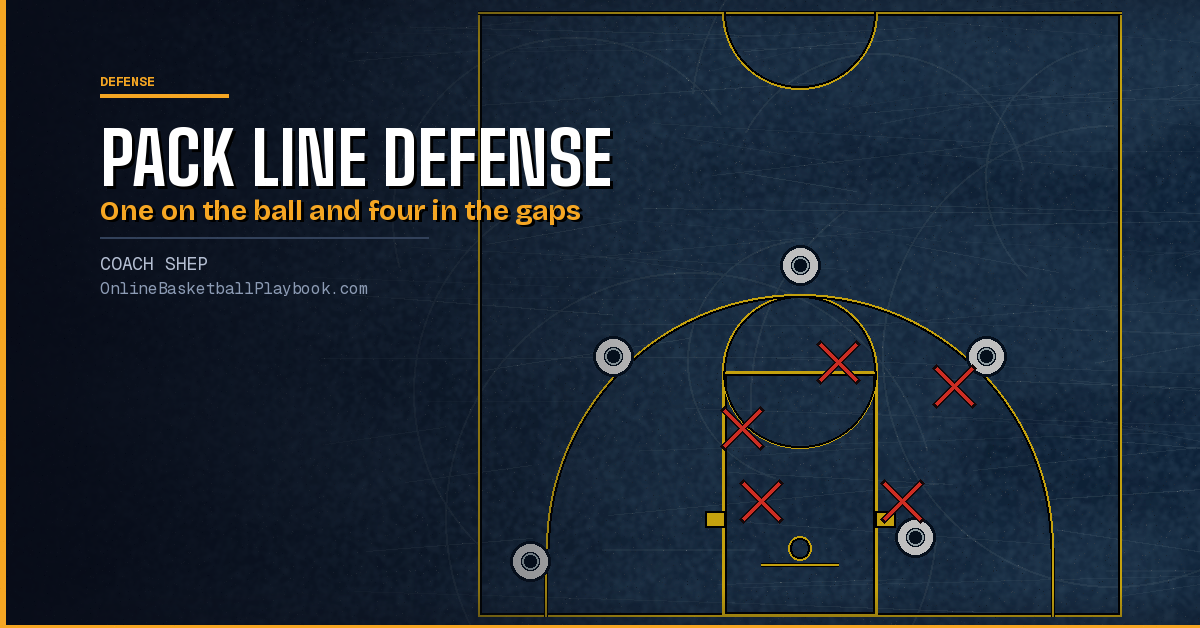
Pack Line Defense: Rules, Post Coverage and How to Install It
Pack line defense as coaches run it: where the line sits, on-ball and gap rules, post doubles, screens, dead balls, the costs and an install order.
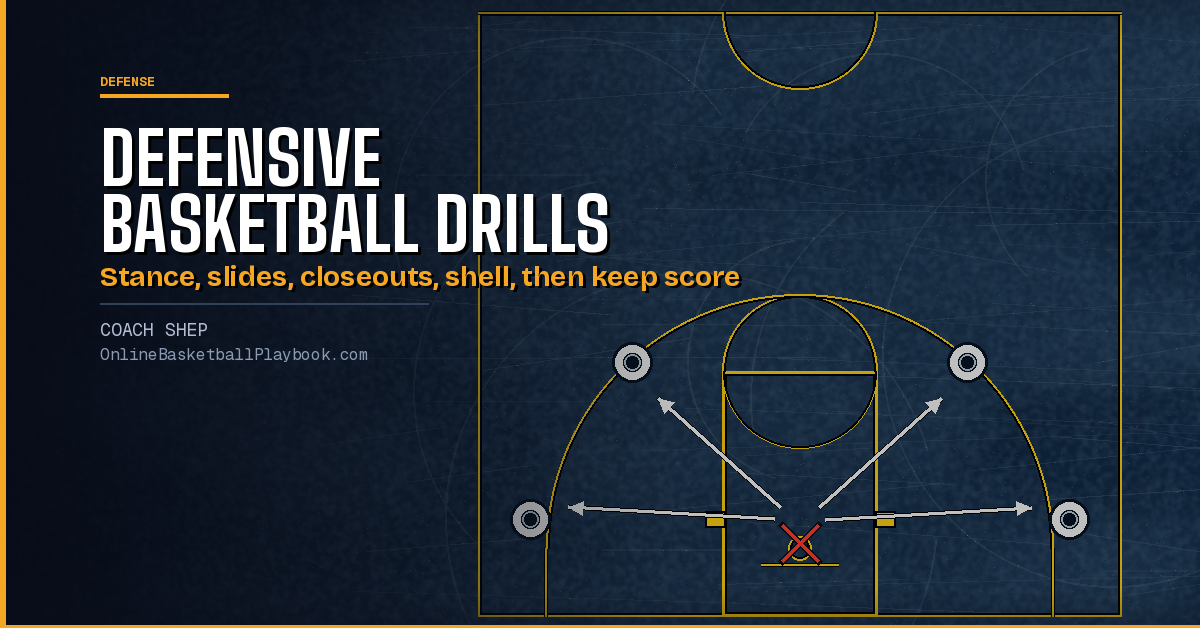
Defensive Basketball Drills: Slides, Closeouts, Shell and Games
Defensive basketball drills in teaching order, from stance and defensive slide drills to closeouts, pass denial, shell and scored games, with the versions coaches split on.
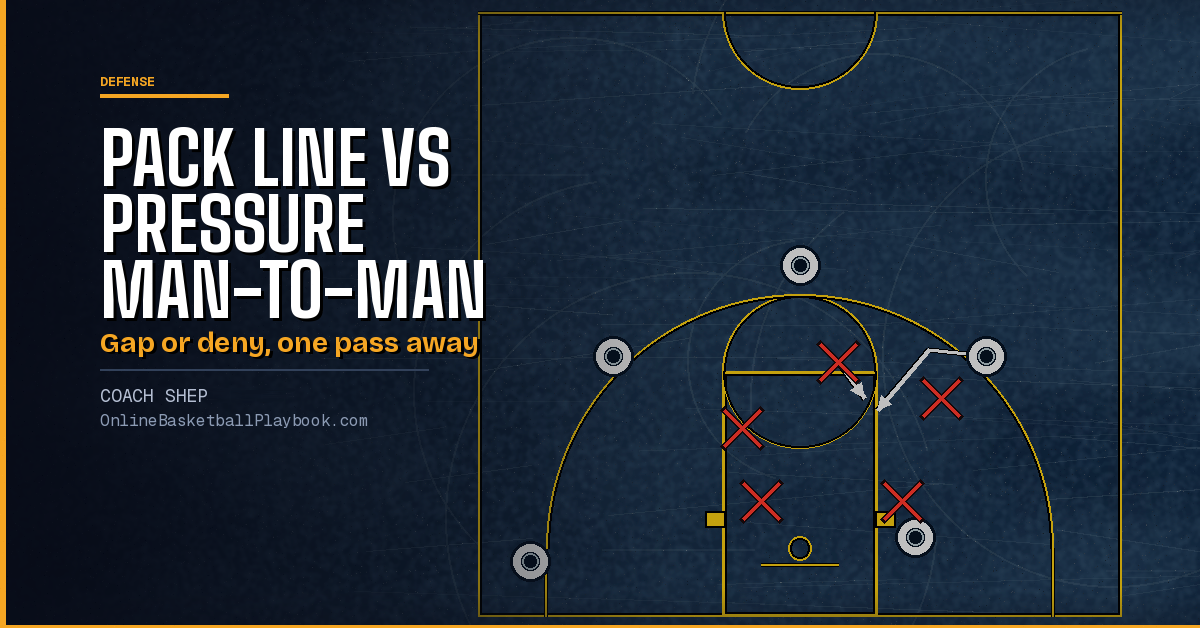
Pack Line vs Pressure Man-to-Man
Both pressure the ball. They split on the defender one pass away, and that one choice decides drives, backdoors, screens and fouls.