How to beat pack line defense starts with the three things it gives you on purpose. It does not deny the pass around the outside. Its defenders jump toward the ball on every pass. Its help comes early, even from one pass away. So the offense moves the ball, screens the helpers and makes the defense close out again and again until a closeout breaks.
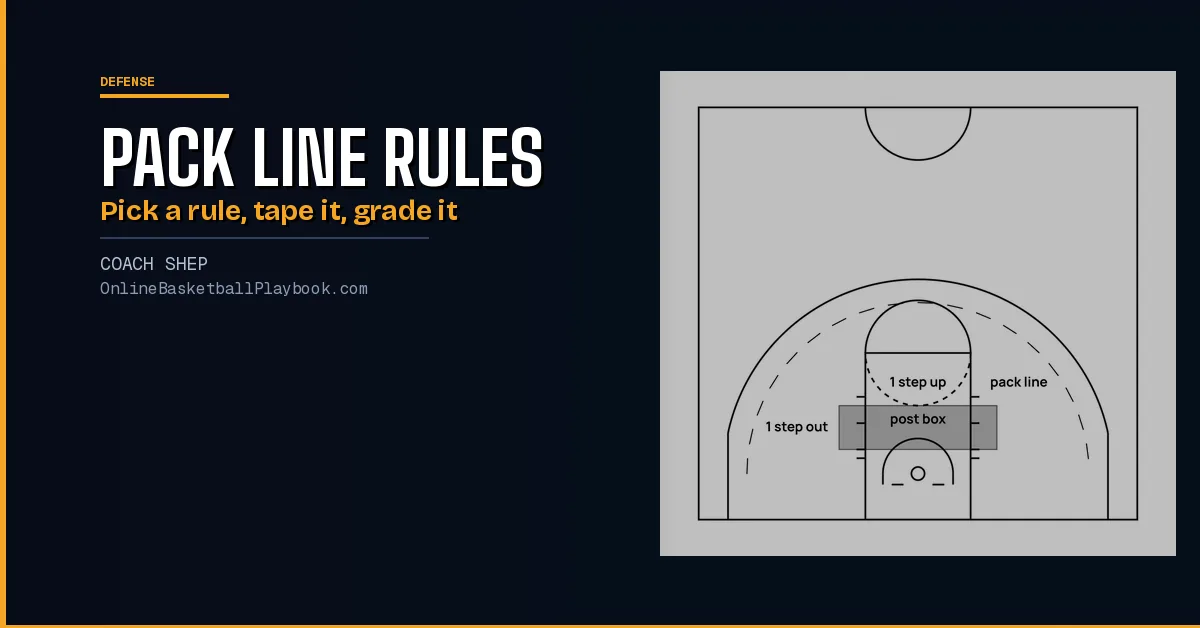
Every attack goes after one rule, and every rule has an answer a pack team can drill. The rules themselves are on pack line defense rules, and the system as a whole is on pack line defense.
Why the Pack Line Is Hard to Beat
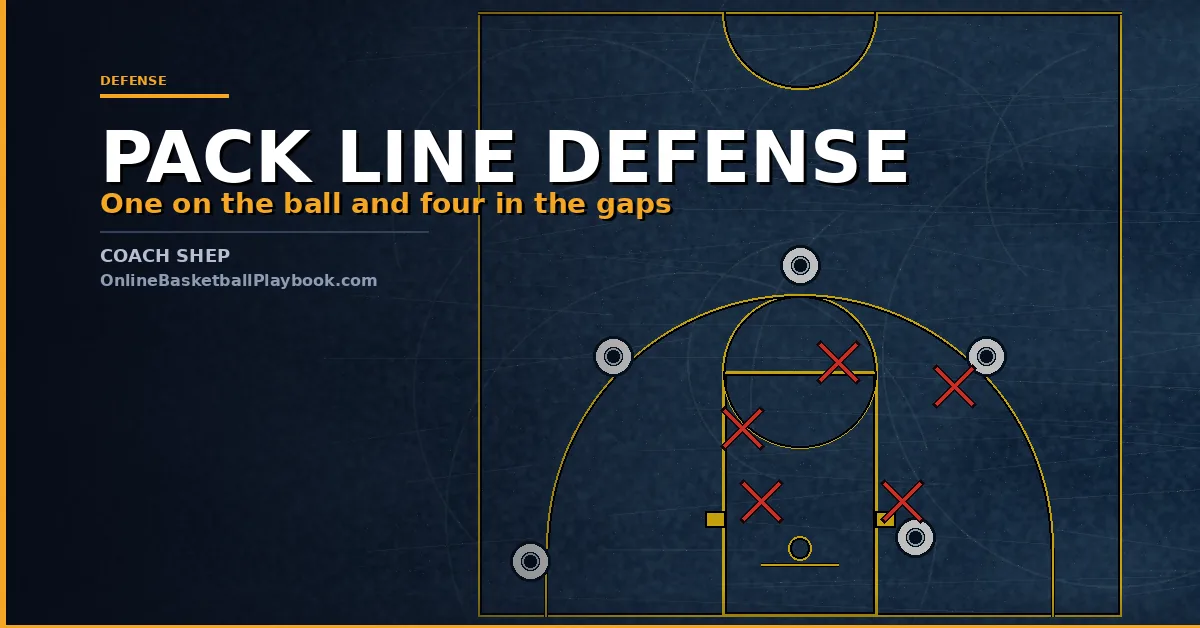
Four defenders stand inside the line in the gaps, so there is no straight path to the rim. A driver who beats his man finds a second defender already waiting. A post who catches deep gets trapped. The defense gives up the pass around the outside and the open look from far out, and it bets that the offense will not make enough of them.
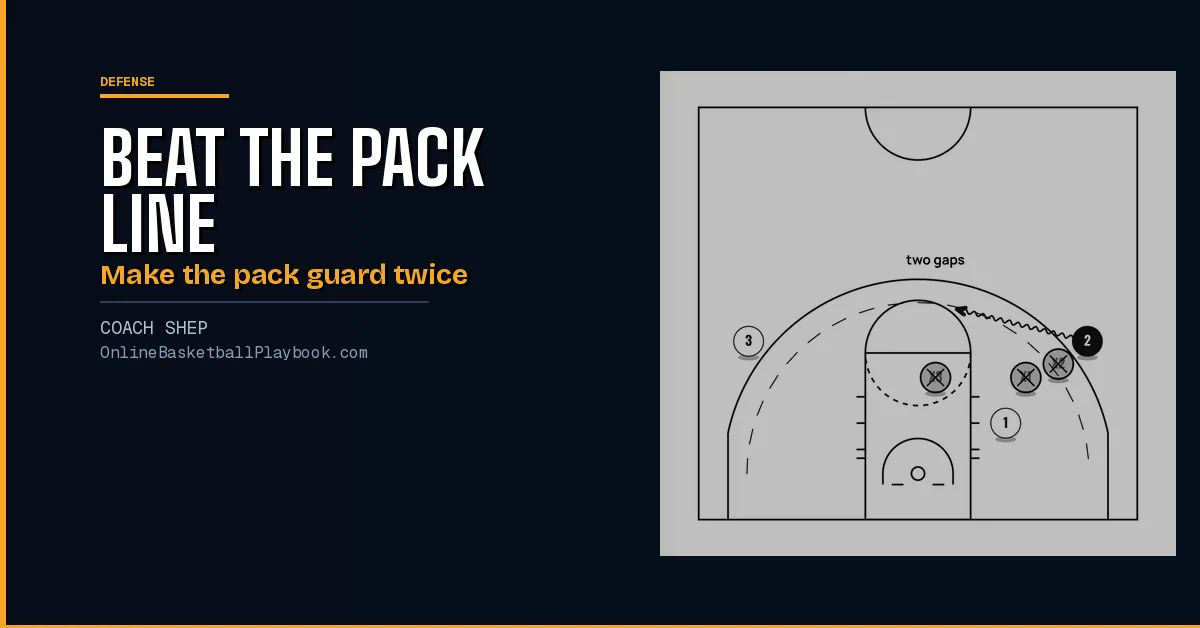
That bet has a cost, and every attack on the pack is built on it. Chuck Daly put the idea in one line: "Defense can't guard two things in a row." A pack defender who helps has to recover. Make him help, then make him recover to a shooter, then make him help again.
1. Reverse the Ball
The attack. The pack does not deny perimeter passes, so swing the ball side to side before you attack. The defense has to guard on the third and fourth side of the floor. Hold the drive until the ball has been reversed, and have the driver expect to jump stop and pass.
The answer. All five move on the air time of every pass and rebuild their spots for the whole possession. When the drive comes, the first helper meets it on the first bounce, stops it and leaves. A helper who stays has made a trap, and the kick-out is a rhythm three. On the kick-out, the help defender closest to the next pass takes it and the first helper runs to the other man, so their paths cross in an X.
A stop is about ten seconds of defense. A long possession is part of the job for a pack team.
2. Spread It Four Out
The attack. Play four out with the wings deep in the corners, and have every cutter finish all the way out at the arc so nobody clogs the paint. More space means longer help and longer closeouts. The spacing rules are on 4 out 1 in offense and 5 out motion offense.

The answer. Deny the cutter inside the arc and release him outside it. Let him go once he is out there, and get back in the gap. A pack team that practices in a four-around shell with no post sees this spacing every day, because more space is the worst case for a defender.
3. Make a Double Gap
The attack. With four defenders inside the line, one gap is too small to drive. So the passer cuts right past the teammate who caught it. The receiver drives into the space the cutter left and tries to rub his defender off on the cutter. One gap has become two.


The answer. The defender whose man passed goes back into the pack first, then toward the ball, so he ends up closer to the ball than the passer. He keeps a body on the cutter inside the arc. The on-ball defender guards his yard and does not get beaten in a straight line.
4. Drive in a Straight Line
The attack. The pack lives on closeouts, so tell the player who catches to go right away and go straight, before the help loads. A straight-line drive often starts from a poor closeout.
The answer. No straight line is one of the two on-ball rules, next to no baseline. Close out hard and short, with the weight back, ready to absorb the first dribble. The pack gives the on-ball defender help in the gap. It cannot cover for a defender who gets beaten in a straight line. The footwork is on closeout and recover and the drive-and-kick reads are on drive and kick drills.
5. Skip It, Then Drive the Baseline
The attack. Skip the ball across the floor, again and again, to keep the defense in long closeouts until one breaks. Then drive the baseline off the catch, before the help side has moved.

Chuck Daly's rule for an offense was short: "Always play against a team that's in recovery." The skip pass is how you keep the pack there.
The answer. No baseline is the rule. The help side sprints across the midline on the skip with both feet and pinches on the reversal. If the driver gets loose anyway, the help defender meets him outside the post box on the first bounce. Nobody watches a skip go by, and every closeout is sprint, chop and a hand above the eyes.
6. Screen the Helpers
The attack. A flare screen punishes a defender for jumping to the ball. Flare the player who just passed, and his defender, who jumped toward the ball, now has the longest way back. Or screen a help defender on the weak side while a shooter drifts to the far wing or corner for a skip, a pin-and-skip. Or run a shooter off two staggered screens on the weak side. All three make the closeout longer. The screens are drawn on flare screen and back screen.


The answer. The screener's defender yells "flare," and the defender being screened fights over the top with his hands up. With pressure on the ball, the pass over a flare is a hard one to throw. On the weak side, keep the triangle flat. A big triangle gets screened and makes the closeout too long. On a double stagger, the cutter's defender chases hard, the screener's defender nearest the ball steps into the passing lane and the one farther away is the zone man. Both call it, and nobody switches unless the scouting report says to.
7. Slip, Pop and Split the Ball Screen
The attack. Scoring straight off a ball screen is hard against a pack. So the screener slips or pops to open space, and the handler splits the screen or refuses it. See pick and pop for the shooting big's side of it.
The answer.
- The slip. A teammate in the gap calls "X" and sprints out to the slipper, and the screener's defender takes the player that teammate left.
- The pop. Switch the bigs.
- The split. On a trap, close it shoulder to shoulder.
- The refuse. The on-ball defender makes the handler use the screen. If he gets by anyway, the lowest defender in the gap meets him before the ball reaches the post box.
Every ball screen coverage is on how to defend the pick and roll.
8. Pass Out of the Post Trap
The attack. Expect the trap. Teach the post to look to the middle on the catch, see where the trap comes from and fake a pass to move the rotating defenders. He is looking for a teammate diving on the weak side, or for the skip when one defender is left guarding two.

The answer. The trapper calls it early, because a late call sends two defenders and nobody knows who has the first pass out. The weak-side defender stays on the midline and does not triple the post. On the pass out, the defender in high help takes the first pass and the trapper takes the other guard. If the post is not a major threat and the shooters around him are, do not trap at all: dig and stay home. More on post defense.
9. Catch Ready to Shoot
The attack. Help comes even from one pass away, so catch the ball ready to shoot. Open jump shots have to fall before the inside opens up.
The answer. A late chop gives up the catch-and-shoot three, which is the bet the pack made from the start. So the closeout is under the shooter's chin on the catch, sized by the shooter, and the scouting report tells each defender which shooter he has.
10. Run Before It Sets
The attack. Attack before the pack is set. Get the ball up the floor and score before four defenders are in the gaps. See blocker-mover offense for a half-court system built around the flare and the shooter, and how to beat man to man defense for the wider set of reads.
The answer. Transition comes first in the pack line. Three to the glass and two back, sprint, get ahead of the ball, build a wall, then set the pack. If the other team runs, send more back. The details are on transition defense.
Running a zone offense against it is one more attack. A pack can look like a match-up zone, with pressure on the ball and help in the paint, so space out to the arc, reverse and skip. That is the same spacing, reversal and skip, and the answers are the same.
The Clock and the Score
The offense can set the pace against a pack. With no shot clock, it can slow the game down whenever it wants and make the defense guard for a long time.
Late in a game, a pack team that is behind may have to deny to force a turnover. Going from pack to deny takes practice, so a pack team works on it before it needs it:
- Keep a second defense. A change-up with its own rules, built to change the tempo and to come from behind.
- Deny every day. The dead-ball minute of the shell is a minute of full denial.
- Finish scrimmages with the clock. Play the last two minutes of the defensive scrimmage as a real game, with the clock and the score.
Seven Breakdowns to Hunt
On film, these seven show up again and again against a pack. An offense looks for them. A pack team drills them out.
- Biting on shot fakes. Chop with the soles of the shoes on the floor and the eyes on the belly button.
- Reaching. Hands fly back on the drive. Wall up on the post and never reach.
- Hands down. Pointers up off the ball, a hand above the eyes on the closeout.
- Silence. Every defender has a call on every pass.
- The post defender helps too much. He stays with his man, and the help comes from high help.
- Late on the post trap. The trapper calls it early and sprints on the entry.
- Not getting on the floor. Dive for the loose ball and win it.
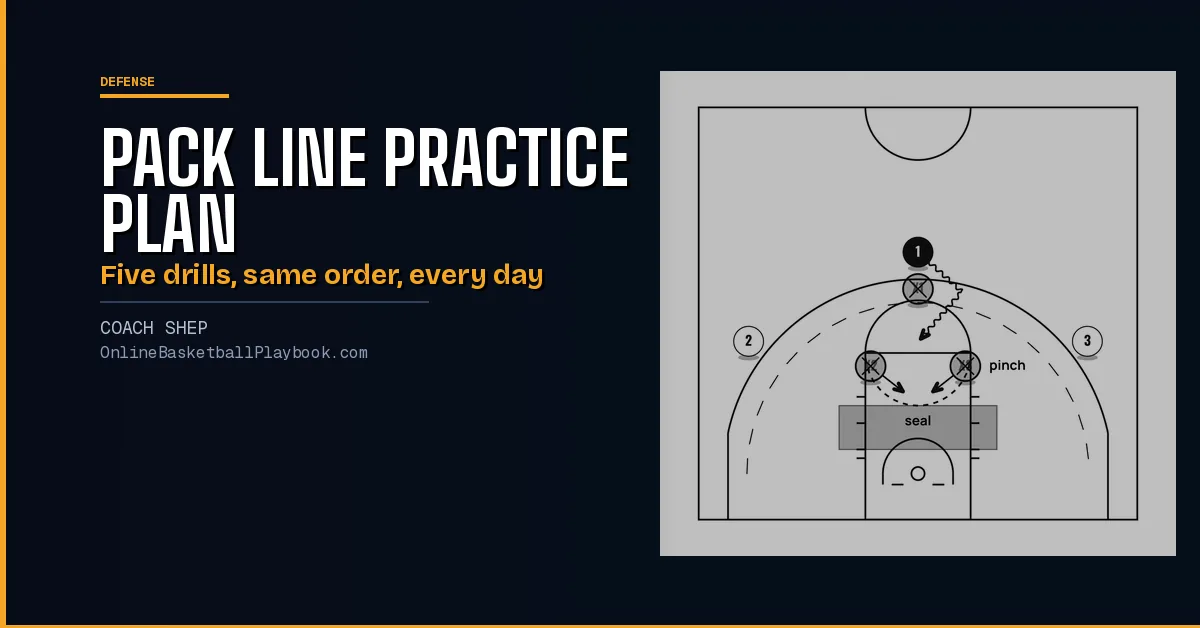
A pack team should see every one of these attacks in practice before it sees them in a game. Have a scout team or the JV run them. The drills that build the answers are on pack line defense drills and the pack line defense practice plan.
Coaching Books on Amazon

Basketball Coaching: A Multiple Option System Based on Bill Self and the Kansas Jayhawks
Questions Coaches Ask
What is the best offense against the pack line defense?
One that spaces the floor, reverses the ball and makes the defense help and recover twice in a row: double gaps, skip passes, flare and pin screens on the helpers and a post who passes out of the trap.
What is a double gap against the pack line?
The passer cuts right past the teammate who caught the ball, and the receiver drives into the space the cutter left. One small gap becomes a gap twice as wide.
Does the pack line give up a lot of threes?
It gives up the pass around the outside on purpose, closes out on every catch and accepts some catch-and-shoot threes. That is why the closeout is sized to the shooter.
How do you attack a pack line defense with flare screens?
Flare the player who just passed. His defender jumped toward the ball and now has the longest way back to a shooter, and the pass over the flare comes before the help can recover.
Every guide in this section sits under Defense. The side-by-side with the other half-court man-to-man is pack line vs pressure man-to-man.
Get the next coaching guide in your inbox
One email when a new guide or diagram set goes up. Free.
Want the printable playbook packs?
Playbook packs: zone attack, press break, press defense, out of bounds, quick hitters, practice plans and the youth turnover cure, each a printable PDF. Or draw your own version free in PlayDraw.
See the playbook packsMore Pack Line Defense Guides
- Pack Line Defense Rules: 13 Decisions and Where to Start
- Pack Line Defense Practice Plan: Install Order and Daily Drills
- Basketball Defensive Score Sheet: Grade Every Possession
Back to Pack Line Defense and every Defense page.
Keep Building
Related breakdowns
Pack Line Defense: Rules, Post Coverage and How to Install It
Pack line defense as coaches run it: where the line sits, on-ball and gap rules, post doubles, screens, dead balls, the costs and an install order.
Pack Line Defense Practice Plan: Install Order and Daily Drills
A pack line defense practice plan: day one, five daily drills in order, a ten-minute shell, the install order and how to build each week around one leak.
Pack Line Defense Rules: 13 Decisions and Where to Start
Pack line defense rules for the line, feet, ball screens, the post, the dead ball and closeouts, with a starting rule for each and the other ways teams run it.