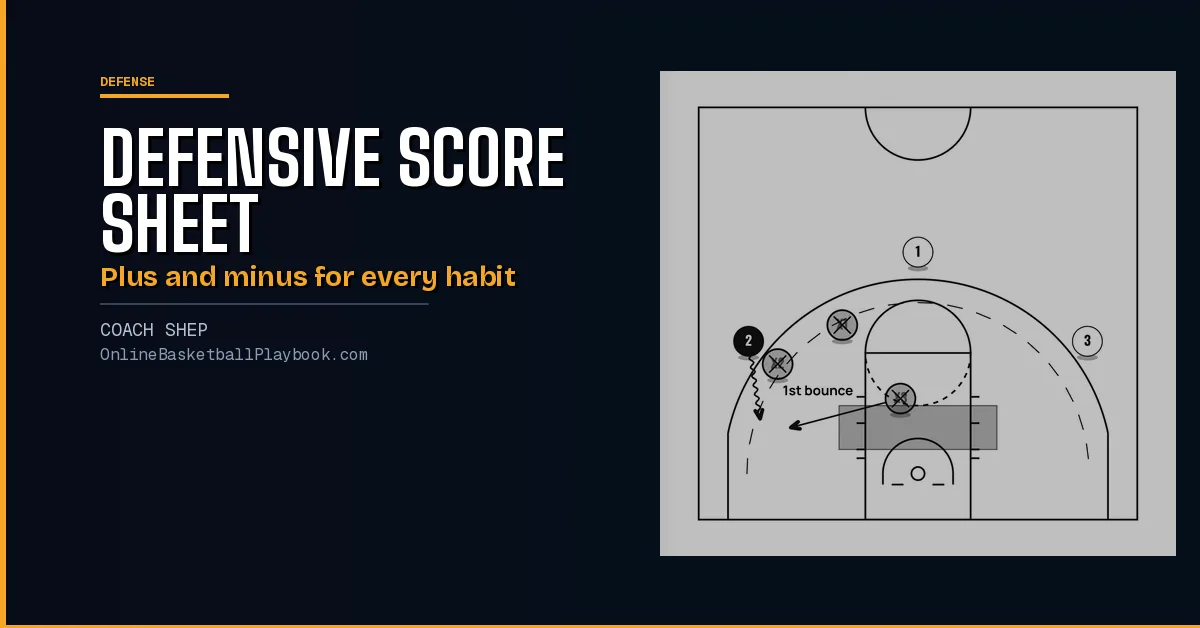
A basketball defensive score sheet is a scorecard for every player on the roster. When a player makes a play on the plus list, he gets the points for it. When he makes a play on the minus list, he loses them. One person keeps it during the game, and the totals go up where the whole team can see them. These rows grade pack line defense.
The box score tells you who scored. It does not tell you who sprinted back, who met the driver on the first bounce or who passed up a charge. For the stats to track on offense and defense, see the basketball stat sheet. The defense these rows grade is on pack line defense.
Why Keep a Defensive Score Sheet
Two reasons. The first is your players. You can talk about the paint, the charge and the sprint back all season. The sheet puts a score on them, so players feel it, and the board is public.
The second is you. The sheet tells you the leak. When one minus row keeps filling up, you know which habit broke and what the next week of practice is for. A sheet full of gambles is telling you something. So is a sheet full of missed first-bounce help.
Brad Stevens said it plainly: "If you don’t have accountability you will not improve."
Get the free practice stat sheets (PDF)
Four printable sheets: pack line, zone, no-middle and a blank one for your own defense. Plus and minus points for every habit, ready for drills, scrimmages and game film. Free.
The Plus List
Taking a charge is tied for the highest single play on the list. A clean steal is worth three. A steal try that misses costs five on the minus list, because it leaves the gap open.
| Points | Play | What it means |
|---|---|---|
| +7 | Took a charge | Tied for the highest single play |
| +7 | Five-count on a dead ball | Team play: all five on the floor |
| +7 | Great hustle | A play on the floor that changes the possession |
| +5 | Forced turnover or five-count | Team play: ball pressure that forces it without a charge |
| +5 | Great help | Help, the post trap, or first-bounce help across the midline |
| +5 | Won a 50/50 ball | Came up with the loose ball |
| +5 | The stop | Team play: about ten seconds, no layup, no uncontested shot, our rebound on the first try |
| +5 | Great screen | Offense: a jump stop into a collision |
| +5 | Offensive rebound | Found a body on our miss |
| +3 | Great first step | Guarded his yard |
| +3 | Great shot contest | A hand up above the shooter's eyes, not across his face |
| +3 | Steal | A clean steal, not a gamble |
| +3 | Great cut | Offense |
| +3 | Defensive rebound | |
| +3 | Assist | Offense |
| +3 | Timeout huddle | Team play: arms around each other in the timeout |
| +3 | Great 911 | Sprinted to the rim when the ball got in the paint |
| +3 | Great bench energy | |
| +3 | Acknowledged a teammate | Pointed to the man who made the play |
| +2 | Tip or deflection | Active hands |


The Minus List
A lost loose ball costs five. So does a catch with two feet in the post box, a jog back on defense and a shot with no body found. Most misses of position cost three. A big triangle costs two, because a deep triangle gets screened.
| Points | Play | What it means |
|---|---|---|
| -7 | Passed up a charge | Had it and stepped out |
| -5 | Costly gamble | Left his gap chasing a steal and missed |
| -5 | Lost a 50/50 ball | |
| -5 | Allowed a duck-in | The post caught it with both feet in the box |
| -5 | No offensive board | Did not find a body on our miss |
| -5 | No sprint | Jogged back |
| -5 | No body on the shot | Did not find a man to box out |
| -3 | No shot contest | Closed out with no hand up |
| -3 | No 911 | Did not sprint to the rim |
| -3 | Allowed penetration | Lost his yard |
| -3 | No first-bounce help | Did not meet the driver outside the box |
| -3 | No help | His spot was not a help spot |
| -3 | Not in a stance | Upright |
| -3 | No stunt | No fake and retreat when the ball was driven to the middle |
| -3 | No midline | Both feet not across the midline |
| -3 | Missed the post trap | |
| -3 | Did not move when his man moved | |
| -3 | Turnover | Lost the ball |
| -3 | Did not play the scouting report | |
| -3 | No pinch | Ball in the middle and the other four without a foot in the paint |
| -3 | Not first to the paint | Five pairs of shoes not in the paint first in transition |
| -3 | Wrong ball screen coverage | Not the coverage the scouting report called |
| -3 | No check | The player assigned to get back crashed instead |
| -3 | Did not see both | Pointers not up, not seeing ball and man |
| -3 | No matchup | Guarded nobody, or never called his man's name |
| -2 | Big triangle | Sat too deep in the gap |

A few rows are offense: the great screen, the great cut, the assist and the offensive rebound on the plus side, the turnover on the minus side. The sheet grades the whole player, with the weight on defense.
Rules That Keep the Board Honest
- One mark per possession. Do not hit a player twice for the same action. A player who takes a charge gets the charge, not great hustle on top of it.
- One exception. A player who turns it over and then does not sprint back gets both minuses, because those are two actions.
- Mark all five on a team play. The five-count, the forced turnover, the stop and the timeout huddle go to every player who was on the floor.
- Keep the columns apart. Pluses and minuses stay in their own columns all night and only meet after the horn. A player's total is his pluses minus his minuses.
- Ten minutes to win it. A player must play more than ten minutes to win the board. A player under ten minutes still gets his plays marked so he can see what he did.
Keeping the Basketball Defensive Score Sheet on Game Night
One person keeps the sheet, on paper or on a phone. It should not be the head coach if he is coaching live.
Before the tip. Write the opponent and the date, the roster across the top, and start every player's minutes at zero. Only a final minutes number is needed at the horn, and a helper can keep a running mark.
During the game. Mark the play when you see it, the player first and then the play.
- No debate. Nobody argues during the possession. Argue after.
- Skip what you missed. If the keeper did not see it, he does not mark it. A guess ruins the board.
- Mark everybody. Every player who gets in, whatever his minutes.

Dick Bennett had a simple rule for the jog back: "Always take a guy out if he loafs back during a game."
After the Horn and the Next Day
- Add each player's pluses and minuses and write the total.
- Star the top total among the players with more than ten minutes. He starts the next game.
- Number the next five starters from the eligible totals.
- Write one defensive fix and one offensive fix for the team, a word or two each, such as "stance," "face cuts," "scout," "lazy passes," "crash" or "attack."
The next day, start the top total and the top five, unless fouls or a scouting matchup says otherwise. The board is public on purpose. More on lineups by effort is on how to build a defensive identity.
Grading From Film
The rules do not change on film: one mark per possession, and a charge is not also great hustle. What changes is the target. Do not chase every row. Hunt the one leak the week is built for.
- A week on first-bounce help. Watch the gap defender on every drive and grade only that.
- A week on the first step. Watch the man on the ball.
How to set up the film session itself is on how to run basketball film sessions and self scouting.
Practice Points Are a Separate Board
Keep two boards and never mix them. The game sheet is plus minus minus, with the ten-minute rule. Drills and scrimmages run on their own math: inside a drill, a charge might be worth four points on the drill scoreboard, plus a mark on the practice board for the player who took it. A player who passes one up loses two marks there.
A charge is worth seven on the game sheet and four inside a drill. Practice marks stay on the practice board and never go into a player's game total. Say that out loud to the team once and nobody confuses them.
Read the Sheet, Then Fix the Leak
Find the minus row that filled up in the game, then find the drill that builds that habit.
| Minus row that filled up | What to run that week |
|---|---|
| No first-bounce help, no help | Add the baseline drive help drill and keep Protect the Paint |
| Allowed penetration, not in a stance | Two short reps of the first step drill |
| Costly gamble | The fundamentals game, which pays nothing for a steal, before any lecture |
| No sprint, not first to the paint | Get Back and full-court Change |
| No midline, no pinch, big triangle | Protect the Paint, 3-on-3 no dribble and the shell |
| Did not move when his man moved | 3-on-3 no dribble and the screen minutes of the shell |
| Allowed a duck-in, missed the post trap | The post trap drill and Protect the Paint |
| No body on the shot, no offensive board | Protect the Paint, 3-on-3 no dribble and the post trap drill |
| Wrong ball screen coverage, no matchup | The shell, one coverage for the day |
Then grade the next game for that leak and see if the row got shorter. Every drill named here is laid out on the pack line defense practice plan, with more on pack line defense drills.
Team Numbers Next to the Sheet
The sheet grades players. Pick one team number to go beside it and put it where the team sees it.
- Stops. About ten seconds of defense, no layup, no uncontested shot, our rebound on the first try.
- Three stops in a row. Count the runs and set a goal for how many a game.
- Three box score numbers. The other team's field goal percentage, the rebounding margin and fouls.
- Points per possession. What the other team scores each time it has the ball.
Each number points to its own leak. A high shooting percentage points to the contest, so watch closeouts and hands. A lost rebounding margin points to finding a body. A night at the foul line calls for a no-foul week: assistants officiate, a foul costs as much as losing the drill, and players hold a tennis ball in each hand and keep their feet on the floor. The full list of decisions is on pack line defense rules.
Coaching Books on Amazon

Basketball Coaching: A Multiple Option System Based on Bill Self and the Kansas Jayhawks
Questions Coaches Ask
How do you grade defense in basketball?
Give each player plus points for the habits you teach and minus points for the ones he skips, one mark per possession, kept by one person who is not coaching live. Add the pluses, subtract the minuses and post the totals.
What should a defensive score sheet track?
Charges, help, contests, rebounds, loose balls and getting back on the plus side. Passed-up charges, gambles, post catches, jogging back and missed help on the minus side.
Who should keep the defensive score sheet?
One person, on paper or a phone, and not the head coach if he is coaching live. He marks only what he sees and skips what he missed.
How many points is a charge worth?
Seven on the game sheet, tied with great hustle for the highest single play. Passing one up costs seven.
Every guide in this section sits under Defense. Taking the charge is taught on taking a charge.
Get the next coaching guide in your inbox
One email when a new guide or diagram set goes up. Free.
Want the printable playbook packs?
Playbook packs: zone attack, press break, press defense, out of bounds, quick hitters, practice plans and the youth turnover cure, each a printable PDF. Or draw your own version free in PlayDraw.
See the playbook packsMore Pack Line Defense Guides
- Pack Line Defense Rules: 13 Decisions and Where to Start
- How to Beat Pack Line Defense: 10 Attacks and the Answers
- Pack Line Defense Practice Plan: Install Order and Daily Drills
Back to Pack Line Defense and every Defense page.
Keep Building
Related breakdowns
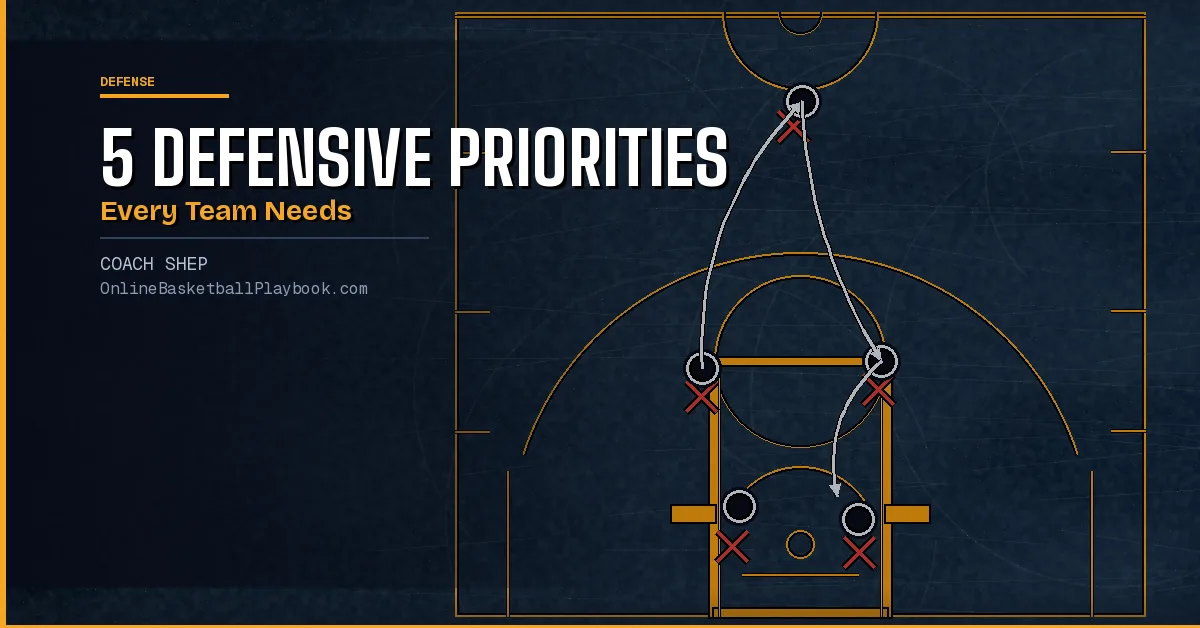

How to Coach Defensive Rotations Effectively
How to coach defensive rotations: baseline trap vs switch-and-rotate, what happens behind the first helper and drills that make the third defender automatic.
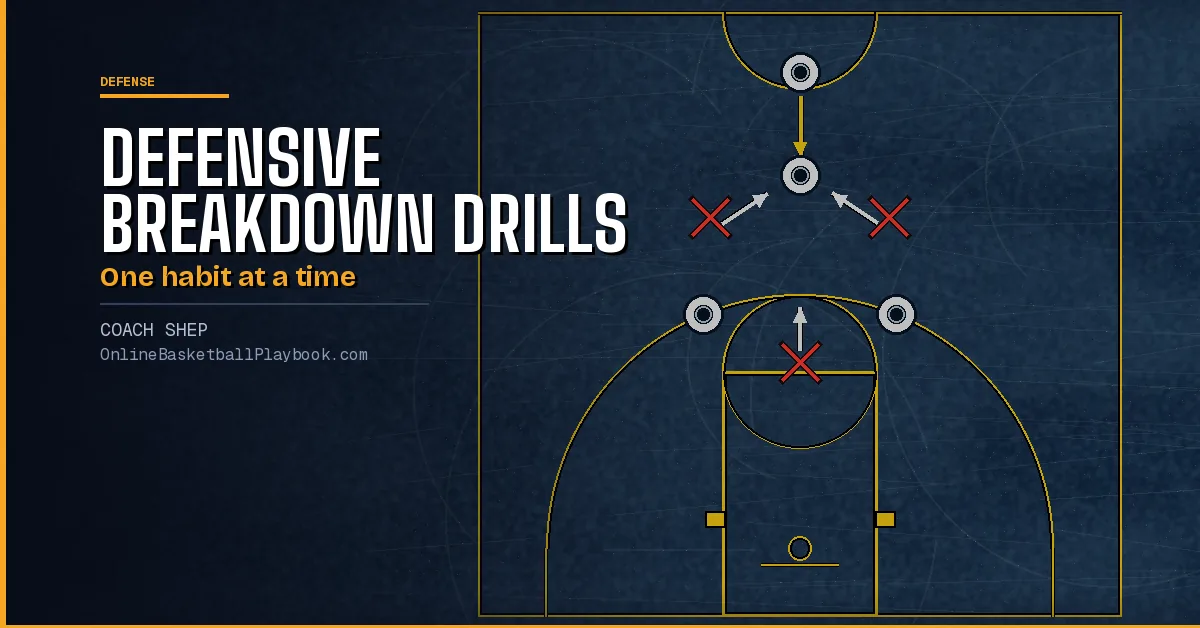
Defensive Breakdown Drills: Step Slide, Circle Trap, Wall Up
Defensive breakdown drills split a defense into one-habit pieces: stance, step slide, circle trap, back-tip, wall up and closeout, each version side by side.