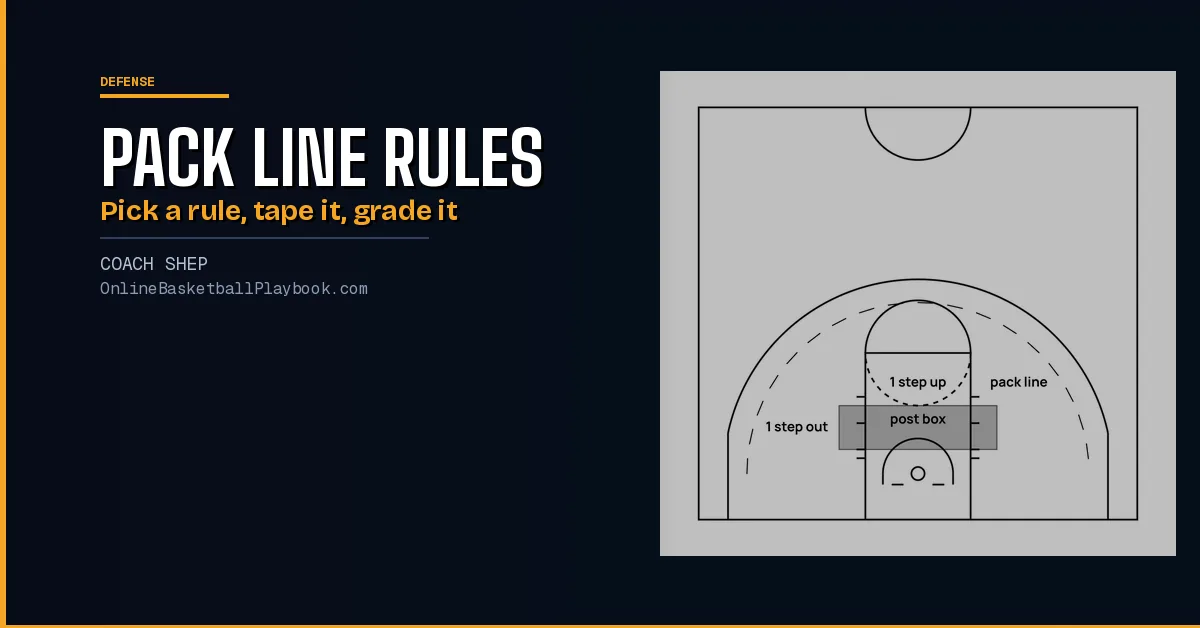
Pack line defense rules start from one idea: pressure the ball, keep the other four inside the line and keep the ball out of the paint. The rules around it change from team to team, and they should, because they depend on your players, the opponent and the scouting report.
Start with one rule for each decision and change one thing at a time. Change three at once and you will not know which one helped. The full system, with its history and post coverage, sits on pack line defense, and the order to teach these rules is on the pack line defense practice plan.
Pack Line Defense Rules at a Glance
Dick Bennett, the coach the defense became known through, put the goals of his defense in one sentence: "For us to be successful on defense, we must get back and stop the basketball, eliminate easy baskets, keep the ball out of the lane, and bother the shooters." The thirteen rules are how a team does that.
| Rule | Where to start | Other ways to run it |
|---|---|---|
| The line | One step inside the arc | Two or three feet inside the arc, or 16 or 17 feet from the rim |
| Feet | Both feet inside | One foot inside, with cutters and ball screeners allowed out |
| Pickup | At the arc | Half court, or a pickup line of your own |
| Ball screens | Hard show, with a short menu | Always over the top, blitz, switch, trap every one |
| Off-ball screens | Fight through, no switching | Switch all with a call, numbered screens, a script per action |
| Back on the shot | Three to the glass, two back | Both guards back every time, three back, two back inside six seconds |
| The post | High side, wall up, a named trap from high help | Big-to-big double, low-man double, double off the cutter, dig with no double |
| Dead ball | One call word and all five deny | A different word |
| Closeouts | Sprint, chop, hand above the eyes, sized by the shooter | Four shooter types, one hand up and one down, a daily drill, no drill |
| The No's | No layups, no offensive rebounds, no uncontested shots | A list of seven, or four |
| The count | Stops | Three stops in a row, field goal percentage and foul trips, points per possession |
| The drill | Protect the Paint, 3-on-3 | 3-on-3 on a 20-second clock, 4-on-4 shell for three stops |
| Effort | Sub for stance and effort, the score sheet sets the starters | A no-foul week |

1. Where the Line Sits
Start the line one step inside the three-point arc. This is the oldest argument in the system and no answer has won it.
- Two or three feet inside the arc. A slightly deeper line with the same shape as the arc.
- Measure from the rim. Skip the arc and draw the line 16 or 17 feet from the basket.
A line closer to the arc keeps closeouts short. A line closer to the rim protects the paint, but the recovery to a shooter gets longer. A deep triangle sells out and cannot get back to the kick-out. A tight one opens the drive. A quick team can live with a line near the arc. A slower team pulls it in toward the rim.

Whatever you pick, tape it on the floor for the first two weeks. Players follow a line they can see.
2. Feet Inside the Line
Start with both feet inside the line whenever your man does not have the ball.
- One foot inside. A looser rule that gives the defender more room to see the ball and costs some protection.
- Let the cutter's and screener's defenders out. The man guarding a cutter or a ball screener can leave the line, because he has to go with his man.
Both feet is the cleaner rule. A coach can see it from the bench and grade it on film. A young team does better with a rule it can check on its own.

The gap itself, how a defender moves on the pass and how help works from there, is laid out on help defense principles and ball you man defense.
3. Where You Pick Up the Ball
Start picking up at the arc. Pressure starts there.
- Pick up at half court. More ground for the on-ball defender to pressure.
- Draw your own pickup line. Any line across the floor that the whole team knows.
Pressure higher up wears on the ball handler, and it wears on your own defender too. If he can stay in front of a quick guard for 94 feet, move the pickup up. If he cannot, let the pack sit behind him and start at the arc. The stance and first step are on defensive stance.
4. Ball Screens
Start with a hard show. The screener's defender hedges up the floor, takes two slides and drives the handler up the floor, then recovers. The screened defender fights through, and the help rotates to cut off the handler. A screen is not a reason to switch.

Inside the hard show, keep a short menu for the situations that call for it:
- Trap an elite handler. Shoulder to shoulder, so he cannot split it.
- Soft show with a slow big. When your big is slow or late to the screen.
- Bump and go under. Against a shooting screener.
- Switch the bigs. On a roll-and-replace or a pick-and-pop.
- Soft show and go under far from the rim. When the screen is out of the scoring area.
Other pack teams start somewhere else:
- Always over the top. A hard hedge and the on-ball defender goes over every screen.
- Blitz as the base. Trap the ball screen and keep drop and switch for later.
- Switch by default. Then jam or go under if the offense takes advantage.
- Switch only for certain positions. Everyone else fights through.
- Trap every ball screen. No exceptions.
Choose by three questions. How fast is your big? Can the handler shoot off the screen? Can the screener shoot? Then pick one coverage for the day and repeat it. Five coverages in one shell means your players run none of them. Every coverage is drawn on how to defend the pick and roll, with the hedge, ice and blitz on their own pages.
5. Off-Ball Screens
Start with fight through. Chase a cutter inside the arc and release him outside it. No switching unless the scouting report says so.
- Switch every off-ball screen. Give the switch its own call.
- Number the screens. One number and one word for each kind of screen.
- Script each action. Chase a down screen in the middle of the floor and shoot the gap in the outer third.
Fighting through makes every player answer for his own man. Switching makes sense when your five are close in size and you can live with the mismatch. Against a team full of bigs who set great screens, you may have no choice. Cutters are covered on how to defend cutters.
6. Who Gets Back on the Shot
Start with three to the glass and two back. The deeper of the two, the fullback, runs to the rim. The other, the halfback, stops at the half-court circle. Then the pack forms.

- Both guards back every time. The guards never crash.
- Three back. The post goes back too.
- Two back inside six seconds. A time limit on getting set.
If the other team runs, send more back. If it beats you on the glass, send more in. Your own rebounders settle the rest. The full transition rules are on transition defense.
7. The Post
Start with three-quarter on the high side. Slide behind on the air time of the entry pass, wall up with high hands and keep the chest on the post with no reach. Then trap: one named defender comes from high help, the post defender stays, and the two make an X on the catch.

- Big-to-big double. One big on the high side and one on the low side.
- Low-man double. The weak-side guard comes down as the low man.
- Double off the cutter. Wait for the entry, then double with the man guarding the cutter.
- No double. Crowd, dig or choke the post with the perimeter defenders and stay home on the shooters.
Decide before the game, not during it. If the post is a major threat, double him. If he is not and the shooters around him are, dig and stay home. If you have a scouting report, let it pick the coverage. The footwork for every post coverage is on post defense.
8. The Dead Ball
Start with one call word when the dribbler picks up the ball, "dead-dead." All five leave the pack and deny, the on-ball defender tightens up and the team goes for the five-count. When the ball goes live again, all five get back in the gap.

Other teams use a different word. The word does not matter. Pick one that sounds nothing like another call, and have everyone say it every time. A word only one player says is not a call.
9. Closeouts
Start with sprint, chop the last few feet and a hand above the eyes. Contest the shot and do not get blown by. Size the closeout to the shooter:
- Short on a driver. Leave room to absorb the first dribble.
- Hard on a shooter. All the way to his shooting shoulder, or run him off the line.
- Regular on a complete player. Under his chin on the catch, ready for either.

If your team cannot chop yet, run three minutes of closeouts at the start of practice until it can. Other ways teams handle closeouts:
- Four shooter types. A name for each type and a closeout for each name.
- One hand up, one hand down. Plus a "shot" call for the box out.
- Five minutes every day. Closeouts before anything else in practice.
- No closeout drill. The sell-out closeout is taught inside the competitive drills.
A pack defense does not deny, so it closes out all night. Closeouts are not a side skill. Footwork and drills are on closeout and recover.
10. The List of No's
Start with three: no layups, no offensive rebounds, no uncontested shots. Get all three and it is a stop.
- Seven No's. No paint, no baseline, no rhythm threes, no direct drives, no fast-break layups, no second shots, no fouls.
- Four No's. A shorter list.
Rick Majerus put the reason for the third No in two sentences: "The mismatch is not what gets you beat. What gets you beat is giving up the uncontested, open shot."
Post the list your players will remember. Three is easy. Seven is a checklist. Either works if you grade it.
11. What You Count
Start by counting stops. A stop is about ten seconds of defense with no layup and no uncontested shot, and the first rebound is yours.
- Three stops in a row. Count the runs and set a goal for how many a game.
- Field goal percentage and foul trips. Contest the shot and do not foul.
- Points per possession. What the other team scores each time it has the ball.
Pick one number and put it where the team sees it. Two numbers is a lot. Five is a spreadsheet. How to grade every player on every possession is on the basketball defensive score sheet.
12. The Drill That Installs the Gap
Start with Protect the Paint. It is 3-on-3, and the offense gets five passes to get the ball into the post box. Only the defense scores, and a charge is worth four. Run it four to six minutes and stop. Two short runs beat one long one.
- 3-on-3 on a clock. A 20-second clock, no ball screens, three dribbles a touch, and extra points when the ball enters the post box.
- 4-on-4 shell for three stops. The defense needs three stops to get out.
With five on the floor and a short practice, the 4-on-4 shell does more. For the gap and nothing else, use Protect the Paint. Both are drawn on pack line defense drills.
13. Effort and Who Starts
Start with this rule: a wrong position is fine while a player is learning, and being out of a stance is a choice. Stance and effort get a sub. The totals on the score sheet decide who starts the next game.
Doc Rivers said it this way: "I put players in and take them out based on effort and defense, not making or missing shots."
- A no-foul week. Assistants officiate. A foul costs as much as losing the drill. Players hold a tennis ball in each hand and keep their feet on the floor.
If your team fouls too much, run the no-foul week. If it plays soft, sub fast. If both, start with the fouls.
Coaching Books on Amazon

Basketball Coaching: A Multiple Option System Based on Bill Self and the Kansas Jayhawks
How offenses go after each of these rules, and the answer for each, is on how to beat pack line defense. For the other half-court choice, see pack line vs pressure man-to-man.
Questions Coaches Ask
What are the rules of the pack line defense?
One defender pressures the ball and the other four keep both feet inside a line one step inside the arc. No baseline drive, no straight-line drive, no post catch with two feet in the post box, and all five deny when the dribble is used.
How far inside the arc is the pack line?
A good starting point is one step inside the three-point arc. Teams also use two or three feet inside the arc, or a line 16 or 17 feet from the rim.
Do you switch screens in the pack line?
One starting point is to fight through off-ball screens and switch only when the scouting report says so. On ball screens a hard show is one starting point, with a switch of the bigs on a pick-and-pop.
What happens when the dribble is picked up?
The defense calls it with one word, all five leave the pack and deny the next pass, and the team goes for the five-count. When the ball is live again, they get back in the gap.
Every guide in this section sits under Defense.
Get the next coaching guide in your inbox
One email when a new guide or diagram set goes up. Free.
Want the printable playbook packs?
Playbook packs: zone attack, press break, press defense, out of bounds, quick hitters, practice plans and the youth turnover cure, each a printable PDF. Or draw your own version free in PlayDraw.
See the playbook packsMore Pack Line Defense Guides
- How to Beat Pack Line Defense: 10 Attacks and the Answers
- Pack Line Defense Practice Plan: Install Order and Daily Drills
- Basketball Defensive Score Sheet: Grade Every Possession
Back to Pack Line Defense and every Defense page.
Keep Building
Related breakdowns
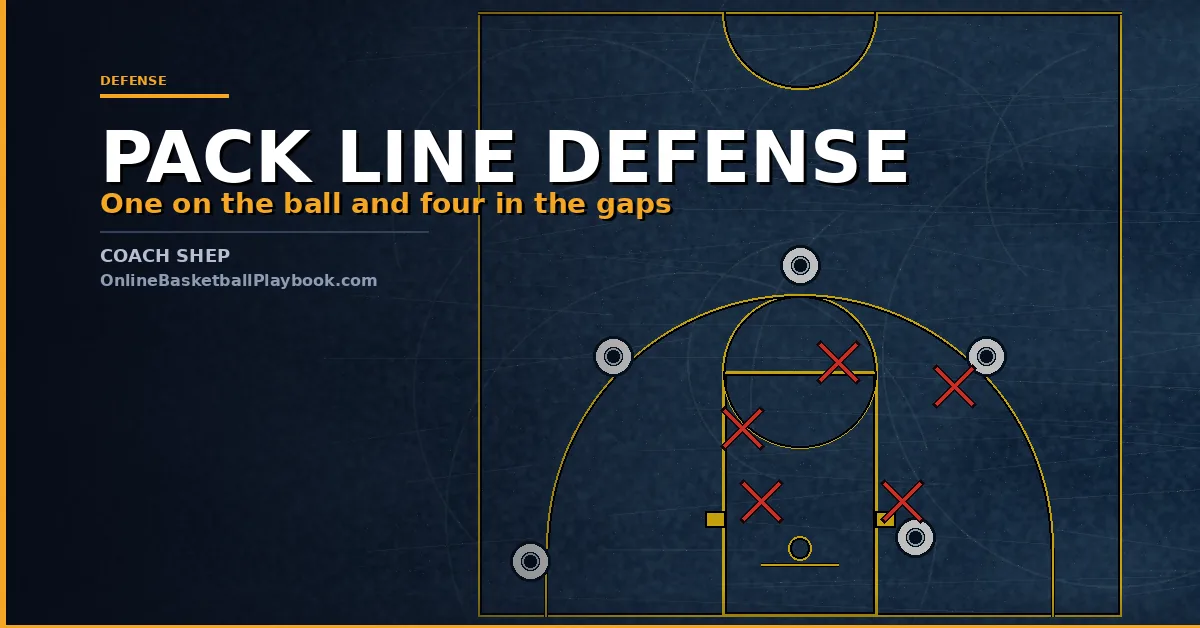
Pack Line Defense: Rules, Post Coverage and How to Install It
Pack line defense as coaches run it: where the line sits, on-ball and gap rules, post doubles, screens, dead balls, the costs and an install order.
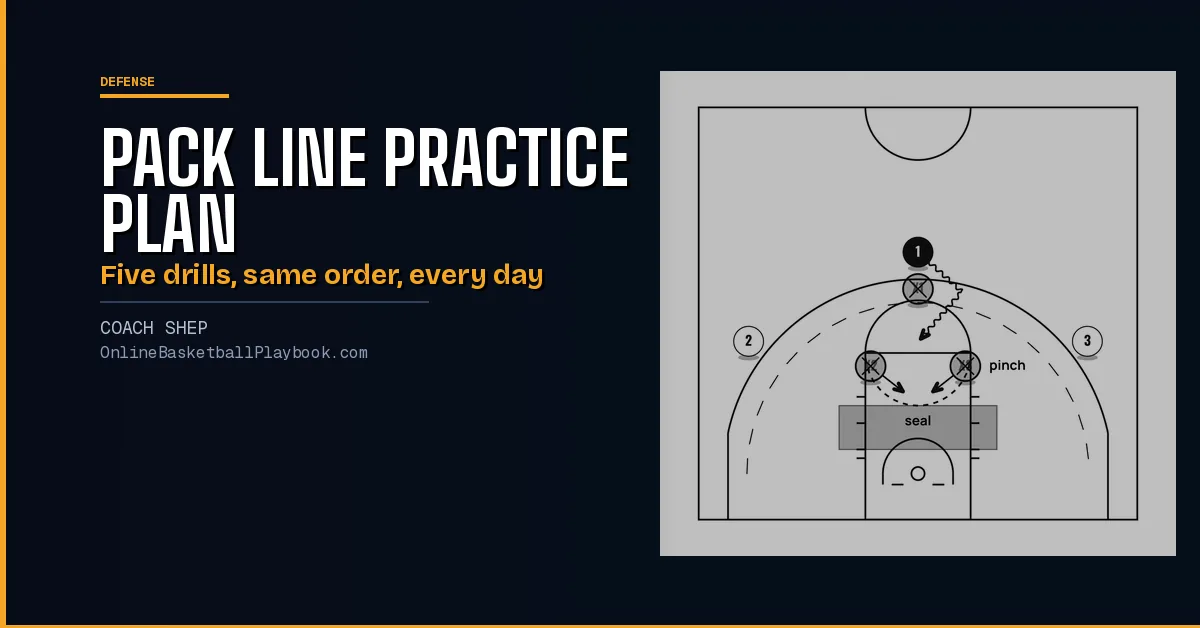
Pack Line Defense Practice Plan: Install Order and Daily Drills
A pack line defense practice plan: day one, five daily drills in order, a ten-minute shell, the install order and how to build each week around one leak.
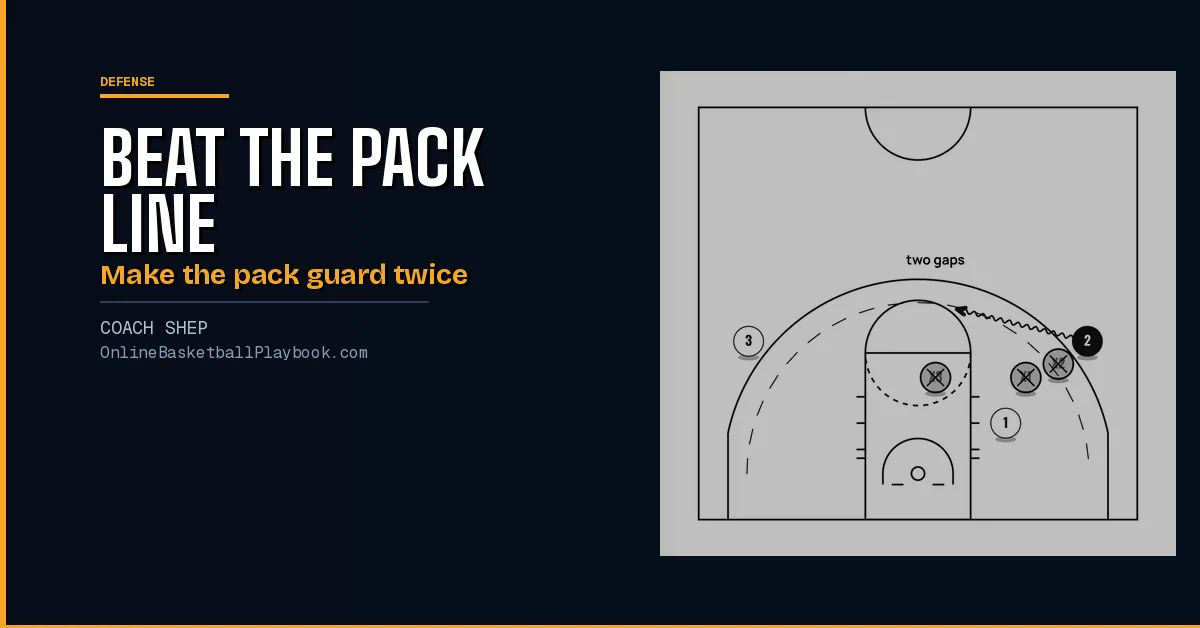
How to Beat Pack Line Defense: 10 Attacks and the Answers
How to beat pack line defense with ball reversal, four-out spacing, double gaps, skips, flare and pin screens and post passing, and how the pack answers.