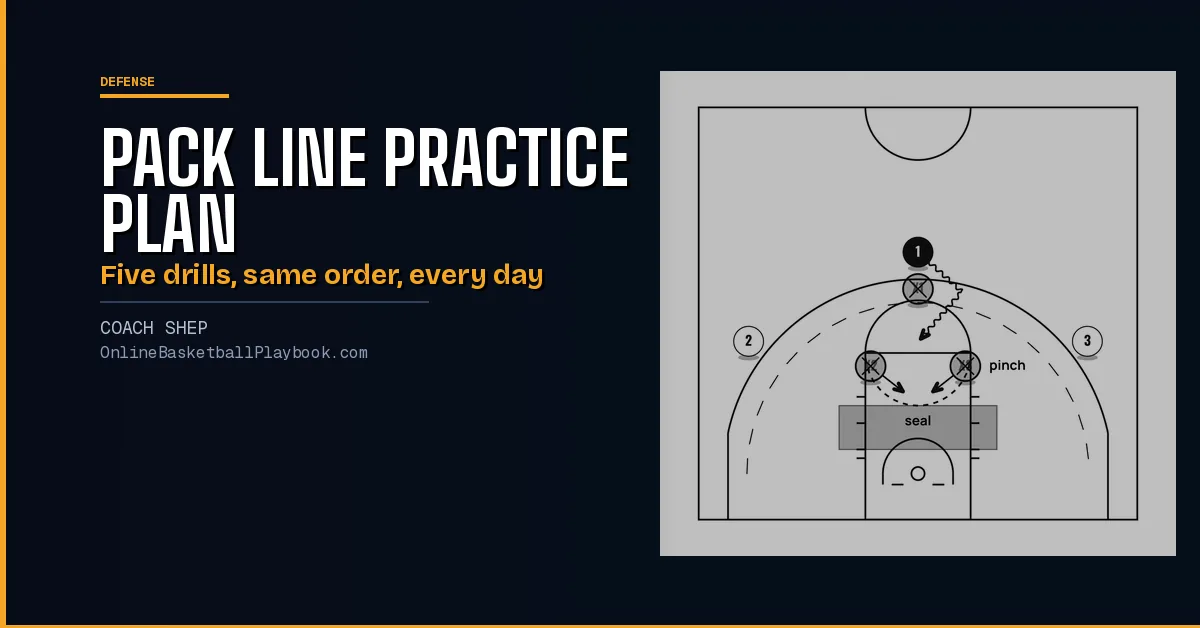
A pack line defense practice plan puts the defense in one piece at a time. Each piece sits on the one before it, so the order counts more than the drill names. Teach three things on day one, run five drills every day in the same order, then add the rest of the defense from the perimeter to the post and on to screens, transition and out-of-bounds.
The rules being taught are on pack line defense rules, and more drills for each habit are on pack line defense drills. The system as a whole is on pack line defense.
Day One: Tape, Position and Language
Three things get taught before any drill.
- Tape the two areas. The pack line one step inside the three-point arc. The post box one step outside the lane on each side and one step above the second hash mark, all the way across the paint. Leave the tape down for two weeks.
- Define the position. Your man has the ball or he does not. If he has it, you were there on the catch with high hands, close enough to pressure without getting beaten to the outside or in a straight line. If he does not, both feet are inside the line and you are in the gap.
- Teach the language. Cut every term to its simplest form and use the same word every time, coaches and players both.
Then name three rules that are not up for debate:
- Both feet inside the line whenever your man is off the ball.
- No baseline drive and no straight-line drive.
- Wall up on the post and never reach.
The third rule is named on day one and taught when the post goes in. The first two drills are First Step and Protect the Paint. A quiet defender is not accepted on day one either.
The Pack Line Defense Practice Plan: Five Daily Drills
The pack line loses in four ways. The help is late. The first step is a lunge. The post catches with two feet in the box. Nobody recovers to the kick-out. The daily five bring those problems into the open and put a score on them.
| Order | Drill | Numbers | Job |
|---|---|---|---|
| 1 | First Step | 1-on-1 | Contain the first two dribbles |
| 2 | Protect the Paint | 3-on-3 | Make the paint expensive |
| 3 | 3-on-3 No Dribble | 3-on-3 | Off-ball defense with no ball pressure to bail it out |
| 4 | The ten-minute shell | 4-on-4 | The whole vocabulary on one floor |
| 5 | Post trap drill | 5-on-5 | Trap the post catch and contest the kick-out |
Give each one four to six minutes, with a winner and a loser, then move on. Two short runs beat one long one. Stop a drill on the miss, let the makes go, give one correction and play.
Do not start with all five:
- Day one. First Step and Protect the Paint. If the ball keeps getting into the box, stay there.
- When the box holds. Add 3-on-3 No Dribble.
- When names are called and defenders are under the chin on the catch. Add the shell.
- When the talk in the shell is early. Add the post trap drill.
Dick Bennett split the two sides of the ball this way: "We teach offense 5-0/5-5 (whole method) and defense by part (1-1/3-3)." The daily five follow that order, from one on one up. Each drill assumes the one before it held. If First Step is ugly, Protect the Paint is two on one every trip. If the shell is ugly, the post trap is only a speech.
1. First Step
One on one, two hard dribbles at a 45-degree angle, no help. The defender steps the same way with a big first step and is still in front. Watch for the over-correct: a defender who lunges one way gets crossed over and gives up a layup. Coach the big step first and squaring up second.

First Step has no recovery and no contest on a pull-up, so a player can win it and still give up a corner three later. That is why it comes first and not alone. Stance work is on defensive stance.
2. Protect the Paint
This is the most important drill in the plan. Three on three with the ball at the top of the key. The offense stays in its spots and has five passes to get the ball into the post box. Only the defense scores, a charge is worth four, and the defense goes off after every possession.

The scoring pays more for keeping the ball out than for a stop after it gets in, so do not celebrate a scramble once the ball is in the box. The common miss is help behind the ball. The next miss is over-help that turns into a trap, and the kick-out becomes a rhythm three. Protect the Paint has no post, no ball screen and no full closeout distance. Those come later.
3. 3-on-3 No Dribble
This drill trains off-ball defenders when the ball cannot bail them out.
- Setup. Three on three. The defense starts on the baseline. The offense starts at the top of the key and the two wings.
- Offense rules. No dribble. After a pass, the passer screens away. No ball screens, no post-ups, no flares.
- Defense rules. No pressure on the ball. With the ball at the top of the key, the other two pinch. With the ball on a wing, the defender at the top of the key sits in a small triangle and the help is on the midline.


The defense has six musts: call names, do not be screen bait, be under the chin on the catch, put a hand above the shooter's eyes, give up no uncontested shot and find a body on the shot. If the offense scores or the defense misses a must, the defense goes to the back of the line. A defense that gets the stop becomes the offense, and the losing side runs at the end.
Two things sink this drill: big triangles and silence. If names are not called here, the next screen in the shell is a layup. Run it with no dribble until the week looks clean, then live, then with a block out, then with screens. The screen-away rules are on how to defend cutters.
4. The Ten-Minute Shell
Four on four, ten minutes on a clock. Call the name of the piece, then coach that piece.
| Piece | Minutes |
|---|---|
| Jump to the ball | 1 |
| Deny the cut | 1 |
| Deny the flash | 1 |
| Down screens | 1 |
| Back screens | 1 |
| Ball screens, one coverage for the day | 3 |
| Dead ball, all five deny | 1 |
| 911, all five sprint to the rim once the ball reaches the paint | 1 |
Two more minutes can go on the end when there is time: first-bounce help from under the rim, and 911 from a scramble.

On the first piece the offense stands still, four on the perimeter and nobody in the post, passing and holding each catch for a couple of seconds. That standing shell is where players learn the calls: every defender says ball, gap or help on every pass. After that first piece, give the offense a reason to go hard, or the shell teaches fake triangles. The full drill is on shell drill basketball.
5. The Post Trap Drill
Five on five. Every post catch gets trapped, and every pass out of the trap gets contested. The wings start in the corners, the post starts on the first hash with his defender on the high side, and a coach passes to the guard on the post side. The corner pass and the entry from the corner are allowed, and the offense gets two passes out of the trap.

The entry is scripted, so a live post will duck in, dribble out or seal the trapper later. Do not add the answers to those until the scripted pass out of the trap is clean. Post footwork is on post defense.
The Install Order After the Daily Five
The daily drills come first. Then add the rest in this order. It builds from the perimeter to the post, then lets the offense move.
- Moving on the air time. What all five do while a pass is in the air. For the defender whose man is catching, the move ends in a closeout.
- The post. Three-quarter on the high side, pop back, wall up. Then run the shell three around one.
- Screen language. If you number your screens, teach the numbers now, before the offense starts cutting and screening.
- Shell actions. Back to four around none, one action at a time: the basket cut, then the weak-side down screen or exchange, then the flare.
- Ball screens. Start with a wing ball screen and only the two defenders in the action. When those two have it, spend two or three days mixing ball screens with off-ball actions in the shell, then bring in the other three.
- Transition. Now you can scrimmage. Practice time shifts to getting back and getting set. See transition defense drills.
- Out-of-bounds defense. The last piece before a full game. See how to defend inbounds plays.
- The common actions your opponents run. Start with the last game of last season and work back through your losses to the actions you struggled to guard. Add the patterns your early opponents like. That list is your plan for the common actions.
Ball screens can also go in earlier: on day four, because so many teams run the pick and roll, or with the shell. A press or a second defense waits until the five daily drills are clean.
Whole, Part, Whole
Use the same method for every action.
- Show the whole action, five on five.
- Break it down to the fewest players you can. Fewer players means more space, and more space is the worst case for a defender.
- Build it back up to five on five.
Drills for the Days You Need Them
- Baseline drive help. Teams of four, the winner stays on defense. The offense fills both corners and both slots, and four defenders start under the net. A coach starts the ball in a corner and taps a player, who drives the baseline. One defender meets him outside the box on the first bounce while the other three play the pack. One point for a stop, four for a charge. Then allow one skip and a shot, then a skip and one more pass.
- Change and Get Back. Talk under panic, and getting back when the pack is late in live play.
- The fundamentals game. Eight minutes, a 45-second shot clock, only the defense scores: one point for a great first step, first-bounce help, a great contest, a great midline, all five in 911 or a rip through a screen to a catch under the chin. Three for a shot-clock violation, four for a charge, nothing for a steal. A foul or a missed block out sets the defense back to zero.

If your team cannot chop a closeout yet, put three minutes of closeouts in front of the daily drills until it can. Closeout drills are on closeout and recover.
Build the Week Around One Leak
Once the five are in, build each week around the one habit that leaked in the last game. Grade that habit and nothing else on film.
| Leak | Where it gets its reps |
|---|---|
| The first step | First Step and Protect the Paint. Add two short reps of First Step. |
| First-bounce help | Protect the Paint and the 911 minute. Add baseline drive help. |
| The midline and the pinch | Protect the Paint, 3-on-3 No Dribble and the shell |
| Moving when your man moves | 3-on-3 No Dribble and the screen minutes of the shell |
| The post box | The post trap drill and Protect the Paint |
| The contest | 3-on-3 No Dribble, the post trap drill and the fundamentals game |
| The recovery | Protect the Paint, the 911 minute and Change |
| Finding a body on the shot | Protect the Paint, 3-on-3 No Dribble and the post trap drill |
| Getting back | Get Back and full-court Change |
| Gambling for steals | The fundamentals game, which pays nothing for a steal |
If you run all five and still give up layups, find out which hole opened before you add a sixth drill. Grading each habit possession by possession is on the basketball defensive score sheet.
A Few Weeks In
When the habits are forming, three things show up in drills and scrimmages: no layups in transition, far fewer fouls and fewer uncontested shots. One more thing shows up too. Your offense struggles, because it cannot score on your defense. That means the defense works. Do not panic and move practice time to offense.
- Do not run your own sets against your own defense. When the plays fail, players lose faith in them. Use a scout team, the JV or the actions your opponents will run.
- Bring in a few new drills. After a couple of weeks, new drills that teach the same habits give the team energy.
- Play 3-on-3 for the post box. A 20-second clock, no ball screens, three dribbles a touch, and two points for the offense any time the ball gets into the post box. Four or five possessions a side early in the season, two or three once games start.
Coaching Books on Amazon

Basketball Coaching: A Multiple Option System Based on Bill Self and the Kansas Jayhawks
Questions Coaches Ask
How do you install the pack line defense?
Tape the pack line and the post box, define on-ball and off-ball position, teach the calls, then add five daily drills one at a time: First Step, Protect the Paint, 3-on-3 No Dribble, the shell and the post trap.
How long should pack line drills run?
Four to six minutes each, with a winner and a loser. Two short runs beat one long one. The shell can run ten minutes on a clock.
When do ball screens go into the pack line?
After the post, the screen language and the off-ball shell actions. They can also go in on day four or with the shell, because so many teams run the pick and roll.
What is the most important pack line drill?
Protect the Paint: 3-on-3, five passes to get the ball into the post box, only the defense scores and a charge is worth four.
More practice structure is on practice plans. Every guide in this section sits under Defense.
Get the next coaching guide in your inbox
One email when a new guide or diagram set goes up. Free.
Want the printable playbook packs?
Playbook packs: zone attack, press break, press defense, out of bounds, quick hitters, practice plans and the youth turnover cure, each a printable PDF. Or draw your own version free in PlayDraw.
See the playbook packsMore Pack Line Defense Guides
- Pack Line Defense Rules: 13 Decisions and Where to Start
- How to Beat Pack Line Defense: 10 Attacks and the Answers
- Basketball Defensive Score Sheet: Grade Every Possession
Back to Pack Line Defense and every Defense page.
Keep Building
Related breakdowns
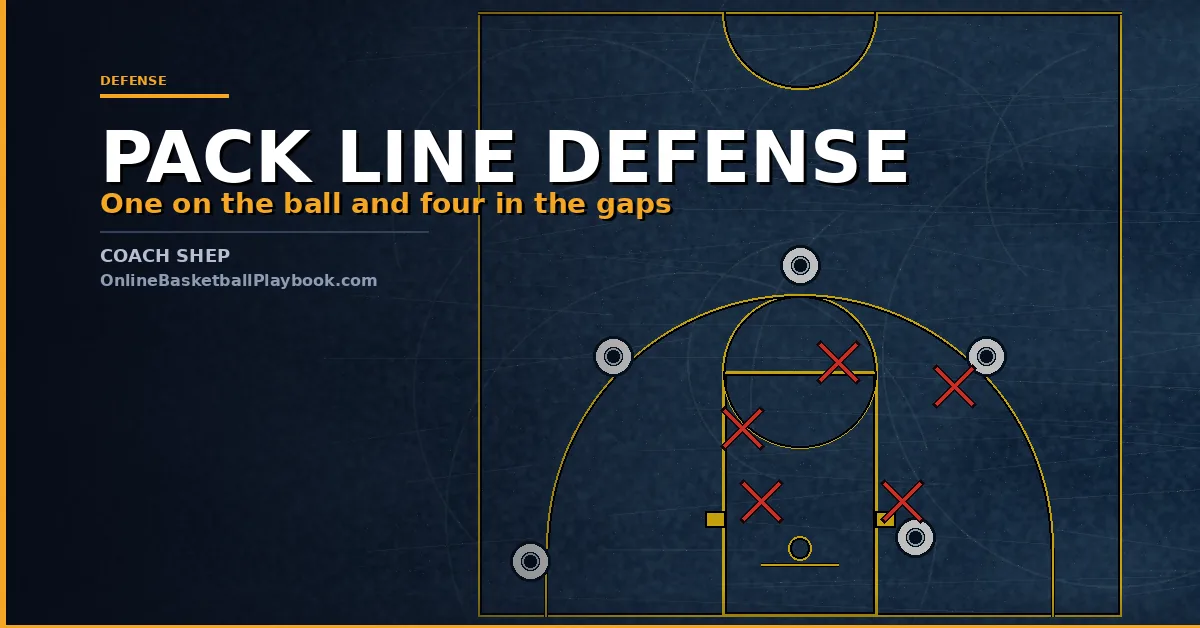
Pack Line Defense: Rules, Post Coverage and How to Install It
Pack line defense as coaches run it: where the line sits, on-ball and gap rules, post doubles, screens, dead balls, the costs and an install order.
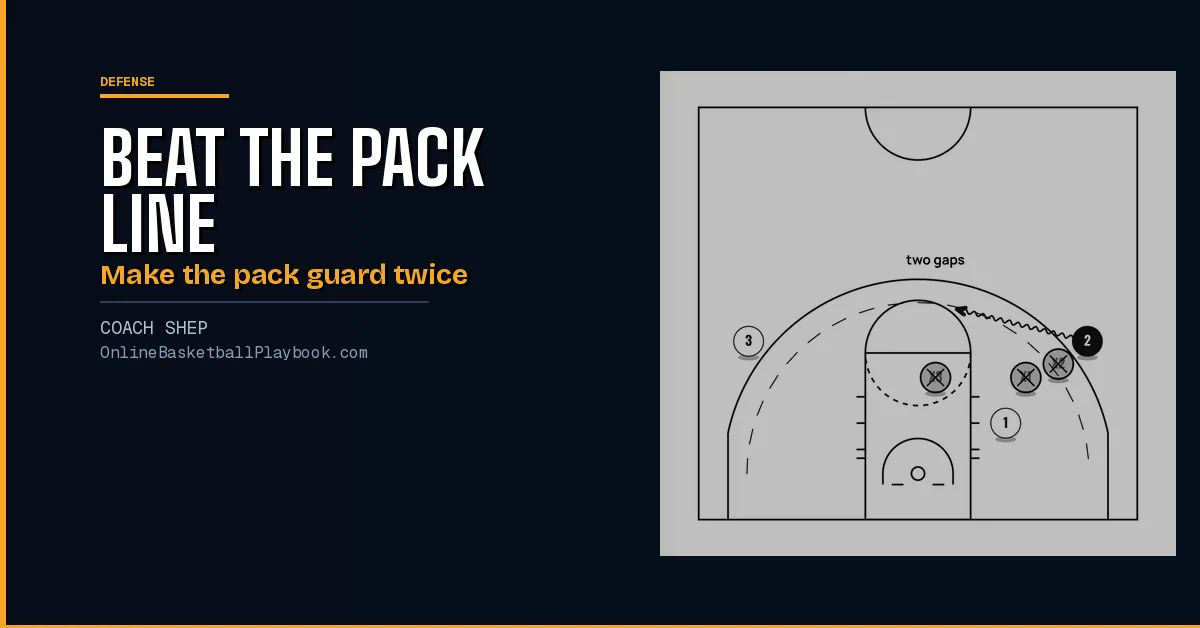
How to Beat Pack Line Defense: 10 Attacks and the Answers
How to beat pack line defense with ball reversal, four-out spacing, double gaps, skips, flare and pin screens and post passing, and how the pack answers.
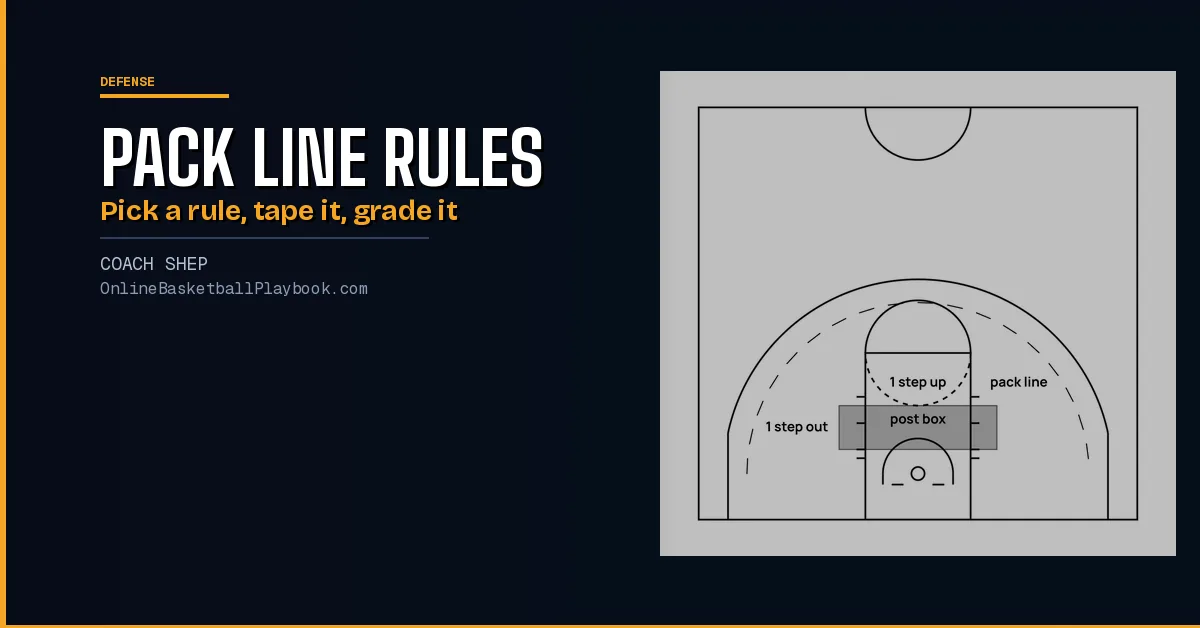
Pack Line Defense Rules: 13 Decisions and Where to Start
Pack line defense rules for the line, feet, ball screens, the post, the dead ball and closeouts, with a starting rule for each and the other ways teams run it.