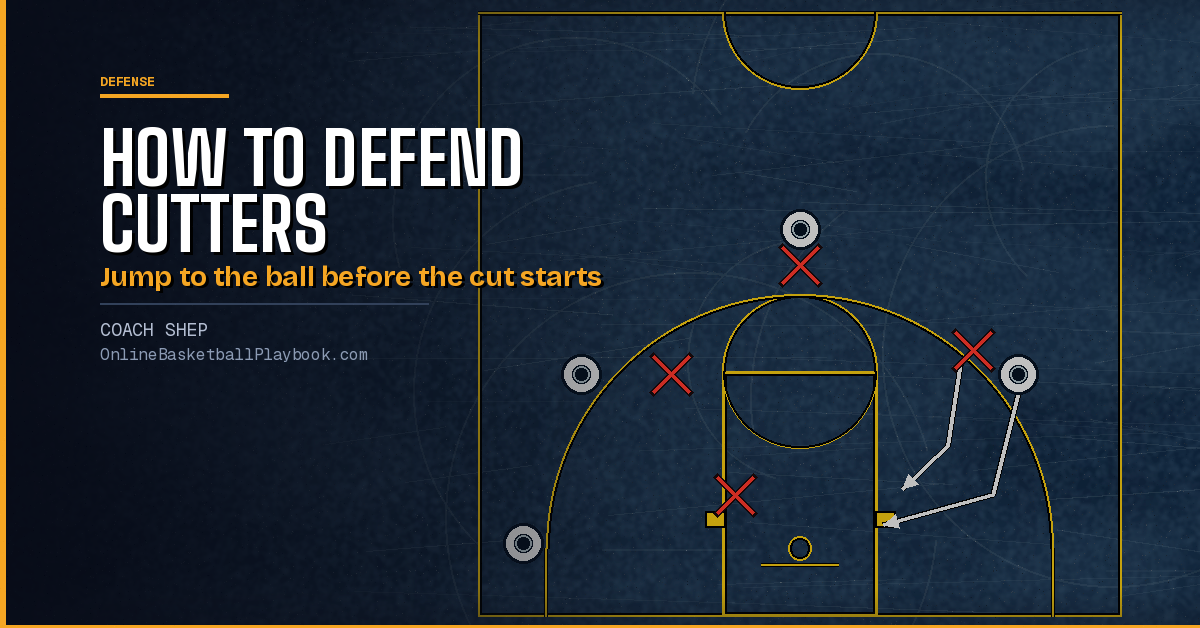
How to defend cutters comes down to where the defender stands before the cut starts. A cutter who catches on the move toward the rim gets a layup, so every off-ball defender is taught to keep his man from catching on the way to the basket or to the ball. This page covers the rules that apply to every cut (jumping to the ball, staying ball side, the one-pass-away stance and the bump), then each cut in turn: the give and go, the back cut, the weak-side cut, the flash, the curl and the cuts that come off screens, plus how zones handle cutters. The drills that build these habits are on drills to teach defending cutters.
How to Defend Cutters: The Rules for Every Cut
Jump to the ball while the pass is in the air. Every pass moves every defender a step toward the ball before it arrives. Ettore Messina asks for one or two steps on every pass. Another version adds that the step happens on a dribble too, not only on a pass. One version puts the payoff at 90 percent of a defender's cutter problems.
Stay between your man and the ball. Messina names this as the most common off-ball mistake and makes it his first rule for every defender away from the ball: be between your man and the ball, never only between your man and the basket. The cue in another version is to see your man and the ball at every spot.
Your position is your help. In the pack line every off-ball defender is already inside the line, so one version has no separate help mode, only recovery. Another version's one exception is the man who is cutting or setting a ball screen. Where the defender two passes away stands is on help defense principles.
No uncontested cuts. One version says a completed give and go comes from careless or lazy defense, and the cutter should never get a direct cut. Another keeps a guard's defender ball side for a beat after his man passes so he does not get face cut.
Rotate on the flight, not before. Hubie Brown never rotates until he sees the ball in the air. Another version moves on the air time of a skip pass and recovers on the pick-up of the ball.
The One-Pass-Away Stance
The biggest split in cutter defense is how a defender plays the man one pass from the ball. The real fork is deny or pack:
| Version | Stance one pass away |
|---|---|
| Full deny | Chest to the man, hand and foot in the passing lane, eyes over the lead shoulder. This version argues against ball-you-man here, because a backdoor then needs a 180-degree turn. |
| Shadow | Low, rear foot about twelve inches behind the man, one arm at shoulder height in the lane and the other at his hip, short slides to shadow him |
| Up the line, a step toward the ball | Up the passing line and a step or two toward the ball, close enough to steal and still able to help on a drive. Full denial once the dribble is picked up. |
| Force the back cut | An aggressive elbow in the passing lane to invite the back cut on purpose, then change eyes when the man goes behind |
| Pack line | Ball-you-man in a low stance inside the pack line, about 16 feet out. No perimeter denial except on a dead ball. |
| Three stances by ball spot | Nose on the ball, a half-away angled stance one pass away, and a close aggressive denial |
One rule is to pick one pole, deny or pack, because mixing the two without rules causes breakdowns. The pack line's case is that it kills backdoor cuts, and it names the Princeton offense as the reason. Both systems are compared on pack line vs pressure man to man.
Whichever stance, keep both jobs. Any time a defender is one pass away, he must be able to stop the drive and close out to his man. The farther his man is from the ball, the closer he can play to the ball, because the pass is longer. The scouting report moves him too: guarding a non-shooter he can sit closer to the ball, guarding a good shooter he stays closer to his man. Sagging so far that he cannot recover on one pass is the mistake. Ball-you-man positioning is on ball-you-man defense.
Bumping the Cutter
"Bump the cutter" is a common cue, and coaches mean different amounts of contact by it:
- Win the spot. Bumping is not contact. The defender wins inside position on the cutter, or failing that puts an arm in the passing lane, like a half or three-quarter front on a post. Both players are entitled to the spot, and footwork decides who gets there first, the same as fighting for rebounding position.
- Hands out, body legal. Bumping a cutter with the hands out is listed as a legal use of the body, alongside the arm bar.
- Push him like a dribbler. On a cutter who keeps going to the far side, stay ear on chest and push him with an elbow-high arm toward the baseline, as if he were a dribbler. It disrupts the flow and takes away weak-side down and base screens.
- Zone bump. The weak forward in one 1-1-3 bumps baseline cutters.
Arm-bar rules by level are on the basketball fouls list.
Defending the Give and Go
When the man you guard passes and cuts, jump in the direction of the pass into a shoulder to shoulder denial. The cutter has to go behind you, away from the ball, instead of cutting in front of you to the rim.

Two other versions:
- Off and away. Take one stride off and away from the cutter, between him and the ball, then shadow the return pass all the way to the basket.
- Pass and screen away. Jump to the pass first, then settle into help once the passer has gone to screen.
Defending the Back Cut
The back cut is the counter to strong denial, so it is a team job. The denying defender drops shoulder to shoulder with his ear on the cutter's chest, keeps his eyes on the ball, resists the cut and forces it toward the baseline, ending in a front. The defender on the ball pressures the passer. The help side intercepts, deflects or takes a charge.

If beaten. Put the opposite hand in the passing lane with a quick snap of the head, then sprint to catch up and try to deflect.
Other versions. One version invites the back cut with an elbow in the lane, changes eyes when the man goes behind, and drops its help side back first to take the cut away. A 1-on-1 drill version fronts on the ball side the moment the back cut reaches the block. The pack line answers it with position: no denial, so no back cut. The offense's side of this read is on cut or backdoor: reading the denial, and what calls the backdoor is on backdoor triggers.
The dribble clear. When the ball handler dribbles at a wing, treat the wing's back cut like any back cut, dropping toward the baseline. If he goes out to the weak-side wing instead, sag to help.
The Weak-Side Cut and the Flash
Weak-side cut. First move in the direction of the pass into denial, then sag to help as the passer goes away. Never follow the cutter out to the weak-side wing. A clear-out drill version holds pass denial in the middle of the key rather than chasing him away from the ball.
The flash. Play up the lane with the ball, yourself and your man in split vision. Force the flasher to cut in front of you, allow no step into the paint, and block the flash toward the ball. Then deny him and push him toward the top of the key. Another version arm-bars the flash from the help side, then fronts from the baseline once the cutter reaches the block. A pack line version keeps one foot in the paint whenever the ball is below the wing, so the defender is already in the flash lane.

Flashes by a post player continue on post defense.
The Curl
A curl comes off a down screen. A big screens down for a guard, the guard's defender chases, and the guard curls tight around the screener into the lane. Chase him tightly around the screen. The common error is dropping back outside, expecting him to come back to his old spot. A smart cutter reads that and pops to the corner for a skip pass and an open three.

Cuts Off Screens
Start with jobs. The screener's defender calls the screen and owns any lane cut, so if the screener rolls or slips to the rim, that is his man. The cutter's defender has no ball responsibility at all. His only job is the cutter. No one can fight over a flare screen and stop the ball at the same time, so every player has to know which job is his before the screen comes.
The defense also picks how to guard each screen, and it does not have to switch them all. Switching is one tool, not the whole man-to-man. Messina chooses the cut he gives: on a ball-side screen he chases the shooter to force a curl, and on a weak-side screen he fakes the chase and goes over the top to push the shooter into a flare, because the skip pass is the hardest pass to complete.
Down screen.
- Chase in the cutter's footsteps with no switch, so there is no big-little mismatch.
- Chase on the ball side, go over the top on the weak side (Messina).
- Go over the screen, the third lane, and beat the cutter to the spot.
- Jump switch: the screener's defender steps into the cutter's path and the cutter's defender takes the screener.
- Follow tight and get a bump from the screener's defender, who jumps to the ball within touching distance.
Back screen.
- Switch. The screened defender steps in front of the screener to take away the roll and switches back at the first chance on a mismatch.
- Automatic switch, with the screener's defender calling it, because the screened man cannot see the screen coming.
- Make contact and get into the cutter, fighting through instead of switching. This only works when the screener's defender talks early.
- Whichever you choose, open up so the lob stays in front of you.
Flare screen.
- Treat it like a back screen set on the perimeter and switch it.
- Or stay with the shooter without switching. The cutter's defender guards the shooter only and leaves the ball to the screener's defender.
- A weak-side helper caught out of position steps under before switching so he is not sealed.
Base or cross screen.
- Contact switch if the cutter goes low.
- No switch and strong denial toward the top of the key if he goes high.
UCLA cut (a back screen at the high post for the guard who just passed to the wing).
- Over: the cutter's defender jumps toward the pass into denial and the screener's defender steps out to push the cutter wide.
- Under: the cutter's defender chases while the screener's defender guards the lane until he catches up.
- Push him high: the cutter's defender opens up and forces the cutter to go over the top of the screen, the long way around, instead of cutting straight to the rim (Hubie Brown).
Two habits run under every coverage. Call the screen before it is set. And pressure the passer, so he has to put the ball on the floor and the cutter's window closes. Screen coverages in full are on defending screens in basketball and defensive switching, and the offensive actions are on back screen, down screen and flare screen.
Whatever coverage you choose for each screen, pick it, name it and rep it until it is automatic. A team that knows its one job on every screen beats a team with a better scheme it has to think about.
Get the next coaching guide in your inbox
One email when a new guide or diagram set goes up. Free.
Cutters Against a Zone
A zone's gaps are where cutters live, so zones write their own rules. Messina says a zone defends cuts with the same fundamentals as man. The written rules differ by version:
- 1-3-1 match-up. A flash to the high post or elbow is played man to man by whoever had that post. A shallow ball-side cut rotates the defense clockwise. On a deep ball-side cut the help-side defender goes all the way to the far corner. A weak-side cut goes to the baseline defender, and a baseline cut on a reversal is played man to man because no rotation covers it.
- Matching zone. Swap zones on a shallow cut, zone off a deep cut to the help side, and check and delay a deep ball-side cut before releasing it to the deepest off-side defender while the others drop to the rim.
- 1-1-3. Four ways to handle a corner or short-corner cutter: release him, X-cut, keep the weak forward with him, or step the center out.
- Match-up hand-off. The first defender calls the cutter and passes him to the next defender at the boundary between areas.
The hand-off is drawn on how to coach a match-up zone.
Teaching It
Drill every cut by name. One list of cuts every defender must be drilled on is the give and go, the weak-side wing cut with or without a screen, the flash to the high or low post and the back cut, with the warning that explaining them once on film does not carry to a game. A coach-fed version runs the weak-side ball cut, protecting the block and elbow, and the flash low to high, high to low, and low to high to weak side. The shell drill adds a cutter stage after on-ball, deny and help. Messina uses 4-on-4 because it forces defenders to handle unpredictable cuts.
The drill setups are on drills to teach defending cutters and the shell drill. The man defense these habits sit inside is built up on building up man-to-man defense.
Questions Coaches Ask About Defending Cutters
How do you defend a cutter in basketball?
Jump to the ball on every pass so you are already between your man and the ball, win the spot on his path, and deny him the catch on his way to the rim or the ball.
What does it mean to bump a cutter?
Coaches differ. Some mean winning inside position or getting an arm into the lane with no contact, others allow a legal body bump with the hands out, and some push a cutter toward the baseline with an elbow-high arm.
How do you stop a backdoor cut?
Drop ear on chest with the cutter toward the baseline, keep your eyes on the ball and end in a front, while the ball defender pressures the passer and the help side waits for the pass.
How do you defend a give and go?
When your man passes, jump in the direction of the pass into shoulder to shoulder denial so he has to cut behind you.
Should you deny or sag one pass away?
Both are taught. Denial systems play up the line, and pack line teams play ball-you-man with no denial. In either one, the defender must be able to stop the drive and close out to his man.
Want every diagram on the site?
OBP Pro members get the full diagram files for every guide on the site, ready for a practice binder or a scouting report. $9 a month. Or draw your own version free in the play drawer.
See what OBP Pro includesMore Coaching Guides From This Batch
- Tandem 2-3 Zone: Rules, Rotations and the Tandem Front
- Zone Defense Drills: Slides, Closeouts, Traps and Rebounding
- Taking a Charge in Basketball: Technique, Falls and Drills
- Post Defense in Basketball: Front, Three-Quarter or Behind
Back to Building Up Man-to-Man Defense and every Defense page.
Keep Building
Related breakdowns
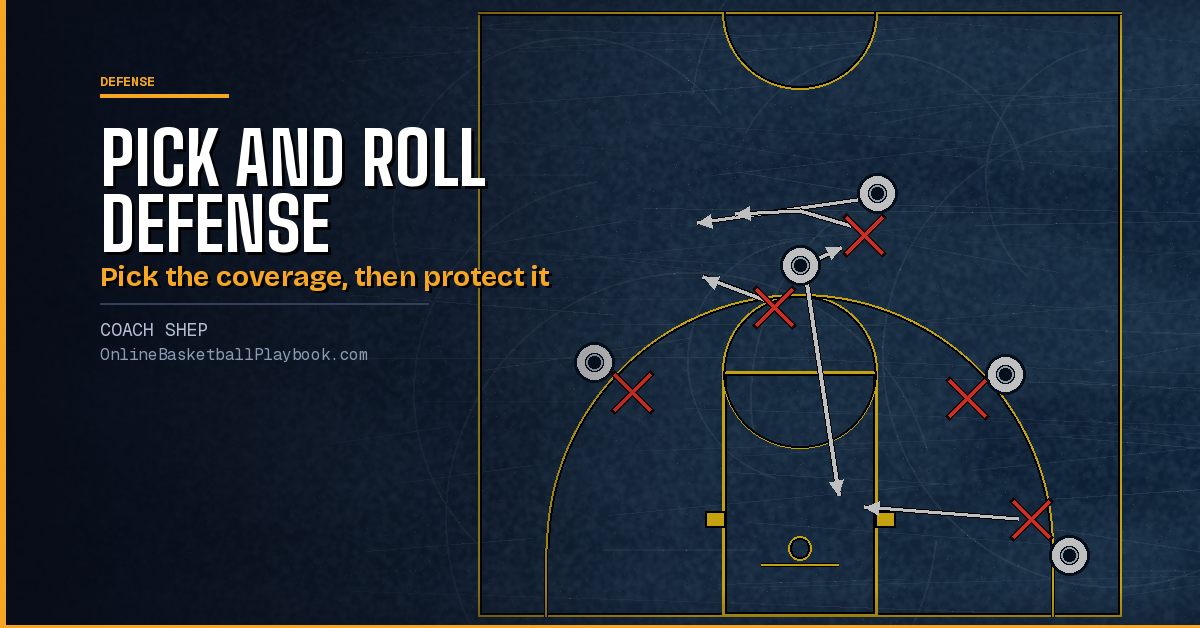
Pick and Roll Defense: Every Ball Screen Coverage Compared
Pick and roll defense compared: drop, show, blitz, switch, ice and under, what each takes away and gives up, the help behind it and how to choose.
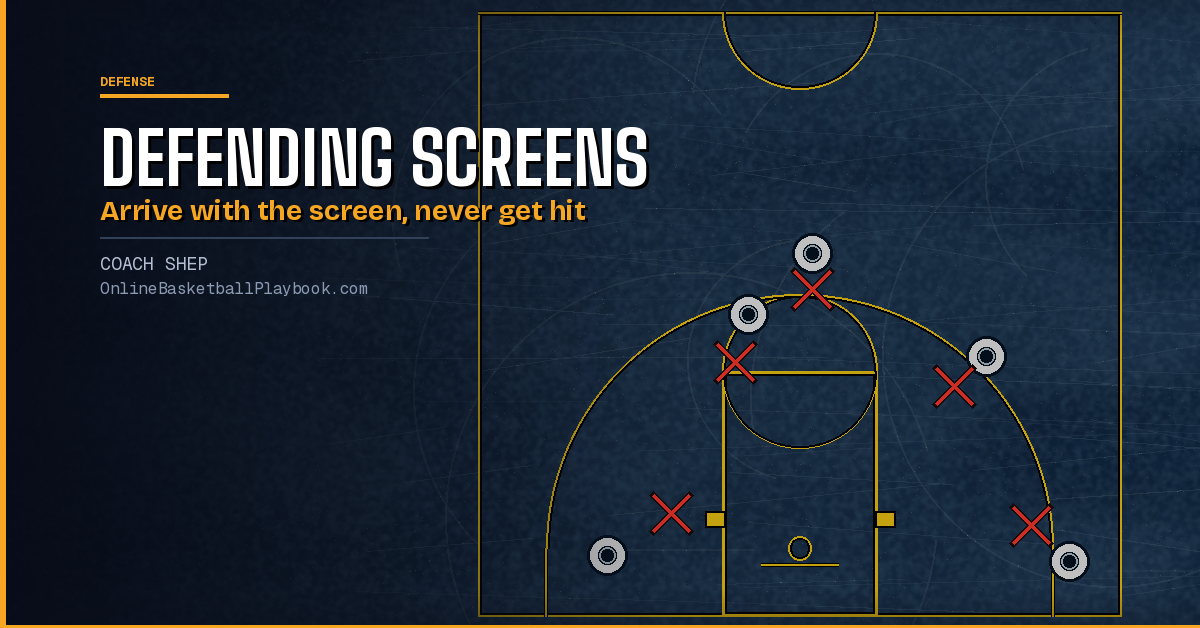
Defending Screens in Basketball: 5 Keys for Every Coverage
Defending screens in basketball comes down to five keys that hold under any coverage, for ball and off-ball screens, with the mistakes that cost baskets and drills.